Joshua 9 — The Mister Translation
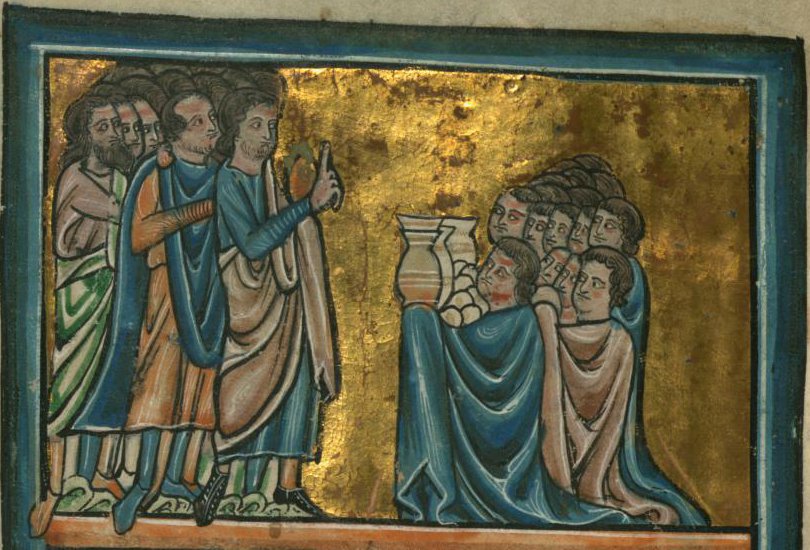
The upper half of a leaf from the same Oxford picture-book as the Joshua 7 frontispiece — this page is the back of that one, and its lower scene, cropped away here, is the next chapter’s five kings marching on Gibeon. De Brailes gives the Gibeonites what they asked for, a hearing on their knees, and the evidence they brought: jugs held up and a stack of round loaves. He does not give them the costume. The robes are whole and bright, nothing is patched, the wineskins of vv4 and 13 have become pottery, and there are no donkeys — the painter shows the moment of the bargain rather than the disguise that won it. The standing figure raising two fingers is the gesture of speech, or of swearing; the chapter has both at v15. Ink and pigment on parchment, the page about the size of a hand; the Walters Art Museum released the image into the public domain.
_-_Walters_W10619V_-_Full_Page.jpg)
★★★ The kings who gather are the Hittite, the Amorite, the Canaanite, the Perizzite, the Hivite and the Jebusite — the same six nations, in the same order, that Deuteronomy 20:17 (already on these pages) names in the law of the ban. The sentence just before that list is the one this whole chapter turns on: of the cities of these peoples … you shall not let anything that breathes live (20:16). And the sentence just before THAT one is the exemption: thus you shall do to all the cities that are very far from you (20:15). The kings of all six gather to fight. One Hivite town is about to answer the same news the other way, by claiming to live very far away.
★★ ‘Beyond the Jordan’ means the west bank in v1 and the east bank in v10, and the Hebrew is the same two words both times, be’ever ha-Yarden. The phrase names whichever bank is across from the speaker, and nothing in v1 says which; Joshua 5:1 (now on these pages) had to add westward to make it point west. The ASV and the Douay-Rheims keep the phrase identical in both verses, ‘beyond the Jordan’, and so does the Geneva, ‘beyond Jordan’. The KJV reads ‘on this side Jordan’ in v1 and ‘beyond Jordan’ in v10; the NIV reads ‘west of the Jordan’ and then ‘east of the Jordan’; the NWT 1984 reads ‘on the side of the Jordan’ and then ‘on the other side of the Jordan’. Each of those three is a correct reading of the geography, and each hides that the text uses one phrase for two opposite banks.
★ They gather peh echad, ‘one mouth’. The phrase stands in three verses of the Hebrew Bible: this one, and the twin accounts of four hundred prophets telling a king what he wants to hear with one mouth (1 Kings 22:13; 2 Chronicles 18:12, neither yet on these pages). The ASV reads ‘with one accord’, the NWT 1984 ‘unanimously’; the NIV leaves the phrase out. This translation keeps the mouth, because the chapter has another one waiting at v14.
★★★ The Masoretic Text closes v2 with an open break, {פ}, and the Greek Joshua puts a whole scene into it. In the Septuagint the altar on Mount Ebal and the reading of the law — Joshua 8:30–35 (now on these pages) — come here, between the kings gathering and Gibeon’s delegation, rather than at the end of the Ai campaign. A Dead Sea Scroll of Joshua, 4QJosha (4Q47), puts that scene’s last two verses, 8:34–35, somewhere else again: at the opening of chapter 5, just after the Jordan crossing and before the circumcision at Gilgal. Three ancient witnesses, three positions for the same ceremony. This translation keeps the Masoretic order and reports the other two.
★★★ Be’ormah, ‘with cunning’, stands in exactly two verses of the Hebrew Bible. The other is Exodus 21:14 (already on these pages): if a man schemes against his neighbour, to kill him by cunning, you shall take him even from my altar, that he may die. In the law, cunning forfeits the protection of the altar. In this chapter, cunning ends at v27 with the Gibeonites serving at the altar for good. See ormah: the noun stands in five verses, the other three in Proverbs, where Wisdom offers it to the naive and keeps house with it, and its root is the serpent’s, arum, ‘crafty’, at Genesis 3:1 (already on these pages).
★★ ‘They too’ — gam-hemmah — does not say too as whom. The nearest cunning in the book is Israel’s own ambush at Ai, the whole of the previous chapter; the nearest hearing is the kings of v1, who heard the same news and reached for their weapons. Both readings stand. The ASV keeps the word, ‘they also did work wilily’; the KJV drops it, ‘They did work wilily’, and the RV60 drops it too, «usaron de astucia», where the RV 1909 had kept it, «Ellos usaron también de astucia»; the NWT 1984 turns comparison into independence, ‘even of their own accord’.
★★★ Envoys or provisions: the verb that says what they did is one letter away from another verb, and the shelf splits exactly on that letter. The Masoretic vayyitstayyaru, from tsir, an envoy, means ‘they made themselves envoys’ — a form found in this verse and nowhere else. Change its resh to a dalet, two letters easily confused in Hebrew square script, and it becomes vayyitstayyadu, ‘they provisioned themselves’ — the verb the Gibeonites themselves use at v12, hitstayyadnu, ‘we packed it as provisions’. The NIV’s own footnote names the witnesses for that reading — ‘some Hebrew manuscripts, Vulgate and Syriac (see also Septuagint)’ — and the Greek Joshua does have the Gibeonites make provision and prepare themselves. The ASV and KJV follow the Masoretic letter, ‘made as if they had been ambassadors’, as do the Geneva, ‘feigned themselves ambassadors’, the RV 1909, «fingiéronse embajadores», and the RV60, «se fingieron embajadores»; the NIV reads ‘went as a delegation’. The NWT 1984 reads ‘stocked themselves with provisions’ and the Douay-Rheims ‘took for themselves provisions’ — the Douay because it translates the Vulgate; the NWT 1984 translates the Hebrew and still chooses the variant here. This translation keeps the Masoretic resh, as it keeps every Masoretic reading, and puts the variant here.
★★★ The costume is built out of a sentence Moses said about Israel’s own clothes. Deuteronomy 29:4 (already on these pages; 29:5 in most English Bibles): I led you forty years in the wilderness; your garments did not wear out on you, and your sandal did not wear out on your foot — salmot, na’al, balah. The Gibeonites’ disguise is those three words with the negative taken off: worn-out sandals … worn-out garments at v5, and at v13, in their own mouths, these garments of ours and our sandals are worn out. The verb runs five times in vv4, 5 and 13, over sacks, wineskins, sandals and garments. Israel walked forty years without wearing out a sandal; the Gibeonites, from towns Israel’s army reaches on the third day (v17), show worn-out ones as proof of distance.
★★ Niqqudim: crumbled, or spotted with mould? The consonants are the ones that make Jacob’s flocks ‘speckled’ at Genesis 30:32 and 39 (already on these pages), which is the likeliest root of ‘mouldy’: bread gone spotty. But as a word for bread it stands in three verses, and the third, 1 Kings 14:3 (not yet on these pages), has Jeroboam’s wife carry ten loaves, and niqqudim, and a jar of honey — some kind of dry baked thing, biscuits or crumb-cakes. So it is either crumbs or speckles, and the shelf divides cleanly. The KJV reads ‘dry and mouldy’, the ASV ‘dry and was become mouldy’, the NIV ‘dry and moldy’, the RV60 «seco y mohoso»; the NWT 1984 reads ‘dry and crumby’, the Douay-Rheims ‘hard, and broken into pieces’, the NVI «duro y hecho migas». This translation reads ‘crumbled’, following the one other place the word is food, and leaves the speckled sense here. See niqqudim.
★ At vv12–13 the props become testimony. This bread of ours … these wineskins … these garments: three demonstratives, each pointing at an exhibit. The bread was hot, the skins were new, and the journey was very long — the same me’od, ‘very’, they attach to far at v9 and v22.
★★★ The Gibeonites say, almost to the word, the one thing that would put them under Deuteronomy 20’s law for distant cities instead of its law for these nations. Deuteronomy 20:10–11 (already on these pages): proclaim peace to a city, and if it answers with peace, all the people found in it shall become forced labour for you, and shall serve you; and 20:15 limits that to the cities that are very far from you. At v22 Joshua quotes their lie back to them: We are very far from you, rechoqim … me’od, the adverb of 20:15. They are, in fact, of ‘these nations’: v7 names them Hivites, the fifth name on 20:17’s list.
★★ Me’erets rechoqah, ‘from a distant land’, stands in seven verses of the Hebrew Bible, and two of the others are also envoys. Apart from this chapter’s v6 and v9, it is the foreigner of Deuteronomy 29:21 (already on these pages); the foreigner of Solomon’s prayer, twice told (1 Kings 8:41; 2 Chronicles 6:32); and the Babylonian delegation to Hezekiah, also twice told — where did these men come from? … from a distant land, from Babylon (2 Kings 20:14; Isaiah 39:3, none of these yet on these pages). The Gibeonites are lying about the distant land. The Babylonians are telling the truth, and Isaiah tells Hezekiah that everything they were shown will be carried off to Babylon (2 Kings 20:17).
★★ The men of Israel ask exactly the right question. How then can we cut a covenant with you? is the law of Exodus 34:12 (lest you make a covenant with the inhabitants of the land) and Deuteronomy 7:2 (you shall cut no covenant with them), both already on these pages, put as a question. They know the law. What they do not do is take the question to the one place Numbers 27 said it should go — see the note on v14.
★ V7 is written in the plural and read in the singular. See ketiv/qere: the consonants spell vayyomru, ‘and they said’; the reading tradition says vayyomer, ‘and he said’, and with it the whole exchange runs in the singular on both sides — the man of Israel says to the Hivite, perhaps you are living in my midst; how shall I cut a covenant with you?, a nation addressing a nation as one man addresses another. The verse’s second pair, akhrot/ekhrot, is a spelling difference only. This translation renders the collectives as the English plurals a reader expects and keeps the singulars here.
★★ ‘We are your servants’, before anyone has asked them to be. They call themselves Israel’s servants four times — vv8, 9, 11 and 24 — which is the second half of Deuteronomy 20:11, and shall serve you, offered before the treaty is even made. And Joshua’s question gets half an answer. Who are you, and where do you come from? They answer where, at length. They never say who.
★★★ Their list is Rahab’s list, and it stops where the news would give them away. Rahab told the spies we have heard how Jehovah dried up the waters of the Red Sea … and what you did to the two kings of the Amorites who were beyond the Jordan, to Sihon and to Og (Joshua 2:10, now on these pages). The Gibeonites recite the same two items: Egypt, and the two kings of the Amorites who were beyond the Jordan, Sihon and Og. They do not mention the Jordan drying up, or Jericho, or Ai — and v3 says it was precisely Jericho and Ai they had heard about. News that fresh would have told Joshua they lived close by.
★★ ‘From a very distant land … for the name of Jehovah your God’ is the exact visitor Solomon will ask God to welcome. The foreigner who is not of your people Israel, when he comes from a distant land for your name’s sake (1 Kings 8:41, not yet on these pages) — prayed by the king who opened his reign sacrificing on the great high place at Gibeon itself (1 Kings 3:4, not yet on these pages). The Gibeonites fake the one arrival that prayer is written for.
★ A city with elders and no king. The chapter opens on all the kings west of the river; Gibeon speaks through our elders and all the inhabitants of our country (v11), and no king of Gibeon is named here or later. Joshua 10:2 (now on these pages) calls it a great city, like one of the royal cities — like one, not one.
★★★ The procedure existed, and it was written for Joshua by name. Numbers 27:21 (already on these pages): he shall stand before Eleazar the priest, who shall inquire for him by the judgement of the Urim before Jehovah; at his mouth they shall go out and at his mouth they shall come in. Inquire, mouth, Jehovah: the three words of this verse are all there. Whose mouth Numbers means — the priest’s, speaking what the Urim gives, or Jehovah’s, the nearest name before it — its grammar leaves open; this chapter names it outright. See Urim. Lo sha’alu, ‘they did not ask’, stands in two verses of the Hebrew Bible. The other is Isaiah 30:2’s charge against the envoys going down to Pharaoh for protection — both times a decision about foreigners, made without asking: they walk to go down to Egypt, and my mouth they have not asked (not yet on these pages).
★★ This is the chapter’s second mouth. At v2 the kings of the land agree with one mouth. At v14 Israel does not consult the mouth that matters. The NWT 1984 keeps the Hebrew order and the organ, ‘at the mouth of Jehovah they did not inquire’, as does the ASV, ‘asked not counsel at the mouth of Jehovah’; the NIV keeps ‘did not inquire’ and loses the mouth; the Living Bible reads ‘They did not bother to ask’.
★★ ‘The men took some of their provisions’ — to test them, or to eat with them? The Hebrew says only took. Tasting the bread is an inspection, which is how the NIV reads it, ‘sampled their provisions’; eating together is how Jacob and Laban sealed theirs on these pages — they ate bread on the mountain afterwards (Genesis 31:54, already on these pages) — and the NVI reads it that way, «participaron de las provisiones». The Geneva goes a third way: ‘accepted their tale concerning their victuals’. Whichever it was, the men took the bread’s word for it.
★★★ Two laws already on these pages are undone here in their own words. Deuteronomy 7:2: lo-tikhrot lahem berit, you shall cut no covenant with them. This verse: vayyikhrot lahem berit, he cut a covenant with them — the same three words with the negative gone. Deuteronomy 20:16: you shall not let anything that breathes live, lo techayyeh. This verse: lechayyotam, to let them live — the same verb in the same stem. And the one clause of Deuteronomy 20 that IS kept is the one meant for distant cities: proclaim peace (20:10), and Joshua made peace, shalom. The Gibeonites have walked Israel into the procedure for a distant land, one step at a time.
★★ It is the second Canaanite household in this book to be let live. Rahab the prostitute, and her father’s household, and all who belonged to her, Joshua kept alive (Joshua 6:25, now on these pages), with the same verb. The difference is how the oath was got: the spies swore to Rahab knowing exactly who she was; the chieftains swear to Gibeon deceived. The verb runs on through the chapter — keep them alive at v20, let them live at v21 — three times in seven verses.
★ Who swore, and in what words. The oath is sworn by nesi’ei ha-edah, the chieftains of the congregation. The ASV reads ‘the princes of the congregation sware unto them’; the NWT 1984 ‘the chieftains of the assembly swore to them’; the NIV ‘the leaders of the assembly ratified it by oath’; the Douay-Rheims ‘the princes also of the multitude swore to them’.
★★ Mi-qqetseh sheloshet yamim, ‘at the end of three days’, stands in two verses of the Hebrew Bible, both in this book. Joshua 3:2 (now on these pages) is the three days of waiting on the riverbank before the crossing; this is the three days the lie lasts. And Israel’s army, marching out to see, reaches the very distant land on the third day (v17).
★ Four towns, not one. Gibeon, Chephirah, Beeroth and Kiriath-jearim sit together on the hills north and west of Jerusalem; the chapter treats them as a single people answering through one set of elders. See Gibeon, Chephirah, Beeroth and Kiriath-jearim — the last of them, generations later, the town where the ark will rest for twenty years.
★★★ Vayyillonu, ‘and they grumbled’, is the wilderness’s verb, now heard in the land. See lun: it is what the people did over the bitter water at Marah (Exodus 15:24) and what the whole congregation did after the spies’ report (Numbers 14:2, both already on these pages). This is its first appearance in Joshua, and its target has changed: not Moses, not Aaron, but the congregation’s own chieftains, for keeping their word. The same consonants spell a second verb entirely, ‘to lodge overnight’, and it was that one at Joshua 3:1, where Israel lodged on the riverbank.
★★★ ‘We cannot touch them’ is not the end of the story, and the Bible tells the rest. Nishbe’u lahem, ‘they had sworn to them’, stands in two verses of the Hebrew Bible: v18, and 2 Samuel 21:2 (not yet on these pages) — now the Gibeonites were not of the sons of Israel, but of the remnant of the Amorites; and the sons of Israel had sworn to them; and Saul sought to strike them down in his zeal. There, a three-year famine in David’s reign is laid to Saul’s killing of the Gibeonites (21:1), and seven of Saul’s descendants are handed over to them. The wrath the chieftains fear at v20 is the thing that book reports arriving when the oath is broken. And 2 Samuel calls them Amorites where this chapter calls them Hivites: two books, two labels for the same towns.
★ Whose wrath? The Hebrew says only qetsef, ‘wrath’, with no owner. The ASV keeps it bare, ‘lest wrath be upon us’, as does the RV60, «para que no venga ira sobre nosotros»; the NIV supplies both an owner and a crime, ‘so that God’s wrath will not fall on us for breaking the oath’, and the NVI reads «el castigo divino».
★★★ The Gibeonites are given a role that Deuteronomy had already counted inside the covenant. ‘Cutters of wood and drawers of water’ stands in three verses of the Hebrew Bible, all in this chapter (vv21, 23, 27). But the idea stands one book earlier, in the singular: at Deuteronomy 29:10 (already on these pages; 29:11 in most English Bibles), the people who stand before Jehovah to enter his covenant include your stranger who is in the midst of your camp, from the one who cuts your wood to the one who draws your water — the same chapter that told Israel its sandals had not worn out. Readings differ on which way the influence ran: Andrew D. H. Mayes, in an essay titled ‘Deuteronomy 29, Joshua 9, and the Place of the Gibeonites in Israel’ (1985), argued that Deuteronomy’s phrase reinterprets this chapter, giving the Gibeonites a legitimate place inside Israel rather than outside it. See chotev etsim.
★★ Where the chieftains stop speaking in v21 depends on the version. The Hebrew has them say one word — yichyu, ‘Let them live’ — and then goes on in narrative: vayyihyu, ‘and they became’. The ASV follows that, ‘Let them live: so they became hewers of wood’, and so does the RV60, «Dejadlos vivir; y fueron constituidos leñadores y aguadores». The KJV puts the labour into their mouths, ‘Let them live; but let them be hewers of wood’, as do the NIV, ‘Let them live, but let them be woodcutters’, the NWT 1984, ‘Let them live and let them become gatherers of wood’, and the RV 1909, «Vivan; mas sean leñadores y aguadores».
★★ Lamah rimmitem, ‘why did you deceive us?’, is Jacob’s question. See rimmah: it is the verb Jacob throws at Laban the morning after the wedding, when the bride turns out not to be who he was told — Why then have you deceived me? (Genesis 29:25, already on these pages). Now Jacob’s descendants ask it of strangers who were not who they said.
★★★ The covenant verb comes back as the sentence. See karat, ‘to cut’: the chapter has used it five times for cutting the covenant (vv6, 7, 11, 15, 16), and now Joshua uses it a sixth: there shall never be cut off from you a servant. The covenant cut to keep them alive becomes a service that will never be cut off. The NWT 1984 keeps the verb, ‘will never be cut off from YOU’, and so does the TNM, «nunca será cortado de ustedes»; the ASV reads ‘there shall never fail to be of you bondmen’, the KJV ‘there shall none of you be freed from being bondmen’, the NIV ‘You will never be released from service’.
★★★ Arurim, ‘cursed’, and eved, ‘servant’, are the two words of Noah’s sentence on Canaan — Cursed be Canaan; the lowest of servants he will be to his brothers (Genesis 9:25, already on these pages) — and the Hivites are sons of Canaan in the table of nations (Genesis 10:17). The verbal link is real. It is also the link that was pulled on. The phrase ‘hewers of wood and drawers of water’ passed into English as a byword for a permanent labouring class, and was pressed into service as one: in a 1952 cover story on South Africa’s prime minister, D. F. Malan, Time reported that in his ten years as a Dutch Reformed minister, before politics, he had built his attack on Black South Africans on ‘cropped passages from the Old Testament’, and printed the King James wording of v21 as its example. Read the verse: the curse is Joshua’s, it falls on the people of four named towns, and it gives its own reason in the sentence before it — a lie told to get a treaty. It says nothing of colour, race or continent, and the Genesis 9 page sets out the same misreading of Noah’s words. ⚠ The Douay-Rheims alone reads ‘your race shall always be hewers of wood’ — ‘race’ in its older English sense of a family line, a word the Hebrew’s plain from you does not contain.
★ ‘The house of my God’, with no house standing. Israel has a tent and an ark in this book, not a building; the phrase points at the one or ahead to the other. V27 is more exact about where the service will be done: for the altar of Jehovah.
★★ Hugged hugad, ‘it was surely told’, stands in two verses of the Hebrew Bible. The other is Ruth 2:11 (not yet on these pages), Boaz to the Moabite gleaner: it has been fully told me, all that you have done for your mother-in-law. Both times the doubled verb of report stands at a meeting between Israel and a foreigner — here the foreigners have been told what Israel’s God commanded; there Israel has been told what the foreigner did. The ASV reads ‘it was certainly told thy servants’, the NWT 1984 ‘your servants were plainly told’, the NIV ‘Your servants were clearly told’; the Geneva lets the doubling go, ‘it was told thy servants’.
★★ What they were told is accurate. To give you all the land, and to annihilate all the inhabitants of the land from before you: the command, stated correctly, by the people it was about. The confession is a plain one — they knew the ban, and lied to get out from under it — and it ends on fear, we were very afraid for our lives, the note Rahab struck at Joshua 2:9, the terror of you has fallen upon us.
★★★ Kattov vekhayyashar, ‘as is good and right’, stands in two verses of the Hebrew Bible. The other is Jeremiah 26:14 (already on these pages), Jeremiah before the princes who want him dead: look, I am in your hand. Do to me as is good and right in your eyes. Here: look, we are in your hand; as is good and right in your eyes to do to us, do. A deceiver and a prophet use the same surrender, and both are spared.
★★ Joshua rescues the people he has just cursed — from his own nation. He delivered them from the hand of the sons of Israel, and they did not kill them: the chapter’s last danger to Gibeon is Israel itself, the congregation that grumbled at v18.
★★★ ‘The place that he will choose’, in these exact words, stands in twenty-two verses of the Hebrew Bible, and twenty-one of them are in Deuteronomy. Twenty of those are the sanctuary God will choose, beginning at Deuteronomy 12:5; one, 23:17, is an escaped slave choosing where to live. This verse is the twenty-second: the only time, in any wording, that the Hebrew Bible speaks of a place God will choose outside Deuteronomy. Like Deuteronomy 31:11 (already on these pages) it has no subject — the place that he will choose — and it keeps the future tense: the narrator writes as if the choosing were still to come. The ASV reads ‘in the place which he should choose’, the NWT 1984 ‘at the place that he should choose’; the RV60 supplies the subject, «en el lugar que Jehová eligiese»; the Douay-Rheims puts it in the past, ‘hath chosen’; and the Living Bible explains it in a parenthesis, ‘wherever it would be built’.
★ ‘Until this day’ is the book’s own signature — the stones in the Jordan (4:9), Gilgal’s name (5:9), Rahab (6:25), Achan’s cairn (7:26), Ai and its king (8:28–29), all now on these pages — and here it says the Gibeonites were still carrying wood and water for the altar when the book was written. The chapter closes on an open break, {פ}.
Echoes paid. Joshua 3’s three days is answered by this chapter’s (v16). Joshua 2’s note on Rahab’s exemption named Gibeon as the book’s next such seam, and v15 lets them live with the verb that kept Rahab alive. Joshua 8 lent Ai the distant-city plunder law of Deuteronomy 20:14, and this chapter shows a Canaanite town claiming the distant-city status outright; the same chapter’s altar on Ebal is the scene the Greek Joshua moves to the break after v2. Deuteronomy 7:2, 20:10–17 and 29:4–10 are all quoted here in their own words, three of them inverted; Exodus 21:14’s cunning and Numbers 27:21’s mouth return; and Jacob’s why have you deceived me? is asked again, by his descendants.
Echoes planted. When Adoni-zedek king of Jerusalem hears that the inhabitants of Gibeon had made peace with Israel (10:1), five Amorite kings march on Gibeon, and Gibeon sends to Joshua at Gilgal as your servants (10:6) — the treaty tested the day after it is sworn, and the sun stands still over Gibeon. Joshua 11:19 will say that there was not a city that made peace with the sons of Israel, except the Hivites, the inhabitants of Gibeon. 2 Samuel 21 carries the oath forward to Saul’s breach and David’s famine; 1 Kings 3 puts Solomon on Gibeon’s great high place, and 1 Kings 8 puts the distant-land foreigner into his prayer.
Decisions. Hebrew and English verse numbers align through the whole chapter. The Masoretic text carries two open breaks, {פ} after v2 and {פ} after v27. Be’ever ha-Yarden is ‘beyond the Jordan’ both times, in v1 and v10, though it points at opposite banks; ha-Shefelah is kept as a name, the Shephelah; peh echad is ‘with one mouth’; be’ormah is ‘with cunning’, as at Exodus 21:14; vayyitstayyaru is ‘posed as envoys’, the Masoretic reading, with the variant in the note; balah is ‘worn out’, as on the Deuteronomy 29 page; niqqudim is ‘crumbled’; karat berit is ‘cut a covenant’ throughout, so that v23’s ‘cut off’ can be heard; ish Yisrael and ha-Chivvi, grammatically singular, are ‘the men of Israel’ and ‘the Hivites’; pi Yehovah is ‘the mouth of Jehovah’, as at Numbers 27:21; chayah in its causative stems is ‘let live’ and ‘keep alive’, matching Deuteronomy 20:16 and Joshua 6:25; nesi’ei ha-edah is ‘the chieftains of the congregation’, keeping edah apart from qahal; lun is ‘grumbled’, as on the Exodus and Numbers pages; qetsef is ‘wrath’, left without an owner; chotvei etsim ve-sho’avei mayim is ‘cutters of wood and drawers of water’, matching Deuteronomy 29:10’s ‘the one who cuts your wood … the one who draws your water’; rimmitem is ‘deceive’, as at Genesis 29:25; arurim is ‘cursed’; hashmid is ‘annihilate’; ha-maqom asher yivchar is ‘the place that he will choose’, as at Deuteronomy 31:11. ‘Jehovah’ for the tetragrammaton continues this project’s own convention. God does not speak in this chapter at all, and no one asks him to — which is the chapter’s point.
Library. Five new dictionary entries in both languages: tsir, the envoy and the one-letter variant; niqqudim, crumbs or speckles; chotev etsim, the cutters of wood and drawers of water; lun, the wilderness’s grumbling; and rimmah, to deceive. One entry gains a Spanish twin for the first time and is extended, ormah, with Exodus 21:14 and this chapter. Three existing entries extended in both languages: karat, with the covenant cut in v15 and the servitude never cut off in v23; balah, with the Gibeonites’ costume; and mas, with Deuteronomy 20:11 and a chapter that grants its outcome without using its word. Three new encyclopedia entries: Chephirah, Beeroth and Ashtaroth. Three updated: Gibeon, which also gains its Spanish twin; the Hivites; and Kiriath-jearim.
⚠ A note on order: Joshua stands on these pages at chapters 1, 2, 3, 4, 5, 6, 7, 8, 9 and 10. Joshua 11–24 remain the open sequence; next in this book is Joshua 11, the northern kings at the waters of Merom and the burning of Hazor.