Joshua 5 — The Mister Translation
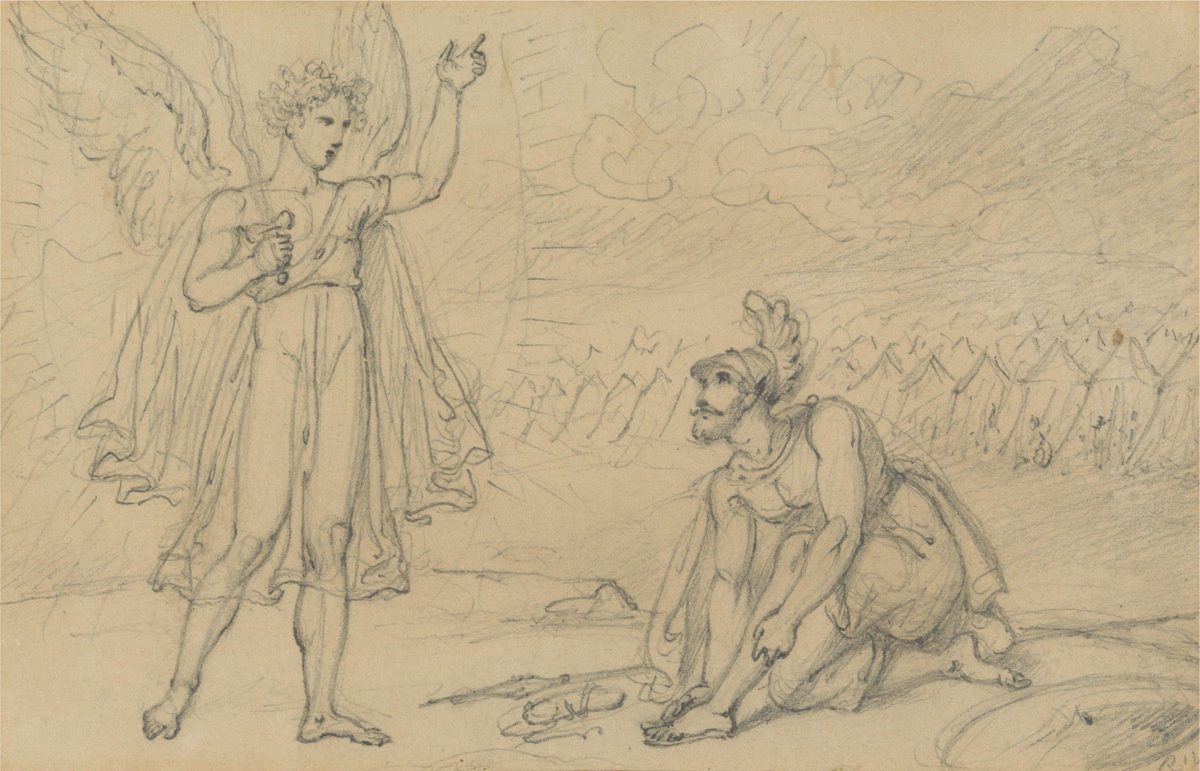
Westall draws v13 and v15 at once: the sword is drawn, and the sandal is already off — one sandal, which is what the Hebrew says and what only the KJV, ASV and Geneva keep. The wings are the painter’s; the text says a man, and Joshua asks him whose side he is on because he cannot tell. The camp behind them is Gilgal, the tents of a nation still healing from v8; Joshua’s plumed helmet and cuirass are a Roman officer’s, not anything the text describes. It is a working sketch — the cloud and the tents are a few strokes — and it is undated; the Yale catalogue gives only before 1835, the year before Westall’s death. The commander’s raised finger points where the text does: away from himself.
_-_B1986.12.4_-_Yale_Center_for_British_Art.jpg)
★★★ The scroll says until WE had crossed; the Masoretes read until THEY had crossed; and two witnesses on the shelf print the scroll. The consonants written in the text are avarnu, ‘we crossed’; the form the Masoretes mark to be read is avram, ‘their crossing.’ It is a real difference: the read form keeps the narrator outside the story, reporting what the kings heard about them; the written form has the narrator inside it, one of the people who walked across. This translation prints the read form, as it has at every ketiv/qere so far, and records the written one here — but the written one is not alone in this chapter. Verse 6 says the land was sworn to their fathers to give US, with no qere to correct it, and Joshua 4:23 (already on these pages) had just taught the fathers to say that the Red Sea was dried up from before us until we had crossed. A chapter that opens with the kings hearing the news says we twice in six verses. The KJV reads ‘until we were passed over’, and the ASV the same, ‘until we were passed over’ — the two witnesses on the shelf that print what is written rather than what is read; the NWT 1984 reads ‘until they had passed over’, the NIV ‘until they had crossed over’, the Geneva 1599 ‘until they were gone over’, the Douay-Rheims ‘till they passed over’; the Living Bible has no clause to carry either. In Spanish the RV60 and RV 1909 read «hasta que hubieron pasado», the TNM 1987 «hasta que hubieron pasado al otro lado», the TNM 2019 «hasta que lo cruzaron», the NVI «para que los israelitas lo cruzaran» — all five witnesses on the Spanish shelf on the read form. The Greek Bible has en tō diabainein autous, ‘in their crossing,’ the read form too.
★★★ ‘Their heart melted, and there was no spirit in them any more’ — Rahab’s sentence, said now by the narrator of the kings. On her roof Rahab had said we heard, and our heart melted, and no spirit rose up any more in any man because of you (Joshua 2:11, already on these pages); the narrator now reports it of every king west of the river, with the verb she used, masas. The form vayimas, ‘and it melted,’ stands in three verses of this book — hers, this one, and 7:5’s (not yet on these pages), where after the defeat at Ai the heart of the people melted and became water: the melting the Canaanites suffer in chapters 2 and 5 will be Israel’s in chapter 7. It is the verb Deuteronomy 1:28 gave the scouts, our brothers have melted our heart, and 20:8 the coward who must go home before he melts the heart of his brothers (both already on these pages); and it is what the manna did when the sun grew hot (Exodus 16:21, already on these pages), a chapter before the manna stops in this one. Od ruach, ‘spirit any more,’ stands in three verses of the Hebrew Bible: Rahab’s, this one, and 1 Kings 10:5 (not yet on these pages), where the Queen of Sheba sees Solomon’s table and there was no more spirit in her — the same idiom for being knocked breathless, once by terror and once by wonder. And hovish, ‘dried up,’ is the verb this book has been passing from mouth to mouth: it stands in three verses of this book — Rahab of the Red Sea (2:10), the fathers of the Jordan and the Red Sea together (4:23), and here the kings, hearing it. The KJV reads ‘their heart melted, neither was there spirit in them any more’, the ASV the same; the NWT 1984 ‘their hearts began to melt, and there proved to be no spiritedness in them anymore’; the NIV ‘their hearts melted in fear and they no longer had the courage to face the Israelites’; the Geneva 1599 ‘their hearts fainted: and there was no courage in them anymore’; the Douay-Rheims ‘their heart failed them, and there remained no spirit in them’; the Living Bible ‘their courage melted away completely and they were paralyzed with fear’. In Spanish the RV 1909 reads «desfalleció su corazón, y no hubo más espíritu en ellos», the RV60 revises the last noun, «no hubo más aliento en ellos», the TNM 1987 «empezó a derretírseles el corazón, y resultó que ya no había espíritu en ellos», and the NVI «¡No se atrevían a hacerles frente!». The Greek Bible reads etakēsan autōn hai dianoiai, ‘their minds melted,’ and adds a verb the Hebrew does not have, kateplagēsan, ‘they were struck with terror.’ Calvin’s summary of the verse: ‘before the conflict commenced, the enemy were already routed by the terror which the fame of the miracle had inspired.’
★★ ‘Beyond the Jordan westward’ — the phrase names the bank the narrator is standing on, and the sea it names is only the sea. Be-ever ha-Yarden yammah stands in three verses of the Hebrew Bible, all in this book (this verse, 12:7 and 22:7, neither yet on these pages), and each time it means the west bank — the side Israel has just crossed to. Rashi’s gloss: ‘on the side to which the sons of Israel crossed, which is the western side, since they had been on the eastern side.’ Beyond the Jordan is not a fixed place but a point of view: Deuteronomy 1:1 and 1:5 (already on these pages) use it of Moab, the EAST bank, from the vantage of the land, and this verse uses it of Canaan from the vantage of Moab, and adds westward so that the reader cannot mistake it. ‘All the kings of the Amorites’ stands in two verses of the Hebrew Bible, this one and 10:6 (not yet on these pages), where Gibeon sends for help against five of them; and the pairing — Amorites inland, Canaanites by the sea — is the scouts’ map at Numbers 13:29 (already on these pages): the Amorite dwell in the hill country; and the Canaanite dwells by the sea and along the Jordan. Three versions name the sea the Hebrew leaves unnamed: the Living Bible reads ‘along the Mediterranean coast’, the NVI «de la costa del Mediterráneo», and the Douay-Rheims ‘who possessed the places near the great sea’ — the Torah’s own name for it (Numbers 34:6, already on these pages), imported here from Jerome’s Latin; the Greek Bible replaces the Canaanites altogether with hoi basileis tēs Phoinikēs, ‘the kings of Phoenicia,’ a Greek name for the same coast. The KJV reads ‘on the side of Jordan westward’, the ASV ‘beyond the Jordan westward’, the NWT 1984 ‘on the side of the Jordan to the west’, the NIV ‘west of the Jordan’; the RV60 «al otro lado del Jordán al occidente». An open break, {פ}, closes the verse: the kings are left with their melted hearts, and the next word is a knife.
★★★ The knives are stone, and the last flint the Torah put to a foreskin was in Zipporah’s hand. Charvot tsurim, ‘knives of flint,’ stands in two verses of the Hebrew Bible, v2 and v3 of this chapter, the command and its execution word for word. Cherev is the ordinary word for a sword — it is the sword drawn in the man’s hand at v13 — and tsur is rock, the Rock of Moses’ song (Deuteronomy 32:4, already on these pages); a cherev of tsurim is a blade made of stones. At Exodus 4:25 (already on these pages) Zipporah took a flint, a tsor, and cut off her son’s foreskin — the same stone, with a different vowel, on the way down to Egypt at a lodging-place; here the same stone on the way into Canaan at Gilgal, and both times the cutting is what stands between Israel and the next thing God will do. The Torah’s own altar law prefers unworked stone to iron (Deuteronomy 27:5, already on these pages). The Targum read the adjective for the noun, ‘sharp knives,’ and Rashi follows it, citing Psalm 89:44 (not yet on these pages), where tsur charbo is the edge of his sword: ‘when the sharp edge is turned sideways it does not cut well.’ That reading is the KJV’s, ‘Make thee sharp knives’, the Geneva 1599’s, ‘Make thee sharp knives’, and the Reina-Valera’s in both editions, RV 1909 and RV60 «Hazte cuchillos afilados». The stone is the NWT 1984’s, ‘Make for yourself flint knives’, the NIV’s ‘Make flint knives’, the TNM 1987’s «Hazte cuchillos de pedernal», and the Douay-Rheims’ ‘Make thee knives of stone’, after Jerome’s cultros lapideos; the NVI keeps both, «cuchillos de piedra afilada». The Greek Bible had both too, and more: machairas petrinas ek petras akrotomou, ‘stone knives out of sharp-cut rock.’ The Living Bible has the Lord instruct them ‘to manufacture flint knives for this purpose’, and prints the same paragraph twice, once under v2 and once under v3.
★★★ ‘Circumcise the sons of Israel again, a second time’ — two words for one idea, and a question the text answers in its own way four verses later. Ve-shuv mol … shenit: shuv, the verb to turn back, used as Hebrew uses it for again, and then shenit, a second time, saying it once more. This translation keeps both. The KJV reads ‘circumcise again the children of Israel the second time’, the ASV the same; the NWT 1984 ‘circumcise the sons of Israel again, the second time’; the Douay-Rheims keeps one, ‘circumcise the second time the children of Israel’, and the NIV the other, ‘circumcise the Israelites again’. ⚠ The Geneva 1599 reads shuv as a verb in its own right: ‘Make thee sharp knives, and return, and circumcise the sons of Israel the second time’ — Joshua told to go back somewhere first. The Reina-Valera has the idiom Spanish keeps for this, «vuelve a circuncidar la segunda vez», turn back to circumcise, in both the RV 1909 and the RV60; the TNM 2019 reads «para volver a circuncidar» and drops the second time. The Greek Bible read the consonants of shuv as a different verb, yashav, to sit, and prints kathisas periteme, ‘sit down and circumcise’ — a translator’s slip that Brenton’s English faithfully carries, ‘sit down and circumcise the children of Israel the second time.’ What the second time means has been argued since the Talmud. Rashi, following Yevamot 71b, takes the first time to be the night of the exodus, when all the sons of Israel did what the Passover law required (Exodus 12:48–50, already on these pages), and explains the forty-year gap by a tradition that ‘the north wind did not blow for them, and they did not have a suitable day to circumcise themselves’; he adds that ‘our Sages said, The second time refers to exposing the corona at circumcision,’ a second stage of the rite not given to Abraham — two readings, reported here as his. Calvin finds the whole gap ‘very strange and almost monstrous’ and reads it as judgement: ‘the use of circumcision ceased during the whole of that period as a sign of malediction or rejection,’ a people shown in their own sons what they had forfeited. The text’s own explanation is the narrator’s, in vv4–7, and it does not give a reason for the omission, only the fact of it. The Living Bible supplies the arithmetic in a parenthesis, ‘(It was the second time in Israel’s history that this was done.)’.
★★ Gibeath-ha-araloth, the Hill of the Foreskins — a place named for what was left on it. The name stands in one verse of the Hebrew Bible. It is two ordinary words with the article, the hill of the foreskins, orlah being the noun Genesis 17:11 (already on these pages) minted on Abraham’s own flesh; Rashi: ‘so called because of the event, which were made into a hill.’ This translation prints the name and glosses it, as the Numbers 11 page does with Taberah. The shelf splits by whether it hears a name. The KJV, ASV and Geneva 1599 read ‘the hill of the foreskins’, the Douay-Rheims ‘in the hill of the foreskins’, the Living Bible ‘The Hill of the Foreskins’, the RV 1909 «el monte de los prepucios»; the NIV reads ‘Gibeath Haaraloth’, the NWT 1984 likewise keeps it as a name, and the TNM 1987 reads «Guibeat-haaralot»; and the RV60 and NVI translate half of it, «el collado de Aralot» and «la colina de Aralot», a Spanish hill with a Hebrew foreskins. The Greek Bible reads epi tou kaloumenou topou Bounos tōn akrobystiōn, ‘at the place called Hill of the Foreskins,’ and it is not done with these knives. In the Greek Joshua, at 21:42 and again at 24:31 (in Brenton’s numbering; neither chapter yet on these pages), two sentences the Hebrew does not have follow the knives to Joshua’s grave: there they put with him into the tomb in which they buried him, the knives of stone with which he circumcised the children of Israel in Galgala … and there they are to this day — a relic, with the book’s own until this day attached to it. This page reports the Greek addition as the Greek’s. Josephus, who tells the crossing, the twelve stones, the Passover and the manna’s end in one paragraph (Antiquities 5.1.4), does not mention the circumcision at all.
★★★ The narrator stops the story to explain, and the explanation is that a whole generation was born and never circumcised. Ve-zeh ha-davar asher, ‘and this is the reason that,’ stands in four verses of the Hebrew Bible, and the first is Exodus 29:1 (already on these pages), this is the thing that you shall do for them, to sanctify them — the priests’ consecration, opened with the phrase that here opens a nation’s. The argument of vv4–5 is a syllogism: everyone who came out of Egypt was circumcised (Exodus 12:48, already on these pages, had made it the condition of eating the Passover, and 12:50 says all the sons of Israel did); the men of war among them are all dead; everyone born on the way was not circumcised; therefore the army that will take Jericho is, but for Joshua, Caleb and whoever left Egypt as a boy, an uncircumcised army. Ha-zekharim, ‘the males,’ is the word of Genesis 17:10, every male among you shall be circumcised. The verb is active and subjectless, lo-malu, ‘they had not circumcised’ — the KJV keeps it, ‘them they had not circumcised’, as does the ASV, ‘they had not circumcised’, and the NWT 1984, ‘they had not circumcised’; the NIV and Geneva 1599 turn it passive, ‘had not’ and ‘were not circumcised’. ⚠ The Greek Bible tells a different story here, and it is not a small one. Its v4 has Joshua circumcise as many as were born on the way, and as many as were uncircumcised of those who came out of Egypt; its v5 gives the wandering forty-two years, tessarakonta kai dyo etē, where every Hebrew witness has forty; and its v6 says most of the fighting men who came out of the land of Egypt were uncircumcised — the exact opposite of the Hebrew’s all the people who came out had been circumcised. Its wilderness of Mabdaris is the Hebrew word for wilderness, ha-midbar, carried across as if it were a name. The Douay-Rheims, translating Jerome’s Latin, keeps the Hebrew’s facts and reshapes the sentences, ‘during the time of the long going about in the way’ at v4 and, at v6, ‘in the wide wilderness’. The Living Bible prints one paragraph for vv4–5 and, as it did at vv2–3, sets it under both numbers. For the men of war the KJV and ASV read ‘men of war’, the NIV ‘men of military age’, the Douay-Rheims ‘men fit for war’, the Living Bible ‘old enough to bear arms’; the NVI «en edad militar», the RV60 «hombres de guerra».
★★★ Verse 6 is Deuteronomy 2:14 said again, with nation where Moses said generation — and it ends on us. Deuteronomy 2:14 (already on these pages): until the whole generation of the men of war had perished from the midst of the camp, just as Jehovah had sworn to them. This verse: until all the nation, the men of war who came out of Egypt, was finished … to whom Jehovah swore. The verb is the one this book has been using for the crossing: ad-tom, ‘until … was finished,’ stands in eleven verses of the Hebrew Bible, and two of them are this book’s — 4:10, where the priests stood in the river until everything was finished, and this one, where a nation walked until it was; the oath it recalls is Numbers 14:33, until your carcasses are finished in the wilderness, and 32:13, until the whole generation that did evil in the eyes of Jehovah was finished (all already on these pages). ‘Had not listened to the voice of Jehovah’ stands in four verses of the Hebrew Bible, and one of them is Psalm 106:25 (not yet on these pages), retelling this same sentence: they grumbled in their tents; they did not listen to the voice of Jehovah. Zavat chalav u-devash, ‘flowing with milk and honey,’ stands in twenty verses of the Hebrew Bible, and in one verse of this book — this one, the phrase of the burning bush (Exodus 3:8, already on these pages) used the day the people who were promised it are standing in it. ⚠ And then latet lanu, to give US. The narrator who wrote we crossed at v1 and was corrected by the Masoretes writes us here and is not corrected: the land was sworn to their fathers to give to us. Ten of the thirteen versions on the two shelves keep the pronoun — the KJV ‘that he would give us’, the ASV ‘that he would give us’, the Geneva 1599 ‘that he would give us’, the NIV ‘to give us’, the NWT 1984 ‘to give to us’, the RV60 «que nos la daría», the TNM 1987 «darnos», and the TNM 2019 doubles it, «que nos daría a nosotros» — and three do not: the NVI reads «les daría», them; the Living Bible ‘the land he had promised to Israel’; and the Douay-Rheims drops the clause, ‘that he would not shew them the land flowing with milk and honey’. It is the same us as Deuteronomy 5:3’s not with our fathers, but with us (already on these pages), and the same as the fathers were taught to say at 4:23.
★★ ‘Their sons he raised up in their place’ — the verb that set up twelve stones, and a word Deuteronomy keeps for one nation displacing another. Heqim tachtam, ‘he raised up in their place,’ stands in one verse of the Hebrew Bible. Heqim is 4:9 and 4:20’s verb, Joshua set up twelve stones; the next thing raised up is a generation, and it is God who raises it. Tachtam, ‘in their place,’ comes twice in two verses — the sons raised up in their place here, and the whole camp sitting in its place at v8 — and Deuteronomy 2:12, 2:21, 2:22 and 2:23 (all already on these pages) use exactly that phrase, lived in their place, of Esau’s sons displacing the Horites, Ammon the Zamzummim, and the Caphtorim the Avvim: the vocabulary of one people succeeding another in a land, turned here on Israel’s own sons succeeding their fathers. They are the children Deuteronomy 1:39 (already on these pages) promised would go in, who today do not know good from evil. Arelim hayu, ‘they were uncircumcised,’ stands in one verse of the Hebrew Bible, and the sentence gives the reason twice, ki … ki, for they were uncircumcised, for they had not circumcised them. The KJV reads ‘their children, whom he raised up in their stead, them Joshua circumcised’, the ASV ‘their children, whom he raised up in their stead’, the NWT 1984 ‘their sons he raised up instead of them’, the NIV ‘So he raised up their sons in their place’; the Douay-Rheims ‘The children of these succeeded in the place of their fathers’; the Living Bible ‘the men who had grown up to take their fathers’ places’, and it drops the two for clauses. In Spanish the RV60 reads «que él había hecho suceder en su lugar», the NVI names the subject the Hebrew leaves as he, «a quienes Dios puso en lugar de ellos», the TNM 2019 «los reemplazó con sus hijos».
★★★ Tammu kol-ha-goy, ‘all the nation had finished,’ for the third time — and the infinitive that follows it is the one Jacob’s sons used at Shechem. The clause stands in three verses of the Hebrew Bible, all in this book: 3:17 and 4:1 (already on these pages), of a nation that had finished crossing, and this verse, of a nation that had finished being circumcised — the third instalment the Joshua 4 page promised. The infinitive is le-himmol, ‘to be circumcised,’ and that form stands in two verses of the Hebrew Bible: this one, and Genesis 34:17 (already on these pages), the terms Jacob’s sons set the men of Shechem — if you will not listen to us, to be circumcised, then we will take our daughter and go. Every reader of Genesis knows how that circumcision ended: on the third day, when they were in pain, Simeon and Levi each took his sword, and came upon the city unopposed (34:25). A whole nation now sits in the same condition a few kilometres from a walled city, and Calvin draws the line himself: ‘if in similar circumstances two sons of Jacob, were able to force their way into the town of Sichem and plunder it, after slaying its citizens, how much more easy would it have been for the neighboring nations to attack the Israelites while thus wounded’ — ‘a sad and severe trial that God did not choose to have the people circumcised till they were hemmed in by enemies on every side.’ Verse 1 is the answer the chapter gave before the question: the kings’ hearts had already melted. Vayeshvu tachtam, ‘they stayed in their place,’ is v7’s tachtam again; the Targum reads ‘in their places,’ and Rashi adds what it means, ‘they did not besiege the city.’ Ad chayotam stands in one verse of the Hebrew Bible, and the word is not healed but lived — the infinitive of chayah, to live, the verb this book will use at 9:15 (not yet on these pages) when Joshua makes a covenant with the Gibeonites to let them live: the camp sat still until it was alive again. The NWT 1984 reads ‘they kept sitting in their place in the camp until they revived’, the closest on the shelf, and the TNM 1987 «se quedaron sentados en su lugar en el campamento hasta que revivieron»; the KJV and ASV ‘they abode in their places in the camp, till they were whole’, the Geneva 1599 ‘till they were whole’; the NIV ‘they remained where they were in camp until they were healed’, the Douay-Rheims ‘until they were healed’, the RV60 «hasta que sanaron», the NVI «hasta que se recuperaron»; the Living Bible reads ‘until the raw flesh of their wounds had been healed’ and moves the whole sentence to the end of v9, after the naming of Gilgal.
★★★ ‘Today I have rolled away the reproach of Egypt from off you’ — and the verb is Jacob’s at the well. Galloti, from galal, to roll: read as this verb, the form stands in one verse of the Hebrew Bible (the same letters spell my exiles at Isaiah 45:13 and a word for paths at Psalm 17:5, so the count is by reading). It is the verb of Genesis 29:10 (already on these pages), where Jacob rolled the stone from the well’s mouth, and of the stone the shepherds roll off it in the verses before; and it is the verb of one psalm’s prayer, whose pairing stands in one verse of the Hebrew Bible, Psalm 119:22 (not yet on these pages): gal me-alai cherpah, roll reproach away from me — the same verb, the same noun and the same preposition, me-al, from off, as this sentence. Rashi cites both. The pun is on the camp’s name: Gilgal, with the article, is a circle or a wheel — a ring of stones, most likely, and the name was already in use at 4:19 and, of some Gilgal, at Deuteronomy 11:30 (both already on these pages), which is why the Joshua 4 page called its use there a naming ‘by anticipation.’ Six of the thirteen versions keep the rolling: the KJV and ASV read ‘This day have I rolled away the reproach of Egypt from off you’, the NWT 1984 ‘Today I have rolled away the reproach of Egypt from off YOU’, the NIV ‘Today I have rolled away the reproach of Egypt from you’, the TNM 1987 «Hoy he hecho rodar de sobre ustedes el oprobio de Egipto»; the rest lose the pun, the Geneva 1599 ‘taken away the shame of Egypt’, the Douay-Rheims ‘taken away from you the reproach of Egypt’, the RV 1909 and RV60 «Hoy he quitado de vosotros el oprobio de Egipto», the TNM 2019 «les he quitado de encima la deshonra de Egipto», and the Greek Bible apheilon, ‘I have taken away’ — which also drops until this day and adds a patronymic, Joshua son of Naue. Two versions supply an etymology of their own: Josephus writes that the camp ‘was called Gilgal, which denotes liberty; for since now they had passed over Jordan, they looked on themselves as freed from the miseries which they had undergone from the Egyptians, and in the wilderness’ (Antiquities 5.1.11), and the Living Bible reads ‘the place where this was done was called Gilgal (meaning, “to end”)’. Neither is what the word means.
★★★ What was the reproach of Egypt? The text does not say, and four readings have stood for centuries. Cherpat Mitsrayim stands in one verse of the Hebrew Bible. Cherpah is a reproach in the mouth or a disgrace on the body, and each reading picks one. (1) The disgrace of being uncircumcised — Genesis 34:14 (already on these pages) uses this very noun of it, to give our sister to a man who is uncircumcised, for that is a disgrace to us; the Living Bible prints this reading as the text, ‘Today I have ended your shame of not being circumcised’. (2) The taunt Egypt would have made if Israel had died in the desert — why should the Egyptians say: For evil he brought them out, to kill them in the mountains (Exodus 32:12, already on these pages; Deuteronomy 9:28 makes the same argument); Rashi reports the reading of Rabbi Moshe ha-Darshan, in which the Egyptians had named a blood-omen against them and ‘the mixed multitude that went up with them were still taunting them,’ until the blood of circumcision answered the omen. (3) The disgrace of having been slaves — the NVI prints this one as the text, «Hoy les he quitado de encima la vergüenza de haber sido esclavos en Egipto». (4) Calvin’s: the charge of being runaways, ‘They might, therefore, have been regarded as deserters, had not the disgrace been wiped off by the appeal to circumcision, by which the divine election was sealed in their flesh before they went down into Egypt.’ The Hebrew fits any of them and chooses none; this translation keeps reproach of Egypt, which is as open as the original, and leaves the choosing here. The naming formula, vayiqra shem ha-maqom ha-hu, stands in three verses of the Hebrew Bible: Jacob’s Mahanaim, God’s camp (Genesis 32:3), Taberah (Numbers 11:3; both already on these pages), and this camp; the subject is the impersonal he that Hebrew uses for one, and the shelf divides over who did the calling — the Geneva 1599 reads ‘he called the name of that place, Gilgal’, the KJV ‘the name of the place is called Gilgal’, the ASV ‘the name of that place was called Gilgal’, the NWT 1984 ‘the name of that place came to be called Gilgal’, the NIV ‘the place has been called Gilgal to this day’. This translation prints it as the Numbers 11 page does, was called. And ad ha-yom ha-zeh, until this day, is the second of the fifteen verses of this book that carry it, after 4:9’s stones in the river: a name still on a map when the sentence was written.
★★★ ‘They kept the Passover’ — the last time the Bible said those words, the camp was at Sinai in the second year. Vaya’asu et-ha-pesach stands in two verses of the Hebrew Bible: Numbers 9:5 (already on these pages), they kept the Passover in the first month, on the fourteenth day of the month, between the two evenings, in the wilderness of Sinai, and this verse. Between the two the Torah gives laws for the Passover and no report of one kept, and readers have divided over the silence: Calvin holds that it was kept every year and the text simply does not say so, and argues against ‘some who think that the words used imply that the practice was unusual. They hence infer that, like circumcision, it had been interrupted for a period of forty years’; his own editor, in a footnote, sides with the some, citing Exodus 12:48’s bar on the uncircumcised and 12:25’s when you come to the land … you shall keep this service. Either way the order of this chapter is the order of that law: circumcision first, then Passover, because no uncircumcised person shall eat of it. ‘On the fourteenth day of the month’ stands in five verses of the Hebrew Bible, and the month is not named here; 4:19 had given it, the first. La-chodesh ba-erev, ‘of the month, in the evening,’ stands in three verses of the Hebrew Bible: Exodus 12:18, the Passover law; Leviticus 23:32, the evening of the Day of Atonement (both already on these pages); and this one. Be-arvot Yericho pays 4:13’s plains of Jericho, and answers the book of Numbers, whose Passover was kept at Sinai and whose last camp was the plains of Moab (Numbers 22:1, already on these pages): the first Passover in the land is kept on a plain with the enemy’s city in its name. Josephus has an altar built of the twelve stones and a sacrifice offered on it before the feast (Antiquities 5.1.4), neither of which the Hebrew mentions. The KJV reads ‘kept the passover on the fourteenth day of the month at even in the plains of Jericho’, the ASV the same; the NWT 1984 ‘proceeded to carry out the passover’ ‘on the desert plains of Jericho’; the NIV ‘celebrated the Passover’; the Douay-Rheims ‘they kept the phase’, Jerome’s Latin for the feast carried into English as a word; the NVI adds the month, «del día catorce del mes primero». ⚠ The Living Bible reads ‘during the evening of April first’ — and at 4:19 it had dated the crossing to ‘the 25th of March’: seven days on its calendar between the tenth of the month and the fourteenth, where the text has four.
★★★ ‘On the morrow after the Passover’ is the day Israel left Egypt — the same three words, forty years apart to the day. Mi-mochorat ha-pesach stands in two verses of the Hebrew Bible: Numbers 33:3 (already on these pages), on the day after the Passover the children of Israel went out with a high hand, before the eyes of all the Egyptians, and this verse, where they eat the land. The fifteenth of the first month, out of Egypt; the fifteenth of the first month, into Canaan’s food. Mochorat is the noun of machar, the tomorrow the sons ask their questions on at 4:6. What they eat is avur ha-arets, and read as this noun, avur stands in two verses of the Hebrew Bible — v11 and v12 of this chapter, nowhere else; it is built on avar, the verb this book has been using for cross, and the lexicons take it as what has passed, the yield already in. That is why the KJV reads ‘the old corn of the land’ in both verses, following the rabbis, for whom the new crop could not be touched until the sheaf of Leviticus 23:10–14 (already on these pages) had been waved — Rashi: ‘This was the day of waving the Omer, for they sacrificed the Omer first’ — and Calvin agrees on other grounds, ‘this is to be understood of the produce of the former year.’ The ASV reads ‘the produce of the land’, the NWT 1984 ‘the yield of the land’, the NIV ‘the produce of the land’, the Geneva 1599 ‘the corn of the land’, the Douay-Rheims ‘the corn of the land’ and then, at v12, ‘the corn of the present year’, the opposite of the KJV’s old; the Living Bible ‘the gardens and grain fields which they invaded’. In Spanish the RV60 reads «del fruto de la tierra», the NVI «de los productos de la tierra». Matsot ve-qalui, ‘unleavened bread and roasted grain,’ stands in one verse of the Hebrew Bible; the word qalui itself stands in two verses of the Hebrew Bible, this one and Leviticus 2:14 (already on these pages), the firstfruits offering of fresh ears roasted with fire — and Leviticus 23:14’s list of what may not be eaten before the sheaf is waved is bread, roasted grain, fresh grain. The meal named here is the meal that law names. The KJV reads ‘unleavened cakes, and parched corn’, the ASV ‘unleavened cakes and parched grain’, the NWT 1984 ‘unfermented cakes and roasted grains’, the NIV ‘unleavened bread and roasted grain’; the Douay-Rheims ‘unleavened bread of the corn of the land, and frumenty’, a word for boiled wheat; the RV60 «los panes sin levadura, y en el mismo día espigas nuevas tostadas», the NVI «panes sin levadura y de trigo tostado». Then the date-stamp: be-etsem ha-yom ha-zeh, ‘on that very same day,’ stands in fourteen verses of the Hebrew Bible, and the Torah keeps it for its heaviest days — Noah entering the ark (Genesis 7:13), the exodus itself (Exodus 12:17, 41, 51), Moses told to climb Nebo (Deuteronomy 32:48), and, twice, Abraham: on that very same day Abraham was circumcised, and Ishmael his son (Genesis 17:23, 26; all already on these pages). A chapter of circumcision dates its first meal with the phrase of the first circumcision. The KJV and ASV read ‘in the selfsame day’, the NWT 1984 ‘on this same day’, the NIV ‘that very day’; the NVI and the Greek drop it.
★★★ And the manna ceased — the verb is shavat, the manna keeps a sabbath, and a sentence from Exodus 16 is paid forty years on. Vayishbot ha-man stands in one verse of the Hebrew Bible. The verb is the one Genesis 2:2 (already on these pages) uses of God on the seventh day, he rested from all the work he had done, and the one the manna chapter itself uses of the people on their first sabbath, so the people rested on the seventh day (Exodus 16:30, already on these pages): the bread that taught Israel to stop on the seventh day stops. That chapter had ended with the sentence this verse pays: the children of Israel ate the manna forty years, until they came to an inhabited land; they ate the manna until they came to the border of the land of Canaan (16:35), and Deuteronomy 8:3 and 8:16 (already on these pages) had said what the forty years of it were for. Rashi has the manna stop falling on the day Moses died, the seventh of Adar, and the people eat from what was in their vessels until this morning — a reading, reported as his. Tevuat erets Kenaan, the yield of the land of Canaan: the phrase the land of Canaan stands in eight verses of this book, and this is the first — the narrator gives the land its name the day its bread is eaten. The Greek Bible reads en tautē tē hēmera exelipe to manna, ‘on THIS day the manna failed,’ where the Hebrew has on the morrow, and tēn chōran tōn Phoinikōn, ‘the land of the Phoenicians,’ for Canaan, as at v1; Josephus, ‘then it was that their former food, which was manna, and of which they had eaten forty years, failed them’ (Antiquities 5.1.4). The KJV reads ‘the manna ceased on the morrow after they had eaten of the old corn of the land’, the ASV ‘the manna ceased on the morrow, after they had eaten of the produce of the land’, the NWT 1984 ‘the manna ceased on the following day’, the NIV ‘The manna stopped the day after they ate this food from the land’, the Geneva 1599 ‘the Manna ceased on the morrow’; the Living Bible ‘no manna fell, and it was never seen again!’; the RV60 «el maná cesó el día siguiente» and «nunca más tuvieron maná», the TNM 1987 «no ocurrió más maná»; the NVI keeps the stopping and the year and drops the middle clause, «Un día después dejó de caer maná y durante ese año el pueblo se alimentó de los frutos de la tierra de Canaán». Rashi’s parable on there was no more manna: a child asked why he eats barley bread answers, because I have no wheat bread — they ate the land’s grain because the manna was gone, not the other way round. A closed break, {ס}, ends the paragraph, and the man with the sword is the next word.
★★★ Joshua sees the man the way Abraham saw his three visitors, and the sword in the man’s hand is the one Balaam’s donkey saw. Vayissa einav vayar ve-hineh, ‘he lifted up his eyes and looked, and look —,’ stands in three verses of the Hebrew Bible: Genesis 18:2 (already on these pages), Abraham at the tent door, and look — three men standing near him; Genesis 24:63, Isaac in the field toward evening, seeing camels coming; and this verse, Joshua at Jericho seeing one man. Twice in the Bible a man lifts his eyes to find someone standing there who is more than he looks. ‘And look — a man standing’ stands in one verse of the Hebrew Bible, and le-negdo, ‘opposite him,’ stands in one verse of the Hebrew Bible — the neged of Genesis 2:18’s a helper corresponding to him (already on these pages), the word for a thing set over against you, face to face. Ve-charbo shelufah be-yado, ‘with his sword drawn in his hand,’ stands in three verses of the Hebrew Bible, and all three swords are in an angel’s hand: Numbers 22:23, where the she-ass sees the angel of Jehovah standing in the road with his sword drawn in his hand and Balaam does not, until 22:31 (both already on these pages), when he bowed down and fell on his face; this verse; and 1 Chronicles 21:16 (not yet on these pages), where David sees the angel standing between earth and heaven, with his sword drawn in his hand over Jerusalem, and falls on his face too. Joshua is the one of the three who walks toward the sword. Bi-Yricho is, in the Hebrew, ‘in Jericho’ — the city is shut (6:1, already on these pages) and Joshua is not inside it; Rashi takes the preposition as the rabbis’ rule that a city’s outskirts count as the city, and this translation prints at, the sense v10’s at Gilgal gives the same preposition. Calvin thinks Joshua was alone and ‘had gone aside to examine where the city ought to be attacked.’ Ha-lanu attah, ‘are you for us,’ stands in one verse of the Hebrew Bible; the Targum, Rashi reports, paraphrases it ‘have you come to support us?’ The KJV reads ‘there stood a man over against him with his sword drawn in his hand’ and ‘Art thou for us, or for our adversaries?’, the ASV the same; the NWT 1984 ‘a man standing in front of him with his drawn sword in his hand’ and ‘Are you for us or for our adversaries?’; the NIV ‘Are you for us or for our enemies?’; the Geneva 1599 ‘Art thou on our side, or on our adversaries?’; the Douay-Rheims ‘Art thou one of ours, or of our adversaries?’ and, for the place, ‘in the field of the city of Jericho’; the Living Bible ‘Are you friend or foe?’, and it has Joshua ‘sizing up the city of Jericho’. In Spanish the RV60 reads «¿Eres de los nuestros, o de nuestros enemigos?», the TNM 1987 «¿Estás de parte de nosotros, o de nuestros adversarios?», and the NVI has Joshua address the stranger with the formal pronoun, «¿Es usted de los nuestros o del enemigo?».
★★★ ‘No’ — the man refuses the question’s either/or, and gives a title that exists in no other verse of the Bible. Lo: not for you, not for them. Calvin: ‘the denial applies equally to both parts of the question, namely, that he was neither an Israelite nor a Canaanite, and was thus equivalent to a denial of his being a mortal man.’ The KJV and ASV read ‘Nay’, the NWT 1984 ‘No’, the NIV makes the logic explicit, ‘Neither’, the NVI «¡De ninguno!»; the Living Bible drops the word and lets him answer with his rank. ⚠ So does the Greek Bible, which has no no at all: egō archistratēgos dynameōs Kyriou nyni paragegona, ‘I, the chief captain of the Lord’s host, have now come’ — and it has no prostration either, only Joshua falling on his face and asking, despota, ti prostasseis tō sō oiketē, ‘Master, what do you command your servant?’ Sar-tseva-Yehovah, ‘the commander of the army of Jehovah,’ stands in two verses of the Hebrew Bible, v14 and v15; the ordinary title sar ha-tsava, a king’s army commander, stands in ten verses — Abner’s, Joab’s, Naaman’s — and one of the ten is Daniel 8:11 (not yet on these pages), the prince of the host, whom the little horn magnifies itself against; Daniel 10:21 calls Michael your prince and 12:1 (already on these pages) the great prince, and Rashi names him here: ‘the officer mentioned here is the angel Michael.’ A sar is any chief with men under him, and the tsava he commands is, in this book, Israel — the army of 4:13 — or the host of heaven, or both; Calvin reads Israel, ‘the chosen people whom he honorably styles the Lord’s host,’ and identifies the commander with the angel of the exodus and, through Paul (1 Corinthians 10:4), with Christ: ‘Of this fact Paul is a competent witness, who distinctly declares that it was Christ.’ Three readings, then, stand with their pedigrees — an angel, and Michael in particular (Rashi, after Daniel); the angel of Jehovah who is Jehovah’s own presence, as at the bush; and a pre-incarnate Christ (Calvin, and the Reformed tradition after him) — and this translation prints commander and leaves the identification where the Hebrew leaves it, in the reader’s hands. What the text itself does is stranger than any of them: the man never says what he came to say. Verse 15 ends with a sandal, and the next words are And Jehovah said to Joshua: See, I have given Jericho into your hand (6:2, already on these pages) — the message the commander brought, in the mouth of Jehovah, on the far side of a chapter division. Attah vati, ‘now I have come,’ stands in one verse of the Hebrew Bible; Rashi hears in it a comparison with Moses, who was offered an angel and refused (Exodus 33:15, already on these pages): ‘in the days of your master, Moses, I came, but he did not want my presence.’ For the title the KJV reads ‘captain of the host’, the ASV and NWT 1984 ‘prince of the host of Jehovah’ and ‘prince of the army of Jehovah’, the NIV ‘commander of the army’, the Geneva 1599 ‘a captain of the host’, the Douay-Rheims ‘prince of the host’, the Living Bible ‘the Commander-in-Chief’; the RV60 «Príncipe del ejército de Jehová», the TNM 1987 «príncipe del ejército de Jehová», the NVI «comandante del ejército». Then Joshua’s posture, and a doctrinal seam in the shelf: el-panav artsah, ‘on his face to the ground,’ with this preposition stands in two verses of the Hebrew Bible (the other is Joab before David, 2 Samuel 14:22, not yet on these pages), and the verb that follows is hishtachavah, to bow down, the one word Hebrew has for a courtier’s bow and for worship. Seven versions read it as worship — the KJV ‘did worship’, the ASV ‘did worship’, the Geneva 1599 ‘did worship’, the Douay-Rheims ‘worshipping’, the Living Bible ‘worshiped him’, the RV 1909 and RV60 «le adoró» — and six as a bow: the NWT 1984 ‘prostrated himself’, the NIV ‘fell facedown to the ground in reverence’, the TNM 1987 «se postró», the NVI «se postró rostro en tierra». Whether Joshua worships depends on who the man is, and the verb will not say. Mah adoni medabber, ‘what does my lord say,’ stands in one verse of the Hebrew Bible. The Douay-Rheims divides v14 into two verses at this point and runs its chapter to sixteen.
★★★ Take off your sandal from your foot is the sentence from the burning bush, with two things changed: the sandal is singular, and the ground is gone. Exodus 3:5 (already on these pages): take off your sandals from your feet, for the place on which you are standing is holy ground — shal-ne’alekha me’al raglekha … admat-qodesh hu, both nouns plural. Here: shal-na’alkha me’al raglekha … qodesh hu, one sandal, one foot, and it is holy with no ground to be holy. The imperative shal with a sandal stands in two verses of the Hebrew Bible, those two; the verb is nashal, which Deuteronomy 7:1 and 7:22 (already on these pages) use of Jehovah shaking loose seven nations from before Israel and an axe-head slipping from its handle at 19:5 — the verb that will clear the land of its nations is the one that clears Joshua’s foot. Ha-maqom asher attah omed alav, ‘the place on which you are standing,’ stands in two verses of the Hebrew Bible, Moses’ and Joshua’s, and nowhere else: the successor is given his predecessor’s first sentence from God, on a plain instead of a mountain, with the holiness located, as the qodesh entry puts it, in who is standing there and not in the dirt. Only three versions keep the singular: the KJV ‘Loose thy shoe from off thy foot’, the ASV ‘Put off thy shoe from off thy foot’, the Geneva 1599 ‘Loose thy shoe of thy foot’. The rest give Joshua two: the NWT 1984 ‘Draw your sandals from off your feet’, the NIV ‘Take off your sandals’, the Douay-Rheims, at its own v16, shoes and feet, the Living Bible ‘Take off your shoes’, the RV 1909 «Quita tus zapatos de tus pies», the RV60 «Quita el calzado de tus pies», the NVI «Quítate las sandalias», the TNM 1987 «Quítate las sandalias de los pies». The Greek Bible keeps one, lysai to hypodēma ek tōn podōn sou, a sandal from feet, adds now to the standing, and ends there: and Joshua did so, vaya’as Yehoshua ken, is not in it. The KJV reads ‘the place whereon thou standest is holy. And Joshua did so’, the NWT 1984 ‘the place on which you are standing is holy. At once Joshua did so’, the NIV ‘the place where you are standing is holy. And Joshua did so’, the Living Bible ‘for this is holy ground’, restoring the ground the Hebrew left out; the NVI «porque estás pisando tierra santa» does the same, and the RV60 keeps the Hebrew’s bareness, «porque el lugar donde estás es santo». The chapter ends with Joshua barefoot, waiting for a message, and no break in the Masoretic text before 6:1 begins with a city shut tight.
Echoes paid. Joshua 2:11’s melted heart and vanished spirit, of the kings at v1, and 2:10’s dried up, in their ears at v1; 3:17 and 4:1’s ‘all the nation had finished’, of circumcision at v8, the third the Joshua 4 page promised; 4:19’s Gilgal, named at v9, and its tenth of the month, four days on at v10; 4:13’s plains of Jericho at v10; 4:9’s heqim and its ‘until this day’, at v7 and v9; 4:23’s us, in the scroll at v1 and in the text at v6; 4:10’s until … was finished, at v6. Exodus 3:5’s sandal and holy place, at v15; 4:25’s flint, at v2; 12:48’s bar on the uncircumcised, in the order of vv2–10; 12:18’s fourteenth day in the evening, at v10; 16:35’s manna ‘until they came to the border of the land of Canaan’, at v12, and 16:30’s resting verb, of the manna itself; 16:21’s melting manna, in the melting hearts of v1; 29:1’s ‘this is the thing’, at v4; 32:12’s ‘why should the Egyptians say’, in the reproach of v9; 33:15, in Rashi’s reading of v14. Genesis 17:10’s every male and 17:26’s ‘that very same day’, at vv4 and 11; Genesis 34:17’s to be circumcised and 34:14’s uncircumcised disgrace, at vv8–9; 29:10’s rolled stone, at v9; 32:3’s naming of a camp, at v9; 18:2’s lifted eyes, at v13; 2:2’s resting God, at v12, and 2:18’s neged, at v13. Numbers 9:5’s Passover kept, at v10; 33:3’s morrow after the Passover, at v11; 14:33 and 32:13’s until … finished, at v6; 13:29’s Canaanites by the sea, at v1; 22:23’s drawn sword, at v13; 22:1’s plains of Moab, answered at v10; 11:3’s naming formula, at v9. Deuteronomy 2:14’s generation of the men of war, at v6, and 2:12’s in their place, at vv7–8; 1:39’s children who will go in, at v7, and 1:28’s melted heart, at v1; 5:3’s with us, at v6; 7:1’s nations shaken loose, in the verb of v15; 8:3’s manna as a test, ended at v12; 11:30’s Gilgal, at v9; 27:5’s stones without iron, beside the knives of v2; 32:48’s ‘that very same day’, at v11. Leviticus 23:14’s roasted grain before the sheaf, and 2:14’s roasted ears, at v11.
Echoes planted. The melted heart a third time, Israel’s own, at 7:5; ‘all the kings of the Amorites’ at 10:6; beyond the Jordan westward at 12:7 and 22:7; to let them live, the Gibeonites, at 9:15; the land of Canaan in seven more verses of this book, from 14:1; ‘until this day’ in thirteen more, the next at 6:25 (already on these pages) and then Achan’s cairn at 7:26; the message the commander came to give, at 6:2 (already on these pages); the Greek Bible’s stone knives in Joshua’s grave at 24:31. Farther off: the Queen of Sheba with no spirit left in her at 1 Kings 10:5; Joab on his face to the ground at 2 Samuel 14:22; David’s angel with a drawn sword at 1 Chronicles 21:16; the prince of the host at Daniel 8:11, and Michael your prince at 10:21; the psalm that asks God to roll reproach away from me, 119:22; Psalm 106:25’s did not listen to the voice of Jehovah; Josiah’s Passover at 2 Chronicles 35:17 and the returned exiles’ at Ezra 6:19, and Boaz’s roasted grain at Ruth 2:14 (none yet on these pages).
Decisions. Hebrew and English verse numbers align through this whole chapter (the Douay-Rheims alone runs to sixteen, dividing v14); the Masoretic text carries three breaks — an open {פ} after v1 and after v8, a closed {ס} after v12 — and none between v15 and 6:1. The ketiv/qere at v1 is printed as the read form, until they had crossed, with the written until we had crossed in the note, as this project has done at every such reading. Yammah is ‘westward’; masas is ‘melted’ and kept apart from mug, ‘melt away,’ as the Joshua 2 page has it; ruach is ‘spirit’; hovish ‘dried up,’ as on the Joshua 2 and 4 pages; charvot tsurim is ‘knives of flint’; ve-shuv … shenit is ‘again, a second time,’ both words kept; Gibeath-ha-araloth is printed as a name and glossed, as Taberah is on the Numbers 11 page; ha-davar at v4 is ‘the reason’; lo-malu keeps its active, subjectless form, ‘they had not circumcised’; tom and tammu are ‘finished,’ as at 3:17, 4:1 and 4:10 and on the Numbers 14 and 32 pages; lanu at v6 is ‘us’; heqim is ‘raised up’ of sons where the Joshua 4 page has ‘set up’ of stones, the note carrying the link; tachtam is ‘in their place’ at v7 and v8; ad chayotam is ‘until they revived’; galloti is ‘rolled away’ and Gilgal is glossed ‘Rolling’; cherpah is ‘reproach,’ where the Genesis 34 page reads ‘disgrace’ for the same noun; vayiqra at v9 is ‘was called,’ as on the Numbers 11 page; vaya’asu et-ha-pesach is ‘kept the Passover,’ as on the Numbers 9 page; avur is ‘produce’ and tevuah ‘yield’; matsot ‘unleavened bread’ and qalui ‘roasted grain,’ as on the Leviticus 23 page; be-etsem ha-yom ha-zeh ‘on that very same day,’ as on the Genesis 17 page; vayishbot is ‘ceased’; bi-Yricho is ‘at Jericho,’ matching at Gilgal; hineh is ‘look —’; sar is ‘commander’; vayishtachu is ‘bowed down,’ the neutral word, with the shelf’s split recorded in the note; adoni is ‘my lord’; na’alkha and raglekha are kept singular; qodesh hu is ‘is holy,’ with no ground supplied. ‘Jehovah’ for the tetragrammaton continues this project’s own convention; in this chapter God speaks three times (v2, v9, and, if the commander is his voice, vv14–15), and the narrator twice says we.
Library. Eight new dictionary entries in both languages: tsur, the rock that is also a flint knife; galal, to roll, from Jacob’s well-stone to Gilgal’s name; masas, the melting of hearts and of manna; tamam, to be finished, the verb of these three chapters; avur, the produce that stands in two verses; qalui, roasted grain, from the firstfruits law to Boaz’s field; etsem, the bone of a day; and sar, the chief of an army, a city or a host of heaven. Two entries that had no Spanish twin, cherpah and aral, now have one; eleven existing entries extended in both languages: mul, gaining the second circumcision; orlah, gaining the hill; cherpah, gaining the reproach of Egypt and its four readings; pesach, gaining the first Passover in the land; man, gaining its last morning; naal, gaining Joshua’s one sandal; tsava, gaining the army of Jehovah with a commander; machar, gaining mochorat, the morrow; goy, gaining a nation finished and a nation circumcised; qodesh, gaining a holy place with no ground; and mug, gaining its partner’s third verse. One encyclopedia entry new in both languages, Gibeath-ha-araloth, the hill named for what was left on it; seven updated: Gilgal, Jericho, Joshua, the Amorites, Canaan, Michael and Zipporah, each now pointing at this chapter.
⚠ A note on order: Joshua stands on these pages at chapters 1, 2, 3, 4, 5 and 6. Joshua 7–24 remain the open sequence; next in this book is Joshua 7, Achan, the defeat at Ai, and the valley of Achor.