The MisterLibrarian Bible Project
Catalogued & compared, one chapter at a time
☰ Menu
🌐 Español🗺️ Atlas
CreationBefore the FloodThe FloodAfter the FloodThe PatriarchsEgypt and the ExodusThe KingdomThe ExileThe ReturnBetween the TestamentsThe GospelsThe Apostolic Age
🕰
Jehovah withholds his own presence from the journey ahead, though every other promise stands. Moses pitches a tent of meeting outside the camp, speaks with Jehovah face to face, and presses for God's presence itself rather than a mere angel — then asks to see God's glory.
c. 1446 BC on the early-date chronology this project foregrounds — the immediate aftermath of chapter 32's golden calf.
Full chronology →

Exodus 33 — The Mister Translation
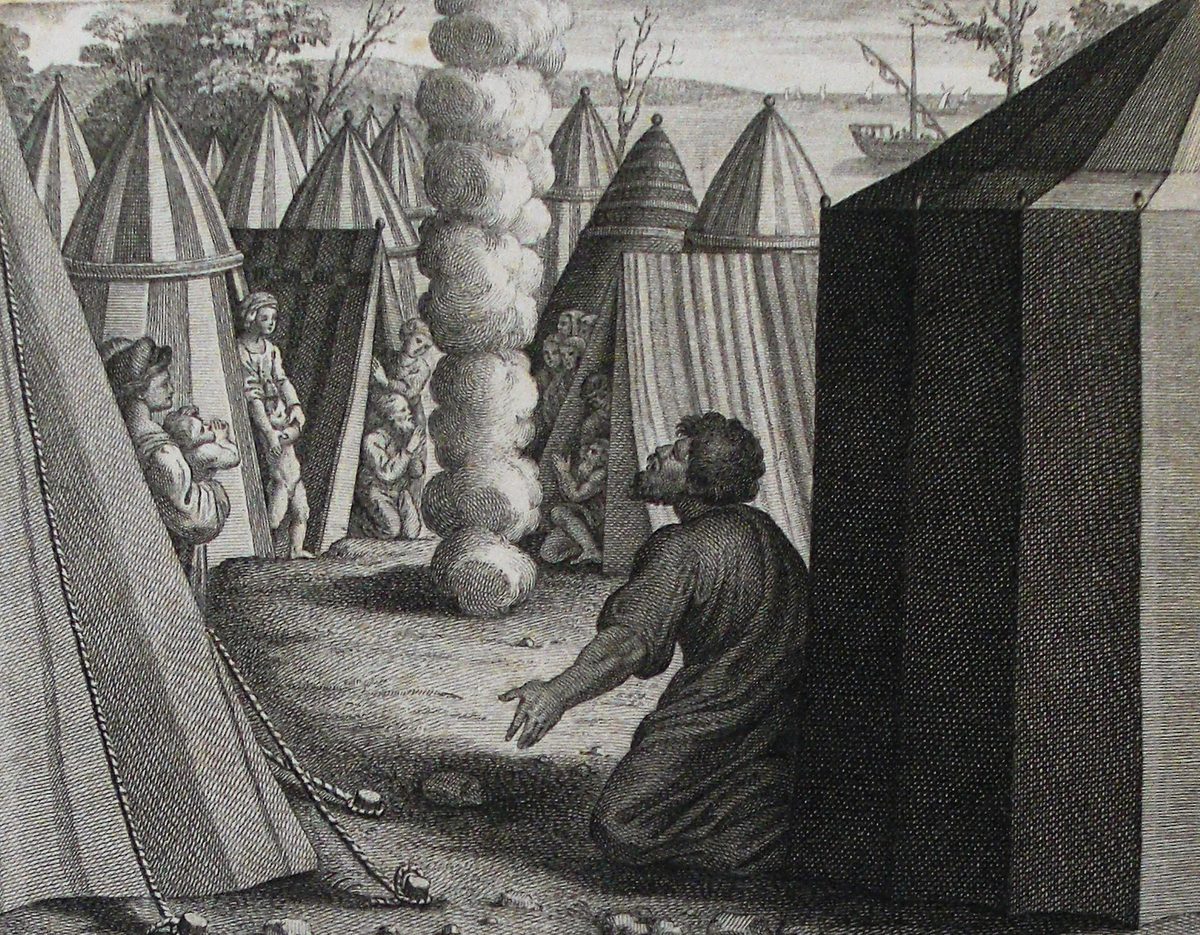
A black-and-white copperplate engraving. At the center, a tall pillar of cloud rises from the ground, rendered as a stack of rounded, billowing puffs. To its right, a bearded man in a loose robe kneels on the ground just outside a large dark tent, one hand reaching toward the cloud. Behind the cloud, a row of conical tents fills the middle distance, and at nearly every tent door a small figure stands or kneels, several with hands raised, watching the pillar. Trees, low hills, and a small sailing boat on a distant river fill the background.
God Talks with Moses (after Raphael)
After Raphael, engraved for an 18th-century illustrated Bible, c. 1700s · The Phillip Medhurst Collection, St. George's Court, Kidderminster, England

⚠ The engraver stages verses 8–10 all at once, in one frame: Moses kneeling at the tent door as the pillar of cloud descends (v9), and, behind him, the whole camp doing exactly what the text says — ‘all the people rose up, and stood, every man at his tent door’ (v8), then ‘rose up and worshipped, every man at his tent door’ (v10) — a field of small figures each framed in their own doorway, watching from a distance the conversation only Moses is allowed to have up close.

Titled ‘after Raphael’ by the collection that preserved it — an old engraver's acknowledgment that the composition borrows its figures from a Raphael original, the common practice behind many 18th-century Bible plates.

CC BY-SA 3.0 (The Phillip Medhurst Collection) · View the original
1
וַיְדַבֵּר יְהוָה אֶל-מֹשֶׁה, לֵךְ עֲלֵה מִזֶּה--אַתָּה וְהָעָם, אֲשֶׁר הֶעֱלִיתָ מֵאֶרֶץ מִצְרָיִם: אֶל-הָאָרֶץ, אֲשֶׁר נִשְׁבַּעְתִּי לְאַבְרָהָם לְיִצְחָק וּלְיַעֲקֹב לֵאמֹר, לְזַרְעֲךָ, אֶתְּנֶנָּה.
And Jehovah said to Moses: Go, get yourself up from here, you and the people whom you brought up out of the land of Egypt, to the land that I swore to Abraham, to Isaac, and to Jacob, saying, To your descendants I will give it —note
Y Jehová dijo a Moisés: Ve, sube de aquí, tú y el pueblo que sacaste de la tierra de Egipto, a la tierra que juré a Abraham, a Isaac y a Jacob, diciendo: A tu descendencia la daré —
2
וְשָׁלַחְתִּי לְפָנֶיךָ, מַלְאָךְ; וְגֵרַשְׁתִּי, אֶת-הַכְּנַעֲנִי הָאֱמֹרִי, וְהַחִתִּי וְהַפְּרִזִּי, הַחִוִּי וְהַיְבוּסִי.
and I will send an angel before you, and I will drive out the Canaanite, the Amorite, and the Hittite, and the Perizzite, the Hivite, and the Jebusite —note
y enviaré un ángel delante de ti, y expulsaré al cananeo, al amorreo, al heteo, al ferezeo, al heveo y al jebuseo —
3
אֶל-אֶרֶץ זָבַת חָלָב, וּדְבָשׁ: כִּי לֹא אֶעֱלֶה בְּקִרְבְּךָ, כִּי עַם-קְשֵׁה-עֹרֶף אַתָּה--פֶּן-אֲכֶלְךָ, בַּדָּרֶךְ.
to a land flowing with milk and honey. For I will not go up in your midst, for you are a stiffnecked people, lest I consume you on the way.note
a una tierra que fluye leche y miel. Porque no subiré en medio de ti, pues eres un pueblo de dura cerviz, no sea que te consuma en el camino.
4
וַיִּשְׁמַע הָעָם, אֶת-הַדָּבָר הָרָע הַזֶּה--וַיִּתְאַבָּלוּ; וְלֹא-שָׁתוּ אִישׁ עֶדְיוֹ, עָלָיו.
And when the people heard this evil word, they mourned, and no man put on his ornaments.note
Y cuando el pueblo oyó esta mala palabra, se enlutaron, y ninguno se puso sus adornos.
5
וַיֹּאמֶר יְהוָה אֶל-מֹשֶׁה, אֱמֹר אֶל-בְּנֵי-יִשְׂרָאֵל אַתֶּם עַם-קְשֵׁה-עֹרֶף--רֶגַע אֶחָד אֶעֱלֶה בְקִרְבְּךָ, וְכִלִּיתִיךָ; וְעַתָּה, הוֹרֵד עֶדְיְךָ מֵעָלֶיךָ, וְאֵדְעָה, מָה אֶעֱשֶׂה-לָּךְ.
And Jehovah said to Moses: Say to the children of Israel, You are a stiffnecked people. If I should go up in your midst for a single moment, I would consume you. Now therefore, take off your ornaments from you, that I may know what to do with you.note
Y Jehová dijo a Moisés: Di a los hijos de Israel: Sois un pueblo de dura cerviz. Si subiera en medio de ti por un solo instante, te consumiría. Ahora pues, quítate tus adornos, y sabré lo que he de hacer contigo.
6
וַיִּתְנַצְּלוּ בְנֵי-יִשְׂרָאֵל אֶת-עֶדְיָם, מֵהַר חוֹרֵב.
And the children of Israel stripped themselves of their ornaments, from Mount Horeb onward.note
Y los hijos de Israel se despojaron de sus adornos, desde el monte Horeb en adelante.
7
וּמֹשֶׁה יִקַּח אֶת-הָאֹהֶל וְנָטָה-לוֹ מִחוּץ לַמַּחֲנֶה, הַרְחֵק מִן-הַמַּחֲנֶה, וְקָרָא לוֹ, אֹהֶל מוֹעֵד; וְהָיָה, כָּל-מְבַקֵּשׁ יְהוָה, יֵצֵא אֶל-אֹהֶל מוֹעֵד, אֲשֶׁר מִחוּץ לַמַּחֲנֶה.
Now Moses would take the tent and pitch it outside the camp, far off from the camp, and he called it the tent of meeting. And everyone who sought Jehovah would go out to the tent of meeting, which was outside the camp.note
Y Moisés tomaba la tienda y la plantaba fuera del campamento, lejos del campamento, y la llamaba tienda de reunión. Y sucedía que todo el que buscaba a Jehová salía a la tienda de reunión, que estaba fuera del campamento.
cross-refs⤷ 25:9
8
וְהָיָה, כְּצֵאת מֹשֶׁה אֶל-הָאֹהֶל, יָקוּמוּ כָּל-הָעָם, וְנִצְּבוּ אִישׁ פֶּתַח אָהֳלוֹ; וְהִבִּיטוּ אַחֲרֵי מֹשֶׁה, עַד-בֹּאוֹ הָאֹהֱלָה.
And whenever Moses went out to the tent, all the people would rise up and stand, each at the door of his tent, and watch after Moses until he had gone into the tent.note
Y sucedía que, cuando Moisés salía a la tienda, todo el pueblo se levantaba, y cada uno se paraba a la puerta de su tienda, y miraba en pos de Moisés hasta que entraba en la tienda.
9
וְהָיָה, כְּבֹא מֹשֶׁה הָאֹהֱלָה, יֵרֵד עַמּוּד הֶעָנָן, וְעָמַד פֶּתַח הָאֹהֶל; וְדִבֶּר, עִם-מֹשֶׁה.
And whenever Moses entered the tent, the pillar of cloud would descend and stand at the door of the tent, and Jehovah would speak with Moses.note
Y sucedía que, cuando Moisés entraba en la tienda, la columna de nube descendía y se paraba a la puerta de la tienda, y Jehová hablaba con Moisés.
10
וְרָאָה כָל-הָעָם אֶת-עַמּוּד הֶעָנָן, עֹמֵד פֶּתַח הָאֹהֶל; וְקָם כָּל-הָעָם וְהִשְׁתַּחֲווּ, אִישׁ פֶּתַח אָהֳלוֹ.
And when all the people saw the pillar of cloud standing at the door of the tent, all the people would rise up and worship, each at the door of his tent.note
Y cuando todo el pueblo veía la columna de nube parada a la puerta de la tienda, todo el pueblo se levantaba y adoraba, cada uno a la puerta de su tienda.
11
וְדִבֶּר יְהוָה אֶל-מֹשֶׁה פָּנִים אֶל-פָּנִים, כַּאֲשֶׁר יְדַבֵּר אִישׁ אֶל-רֵעֵהוּ; וְשָׁב, אֶל-הַמַּחֲנֶה, וּמְשָׁרְתוֹ יְהוֹשֻׁעַ בִּן-נוּן נַעַר, לֹא יָמִישׁ מִתּוֹךְ הָאֹהֶל. {פ}
And Jehovah spoke to Moses face to face, as a man speaks to his friend. Then Moses would return to the camp, but his young attendant, Joshua the son of Nun, did not depart from inside the tent. {פ}note
Y Jehová hablaba a Moisés cara a cara, como habla un hombre a su amigo. Luego Moisés volvía al campamento; pero su joven ayudante, Josué hijo de Nun, no se apartaba de dentro de la tienda. {פ}
cross-refs⤷ Gen 32:30
12
וַיֹּאמֶר מֹשֶׁה אֶל-יְהוָה, רְאֵה אַתָּה אֹמֵר אֵלַי הַעַל אֶת-הָעָם הַזֶּה, וְאַתָּה לֹא הוֹדַעְתַּנִי, אֵת אֲשֶׁר-תִּשְׁלַח עִמִּי; וְאַתָּה אָמַרְתָּ יְדַעְתִּיךָ בְשֵׁם, וְגַם-מָצָאתָ חֵן בְּעֵינָי.
And Moses said to Jehovah: See, you say to me, Bring up this people — but you have not let me know whom you will send with me. Yet you have said, I know you by name, and you have also found favor in my sight.note
Y Moisés dijo a Jehová: Mira, tú me dices: Haz subir a este pueblo —pero no me has hecho saber a quién enviarás conmigo. Sin embargo, tú has dicho: Te conozco por nombre, y también has hallado favor ante mis ojos.
cross-refs⤷ Gen 6:8
13
וְעַתָּה אִם-נָא מָצָאתִי חֵן בְּעֵינֶיךָ, הוֹדִעֵנִי נָא אֶת-דְּרָכֶךָ, וְאֵדָעֲךָ, לְמַעַן אֶמְצָא-חֵן בְּעֵינֶיךָ; וּרְאֵה, כִּי עַמְּךָ הַגּוֹי הַזֶּה.
Now therefore, I pray, if I have found favor in your sight, show me now your ways, that I may know you, so that I may find favor in your sight. And consider that this nation is your people.note
Ahora pues, te ruego, si he hallado favor ante tus ojos, muéstrame ahora tus caminos, para que te conozca, a fin de hallar favor ante tus ojos. Y considera que esta nación es tu pueblo.
14
וַיֹּאמַר: פָּנַי יֵלֵכוּ, וַהֲנִחֹתִי לָךְ.
And he said: My presence will go with you, and I will give you rest.note
Y él dijo: Mi presencia irá contigo, y te daré descanso.
15
וַיֹּאמֶר, אֵלָיו: אִם-אֵין פָּנֶיךָ הֹלְכִים, אַל-תַּעֲלֵנוּ מִזֶּה.
And he said to him: If your presence does not go, do not carry us up from here.note
Y él le dijo: Si tu presencia no va, no nos hagas subir de aquí.
16
וּבַמֶּה יִוָּדַע אֵפוֹא, כִּי-מָצָאתִי חֵן בְּעֵינֶיךָ אֲנִי וְעַמֶּךָ--הֲלוֹא, בְּלֶכְתְּךָ עִמָּנוּ; וְנִפְלִינוּ, אֲנִי וְעַמְּךָ, מִכָּל-הָעָם, אֲשֶׁר עַל-פְּנֵי הָאֲדָמָה. {פ}
For how then shall it be known that I have found favor in your sight, I and your people? Is it not by your going with us, so that we are distinguished, I and your people, from all the people who are on the face of the earth? {פ}note
¿Pues cómo se sabrá entonces que he hallado favor ante tus ojos, yo y tu pueblo? ¿No es acaso en que tú vayas con nosotros, de modo que seamos distinguidos, yo y tu pueblo, de todos los pueblos que están sobre la faz de la tierra? {פ}
17
וַיֹּאמֶר יְהוָה אֶל-מֹשֶׁה, גַּם אֶת-הַדָּבָר הַזֶּה אֲשֶׁר דִּבַּרְתָּ אֶעֱשֶׂה: כִּי-מָצָאתָ חֵן בְּעֵינַי, וָאֵדָעֲךָ בְּשֵׁם.
And Jehovah said to Moses: This thing also that you have spoken I will do, for you have found favor in my sight, and I know you by name.note
Y Jehová dijo a Moisés: También haré esto que has dicho, porque has hallado favor ante mis ojos, y te conozco por nombre.
cross-refs⤷ 32:14
18
וַיֹּאמַר: הַרְאֵנִי נָא, אֶת-כְּבֹדֶךָ.
And he said: Show me, I pray, your glory.note
Y él dijo: Muéstrame, te ruego, tu gloria.
19
וַיֹּאמֶר, אֲנִי אַעֲבִיר כָּל-טוּבִי עַל-פָּנֶיךָ, וְקָרָאתִי בְשֵׁם יְהוָה, לְפָנֶיךָ; וְחַנֹּתִי אֶת-אֲשֶׁר אָחֹן, וְרִחַמְתִּי אֶת-אֲשֶׁר אֲרַחֵם.
And he said: I will make all my goodness pass before you, and I will proclaim the name Jehovah before you. And I will show favor to whom I will show favor, and I will show mercy on whom I will show mercy.note
Y él dijo: Yo haré pasar toda mi bondad delante de ti, y proclamaré el nombre Jehová delante de ti. Y tendré favor de quien tenga favor, y tendré misericordia de quien tenga misericordia.
cross-refs⤷ 34:6
20
וַיֹּאמֶר, לֹא תוּכַל לִרְאֹת אֶת-פָּנָי: כִּי לֹא-יִרְאַנִי הָאָדָם, וָחָי.
And he said: You cannot see my face, for man shall not see me and live.note
Y él dijo: No podrás ver mi rostro, porque el hombre no puede verme y vivir.
21
וַיֹּאמֶר יְהוָה, הִנֵּה מָקוֹם אִתִּי; וְנִצַּבְתָּ, עַל-הַצּוּר.
And Jehovah said: Behold, there is a place by me, and you shall stand on the rock.note
Y Jehová dijo: He aquí un lugar junto a mí, y te pondrás sobre la peña.
22
וְהָיָה בַּעֲבֹר כְּבֹדִי, וְשַׂמְתִּיךָ בְּנִקְרַת הַצּוּר; וְשַׂכֹּתִי כַפִּי עָלֶיךָ, עַד-עָבְרִי.
And it will come to pass, while my glory passes by, that I will put you in a cleft of the rock, and I will cover you with my hand until I have passed by.note
Y sucederá que, mientras pase mi gloria, te pondré en una hendidura de la peña, y te cubriré con mi mano hasta que haya pasado.
23
וַהֲסִרֹתִי, אֶת-כַּפִּי, וְרָאִיתָ, אֶת-אֲחֹרָי; וּפָנַי, לֹא יֵרָאוּ. {פ}
And I will take away my hand, and you shall see my back, but my face shall not be seen. {פ}note
Y apartaré mi mano, y verás mis espaldas; pero mi rostro no será visto. {פ}

The one thing God refuses to promise, twice in six verses

Jehovah repeats every earlier promise almost word for word — the land, the oath to the patriarchs, an angel to clear the way — and then withholds the one thing that would have made all of it bearable: himself. ‘I will not go up in your midst’ (v3) is not a small qualification. An angel can guide; only Jehovah’s own presence, camped at the center rather than sent ahead, was ever the point of the exodus (compare Exodus 29:45, already on these pages — ‘I will dwell among the children of Israel’). This chapter opens by taking that dwelling back.

Stiffnecked’ (vv3, 5) is the same word Jehovah first used of Israel three verses into the previous chapter (Exodus 32:9, already on these pages) — and here he uses it TWICE MORE, once to himself (v3) and once straight to Moses’ face, to be repeated to the people (v5). The repetition is the point: this is not a single outburst but a settled diagnosis, restated as the reason distance is now required rather than nearness. KJV, NIV, and ESV all keep the compound image, ‘stiff-necked’; NASB alone abandons the ox-and-yoke picture for the abstract ‘obstinate’ — the one point on the whole shelf where this word loses its body.

The people’s response is instant and physical: they mourn, and ‘no man put on his ornaments’ (v4) — then, at God’s own command, they strip what ornaments they had left, ‘from Mount Horeb onward’ (v6), a phrase that reads less like a single afternoon and more like a lasting state. Whatever jewelry survived the golden calf’s furnace, none of it is worn again for the rest of the journey this verse describes.

Two tents named ‘the tent of meeting,’ and a conversation like no other in the Torah

Moses personally pitches a plain tent ‘outside the camp, far off from the camp’ (v7) and calls it ‘the tent of meeting’ — the identical name Jehovah has already given, seven chapters earlier, to the tabernacle’s own inner sanctuary, still unbuilt (Exodus 25:9, already on these pages, and repeated through chapters 26–31). These are two different structures sharing one name: the tabernacle’s tent of meeting will stand at the CENTER of the camp, God dwelling among the people; this one stands FAR OUTSIDE it, because the very question this chapter is arguing — whether God will dwell among them at all — has not yet been settled. The name is claimed before the promise is; the building waits for the argument to be won. ⚠ The verb itself is disputed: KJV and NKJV read a plain simple past, ‘Moses TOOK the tent’, a single occasion; ASV, NIV, NASB, and ESV all read the Hebrew imperfect as habitual, ‘Moses USED TO TAKE the tent’ — a standing practice, not a single afternoon. This translation follows the habitual reading; it is what makes the tent a provisional ARRANGEMENT rather than a one-time gesture.

‘And Jehovah would speak with Moses’ (v9) — but the Hebrew verb has no stated subject; its nearest grammatical antecedent is ‘the pillar of cloud’ itself, which ‘stood at the door of the tent’ one clause earlier. Older English translations mark the ambiguity with a bracket, ‘[the LORD] spoke.’ The cloud is never confused with God in this book, but it is consistently the visible SEAT of his voice — the same pattern as the burning bush (Exodus 3:2, already on these pages) and the cloud on Sinai’s summit (Exodus 24:16, already on these pages): a medium the text lets stand in, grammatically, for the one who actually speaks.

‘Jehovah spoke to Moses face to face, as a man speaks to his friend’ (v11) is the boldest claim about access to God anywhere in the Torah, and this book will spend its next twelve verses testing exactly how far that claim can be pressed. See the dictionary entry for the word this idiom shares with Jacob’s own wrestling match, and for the very different job the same Hebrew noun does later in this same chapter.

Joshua, ‘a young man,’ stays behind in the empty tent when Moses returns to camp (v11) — the same Joshua already named at Israel’s first battle (Exodus 17:9, already on these pages). A minor detail, but a consistent one: long before he leads anyone, he is the one who does not leave.

The word that crosses back and forth five times, and the third round of a saved people

‘Favor’ (chen) passes between Moses and God five separate times in six verses — God to Moses (v12), Moses to God twice (v13), Moses to God again (v16), God back to Moses (v17) — a volley that closes exactly where it opened. Moses does not simply ask for something; he takes the very word God used of him and hands it straight back, turning God’s own compliment into the argument’s own currency. Compare this dictionary’s note at the word’s first appearance, ‘Noah found favor in the eyes of Jehovah’ (Genesis 6:8, already on these pages) — there it is stated once, from one side; here it becomes a negotiation.

‘My presence will go with you’ (v14, panai) is literally ‘my FACES will go’ — the same word just used for the face-to-face conversation two verses earlier (v11), now doing an entirely different job. Moses immediately seizes on it and throws it back almost verbatim — ‘if YOUR presence does not go, do not carry us up from here’ (v15) — refusing to accept an angel as a substitute for the very thing just promised. See the dictionary entry for the word’s third and final job in this same chapter, six verses on.

This is the third time in two chapters that Moses argues Jehovah out of a stated intention, and the decisive one. The first time, he argued God back from destroying the people outright (Exodus 32:14, already on these pages). Here he argues God back from the narrower, quieter threat that opened THIS chapter — an angel instead of God’s own presence (v3) — and wins outright: ‘This thing also that you have spoken I will do’ (v17). The chapter’s opening problem is solved before its second half even begins.

Show me your glory — the request no one before Moses has made, and the answer that reshapes the question

‘Show me, I pray, your glory’ (v18) is a new kind of request — not for guidance, not for presence, but to see. No one earlier in this book has asked to look directly at God; even Moses, at his own call, ‘hid his face, for he was afraid to look at God’ (Exodus 3:6, already on these pages). Decades later, the same man who once turned his own face away now asks to see God’s. See the dictionary entry for glory and what it names elsewhere in the Bible when it becomes visible.

God’s answer redirects the request rather than refusing it outright: what will pass by is ‘all my goodness,’ and what will be proclaimed is a name — character, not appearance. ‘I will be gracious to whom I will be gracious, and I will show mercy on whom I will show mercy’ (v19) becomes, centuries later, Paul’s own proof-text for God’s freedom in choosing whom to save, quoted almost word for word (Romans 9:15, not yet on these pages). ⚠ The first verb is built on the same root as CHEN, the very word that just crossed five times between Moses and God (vv12–17) — KJV, NASB, ESV, and NKJV all keep ‘gracious,’ preserving that connection; NIV renders it ‘merciful’ instead, which reads smoothly on its own but severs the very word-link this scene has just spent six verses building. The line answers a question about sovereignty here before it is ever asked that way there.

‘You cannot see my face, for man shall not see me and live’ (v20) closes the arc this chapter opened at verse 11 — the identical Hebrew word for ‘face’ that meant an intimate CONVERSATION nine verses earlier, and meant God’s traveling PRESENCE six verses after that, now names the one thing that is flatly, physically impossible. The chapter ends on the same word it began with, each time asking something different of it.

The staging that follows is the most physical language used of God anywhere in this book — a rock, a cleft, a hand covering Moses until the glory has passed, and only the back left to see (vv21–23). The text does not pretend God has a literal body; it borrows the language of one anyway, because there is no other vocabulary available for what almost happens here.

Notes on this translation

Decisions.Stiffnecked’ kept as one word for qesheh-oref (vv3, 5), matching this translation’s own earlier choice at Exodus 32:9. ‘Favor’ kept for chen (vv12, 13 twice, 16, 17) rather than ‘grace,’ matching this translation’s own earlier choice at Genesis 6:8 — see the note above for the word’s five-fold volley across this chapter. ‘Presence’ chosen for panai/paneka (vv14, 15) over a literal ‘my face(s),’ the standard idiomatic sense when the word describes something going somewhere rather than being seen — but the literal sense returns by design at vv20 and 23; see the new dictionary entry for the word’s full arc across this chapter. The chapter’s two paragraph breaks ({פ} at v11, {פ} at v16) mark the seam between the conversation at the tent and Moses’ formal plea; a third ({פ}) closes the chapter at v23. Verse numbering follows the Hebrew exactly; Hebrew and English Exodus 33 both run 1–23.

A note on order: Exodus stands on these pages at chapters 1–40 — the golden calf and its aftermath now followed by the argument that undoes the worst of it: Moses winning back God’s own presence, then asking to see it directly. Exodus 34, the covenant remade and Moses’ own face left shining, and Exodus 35, the people’s own gifts for the tabernacle at last brought forward, and Exodus 36, the craftsmen at work and the people’s giving finally restrained, and Exodus 37, the ark and the table and the lampstand actually built, and Exodus 38, the bronze altar and the courtyard built at last, and Exodus 39, the priestly garments finally sewn, are now on these pages too. Exodus 40 — the tabernacle raised and the glory of Jehovah filling it, the book’s own last chapter — is now on these pages too. Exodus stands complete here, all forty chapters; the story continues in Leviticus, already begun on these pages.