CreationBefore the FloodThe FloodAfter the FloodThe PatriarchsEgypt and the ExodusThe KingdomThe ExileThe ReturnBetween the TestamentsThe GospelsThe Apostolic Age
🕰
Coming home, Jacob is met by angels at Mahanaim, sends a lavish gift ahead to the brother he fears, prays his first prayer, and wrestles a man at the Jabbok until dawn — crippled, blessed, and renamed Israel.
AM ≈ 2205 · c. 1739 BC — days after leaving Laban, on the threshold of Canaan, Jacob about 97. Terrified that Esau is coming with four hundred men, he divides his camp, prays, and sends waves of livestock as a gift; then, alone by night at the ford of the Jabbok, he is renamed Israel by the wrestler and limps away at sunrise to meet his brother. The turning point of his life and the moment the nation gets its name.
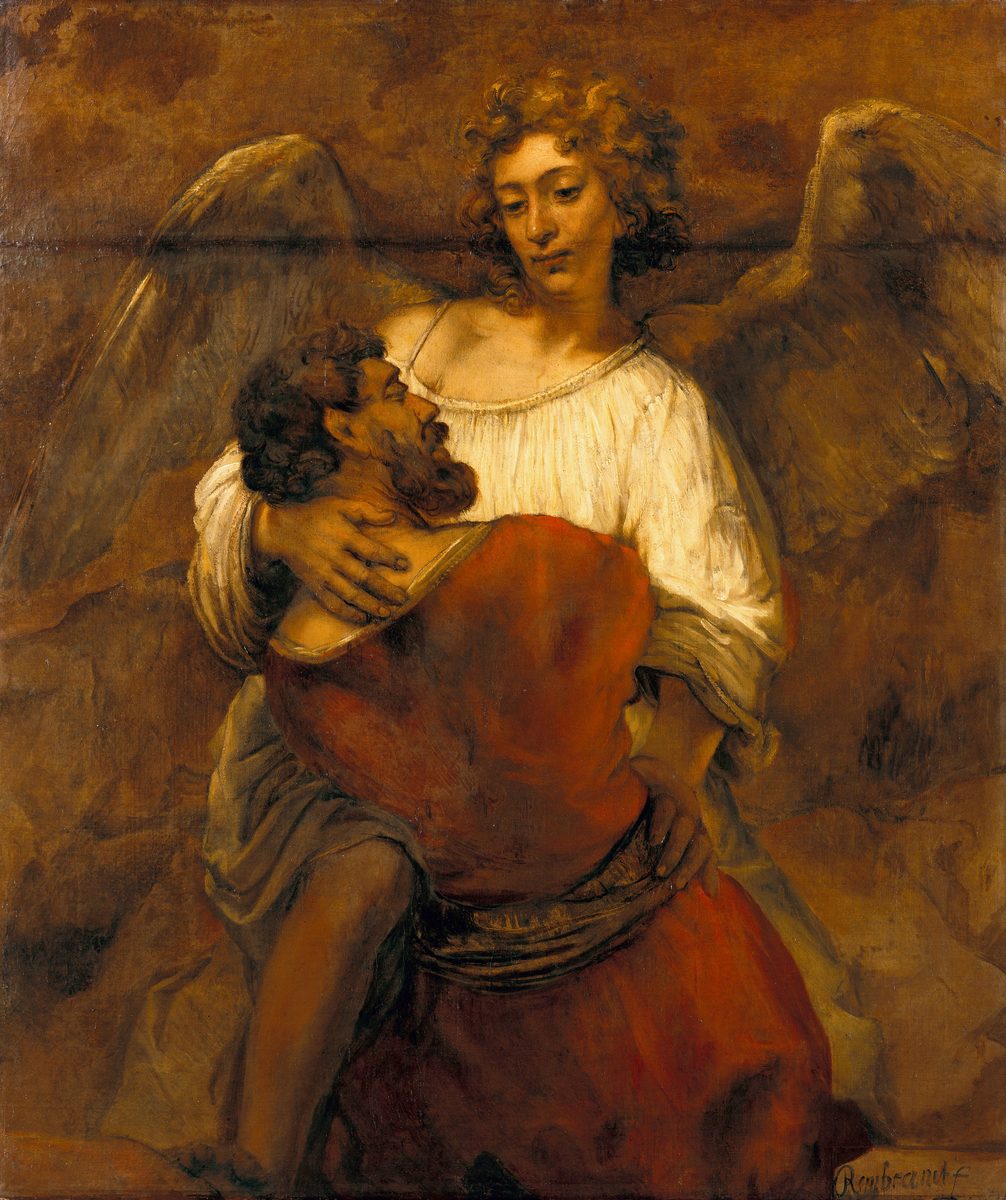
Rembrandt van Rijn, c. 1659 · Gemäldegalerie, Berlin
Rembrandt paints the strangest thing about the passage: it barely looks like a fight. The angel’s hold is almost an embrace, his face is calm and sorrowful, and the effort is all in Jacob’s shoulders and jaw. ⚠ The hand near Jacob’s hip is where the hollow of the thigh is touched — the injury he limps away with, and the reason the text refuses to say who won.
and I have acquired oxen and donkeys, flocks and menservants and maidservants; and I have sent to tell my lord, that I may find favor in your eyes.'"note
And Jacob said, "O God of my father Abraham and God of my father Isaac, O Jehovah who said to me, 'Return to your land and to your kindred, and I will do you good' —note
I am too small for all the kindness and all the faithfulness that you have shown your servant; for with my staff I crossed this Jordan, and now I have become two camps.note
Deliver me, I pray, from the hand of my brother, from the hand of Esau; for I am afraid of him, lest he come and strike me down, mother with children.note
And he put them in the hand of his servants, each drove by itself, and said to his servants, "Pass on ahead of me, and put a space between drove and drove."note
And he commanded the first, "When Esau my brother meets you and asks you, 'Whose are you, and where are you going, and whose are these ahead of you?'—note
and you shall say, 'Behold, your servant Jacob is also behind us.'" For he said, "I will appease his face with the present that goes ahead of me, and afterward I will see his face; perhaps he will lift up my face."note
And when he saw that he could not prevail against him, he touched the socket of his thigh, and the socket of Jacob's thigh was wrenched as he wrestled with him.note
Therefore the children of Israel do not eat the sinew of the thigh that is on the socket of the hip, to this day; because he touched the socket of Jacob's thigh, at the sinew of the thigh.note
Translator's Notes — verse by verse
Jacob comes home to face the brother he cheated — and first meets God
in the dark, and is renamed. Quotations from copyrighted versions (NIV, TLB, NWT) are kept to short phrases for
comparison; KJV, Geneva, Douay-Rheims and ASV are public domain.
Verses 1–3 · Mahanaim — the angels who bracket the exile
A note on the numbering. This translation follows the HEBREW (Masoretic) verse-division,
and here it parts from the common English one by a single verse. In the Hebrew, chapter 32 opens with
Laban's farewell (verse 1) — most English Bibles print that verse as
the last of chapter 31 (31:55) and begin chapter 32 with Jacob on the road. So through this chapter the
Hebrew verse numbers run one ahead of the familiar English: our 32:2 is the English 32:1,
and our 32:33 (the sinew of the thigh) is the English 32:32. Nothing is added or dropped — only the chapter
line falls in a slightly different place, and this edition keeps it where the Hebrew scroll puts it.
Angels going, angels coming. Laban rides off, and Jacob
"went on his way, and the angels of God met him." Twenty years earlier, fleeing this same
road in the other direction, he had seen angels on a stairway at Bethel
(28:12); now, coming home, angels meet him again — the messengers of God bracket his whole exile, at the
border going out and at the border coming back. He names the place Mahanaim, "two camps"
(God's camp and his own) — a word that will echo in a moment when, terrified, he splits his own
company into two camps.
Verses 4–9 · "your servant Jacob" to "my lord Esau"
The supplanter, bowing. The blessing Jacob stole had made him lord: "be
lord over your brothers, and let your mother's sons bow down to you"
(27:29). Now, dreading the reckoning, he inverts it in every line of his message — "your servant
Jacob… my lord Esau" — the thief of the birthright approaching the wronged brother with his
face in the dust. And the word comes back like a blow: Esau is already
on the road to meet him, "and four hundred men with him." Jacob, "greatly afraid and
distressed," does the only thing his old self knows — he calculates, dividing everyone into two camps so
that if one is slaughtered the other might escape. His hands are still scheming; but that night, for the
first time, his voice will turn to prayer.
Verses 10–13 · קָטֹנְתִּיqatonti — "I am too small"
Jacob's first prayer. In all his life so far the schemer has never once been shown
praying; here, cornered, he does — and it is a model of a prayer, laying hold of God's own words. He calls
on "the God of my father Abraham and… Isaac, O Jehovah who said to me, 'Return… and I will do you
good'" (v. 10) — reminding God of the very promise that sent him home. Then the line that turns the whole
Jacob story on its hinge: qatonti, "I am too small" (v. 11;
KJV "I am not worthy") — the man who has spent a lifetime grasping to be
great, who has just become "two camps" of wealth, confesses he is small before "all the
kindness and all the faithfulness" (chesed ve-emet) God has
shown him. "With my staff I crossed this Jordan, and now I have become two camps": he
remembers going out with nothing but a walking-stick. And he closes by holding God to his oath — "you said…
I will make your seed as the sand of the sea" — the promise of the
binding of Isaac (22:17). You cannot be killed tonight, Lord, if your
own word is to stand.
Verses 14–22 · פָּנִיםpanim — a face to be covered, lifted, and seen
The gift, and the drumbeat of "face." Alongside the prayer, Jacob keeps working the
problem the only other way he knows — with a lavish, staggered present (minchah):
550 animals sent ahead in wave after wave, each drove announced as "your servant Jacob's," so that Esau's
anger is worn down by generosity before the brothers ever meet. And listen to the word that pulses through
his plan — panim, "face": "I will cover his face
(akhappera panav — the same verb, kaphar, that will mean 'make
atonement') with the present that goes before my face… afterward I will see his
face; perhaps he will lift up my face" (v. 21). Four faces in one verse —
and it is all building, unknown to Jacob, toward the face he will see first: not Esau's, but God's, at a
place he will call "the Face of God."
Verses 23–33 · יִשְׂרָאֵלYisrael — the night he was renamed
Left alone. Jacob sends everyone he loves across the Jabbok
— the stream whose name, Yabboq, chimes with both Ya'aqov ("Jacob") and the strange verb
of this night, vayye'aveq, "and he wrestled." "And Jacob was left alone;
and a man wrestled with him until the dawn rose." Who is the man? The text says only ish, "a man";
Jacob will say he saw Elohim, "God, face to face"; the prophet Hosea calls him "the angel" (Hosea
12:4). This translation lets the mystery stand, as it did at the well of Hagar
— a man who is somehow God, met in the dark.
The name that is a verdict. Jacob cannot win, but he will not let go, even when his hip
is wrenched from its socket: "I will not let you go unless you bless me" — the man who once
stole a blessing now demands one, wounded, clinging in the dark. And the blessing is a new name: "no longer
Jacob ('supplanter, heel-grabber'), but Israel — Yisrael — for
you have striven (sarita) with God and with
men, and have prevailed" (vatukhal). It is the very word Rachel had cried at
Naphtali's birth, "I have prevailed" (30:8) — but where she prevailed
over her sister by scheming, Jacob prevails over God by holding on. He asks the man's name and is
refused ("Why do you ask my name?"), and named the place Peniel, "the Face of God" — "for I
have seen God face to face, and my life was delivered" (KJV
"for I have seen God face to face, and my life is preserved"). The sun rose on him as he limped away — and
to this day the children of Israel do not eat "the sinew of the thigh" (gid ha-nasheh), remembering
the night their father was crippled and crowned at once. The supplanter has become the God-wrestler; he
goes to meet Esau at last, limping, blessed, and — for the first time — unafraid.
Patterns worth carrying forward
Where this translation keeps the words exact / distinct: the Hebrew
versification kept (our 32:1 = Laban's farewell, the English 31:55), with the offset flagged;
"I am too small" for qatonti
(KJV "I am not worthy") — the grasping man made small; the panim
("face") drumbeat kept across the gift and the wrestling (covered, lifted, seen — up to Peni-el);
"striven" for sarita in the naming of Israel;
"prevailed" for vatukhal, matched to Rachel's word; and the man/God ambiguity of
the wrestler left standing (ish / Elohim / the angel of Hosea 12).
Echoes paid. The angels of Bethel (28:12) now meet
him coming home; "be lord over your brothers" (27:29) inverted into
"your servant… my lord"; "deliver me from Esau," whose murder-grudge
(27:41) drove the flight; the "sand of the sea" seed of the Aqedah
(22:17); "I have prevailed" (30:8); and God seen "face to face," the
seeing-God Hagar first named (16:13). Echoes planted:
the name Israel, re-confirmed at Bethel (ch. 35) and worn by the nation for good; and the brothers'
meeting, one river away (ch. 33).
Next installment in this book: Genesis 33 — the brothers meet at
last; Esau runs to embrace the brother he swore to kill, and weeps on his neck, and Jacob says, "to see your
face is like seeing the face of God."