Genesis 22 — The Mister Translation
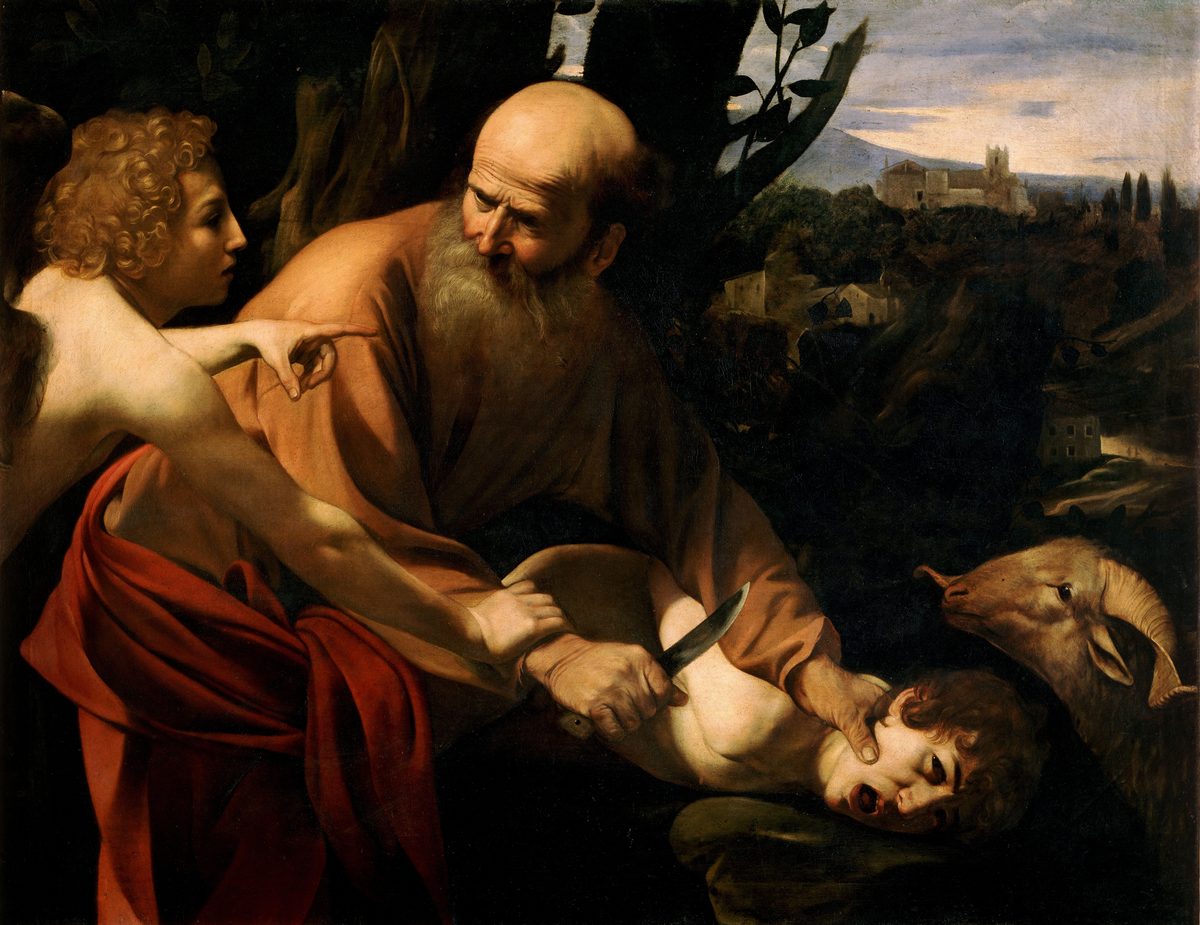
Caravaggio refuses every pious softening. Isaac is not serene — his cheek is mashed into the stone and his mouth is open; Abraham’s hand is on his son’s neck. And the angel does not appear at a distance and speak: he grabs the wrist. ⚠ The ram on the right is looking straight at the knife, which is the painting’s own quiet argument about substitution.
.jpg)
Translator's Notes — verse by verse
Each note explains this translation's choice and compares the seven versions on the shelf. Quotations from copyrighted versions (NIV, TLB, NWT) are kept to short phrases for comparison; KJV, Geneva, Douay-Rheims and ASV are public domain.
The hardest chapter in the book, and the word love enters it. Jewish tradition calls this the Aqedah, "the Binding" — named not for the near-killing but for one verb in verse 9. It opens with a warning the reader gets and Abraham does not: God tested him (nissah; KJV "did tempt," a word that has drifted — the old sense was put to the proof, not lure into evil; NIV "tested"). Then the command, built to wound one clause at a time — "your son… your only one… whom you love… Isaac." That word, ahav, is the first appearance of "love" in the whole Bible — and it enters at the exact moment love is asked to be surrendered. The Septuagint softened yechid ("only one") to agapēton, "beloved," the very word the voice at Jesus' baptism will use; the tradition heard the rhyme early.
Go, you yourself — the bookend. "And go, you yourself" — lekh-lekha: the emphatic doubled command that appears exactly twice in the Torah, and both times to Abraham — at (12:1), "go from your land," which began everything, and here, "go to the land of Moriah," which nearly ends it. The first lekh-lekha gave up his past; the second asks for his future. The rest is famous for its restraint: no inner monologue, no protest (this is the man who argued God down to ten righteous over Sodom — and here says nothing). He "rose early in the morning" (wayyashkem, the very habit banked one chapter ago at Hagar's dawn, 21:14 — now on a far darker morning), split the wood with his own hands, and walked three days into silence. And in verse 5 a sentence the reader cannot weigh: "we will worship, and we will return to you" — plural. Resolve, or faith, or a father unable to say otherwise; the Hebrew leaves it (Hebrews 11:19 read it as faith that God could raise the dead).
The son carries the wood, and the only conversation. "Abraham took the wood… and laid it on Isaac his son" — the boy carries up the hill the wood he is to die on, a detail the Christian tradition has read as figure since the church fathers; the note records the reading and lets the Hebrew stand. Between them passes the only dialogue of the chapter, and it turns on the word that has been the family's whole life: Isaac says "My father," Abraham answers "Here I am, my son" (hineni again — the second of three; the man is completely available to God, to his son, and, at the knife, to the angel). The child's question is the unbearable one: "where is the lamb?" And the answer is the chapter's theological center: "God will see to the lamb for himself" — Elohim yireh-lo, the seeing-verb that will name the mountain (v14). KJV "God will provide himself a lamb" — and "provide" is exactly right, because in English too, to provide is to see ahead (Latin pro-videre): God's provision is God's seeing. The line bookends with "and the two of them went together" (yachdav) — said in verse 6 and again in verse 8, an envelope around the ascent; when they come down, only one is named as returning (v19), and the rabbis never stopped noticing.
The binding, and the hand that stops. The whole episode is named from one word here: "he bound Isaac his son" — vayya'aqod, the verb aqad, which occurs only this once in all of scripture, and gave the scene its Hebrew title, the Aqedah. Jewish memory rests on the binding, not the near-death: an old, consenting Isaac (the midrash makes him thirty-seven) laid on the wood. The narrative slows to single motions — stretched out the hand, took the knife — and then the interruption, doubled for urgency: "Abraham, Abraham!" (as "Simon, Simon" and "Saul, Saul" will later mark a life turned mid-motion). "Now I know" (v12) states the test's whole purpose — not that God learned a fact he lacked, but that the fear of God was made visible, driven into the open where it could be seen. "You have not withheld your son" — lo chasakhta: Paul reverses this exact phrase across the canon — God "did not spare his own Son" (Romans 8:32).
The ram, and the mountain of seeing. "Abraham lifted up his eyes and looked" — the same gesture as the woman at the other well, whose "eyes God opened, and she saw" (21:19): the seeing-thread of this book keeps closing on rescue. "A ram caught in the thicket by its horns" — the substitute, offered up "in place of his son" (tachat beno): a life for a life, the logic of every altar to come. And Abraham names the place Jehovah-Yireh, "Jehovah sees / provides" (KJV "Jehovah-jireh"), sealing the pun the chapter has been building — yireh (he sees to it, v8), yera'eh (it is seen to, v14). This site has collected the seeing-God before: Hagar's El Roi, "the God who sees" (16:13); now the mountain bears the name. And there is one more thread the note owes the reader: 2 Chronicles 3:1 says Solomon built the temple "on Mount Moriah" — so the tradition set this altar exactly where the later altar would stand, and "on the mount of Jehovah it is seen to" became a saying about a specific hill in Jerusalem.
The one oath God swears by himself. "By myself I have sworn" — the only time in the Torah God binds himself with an oath, and the tradition weighed it heavily: there being no one greater to swear by, he swore by himself (Hebrews 6:13 makes the whole argument from this verse). What follows is the seventh and final restatement of the promise first spoken at 12:1-3, and now — after the knife — sealed under oath: seed like the stars of the heavens (the count Abram was shown on a night long ago, 15:5) and now also like the sand on the seashore, a second, earth-bound multitude. And the old universal note returns, its verb upgraded: not just "in you shall all families be blessed" (12:3) but "in your seed shall all the nations of the earth be blessed" — the channel named. The reason given is the chapter's last quiet echo: "because you listened to my voice" (shama beqoli) — the phrase that named a fall in the garden (3:17, "you listened to the voice of your wife"), was turned into a command one chapter ago (21:12, "listen to her voice"), and here becomes the ground of the world's blessing: an obedience that undoes a disobedience. Then the descent, and a return "to Beersheba" — exactly where chapter 21 left him, the well of the oath now holding a second, greater one.
A quiet coda that turns the whole book forward. After the mountain, an ordinary piece of family news arrives from the old country — "your brother Nahor" (left behind in Haran, 11:29) has a houseful of sons. It reads like a genealogical footnote, twelve names of Aramean clans (Uz, where Job will live; Buz; Aram, the people whose language the later scriptures will partly speak). But the list is built to deliver one name, and it lands almost in passing, in verse 23: "and Bethuel fathered Rebekah." The chapter that nearly ended the line of promise closes by naming, without fanfare, the girl who will carry it on — the wife Isaac has not yet met, two chapters early. The son was spared on the mountain; here, quietly, the narrative begins arranging for him to have a future. It is the book's characteristic move: after the unbearable, the ordinary, already turning toward tomorrow.
Patterns worth carrying forward
Where this translation sides with the literal shelf: "you have not withheld your son" (KJV) — kept, because Paul reverses this exact verb; "Jehovah-Yireh" left as the name it is (KJV "Jehovah-jireh"); "the two of them went together," the envelope kept in both verses.
Where it goes its own way: "tested" for nissah (KJV "tempt," aged out of its old proving-sense); "God will see to the lamb for himself" for yireh-lo (KJV "provide" — the note keeps both, since to provide is to see-ahead); "bound" for aqad, the hapax that titles the whole scene; "your only one" for yechid (KJV "only son"), the word the Septuagint rhymed toward "beloved."
Echoes paid and planted. Paid: lekh-lekha, "go, you yourself" — the twin command that brackets Abraham's whole story (12:1 and here); "rose early in the morning," the dawn-habit banked at (21:14); the seeing-God — Hagar's El Roi (16:13) and the eyes opened at the well (21:19), now the name of a mountain; the stars Abram counted (15:5), joined by the sand; "all the families/nations blessed" — the 12:3 promise (12:3) sealed under oath; "listened to my voice" — the garden's fatal phrase (3:17), turned to obedience; and Beersheba (21:33), the well of the oath, holding a second. Planted: Rebekah, named in the coda, waiting for chapter 24; Isaac's own unrecorded descent, which the rabbis never stopped reading; and Moriah — the mountain of seeing that 2 Chronicles will make the Temple Mount.
Next installment in this book: Genesis 23 — the death of Sarah, and the cave of Machpelah: Abraham buys a grave, and the promise of the land begins with four hundred shekels and a field.