Jeremiah 19 — The Mister Translation
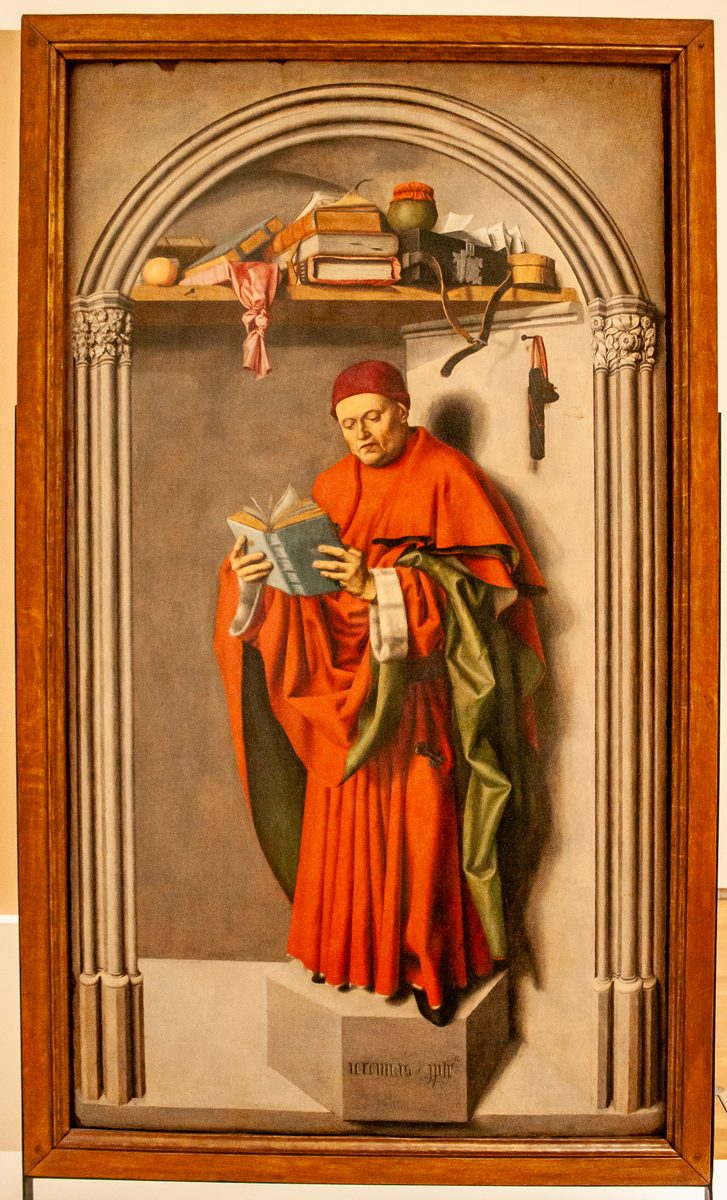
⚠ NOT this chapter's scene — placed here as an honestly-labeled placeholder, not a depiction of Jeremiah smashing the earthen flask before the elders. The painting itself is stranger than it first looks: Jeremiah is dressed not as an ancient Hebrew prophet but as a 15th-century cardinal, in the same scarlet robes a viewer of this altarpiece would have seen on a real churchman — a standard Northern Renaissance habit of painting Old Testament figures in the artist's own contemporary dress rather than attempting historical costume. The panel originally formed the REVERSE of an Annunciation altarpiece, paired there with the risen Christ — Jeremiah placed as a witness to what his own prophecies pointed toward, reading rather than pronouncing judgment. Kept here for its own quality until a real depiction of this chapter's scene turns up.

The same clay, now fired. Chapter 18 sent Jeremiah down to the potter’s house to watch wet clay reworked on the two stones — a vessel gone wrong, and thrown again. This chapter sends him back to the same trade, the same industrial quarter at the city’s edge, for the opposite lesson: not soft clay on the wheel, but a finished, FIRED flask (baqbuq) — a piece the kiln has already sealed past reworking. The window for remaking closed with chapter 18; this chapter opens the window for breaking. See the potter’s craft for the physical reason a fired pot and a fired sentence share one fate.
The word gurgles. Baqbuq is almost certainly onomatopoeic — the buq-buq a narrow-necked jug makes as it empties (see the dictionary entry). It is not incidental that the same three consonants, b-q-q, return four verses later in a very different verb — watch for it at verse 7.
Two benches of witnesses. Jeremiah is told to bring along some of the elders of the people and some of the elders of the priests — the civic bench and the cultic bench, both present at once. What follows indicts exactly those two institutions together (vv 3–5), so both are made to watch it happen.
⚠ A genuine crux, and the shelf splits on it. The gate’s Hebrew name is itself a small textual puzzle: the consonants are written one way and traditionally read another — a ketiv/qere pair — and even once read, the word is ambiguous. KJV, apparently hearing the sense “sun” in the same three letters, reads “the entry of the east gate”; Douay, translating the Vulgate, reads “the entry of the earthen gate”; ASV simply transliterates, “the gate Harsith,” declining to choose. This translation follows the modern consensus and the scene itself: the Potsherd Gate — cheres is also the ordinary word for broken pottery (see the dictionary entry) — the gate that opened onto the potters’ own rubbish. A flask of fired clay is about to be smashed at the gate named for smashed clay.
The valley, named for the first time on these pages. The valley of the son of Hinnom — gei Ven-Hinnom — runs along Jerusalem’s southern and western edge: a real place a person could walk to from the palace in a few minutes, not a myth. Its Greek name, Geenna, is the word this site has already met inside the Sermon on the Mount — “the Gehenna of fire” (Matthew 5:22) — and the fuller record of both names, the valley’s whole history from this chapter’s altars to Jesus’ own vocabulary, is gathered under Topheth.
Forsaken, and made foreign. Two verbs open the charge: they have forsaken me (azav), and va-yenakru — literally “they made this place FOREIGN”, from the same three letters, נ-כ-ר, this site has already tracked in a different stem: nakar, the recognize-verb of the Joseph story, where “haker-na, recognize please” undoes a blind father and then a grieving one. Here the root turns the other way — not failing to recognize a person, but making a PLACE unrecognizable, alien to what it was built to be. KJV and ASV both render it “estranged.”
A wordplay the Hebrew makes and the English cannot quite keep. The charge is that Judah burned its sons as olot — burnt offerings — to Baal, “which I did not command … and it did not come up (alta) upon my heart.” Olah, “burnt offering,” is built on the same root as that closing verb — alah, “to go up” (see the dictionary entry, first met at Noah’s altar). What went up in smoke to Baal never went up in God’s own mind. One root, one chapter, two directions of ascent — and only one of them ever happened.
⚠ Set against the akedah. This is the flattest denial in the book: not commanded, not spoken, never once occurring to God — a direct rebuttal of any claim that child sacrifice was ever divine instruction. It is worth holding this verse against Genesis 22:13, where Abraham “took the ram, and brought it up as a burnt offering” — olah — “in place of his son”: the identical word, olah, used the one time in the Torah a father’s hand is stopped and a substitute supplied. Baal’s worshippers bring their sons AS the offering the God of Abraham refused to accept even from Abraham.
Baal, named outright. The god goes unnamed in the potter’s-house chapter (18:15, “worthlessness”) — this is one of the chapters on either side that supplies the name (see the encyclopedia entry, which flagged the gap). ⚠ One tension worth stating plainly: the Torah’s own legislation against this practice names the recipient MOLECH (Leviticus 18:21; 20:2–5), and 2 Kings 23:10 records Josiah defiling this very Topheth “that no man might make his son or his daughter pass through the fire to Molech” — while Jeremiah, here and at 7:31 and 32:35, calls it worship of BAAL. Whether the prophet means the two names for one and the same rite, or “Baal” (literally “lord, owner”) stands here as a generic title Molech himself could carry, nothing in this chapter settles; the library states both names rather than quietly picking one.
The renaming. “The days are coming … when this place will no longer be called Topheth … but the valley of slaughter” is an oracle this book will not use only once. Word for word, it also stands at Jeremiah 7:31–32, a chapter not yet on these pages; when this project reaches it, watch for the very same sentence to arrive a second time — earlier in the book than its first appearance here.
The flask’s own sound, aimed at the nation. “I will EMPTY OUT (baqoti) the counsel of Judah and Jerusalem” — the very root of the flask in Jeremiah’s hand, baqbuq, which is the reduplicated form of baqaq, “to empty, lay waste.” The sign is not decoration; its own name is the verb of what is about to happen to the people it stands for.
A desolation that hisses at itself. Verse 8 pairs a noun with the verb built on it, twice over — a desolation (shammah) so that it IS desolate (yishom), a hissing (shreqah) so that it hisses (yishroq) — the sentence performing, in its own grammar, the emptiness it describes.
⚠ The worst verse in the chapter, and it is a curse the Torah already named. Parents eating the flesh of their own children under siege is not this chapter’s invention — it is the covenant’s own stated penalty for abandoning it (Leviticus 26:29; Deuteronomy 28:53–57, neither yet on these pages), and it is remembered as having actually happened: once already, at Samaria (2 Kings 6:28–29), and once still ahead of this very audience, at the fall of this city in 586 BC (Lamentations 2:20; 4:10 — watch for it when this project reaches that book). ⚠ Note the shape of the reversal: verse 5 burned sons IN OFFERING to a god; verse 9 has parents EATING sons out of hunger. One horror answers the other along the same axis — what the parents once gave their children TO, the siege will now take FROM them.
The flask breaks — the payoff of chapter 18’s own promise. “As one breaks a potter’s vessel that cannot be mended again” (v11) is not a new image; it is the old one, aged three verses of narrative time and one trip through a kiln. Wet clay reworked itself into another shape at 18:4; fired clay only ever breaks. See the potter for why the kiln, and not the sculptor’s mood, is what decided the ending.
Topheth spreads to the palace roofs. By verse 13 the contagion is no longer confined to one valley: “the houses of Jerusalem, and the houses of the KINGS of Judah” become like Topheth itself, defiled by rooftop incense burned “to all the host of heaven” — tzeva ha-shamayim, the very noun inside “Jehovah of hosts” (v3, v15). The people are shown worshipping the army while ignoring its Commander.
Private sign, public sentence. Everything so far has happened outside the walls, before a handful of elders. Now Jeremiah walks back into the city and stands in the busiest, most exposed place there is — the court of the house of Jehovah itself — and says the same thing again, to everyone. The valley’s oracle, delivered once in private with a broken pot for a visual aid, is now delivered a second time in public with nothing but his own voice. ⚠ This is the sermon that costs him the first recorded violence of his career: turn the page, and Pashhur — the priest in charge of order in that very courtyard — hears “these things” (20:1) and answers them with his fists.
A frame closes. Verse 15 all but repeats verse 3 word for word — “Thus says Jehovah of hosts, the God of Israel … Look, I am bringing …” — the same opening the chapter used to summon its first audience now closes its second. Nothing in between has changed the sentence; only the size of the room it is spoken in.
The last word, and a stiffened neck. The chapter’s final charge is that Judah “made their neck STIFF, refusing to hear” — hiqshu et-orpam, the same idiom this site will meet full-strength at the golden calf (Exodus 32:9, not yet on these pages): a people that will not turn its head to listen. It is, fittingly, the last word before the book’s own account of what not listening costs a prophet — starting with a night in the stocks.
Patterns worth carrying forward
Where this translation sides with the literal shelf: “a potter’s earthen flask” for baqbuq yotser cheres, essentially the whole shelf’s own phrase; “declares Jehovah” for ne’um Jehovah, kept identical to the last two chapters on these pages; Topheth left untranslated, as every version on the shelf leaves it.
Where it goes its own way: the Potsherd Gate for sha’ar ha-charsit (KJV “the east gate,” Douay “the earthen gate,” ASV transliterating “Harsith”) — a genuine three-way crux, resolved here toward the reading that fits the scene, with the others kept in the note at full strength; made … foreign for va-yenakru (KJV/ASV “estranged”), kept literal so the root it shares with Joseph’s “recognize” stays visible; empty out for baqoti, chosen so the echo of the flask’s own name (baqbuq) survives into English.
Echoes paid and planted. Paid: chapter 18’s own forward promise — “the same potter’s clay, now fired” — delivered in full at verse 11, and the potter entry’s account of a kiln completed; Baal named outright, closing the gap the Baal entry itself flagged after chapter 18; olah, the burnt-offering word first met at Noah’s altar, set directly against its one Torah appearance as a SUBSTITUTE — the ram “in place of his son” (Genesis 22:13). Planted: this chapter’s own renaming-oracle, waiting to be met a second time — earlier in the book — at Jeremiah 7:31–32; the siege-curse of verse 9, waiting for Lamentations; “stiff neck,” waiting for the golden calf at Exodus 32; and the sermon just preached in the temple court, waiting exactly one page for Pashhur to hear it.
⚠ One thing left standing, not resolved. Verses 4–5 accuse the nation of worshipping BAAL at this valley’s altars; the Torah’s own legislation against child sacrifice, and 2 Kings’ account of Josiah defiling this same ground, both name the recipient MOLECH. The note states the tension; it does not decide it.
Next installment in this book: Jeremiah 20 — Pashhur, the priest in charge of the temple’s order, hears this very sermon and answers it with his fists: a night in the stocks, a jailer renamed Magor-Missaviv, and the rawest of Jeremiah’s five confessions, already on these pages.