Matthew 27 — The Mister Translation
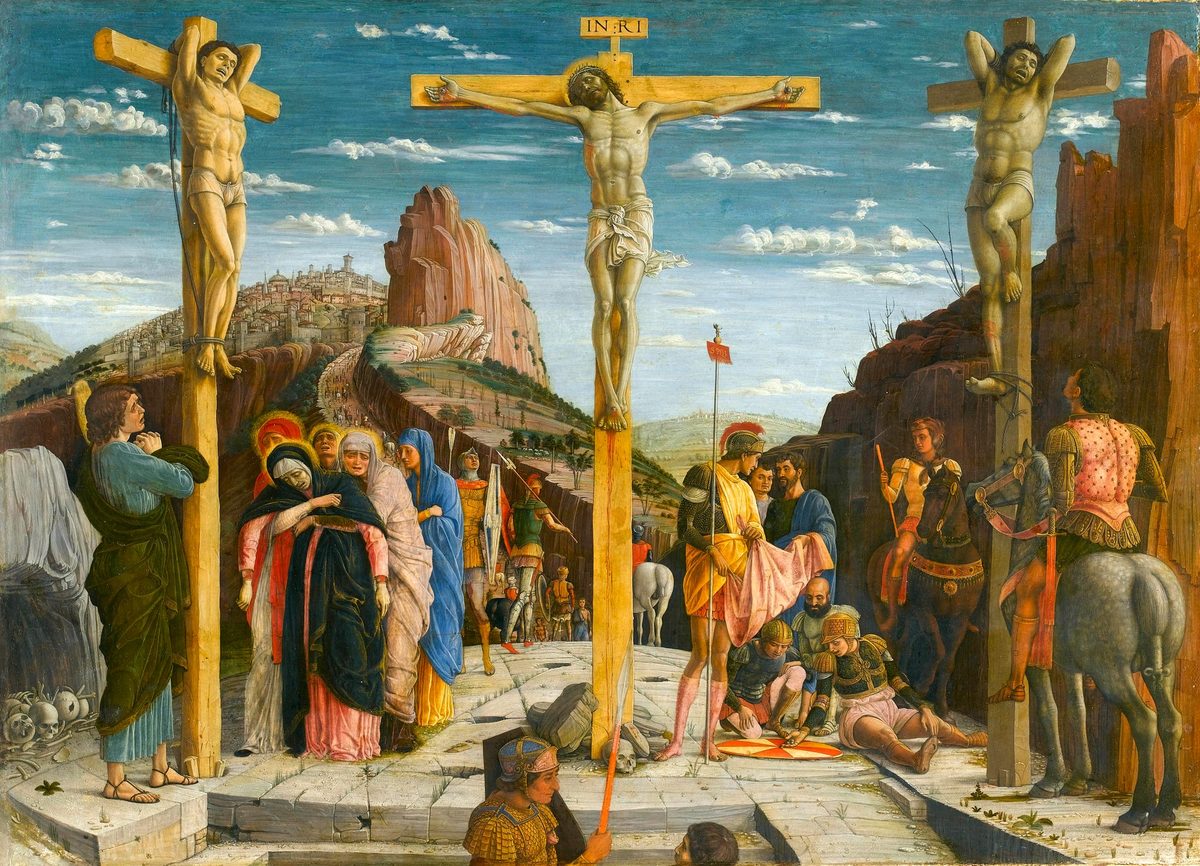
⚠ Mantegna gives the largest patch of ground in the picture to the one thing Matthew declines to comment on. The soldiers in the lower right are casting lots on an upturned shield while a fourth holds up the rose garment: that is Psalm 22:18, both halves of it, and the Gospel reports it in nine words with no announcement that anything is being fulfilled. The painter also literalizes the place-name — the skulls at the foot of the left-hand cross are the Place of a Skull, though the tradition that Adam was buried there is legend, not text. ⚠ And two details are borrowed from elsewhere: the titulus reads INRI, which abbreviates John’s wording, not the ‘This is Jesus, the king of the Jews’ that Matthew gives four verses earlier; and no Gospel says Golgotha was a hill. What is exactly Matthew’s: the two men on either side are tied rather than nailed, the women watch in a group, and there is a Roman officer on the spot.

Translator’s Notes — verse by verse
Each note explains this translation's choice and compares the seven versions on the shelf. Quotations from copyrighted versions (NIV, TLB, NWT) are kept to short phrases for comparison; KJV, Geneva, Douay-Rheims and ASV are public domain.
The verb has not changed. Paredōkan — they handed him over. It is the same word that ran through ten verses of the previous chapter, and it now passes from Judas to the council to Rome without altering: the priests hand over to Pilate, Pilate will hand over to be crucified (v26). Chapter 26’s note said the chain of this verb is the architecture; this is where it leaves Jewish hands.
“The governor.” Hēgemōn is a general word for a ruling official rather than a precise title; Pilate was praefectus of Judaea, and the Pilate Stone found at Caesarea in 1961 gives him that rank. Matthew never uses his title correctly and never needs to. ⚠ A small variant: the Byzantine text adds “Pontius,” supplying the name every creed would later supply. The critical text has only Pilate.
Judas is “filled with regret” — and it is the wrong word for repentance. Metamelētheis, not metanoeō. Chapter 21’s note flagged exactly this distinction and said it was what Judas does here: metamelomai is a change of FEELING, remorse; metanoeō, the word from John’s preaching onward (3:2), is a change of MIND that turns. Matthew chooses the softer, sorrier word, and the man it describes gives the money back and then hangs himself. KJV “repented himself” and NIV “was seized with remorse” — the NIV is closer; ASV “repented himself” keeps the reflexive that used to carry the difference in English and no longer does.
⚠ “You will see to it” — said twice, by both sides. Sy opsē, the priests to Judas (v4); hymeis opsesthe, Pilate to the priests, twenty verses later (v24). Same verb, same brush-off, in both directions: the priests refuse Judas’s blood-money problem and Pilate refuses theirs. This translation prints the phrase identically in both places so the symmetry is visible; no version on the shelf does, because each renders it idiomatically where it stands.
The treasury he cannot use, and the field he buys instead. Korbanas is the temple treasury — a Greek form of Hebrew qorban, an offering, the same root behind the “korban” dodge at 15:5. The priests are scrupulous about the ledger and not about the death: they cannot bank the coins, so they buy real estate.
⚠ And now the hardest problem in the chapter: Matthew says JEREMIAH, and the words are mostly Zechariah’s. The quotation at vv9-10 — thirty pieces of silver, a price, a potter — corresponds to Zechariah 11:12-13, not to anything in the book of Jeremiah. This is a real difficulty, it has been noticed since antiquity, and the library is not going to patch it. What can be said is what is checkable:
⚠ The Hebrew of Zechariah 11:13 says POTTER, and most English Bibles say TREASURY. The word is ha-yotser, the potter; the reading “treasury” comes from ha-otsar, and the versions that print it are following the Syriac and an old emendation rather than the Hebrew in front of them. Which means Matthew’s narrative touches BOTH readings at once: the priests refuse to put the coins in the treasury (v6) and spend them on the potter’s field (v7). Whatever else is going on, he is not working from a hazy memory of the passage.
⚠ And the SCENE is Jeremiah’s, even though the WORDS are not. Jeremiah is the prophet of the potter: sent to the potter’s house to watch a spoiled vessel re-thrown (18:3-4), and sent to smash a potter’s jar in the valley of the son of Hinnom with the oracle that “they shall bury in Topheth, for want of room to bury” and that the place will be renamed the valley of slaughter (19:11, 19:6). He is also the prophet who buys a field and weighs out the silver for it before witnesses (Jeremiah 32:9-10, not yet on these pages). A potter, a purchased field, weighed silver, a burial ground, and a place that gets a new and terrible name — every element of Matthew 27:3-10 is in Jeremiah except the sentence he quotes. The old suggestions follow from that: that Matthew cites a composite by the name of the more prominent prophet, a practice with parallels; that he is naming the scroll-collection rather than the book; or that a copyist’s slip stands at the head of the citation. Some manuscripts simply read “the prophet” with no name, and a few read Zechariah — which is what correction looks like. The library sets the options out and does not choose. KJV, ASV, NIV and NWT all print “Jeremiah” and leave the reader to find out on their own; the honest thing is to print it and say so.
“You say so.” Sy legeis — a near-twin of the sy eipas, “you said it,” given to Judas and to the high priest in the previous chapter (26:25, 26:64), and it does the same work: it concedes the questioner’s sentence without adopting it. Three interrogators, three non-answers built out of the pronoun you. This translation keeps them distinct in English — “you said it” and “you say so” — because the Greek verbs are distinct.
⚠ The silence chapter 12 predicted, and it is a citation coming due. “He did not answer him a single word” — oude hen rhēma. Chapter 12’s note quoted Isaiah 42’s servant who “will not quarrel nor cry out” and said that this was not merely a prediction of temperament but of this specific scene, naming this verse. It has arrived. What Matthew records is not stoicism: Pilate marvelled (thaumazein), which is the word this Gospel uses of crowds watching a miracle.
⚠ The prisoner may have had the same first name, and it is a serious reading. The text printed here reads “Jesus Barabbas” at v16 and, at v17, has Pilate offer the crowd a choice between “Jesus Barabbas” and “Jesus who is called Messiah.” The Nestle-Aland text prints the name; Westcott-Hort, Tregelles and the Byzantine tradition omit it, and so does every version on the shelf (KJV, ASV, NIV, NWT — NIV footnotes it). ⚠ The argument for the longer reading is about motive, which is the only argument that ever settles this kind of question: a scribe copying out the name of a murderer would have every reason to drop a name he revered, and none to add it. Origen, in the third century, says outright that he found the name in manuscripts and that it ought not to be there, on the ground that no sinner is called Jesus — which is a witness both to the reading’s antiquity and to the exact pressure that would remove it. The name is common: it is Joshua. This translation prints it, because a choice between two men named Jesus is what the earliest recoverable text puts in Pilate’s mouth, and because the alternative asks the reader to accept a deletion with an obvious cause.
And the surname is a sentence. Bar-abba is Aramaic for son of the father. Matthew does not translate it and does not comment, having translated Emmanuel and Golgotha when he wanted the reader to hear them. The library notes the meaning and leaves the irony to whoever wants it.
The one person who intervenes for him is a Gentile woman having a dream. “Have nothing to do with that righteous man” — dikaios, the word Joseph was given at 1:19. Matthew’s Gospel opens with foreigners guided by a dream to protect the child (2:12) and closes its trial scene with a foreigner warned by one, unsuccessfully. ⚠ Dreams in this Gospel have been reliable every previous time; this is the first one that fails, and it fails because a man ignores it.
Washing the hands is a quotation too. The gesture is prescribed in Deuteronomy 21:6-7 (already on these pages) for elders disclaiming responsibility for a killing they did not do: they wash their hands and say “our hands did not shed this blood.” Pilate performs a rite from the Law of the people he is overruling, and it does not transfer anything: he is the man with the authority, and the next clause has him using it.
⚠ And now verse 25, which the library is obliged to handle differently from any other verse in this chapter. “His blood be on us and on our children.” The words are on the page and this translation prints them plainly, without softening. But it will not print them without their history, because this single sentence has probably done more violence than any other verse in the New Testament. It was read for centuries as a self-imposed curse of collective and inherited guilt on the Jewish people — the textual warrant for the charge of deicide, for expulsions, for forced conversions, for ghettos, for massacre in Holy Week when passion sermons were fresh. That is not a possible misreading of the verse noted for completeness. It is what the verse was used for, at scale, for a very long time, by people who believed they were reading it correctly.
⚠ So it is worth setting out precisely what the Greek does and does not say. Pas ho laos is “all the people” — laos, Matthew’s word for Israel as a people, which is why the sentence has been read as national. What it describes is a crowd in a courtyard on one morning, one that the same Gospel says was persuaded to be there by the chief priests (v20). Matthew’s own narrative makes the wider claim impossible to sustain from Matthew: the crowds acclaimed him five days earlier (21:9), and the priests plotted at night precisely because they feared those crowds (26:5). Every person in the scene — the accused, the accusers, the crowd, the disciples who ran, the women who stayed — is Jewish. And the phrase “on our children” is ordinary Hebrew idiom for accepting present liability; it is not a doctrine of heredity, and the Law it comes from says flatly that children are not put to death for their fathers.
⚠ The library also records that the churches which printed this verse have said so. The Second Vatican Council’s declaration Nostra Aetate (1965) states that what was done in the passion “cannot be charged against all the Jews, without distinction, then alive, nor against the Jews of today,” and that they are not to be presented as rejected or accursed; a number of Protestant bodies issued comparable statements in the same period. Those documents are twentieth-century. The reading they repudiate had a nineteen-hundred-year run. ⚠ Naming that is not editorializing on a translation — it is the fourth thing this project does with a hard verse, after giving the readings, stating the evidence, and refusing to vote: where a rendering has a history of being used to hurt people, the history gets named. A reader who meets this sentence with no idea what was done with it has been handed something dangerous without a label.
“Having had him flogged.” Phragellōsas — a Latin word, flagellum, in Greek dress, as legiōn and koustōdia are elsewhere in these two chapters. Roman procedure arrives in this Gospel in Roman vocabulary. Matthew spends one participle on it.
⚠ The mocking closes a loop opened in the second chapter. Enepaixan — and chapter 2’s note flagged this verb at its first appearance, where Herod is the one “mocked,” made a fool of by three foreigners who went home another way, and said it would return as what is done to Jesus. It returns here, at v31, and again from the chief priests at v41. The first man mocked in this Gospel is a king who is afraid of a child; the last is the child.
“Hail, king of the Jews!” The same title the magi used at 2:2, and chapter 2’s note said it would return only here — said by Gentiles both times, kneeling both times, and meant the opposite way. The scarlet chlamys is a soldier’s cloak, not royal purple: they dress him as a mock officer with what the barracks had.
The reed does two jobs. He is given it as a sceptre (v29) and beaten with it (v30) — kalamos, a stalk, the same word behind Isaiah 42’s bruised reed that chapter 12 discussed at length. Matthew does not link them and the library only notes that the word is the same.
⚠ “Pressed into service” — the Sermon’s own word. Ēngareusan, from angareuō: a Persian loanword for the imperial right of requisition, the power of an occupying soldier to compel a civilian to carry a load one mile. Chapter 5’s note flagged the verb at “whoever compels you to go one mile, go two” (5:41) and said Matthew would use the rare word once more, on the Cyrenian pressed into carrying a cross. This is that verse. A man from North Africa walking into the city is made to do involuntarily the thing the Sermon told its hearers to do voluntarily and double.
Golgotha, and Matthew translates it. Aramaic gulgolta, a skull. He gave Gethsemane untranslated in the previous chapter and glosses this one, which is his habit with names he wants heard (Emmanuel at 1:23).
⚠ WINE with gall, not vinegar — and the variant is a harmonization. The critical text reads oinon, wine, mixed with cholē, gall; the Byzantine tradition reads oxos, sour wine or vinegar, which is what appears later at v48. Behind both is Psalm 69:21, and the psalm has two things in it: something bitter in the food, and vinegar for the thirst. Matthew uses one at the start and the other at the end, and the Byzantine reading collapses them into the same drink. ⚠ Cholē is also the Greek Old Testament’s word in that psalm, so the allusion is intact either way — but the two-drink shape is the older text’s. KJV “vinegar… mingled with gall” follows the later text and produces a mixture no one has ever been able to picture.
⚠ A citation the KJV supplies and the earliest text does not. They “divided his garments among them, casting lots” is Psalm 22:18 almost word for word — “they part my garments among them, and for my vesture do they cast lots” — and Matthew makes no announcement. The printed Received Text that the KJV follows adds one, “that it might be fulfilled which was spoken by the prophet,” drawn in from John 19:24; it is absent here. Which is worth noticing for its own sake: this chapter is saturated with Psalm 22 — the divided clothes (v35), the shaking heads and the taunt about trusting God (vv39, 43, from Psalm 22:7-8), and the opening line itself at v46 — and Matthew flags almost none of it. The Gospel that announces fulfilments constantly goes quiet exactly where the allusions are thickest.
Two bandits, one at each side. Lēstai — the word discussed at 21:13 and turned back on the arrest at 26:55. ⚠ And chapter 20’s note recorded the grim structural joke Matthew was setting up: two disciples asked for the places at his right and his left, and were told they did not know what they were asking. These are the men who get them.
⚠ “If you are the Son of God” — where the reader last heard that. Word for word, it is the tempter’s formula in the wilderness: “If you are the Son of God, throw yourself down” (4:6), “if you are the Son of God, tell these stones to become bread” (4:3). The demand is identical — prove it by escaping — and it is now made by passers-by, by chief priests, and by the two men dying beside him. Matthew does not point this out. It is the last of the three, and the only one where the offer is declined by doing nothing.
“He has trusted in God — let him rescue him now.” Psalm 22:8: “let him deliver him, seeing he delighted in him.” The mockers are reciting scripture accurately and the Gospel lets them; it is the psalm’s own account of what the sufferer’s enemies say, being said.
“He saved others; himself he cannot save.” The Greek is a bare pair of clauses with no connective — allous esōsen, heauton ou dynatai sōsai — and this translation leaves the join unmade, as the shelf mostly does. ⚠ It is worth recording that the sentence is, on its own terms, an accurate description of what this Gospel has shown for twenty-six chapters, and that the mockers intend it as a refutation.
⚠ The cry is HEBREW and ARAMAIC in the same breath, and that is why they mishear it. Psalm 22:1 in Hebrew reads Eli Eli, lamah azavtani. Matthew gives Ēli ēli lema sabachthani: the address Eli is the Hebrew, and sabachthani is Aramaic — the everyday language — where the Hebrew psalm has azavtani. He is quoting the psalm in the language people actually spoke, with the divine address left in the form the psalm uses. ⚠ And that form is load-bearing, because two verses later the bystanders think he is calling Elijah: Ēli is the beginning of Ēliyahu, and the mistake works in Hebrew as it does not in Aramaic. Which is exactly what the manuscripts fight about here — Westcott-Hort print Elōi, the Aramaic form Mark uses; Tregelles, Nestle-Aland and the Byzantine text print Ēli. This translation prints Eli, because it is the reading the next verse requires. KJV and ASV “Eli, Eli”; NIV “Eloi, Eloi,” which leaves its own verse 47 without a mechanism.
Matthew stops to translate it. He does that four times in this Gospel and always for something he needs the reader to have (Emmanuel, Golgotha, this). He does not gloss it, soften it, or supply the rest of the psalm — which ends in vindication, and which every commentator since has been tempted to supply on his behalf. The library notes the temptation and declines it: the verse Matthew quotes is the first one.
⚠ A sentence some of the oldest manuscripts add before he dies. After v49 Sinaiticus, Vaticanus and other early witnesses include: “But another took a spear and pierced his side, and water and blood came out.” Westcott and Hort printed it in double brackets. It is John 19:34’s detail — but in John it happens after the death, and here it would stand before it, which changes what killed him. Almost certainly a copyist’s note from John that migrated into the text and landed in the wrong place. It is not printed here, and it is recorded because the witnesses carrying it are the two best manuscripts in existence, which is a useful reminder that “oldest” and “original” are not the same word.
“Let go of the spirit.” Aphēken to pneuma — he released it; the verb is the ordinary one for dismissing, letting go, forgiving. Not the passive “expired” of a medical account. KJV “yielded up the ghost” keeps the active sense and the archaism; ASV “yielded up his spirit”; NWT “expired,” which is the one rendering here that loses the agency the Greek gives him.
The curtain, torn from the top. Katapetasma — and Matthew specifies the direction, ap' anōthen, from above downward, which is the one detail that makes it a statement about who did it. He does not say which curtain; the sanctuary had one at the entrance and one before the holy of holies, and the text does not choose. ⚠ That is a real ambiguity, not a translator's shortcut — Hebrew names the two hangings with two entirely different words (Exodus 26:31–37, already on these pages: the cherubim-woven veil before the ark, and the plainer embroidered screen at the outer door), but the Septuagint's Greek renders both with this same word, katapetasma, and Matthew inherits that collapse.
⚠ The shaking, and a family of seven. Seismos — and chapter 8’s note flagged this word where it is used, oddly, of a storm on the lake rather than the ordinary lailaps, and said Matthew’s choice was a pattern. Counting the whole family it is larger than either note first said: the noun at 8:24, 24:7, v54 below and 28:2, and the verb at 21:10, here, and 28:4. The sea did there what the earth does here.
⚠ And then vv52-53, which the library will describe and not explain. The tombs open, “many bodies of the holy ones who had fallen asleep were raised,” and after his rising they enter the city and appear to many. No other Gospel has it; nothing in the New Testament refers back to it; Matthew gives it two verses and never mentions it again. ⚠ The genuine difficulties are worth stating rather than smoothing. The tombs open at the death and the bodies come out after the resurrection, which is either a deliberate proleptic notice — Matthew telling you now what happened later, since the tearing and the shaking belong to the moment of death — or a seam. The readings on offer: a literal report; an apocalyptic tableau in the vocabulary of Ezekiel 37 and Daniel 12, written as prophecy-in-narrative rather than as chronicle; and a later addition, for which there is no manuscript support at all, which is worth saying because it is the one solution that would be tidiest and it has nothing behind it. This translation prints the verses without brackets, keeps holy ones for hagioi rather than the churchier “saints,” and states that the passage is unparalleled and unexplained. KJV and ASV print it plainly; TLB expands it; NWT renders the tombs “memorial tombs” and has the bodies merely thrown out by the quake and seen by passers-by, which is a doctrinal reading of a difficult passage, and is flagged here as such rather than dismissed — it is grammatically available.
⚠ “Truly this was God’s son” — and the Greek has no article. Theou huios. It can be “the Son of God” or “a son of God,” and on a Roman soldier’s lips the second is what the words would ordinarily convey — a divine man, the phrase an imperial subject used of Caesar. Matthew has just had the mockers use the articular form twice (vv40, 43), so the drop is visible in Greek. This translation reads God’s son, which holds both, and says so. KJV, ASV and NIV all read “the Son of God”; NWT “God’s Son.” The library reports the ambiguity and does not decide what a centurion meant.
The women, and what the sentence says they were doing. They had followed him from Galilee diakonousai autō — the participle of the verb whose noun 20:26 made the definition of greatness. Matthew names three and says there were many, and this is the fourth consecutive verse in which the only people still present are women and a foreign soldier.
⚠ Joseph was “made a disciple” — passive. Emathēteuthē. The Byzantine text reads the active, “he became a disciple”; the critical text has the passive, which is the rarer form and the harder one, and this translation follows it. The same verb in the active is the one behind the last command in this Gospel, “make disciples of all nations” (28:19). ⚠ And Matthew calls him rich without comment, nineteen chapters after “it is easier for a camel…” (19:24). The library notes the juxtaposition and observes that Matthew evidently did not find it worth resolving.
“That deceiver.” Planos — and the noun of the same root, the verb of leading astray, is what the discourse used four times of the false messiahs and prophets who would deceive many (24:4, 5, 11, 24). The priests use the chapter’s own word for the thing he warned about, and they use it of him.
“You have a guard.” Koustōdia — Latin custodia, the third Roman loanword in two chapters (legiōn, phragellōsas, this). Whether Pilate’s echete is a grant (“you may have a detachment”) or a dismissal (“you have your own temple police — use them”) is not decidable from the Greek, and the shelf splits without flagging it; the library notes that his last recorded act, like his first, is to decline responsibility.
“The last deception will be worse than the first.” The chapter ends on the opposition making a contingency plan against a resurrection, and on two women sitting opposite a grave. The guard is Matthew’s alone among the Gospels, and its function in his narrative is that the tomb is sealed, watched and officially certified before anything happens to it — which is the state of affairs the next chapter begins from.
Patterns worth carrying forward
Where this translation keeps the words exact / distinct: "handed over" for paradidōmi, unbroken from chapter 26 through priests, Pilate and cross; "filled with regret" for metamelomai, kept apart from the metanoeō of 3:2; "You will see to it" identical at v4 and v24, where the priests and Pilate use the same brush-off on each other; "Jesus Barabbas" at vv16-17, printed rather than quietly dropped; "you say so" for sy legeis, kept distinct from 26:64's "you said it"; "pressed into service" for angareuō, matched to 5:41; "wine with gall" at v34 against the later text's vinegar; "Eli, Eli" rather than the Aramaic Elōi, because v47 depends on it; "let go of the spirit" for aphēken to pneuma, active; "holy ones" for hagioi rather than "saints"; "God's son" at v54, anarthrous and left open; "bandits" for lēstai, matched to 21:13 and 26:55; and "sanctuary" for naos throughout.
Echoes paid. Metamelomai (v3) — the remorse-not-repentance word chapter 21's note said Judas would supply; the silence before Pilate (v14) — Isaiah 42's servant who "will not quarrel nor cry out," which chapter 12's note said pointed at this specific scene; angareuō (v32) — the Sermon's own requisition-verb from 5:41, now compelling a stranger to carry a cross; empaizō (vv29, 31, 41) — the mocking of Herod at 2:16, returning as the mocking of Jesus exactly as chapter 2's note said; "king of the Jews" (v37) — the magi's words at 2:2, nailed over his head as a joke, which chapter 2 promised would return only here; seismos (v51) — part of the seven-strong family chapter 8's note began tracing; the two bandits at right and left (v38) — the places two disciples asked for at 20:21, the "grim structural joke" chapter 20's note recorded; and "if you are the Son of God" (v40) — word for word the tempter's formula at 4:3 and 4:6.
Echoes planted. Seismos once more, at the tomb; "make disciples" (v57), whose active form is the last command in the book; the guard on the tomb (vv62-66), which is Matthew's alone and which the next chapter begins from; and the two Marys sitting opposite the grave (v61), who are the first people in the next chapter too.
⚠ And eight places the library reports rather than decides. The attribution to Jeremiah (v9) for words that are Zechariah's — with the two checkable facts that make it less arbitrary than it looks: the Hebrew of Zechariah 11:13 reads potter where most Bibles print treasury, and Matthew's narrative touches both; and every element of the scene (a potter, a purchased field, weighed silver, a burial ground, a renaming) is in Jeremiah 19 and Jeremiah 32. Jesus Barabbas (vv16-17), where Origen attests both the reading and the reason it would be removed. ⚠ Verse 25, printed plainly and with its history named — the sentence used for nineteen centuries as a warrant for violence against Jews, against what the Greek actually says and what Matthew's own narrative allows. Oinon or oxos at v34, where the later text collapses Psalm 69's two drinks into one. Ēli or Elōi (v46), where the Hebrew form is what makes the Elijah mishearing possible. The spear sentence after v49, carried by Sinaiticus and Vaticanus and printed by Westcott-Hort in double brackets, which would put the piercing before the death. Verses 52-53, unparalleled, unexplained, and reported as such, with the NWT's "memorial tombs" reading flagged as doctrinal but grammatically available. And theou huios (v54), anarthrous, which on a Roman soldier's lips may mean rather less than the shelf's "the Son of God."
Next in this book: chapter 28 — the last of the Gospel, and the shortest. The last of the seismos family, an angel who sits on the stone, and the guards who are the only people in the story to see it and the only ones paid to say otherwise. Two women sent running with a message; a bribe and a rumour that Matthew says was still circulating when he wrote; and, on a mountain in Galilee, eleven men worshipping and some of them still doubting — the same rare word used of Peter on the water — before the four sentences that end the book.