Matthew 20 — The Mister Translation
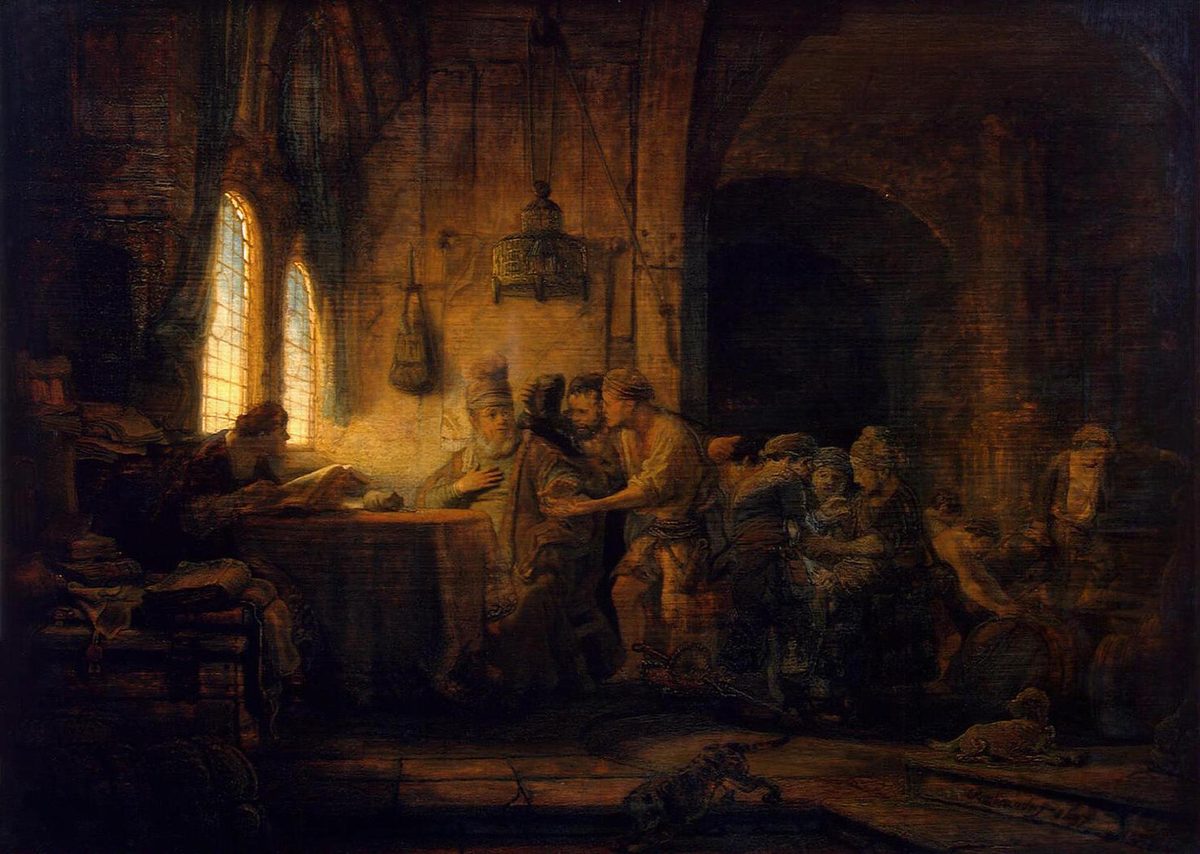
⚠ Rembrandt does not paint the vineyard. He paints verses 8–15 — the reckoning — and puts it indoors, at a table of accounts, with the grumbling labourer leaning across it in the light and the rest waiting in shadow. That is the second chapter running whose art is a northern painter staging a parable as a scene of book-keeping (chapter 18 has van Hemessen doing the same), which says something about what these painters thought the parables were about. Note that the householder is seated and still while the man arguing with him is the one in motion — and that the money on the table is already counted out. Painted in 1637, and now in the Hermitage.

Translator’s Notes — verse by verse
Each note explains this translation's choice and compares the seven versions on the shelf. Quotations from copyrighted versions (NIV, TLB, NWT) are kept to short phrases for comparison; KJV, Geneva, Douay-Rheims and ASV are public domain.
The parable is a bracket, and the previous chapter is inside it. 19:30 ended with "many who are first will be last, and the last first"; this parable opens with "For…", explains it at length, and closes at v16 by saying it again. Everything between is an argument for one sentence. And the sentence was aimed at Peter, who had just asked what the disciples would get for having left everything — so the parable's grumblers are not a stand-in for somebody else. They are the people who asked the question.
The clock, and why the hours matter. Reckoned from about six in the morning, the third hour is nine, the sixth is noon, the ninth is three, and the eleventh is an hour before the working day ends. ⚠ Note what the last group say when asked why they are idle: "because no one hired us." They are not lazy; they are unemployed. The parable is not about effort at all — nobody in it is accused of working badly — and the householder's own defence never mentions the quality of anyone's work.
The one wage. A denarius was the standard day's pay for a labourer, and the first group agreed to it (symphōnēsas, "having come to terms with"). Their complaint in v12 is precise and worth quoting exactly: not that they were underpaid, but "you have made them equal to us." The grievance is the equality. The householder's reply calls the complainer hetaire — "friend," but a cool word, the same one used to the man without a wedding garment (22:12) and by Jesus to Judas in the garden (26:50), never once a term of warmth in this Gospel.
"Is your eye evil?" Ho ophthalmos sou ponēros — not a comment on eyesight but a fixed Semitic idiom: the "evil eye" is stinginess and envy, as the "good eye" is generosity (Deuteronomy 15:9, Proverbs 23:6). Matthew has already used the pair, in the Sermon (6:22-23), where a "single" eye fills the body with light and an evil one with darkness — and that passage sits in the middle of the teaching about money, which is exactly where this one is too. The shelf mostly keeps the literal words — KJV "Is thine eye evil, because I am good?", ASV the same, NWT "is your eye wicked" — while NIV explains it away as "are you envious?", which is the right sense at the cost of the idiom. This translation keeps the eye and puts the idiom in the note.
⚠ And a line the KJV tradition adds at the end. After "the first last," the Byzantine manuscripts continue: "for many are called, but few chosen" — printed by KJV, GNV, DRB and by the Spanish shelf's older witness. It is absent from the earliest manuscripts here, and it is a real sentence of Matthew's — at 22:14, where it ends a different parable and fits it. This looks like a copyist importing a remembered line to round off a paragraph. Its absence changes the parable's temperature considerably: with it, the story acquires a note of selection and exclusion; without it, the last word is simply that the order is reversed.
Each prediction has been more specific than the last. The first (16:21) named Jerusalem, the elders, the chief priests and the scribes. The second (17:22-23) was stripped to the bone and added one verb: paradidosthai, handed over. This third one keeps the verb, uses it twice — handed over to the chief priests, who hand him over again — and then says what none of the others did: to the nations (ta ethnē, the Gentiles), "to be mocked and flogged and crucified."
That last word has not been said before. Crucifixion was a Roman punishment, not a Jewish one, which is why the Gentiles have to enter the sentence for the word to make sense; and the chain of custody is now complete, from the temple authorities to the occupying power. ⚠ Worth noticing the arrangement Matthew has made: this is said on the road, privately, to the twelve — and the very next paragraph is a request for the two best seats in the kingdom. He does not comment on the juxtaposition. He has not commented on any of them.
⚠ Matthew has the mother ask; Mark has the sons. In Mark 10:35 James and John come themselves — "Teacher, we want you to do for us whatever we ask." In Matthew their mother does the asking, and the sons stand there. The difference is real and the usual explanations are worth naming plainly: that Matthew is softening an unflattering picture of two apostles; that Mark is compressing; or that both are true, the mother speaking and the sons wanting it, which Matthew's own next verse supports by having Jesus answer them, in the plural, not her. The library states the difference rather than harmonizing it, and notes that the ten's indignation in v24 is directed at "the two brothers," not at their mother.
The cup. Potērion is an ordinary drinking vessel, and in the prophets it is a standing image for a portion assigned by God — usually of wrath, sometimes of blessing (Psalm 23's cup runs over; Isaiah 51's is the cup of staggering). Here it is the fate he has just described on the road, and it is the same word he will use in Gethsemane, "let this cup pass from me" (26:39). The brothers say dynametha, "we are able" — with no idea what they are agreeing to, which Jesus does not correct: "my cup you will indeed drink." Both of them did, in their different ways; James was the first of the Twelve to be killed.
And an answer that gives nothing away. "To sit at my right and at my left is not mine to give." The seats are not denied, and they are not granted; they are said to be already assigned by another. ⚠ The verse has been read theologically in opposite directions for centuries — as a limitation on the Son, or as a statement about the Father's prerogative in the economy of salvation. The library gives the sentence and does not choose. It does note the grim structural joke Matthew is setting up: the next people described as being at his right and his left, in this Gospel, are two robbers on crosses (27:38).
Two verbs of domination, both compounds, both slightly ridiculous. Katakyrieuousin — to lord it down over — and katexousiazousin, to exercise authority down over. The kata- prefix does the work, and Greek makes the pettiness audible in a way English struggles with. KJV reads "exercise dominion" and "exercise authority"; this translation reads "lord it over" and "throw their weight about," which sacrifices symmetry for the tone. Then the reversal, in two ascending steps: whoever wants to be great becomes your servant (diakonos, the word that will become "deacon" — originally a table-waiter), and whoever wants to be first becomes your slave (doulos, owned property, no euphemism available).
The sentence the chapter exists for. "The Son of Man did not come to be served but to serve, and to give his life a ransom in exchange for many" — lytron anti pollōn. Lytron is the price paid to free a slave or a captive; the preposition anti is the ordinary word for "in place of, in exchange for," and it is doing real work — NWT renders it "a ransom in exchange for many," which is the more exact of the shelf's readings and is followed here, against KJV/ASV's flatter "a ransom for many." ⚠ It is one of only two places in the Gospels where Jesus states the purpose of his death in a transaction-word (the other is Mark's parallel), and the vocabulary is Isaiah's: the servant who "poured out his life to death" and "bore the sin of many" (Isaiah 53:12, already on these pages). ⚠ "Many" has itself been argued over for centuries — whether it limits the scope or is a Semitic idiom for "the great number, all of them." The library reports the argument and does not settle it.
Note where this lands. The teaching is occasioned by two men asking for the best seats and ten men being angry that they asked first. It is not addressed to the powerful. It is addressed to people who have nothing and are already competing over it.
Two, not one — and this is Matthew's habit. Mark has a single named beggar at Jericho, Bartimaeus (10:46); Luke has one man, before the city rather than after. Matthew has two, unnamed. He does the same thing with the demoniacs at Gadara, where Mark has one (8:28), and chapter 8's note set out the explanations offered: that Matthew is doubling deliberately, for a Gospel written to readers who knew that a matter is established on the evidence of two witnesses; that he has merged two incidents; or that he simply preserves a detail the others dropped. ⚠ And there is a further complication this library should not smooth over: Matthew has already told a story of two blind men calling him "Son of David" at 9:27-31. Whether that is a doublet — one tradition told twice — or two events is genuinely disputed. Matthew tells both, and so does this translation.
The title, and who is allowed to say it. "Son of David" opened the Gospel buried in a genealogy (1:1). As a living cry it has been shouted by two blind men (9:27), by a Canaanite woman (15:22), and now by two blind men again — each time by somebody with no standing whatever to confer a royal title, and each time over the objection of the people around them. The crowd here does exactly what the disciples did to the children in 19:13: tells them to be quiet. Next it will be shouted by crowds at the gates of Jerusalem, and the authorities will object to that too.
And the word that ends the chapter. Splanchnistheis — moved in the inward parts, the gut-word. Matthew uses it of Jesus five times, and this is the last; 15:32's note flagged that one more use lay ahead, and this is it. ⚠ Note what the healed men then do: "they followed him" — the verb of discipleship, and the road he is on leads to Jerusalem. The rich young man, who could see, went away (19:22); two blind men, given their sight, walk toward the passion prediction they never heard.
Patterns worth carrying forward
Where this translation keeps the words exact / distinct: the evil eye kept as an eye (with KJV/ASV, against NIV's explanatory "are you envious?"), and the Sermon's good-eye/bad-eye pair named in the note; "lord it over" and "throw their weight about" for the two kata- compounds, trading symmetry for tone; servant (diakonos) and slave (doulos) kept as two different words on two ascending steps; "a ransom in exchange for many" for lytron anti pollōn, keeping anti visible (with NWT, the most exact reading on the shelf here); and friend for hetaire, with the note that it is never warm in this Gospel.
Echoes paid. "The last will be first" (v16) — the bracket around 19:30, which this parable was written to explain and then repeats verbatim; the evil eye (v15) — the Sermon's 6:22-23, and both passages sit inside teaching about money; handed over (vv18-19) — the verb planted at 17:22 and used twice here, now with the Gentiles and the cross named; Son of David (v30) — 9:27 and 15:22, always from someone with no standing to say it; the two blind men — Matthew's doubling habit, flagged at 8:28 and promised there for this chapter; and splanchnizomai (v34) — the fifth and last time Matthew uses it of Jesus, exactly as 15:32's note said.
Echoes planted. The cup (v22), waiting for Gethsemane; at my right and at my left (v23), waiting for two crosses; hetaire, "friend" (v13), waiting for a wedding hall and for a kiss in a garden; and Son of David (v30), waiting one chapter for the gates of Jerusalem.
⚠ And three places the library reports rather than decides. The addition at the end of v16 ("for many are called, but few chosen"), absent from the earliest manuscripts here and original at 22:14 — left out, with what its absence changes stated. The mother at v20, where Matthew and Mark differ about who does the asking — the difference given, the harmonizations named, none adopted. And "many" in v28, argued over for centuries as either a limit or a Semitic idiom for the whole number.
Next in this book: chapter 21 — a colt and a cloak-strewn road, the crowds shouting the very title two blind men have just shouted; a table overturned in the temple and a quotation about a den of robbers; a fig tree with nothing on it; the question about John's baptism that the authorities cannot afford to answer; and two parables aimed straight at the men asking.