Matthew 19 — The Mister Translation
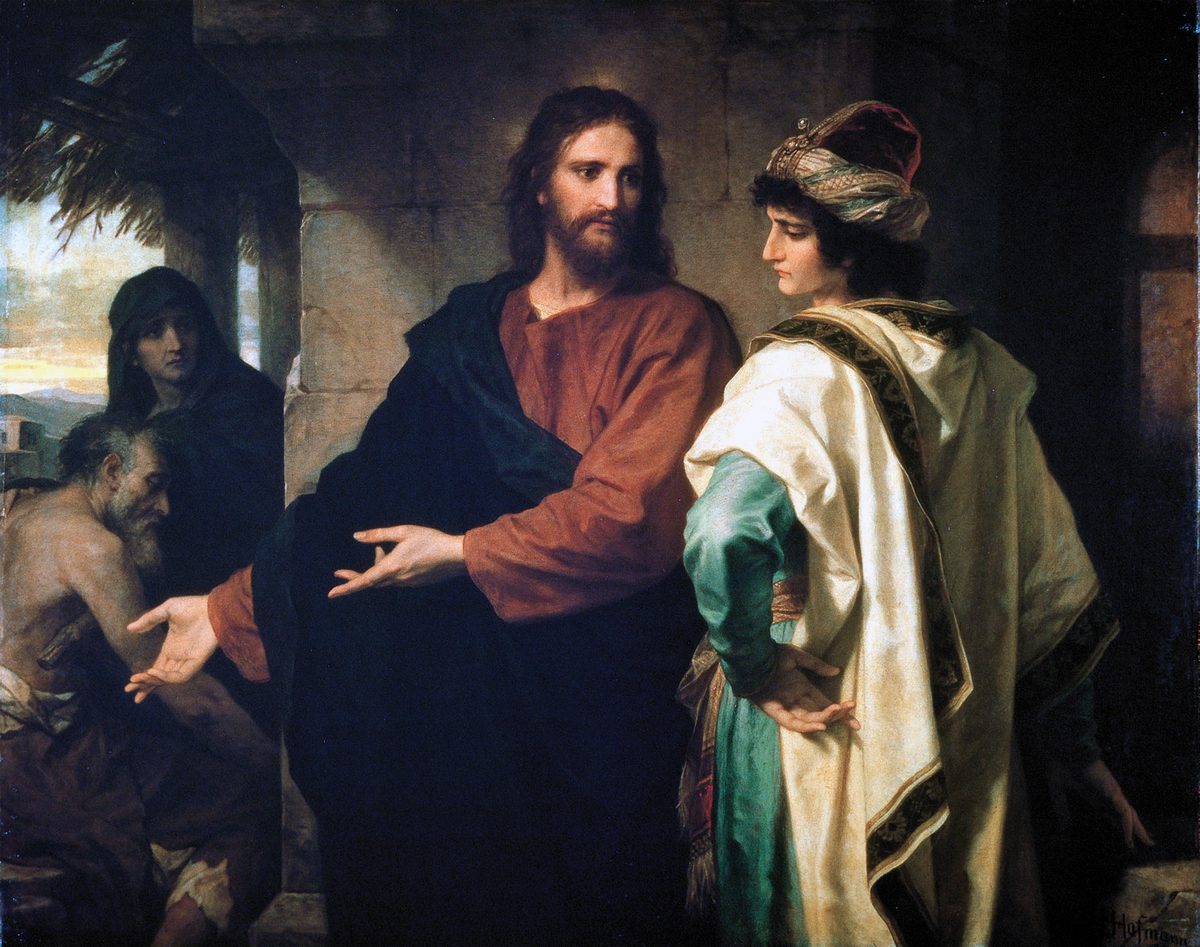
The sermon is in the gesture. Hofmann puts the young man and the beggar on opposite sides of the picture and has Christ turn from the one and point to the other — which is exactly what verse 21 says: sell what belongs to you and give to the poor. ⚠ Note the young man’s hands. They are folded over his own body, in front of the expensive cloak, while the beggar’s is open. Hofmann has decided the outcome before Matthew reports it. Painted in 1889 by a German academic painter whose Christ heads became some of the most widely reproduced religious images of the following century; this panel was bought by John D. Rockefeller Jr. and hangs in Riverside Church in New York — a detail worth a moment, given the subject.

Translator’s Notes — verse by verse
Each note explains this translation's choice and compares the seven versions on the shelf. Quotations from copyrighted versions (NIV, TLB, NWT) are kept to short phrases for comparison; KJV, Geneva, Douay-Rheims and ASV are public domain.
A formula, and the fourth of five. "And it came to be, when Jesus had finished these words" is not a transition Matthew improvises; it is a fixed sentence he lays down exactly five times — 7:28, 11:1, 13:53, here, and 26:1 — once at the close of each of the five great discourses. Chapter 7's note called these the visible joints of the book's architecture and promised the remaining four; this is the fourth, closing the discourse on community life that ran through chapter 18. One left.
And a change of country. "He moved on from Galilee" — Matthew's Galilean ministry is over, and everything from here runs toward Jerusalem. "The region of Judea beyond the Jordan" is geographically odd in English and precise in fact: the route south avoided Samaria by crossing to the east bank, through Perea, and re-crossing near Jericho.
The question is a trap with a school of thought inside it. "Is it lawful to divorce his wife for any cause at all?" — kata pasan aitian. That phrasing is not idle: it is the slogan of one side of a live rabbinic dispute over Deuteronomy 24:1's "some indecency of a matter." The school of Shammai read it narrowly, of sexual sin; the school of Hillel read the words separately — indecency or any matter — and permitted divorce for effectively any cause. The Pharisees are not asking whether divorce is allowed. Everyone agreed it was. They are asking which school he belongs to, and the verb is peirazontes, testing him.
He answers from a book neither school had quoted. Instead of ruling on Deuteronomy he goes behind it, to Genesis 1:27 ("male and female he created them") and Genesis 2:24 ("for this reason a man will leave… and the two will become one flesh"). ⚠ Note what he does with the second quotation: Genesis 2:24 is the narrator's comment, not speech by God — and here it is introduced with "and said," attributed to the Creator who has just been the subject. That is an argument being made by the citation itself, and the shelf all reproduces it without comment.
"Yoked together." Synezeuxen — syn + zygos, a yoke: two animals fastened to one beam and now obliged to walk at the same speed. KJV ASV read "joined together," which has become the wedding-service phrase and has gone abstract; NWT's "yoked together" is the exact image and is followed here on the merits. The prohibition uses anthrōpos — a human being, not specifically a husband — so it is not only the couple who are told not to separate them.
Commanded, or permitted? They say Moses commanded (eneteilato) the certificate of dismissal; he replies that Moses permitted (epetrepsen) it, and for a stated reason: sklērokardia, hardness of heart. The word is not classical Greek — it is built for the Greek Old Testament to carry the Hebrew idiom of an uncircumcised heart. The distinction between a command and a concession is the whole of his answer, and both verbs are kept distinct here.
⚠ The exception clause, and what this library will and will not do with it. Verse 9 permits divorce "not for porneia" — and the same exception appears at 5:32. It appears only in Matthew: Mark 10:11 and Luke 16:18 carry the saying with no exception at all. Two facts are worth having straight before any interpretation. First, porneia is a wider word than adultery, which has its own term (moicheia, used twice in this very verse) — it covers sexual immorality in general, and readings of the clause have turned on that width for centuries: whether it means adultery, or unlawful marriage within forbidden degrees, or unchastity discovered during betrothal. Second, the clause's scope is disputed even grammatically. The library sets out the readings and does not vote — the whole shelf renders the words differently in emphasis (KJV "except it be for fornication," ASV "except for fornication," NIV "except for sexual immorality," NWT "except on the ground of fornication") but none of them settles the question, and neither does this one. ⚠ One textual note that does belong here: the final clause, "and the one who marries a divorced woman commits adultery," is absent from some critical editions and present in others; the text this translation follows prints it, as the Spanish shelf's older witness does and the New World Translation does not.
The disciples' reaction is the honest one. "If such is the case of a man with his wife, it is not worth marrying." They are not being pious; they have just heard that the Hillelite escape hatch is closed, and they conclude that marriage on those terms is a bad bargain. Matthew records it without editorial comment, which is itself notable.
"Make room." The verb is chōreō, from chōra, space: to have room for, to contain, to take in. It is not "understand" and not "accept" exactly — it is closer to having the capacity for. KJV reads "cannot receive this saying," NIV "can accept this word," NWT "not all men make room for the saying." The last is the tightest and is followed here, and it matters because the verb returns as the last word of verse 12: whoever can make room, let him make room. The saying is offered, not imposed.
Three eunuchs, and one of them is a metaphor. Born so; made so by others (the ordinary, brutal fact of the ancient court); and those who "made themselves eunuchs for the sake of the kingdom of the heavens," which the church has read as voluntary celibacy from very early on. ⚠ It is worth saying plainly that at least one famous reader took it literally: Eusebius reports that the young Origen castrated himself on the strength of this verse, and later regretted it. The library reports the tradition without vouching for its details, and notes that the surrounding sentences — "not everyone can make room," "let the one who is able" — are working hard to keep this from being a general rule.
This is the sharpest editorial moment in the Gospel, and it is made entirely by placement. One chapter ago Jesus called a paidion and stood it in the middle of them, said the kingdom belongs to those who become like it, and warned that whoever causes one of these little ones to stumble would be better off drowned (18:2-6). Here paidia — the same word, plural — are brought to him, and the disciples rebuke the people bringing them. Matthew does not comment. He does not need to. ⚠ And the verb he chooses is epetimēsan, the same one used of Jesus rebuking a demon at 17:18 and of Peter rebuking Jesus at 16:22 — a strong word, not a mild discouragement.
"Of such is the kingdom." Tōn toioutōn — "of ones like these," which leaves open whether it means these children or people who resemble them, and the Greek does not decide. Note also what Jesus does not say: nothing about innocence or purity. Chapter 18 already told us what the child is for — a person of no status, set in the middle. Here that person is being turned away at the door by the men who heard the lesson.
⚠ Here Matthew's text and the familiar text are not the same, and the difference is not small. The reading almost everyone knows comes from Mark and Luke: "Good teacher, what shall I do…?" — "Why do you call me good? No one is good except one, God." That exchange has carried an enormous weight of Christological argument for eighteen centuries. But the earliest manuscripts of Matthew read differently: the man says simply "Teacher, what good thing shall I do?", and the answer is "Why do you ask me about the good? One there is who is good." The adjective has moved off the address and onto the deed, and the question stops being about who Jesus is and becomes about where goodness is located. The Byzantine manuscripts read Matthew the way Mark reads — which is precisely what a copyist harmonizing three parallel Gospels would produce, and why the critical editions judge the shorter, odder Matthean form original. The KJV and GNV print the harmonized text; ASV, NIV and NWT print the critical one, and so does this translation. ⚠ The library reports what each family of manuscripts says and declines to referee the theology that has been built on the other reading; that argument is not made less interesting by being made about the right verse.
The commandments he lists, and the one he adds. Five from the second table of the Decalogue — murder, adultery, theft, false witness, honour your parents — and then, appended without warning, "you shall love your neighbour as yourself," which is Leviticus 19:18 and not part of the Ten at all. The list is entirely about other people. Nothing about God is mentioned.
"Complete." Teleios — not moral flawlessness but having reached the telos, the end or purpose: finished, entire, brought to completion. It is the same word as the Sermon's "be teleios as your heavenly Father is teleios" (5:48). KJV reads "perfect," which in 1611 still carried the completeness sense and now mostly does not; this translation reads complete, which is what the young man's own question was reaching for — "what do I still lack?"
And Matthew's own detail. Luke calls him a ruler and Mark says only that he was rich; Matthew twice calls him neaniskos, a young man, and gives him the last word in the scene by giving him none — he simply "went away grieving." Lypoumenos: the same grief-word used of the disciples at the passion prediction (17:23) and of the fellow slaves in the last chapter's parable (18:31). He is the only person in this Gospel who is invited to follow and does not.
The saying has been rescued twice, and neither rescue holds. ⚠ First: some late manuscripts read kamilos, "rope" or "ship's cable," instead of kamēlos, "camel" — the two words were pronounced alike by then. It is a real variant in real manuscripts, and no critical edition adopts it; it appears late, looks exactly like a scribe smoothing a hard image, and the parallel sayings in rabbinic literature use an elephant through a needle's eye, which shows the joke was meant to be absurd. Second, and more popular from the pulpit: the claim that "the Needle's Eye" was a small gate in the Jerusalem wall that a camel could squeeze through on its knees. ⚠ There is no such gate. The story has no ancient source, no archaeological trace, and appears first in medieval commentary; it is repeated because it makes the sentence survivable. This translation prints the camel and the needle and lets the disciples' reaction stand as the correct one: they were "exceedingly astounded," and asked who on earth could be saved.
A word this book almost never uses. Verse 23 says "the kingdom of the heavens," Matthew's standing phrase, used some thirty times. Verse 24, one sentence later, says "the kingdom of God" — one of only a handful of places where he switches, and the first this library has reached; chapter 12's note flagged the pattern and promised these. Whether the two phrases mean the same thing (the usual view, "heaven" standing reverently for the divine name) or whether the switch is doing something local, the fact worth having is that Matthew can say "of God" and almost always chooses not to.
Peter asks the question the young man's exit made unavoidable. "We have left everything and followed you. What then will there be for us?" It is the accounting question, asked immediately after a story about a man who could not do the sum, and Matthew lets it stand without softening it.
Palingenesia. A rare and large word — palin, again, + genesis, birth or origin: a being-born-again of the whole order of things. It occurs only twice in the New Testament, here and at Titus 3:5 (of the washing of rebirth), and the Stoics used it of the periodic remaking of the cosmos. The shelf scatters: KJV "in the regeneration," ASV the same, NIV "at the renewal of all things," NWT "in the re-creation." This translation reads the renewal of all things, because "regeneration" in modern English has been almost entirely captured by the individual and this word is cosmic in scale.
The promise, and the audit at the end of it. Twelve thrones for the twelve who followed — a promise made in the hearing of Judas, which Matthew does not point out and does not need to. Then the hundredfold, and eternal life "inherited." ⚠ And then verse 30, which is aimed at the man who just asked what was in it for him: "many who are first will be last, and the last first." The chapter that began with a legal question about who may leave whom ends by warning the people who left everything not to start counting. Matthew immediately follows it with the labourers in the vineyard, which exists to make that sentence sting — and which closes by repeating it.
Patterns worth carrying forward
Where this translation keeps the words exact / distinct: "yoked together" for synezeuxen (with NWT, against the wedding-service abstraction of "joined"); commanded versus permitted kept as two different verbs, because the distinction is the entire answer; "make room for" for chōreō, so the word can return as the last clause of v12; "complete" for teleios, matched to 5:48 and to the young man's own "what do I lack?"; "the renewal of all things" for palingenesia, which modern "regeneration" has shrunk to the size of one person; and camel and needle printed without rescue.
Echoes paid. The discourse formula (v1) — the fourth of the five seams chapter 7's note promised, after 7:28, 11:1 and 13:53; the exception clause (v9) — the second and last of Matthew's two, after 5:32, exactly as that chapter's note said; paidia (v13) — the same word as 18:2, and the disciples turn them away one chapter after being told not to; teleios (v21) — the Sermon's 5:48; the treasure in the heavens (v21) — the Sermon's 6:20, and the merchant who sold everything for one pearl at 13:45; "follow me" (v21) — the call at 4:19 and its cost at 16:24, here declined for the only time in the book; and the kingdom of God (v24) — the first of the handful of departures from "the kingdom of the heavens" that chapter 12's note flagged and promised.
Echoes planted. "Many first will be last" (v30), which the next chapter's vineyard parable exists to explain and then repeats as its own last line; the twelve thrones (v28), promised in Judas's hearing; and the road toward Jerusalem, which from here is the only direction the book travels.
⚠ And three places the library reports rather than decides. The exception clause at v9 — porneia is wider than adultery and the readings have divided the churches; the readings are given with their reasons and no vote is cast. The v16-17 variant — "Good teacher / why do you call me good" (Byzantine, and identical to Mark and Luke) against "what good thing / why do you ask me about the good" (critical, and peculiar to Matthew), where the harmonizing direction of the evidence is stated but the theology built on the other reading is not adjudicated. And the camel — where the library states flatly that the "rope" variant is late and the "needle gate" has no ancient source, because those are facts about evidence rather than matters of interpretation.
Next in this book: chapter 20 — the labourers hired at dawn, at nine, at noon, at three and at five, and all paid a denarius; the mother of James and John asking for the two best seats; "whoever wants to be great among you will be your servant"; and two blind men outside Jericho who will not stop shouting.