Matthew 17 — The Mister Translation
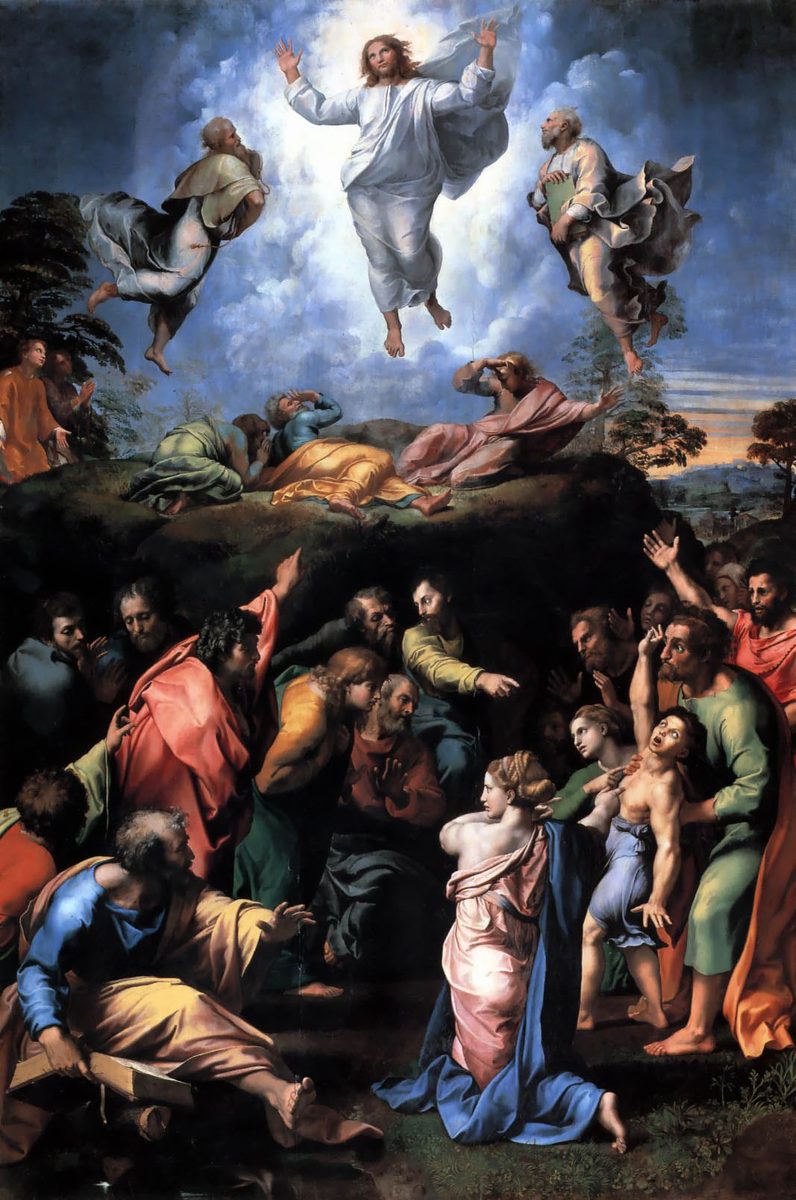
⚠ This one is not a placeholder — it is the chapter. Raphael's last painting, left unfinished at his death in 1520 and placed at the head of his funeral bier, puts BOTH halves of Matthew 17 on a single canvas: the transfiguration of verses 1–8 in the light above, and the boy his disciples could not heal, verses 14–18, in the dark below. The picture's own catalogue title in German says so outright — Transfiguration und Heilung des besessenen Knaben, “Transfiguration and Healing of the Possessed Boy.” Contemporaries were unsettled by the split; Vasari admired it, later academic critics thought the two scenes did not belong together, and the disciple pointing up the hill is the hinge that says they do. Note the argument Raphael is making with the composition: the crowd below is looking everywhere except at the one place the answer is.

Translator’s Notes — verse by verse
Each note explains this translation's choice and compares the seven versions on the shelf. Quotations from copyrighted versions (NIV, TLB, NWT) are kept to short phrases for comparison; KJV, Geneva, Douay-Rheims and ASV are public domain.
"After six days" — counted from what? From Peter's confession and the first passion prediction at 16:16-21, and from the promise six days earlier that "there are some standing here who will not taste death until they see the Son of Man coming in his kingdom" (16:28) — a sentence this chapter is widely read as the first instalment of. Matthew and Mark both say six days; Luke says "about eight." Nobody harmonizes it here; the numbers are simply printed as they stand. The six days are also, unmistakably, Sinai's: Moses waited six days while the cloud covered the mountain, and on the seventh God called to him (Exodus 24:16, already on these pages). The mountain is not named — the Byzantine identification with Tabor is a fourth-century tradition, and Hermon, near Caesarea Philippi where chapter 16 stood, is the other common candidate. The text says only "a high mountain."
The word the chapter is named for. Metemorphōthē is a passive: he was transfigured — something done to him, not performed by him. KJV ASV NIV all say "transfigured," which is the Latin transfiguratus wearing English clothes; NWT agrees. The Greek is meta-morphoō, a change of morphē, of form — and Paul uses the identical verb twice, of Christians: "be transformed by the renewing of your mind" (Romans 12:2) and "we are being transformed into the same image from glory to glory" (2 Corinthians 3:18) — the second in a passage explicitly about Moses' shining face and its veil. English keeps two different words for one Greek verb, and the connection has to be pointed out rather than heard. ⚠ Note what Matthew does not say: not that a light fell on Jesus, but that "his face shone like the sun" — and Matthew has used that exact image once already, of the righteous, "then the righteous will shine like the sun in the kingdom of their Father" (13:43).
Peter's tents. Skēnas — booths, the temporary shelters of the Feast of Booths, when Israel camped out for a week to remember the wilderness. KJV and DRB read "tabernacles," which is the same word in its liturgical sense and points at the feast; NWT and NIV say "tents/shelters," which is what the object is. This translation reads "tents" in the verse and leaves the feast to the note, because Peter is proposing camping gear, not founding a festival. Matthew, unusually, does not editorialize; Mark adds "for he did not know what to say," and Luke "not knowing what he said." Matthew simply lets it stand — and answers it with the cloud.
The voice says what it said at the river, and then one thing more. "This is my beloved Son, in whom I am well pleased" is word for word the voice at the baptism (3:17) — with one difference: there it was spoken over Jesus in public at the start; here it is spoken to three men and carries an imperative appended to it, ἀκούετε αὐτοῦ, "listen to him." That phrase is a quotation. Moses promised "a prophet like me… him you shall hear" (Deuteronomy 18:15, now on these pages), and the Greek Old Testament's wording is the wording used here. So the scene assembles the claim out of parts: Moses stands on the mountain, and the voice tells the disciples to listen to somebody else. Verse 8 closes it by subtraction — they lift their eyes and there is "no one except Jesus himself alone." ⚠ The voice is the Father's, not Jesus', so it is not printed in red here; this library reserves the red letters for the Son's own recorded speech, and the same restraint was used at Revelation 1:8, where the speaker is debated.
And a small verb worth watching. Jesus tells them ἐγέρθητε, "rise" — the passive of the same verb that will say "until the Son of Man has been raised" in verse 9 and "on the third day he will be raised" in verse 23. Three raisings in one chapter, and the first is three frightened men being told to get up off the ground.
"Tell the vision to no one." Horama — a sight, something seen; the word Acts uses constantly for Peter's sheet and Paul's man of Macedonia, but this is its only appearance in the Gospels. Matthew is the one who supplies it (Mark and Luke have no such noun here), and it does a careful job: it declines to say either "a mere vision" or "a bodily event," and simply calls it a thing seen. KJV ASV NWT all read "vision"; NIV softens to "what you have seen," which is a fair gloss but loses the technical noun. The silence has a stated expiry — "until the Son of Man has been raised" — which is the same shape as the silence imposed at 16:20, and the reason is the same: the title only becomes safe to use once the cross has defined it.
The scribes' objection, and a two-part answer. The disciples have just seen Elijah, so the scribal doctrine surfaces: Malachi's promise that Elijah comes before "the great and terrible day" (Malachi 3:23-24 in the Hebrew numbering, 4:5-6 in English; the book is on these pages only at chapter 1). Jesus grants the doctrine and then dates it: "Elijah does come, and will restore all things" — apokatastēsei, the verb of putting a thing back as it was, whose noun stands behind Acts 3:21's "the restoration of all things"; Malachi's own wording is that he will "turn the hearts of fathers to children." Then the turn: "Elijah has already come, and they did not recognize him." ⚠ This is a promise paid off from six chapters back — Jesus had already said of John, "if you are willing to accept it, he is Elijah who is to come" (11:14), where the conditional was doing a lot of work. Here the condition is dropped and Matthew tells us the disciples finally understood. Note what the identification costs: John was beheaded at a birthday party (14:10), and Jesus draws the line straight from that to himself — "so also the Son of Man is about to suffer at their hands." The Elijah question is not about chronology. It is about what happens to the messenger.
Down the mountain into a mess. Raphael understood the structure of this chapter better than most commentators: the glory on the height and the convulsing boy at the bottom are one scene, and he painted them on one canvas. Matthew's own join is the crowd — they come down and there is a father on his knees.
"Moonstruck." Selēniazetai, from selēnē, the moon: afflicted by its phases, which is how the ancient world explained the falling sickness. KJV reads "lunatick" (the same idea by way of Latin luna), and the old Spanish shelf still prints lunático; NIV and NWT modernize to "seizures" / "epileptic." This translation keeps moonstruck, as it did at 4:24 — it is what the word says, and it leaves the reader inside the explanation the text was written with instead of quietly substituting ours. ⚠ And there is a real tension here that the library will not tidy: Matthew's own summary at 4:24 lists "demon-possessed and moonstruck and paralysed" as three separate categories, yet the boy described as moonstruck in verse 15 is relieved when "the demon came out of him" in verse 18. Matthew distinguishes the categories in general and merges them in this case. Both sentences are his.
The variant that decides the rebuke. Verse 20 has one of the more consequential small splits in the Gospels. The critical text reads ὀλιγοπιστίαν, "your little faith"; the Byzantine text reads ἀπιστίαν, "your unbelief." They are not the same charge. Oligopistia is the noun of oligopistos, "little-faith," which as far as we can tell is Matthew's own coinage and appears essentially only on Jesus' lips — to the disciples in the boat (8:26), to Peter sinking (14:31), to all of them about bread (16:8). It is a rebuke about size, aimed at people who are still disciples at the end of the sentence. Apistia is a rebuke about presence. The KJV tradition inherited the Byzantine reading and so prints "unbelief" (KJV GNV); the critical editions read "little faith," and NWT and NIV follow them. This translation follows the critical text — which is the standing rule for the New Testament here — and the choice matters, because the next sentence is about a mustard seed: the smallest thing there is, held up as sufficient. A rebuke for having none would make that answer a non sequitur.
The seed and the mountain. The mustard grain is Matthew's own established image for the smallest beginning (13:31), and the point is not that a little faith achieves a little. It is that the quantity is the wrong question. As for "say to this mountain" — they have just walked down one. Moving mountains was already a proverb for the impossible in rabbinic speech, and it is used as a proverb here; nobody in the Gospels ever relocates a mountain.
⚠ And the verse that is not printed above. Between verses 20 and 22 the KJV, GNV and DRB carry a verse 21: "Howbeit this kind goeth not out but by prayer and fasting." It is absent from the earliest and best manuscripts — Sinaiticus and Vaticanus among them — and the critical text omits it; the usual explanation is that a copyist imported it from the parallel at Mark 9:29, where a shorter form of the line is original. NWT prints the verse number with a dash and a footnote, which is the same decision made here, arrived at differently: the numbering is left with its gap showing rather than silently renumbered, so a reader who goes looking for 17:21 finds an explanation instead of a hole. ⚠ Worth saying plainly what is at stake, because it is not nothing: the added line makes the disciples' failure a matter of insufficient practice, and Jesus has just told them it was a matter of insufficient faith. The library reports the manuscript evidence and does not pretend the sentence is unimportant.
Said again, and shorter. This is the second of Matthew's three passion predictions; the first was at 16:21, where it came with Jerusalem, the elders, the chief priests and the scribes spelled out. Here it is stripped to its bones and one new word is added: paradidosthai, "to be handed over" — the verb that will carry Judas, the Sanhedrin and Pilate all the way to the cross, and which English Bibles usually render "betrayed" when the actor is Judas and "delivered" when it is anyone else. It is one verb, and this translation keeps "handed over" so the chain stays visible. Note the passive: somebody hands him over, and the sentence does not say who.
What changed since the first prediction. Last time Peter took him aside and rebuked him and was called Satan (16:23). This time nobody argues. "They were deeply grieved" — elypēthēsan sphodra, and sphodra is the same intensifier Matthew used eleven verses earlier when the three "were terrified" (verse 6). The chapter's two overwhelming reactions are fear on the mountain and grief on the road. Matthew records no reply at all — which, after 16:22, is its own kind of progress.
Only Matthew has this, and that is not an accident. None of the other Gospels record the episode. Matthew is the Gospel that opens its own author's story at a tax booth (9:9), and it is the one that stops to explain how a temple levy was collected and what coin settles it. Ta didrachma is the annual half-shekel every Israelite male owed for the temple's upkeep (Exodus 30:11-16, already on these pages) — two drachmas, roughly two days' wages. This is not Roman tribute; the argument that follows would be much easier if it were.
The argument, and where it lands. Jesus gets to Peter before Peter can raise it — proephthasen, "spoke first," a lovely small verb — and asks a question about how monarchies actually work: kings tax strangers, not their own household. "Then the sons are free." Since the tax in question is God's, the syllogism is quietly enormous, and Matthew leaves the reader to finish it. Then the whole claim is set aside in a single clause: "so that we do not cause them to stumble" (skandalisōmen, the verb of putting a trap in someone's path). The freedom is asserted and immediately not used. That is the point of the paragraph, and it is why the passage keeps turning up in arguments about Christian liberty.
The coin, and the arithmetic. A statēr was a four-drachma piece — a tetradrachm — which is exactly two didrachmas: the tax for two men, "for me and for you," to the coin. KJV prints the mystifying "a piece of money"; ASV gives "a shekel," NWT transliterates "a stater," and NIV paraphrases "a four-drachma coin," which is the clearest of them at the cost of the word. This translation keeps stater and puts the arithmetic in the note, because the arithmetic is the joke.
⚠ And the thing everyone misses. Matthew never says Peter caught the fish. The chapter ends on the instruction — go, cast, open, take, give — and simply stops. There is no "and he went and found it," which is exactly the sentence a storyteller inventing a miracle would supply. The library notes the silence and does not fill it in.
Patterns worth carrying forward
Where this translation keeps the words exact / distinct: "transfigured" for metemorphōthē, kept passive (with the whole shelf), with Paul's two "transformed" passages named in the note since English splits one Greek verb; "tents" for skēnas (with NWT/NIV, against KJV's "tabernacles," which imports the feast into the verse); "vision" for horama, the technical noun NIV dissolves; "moonstruck" for selēniazetai, matched to 4:24; "little faith" for the critical text's oligopistian rather than the Byzantine "unbelief"; "handed over" for paradidosthai, one verb kept as one verb all the way to the cross; and "stater" for statēra, with the four-drachma arithmetic in the note rather than substituted for the coin.
Echoes paid. The voice (v5) — word for word the voice at the baptism (3:17), now with "listen to him" attached; six days (v1) — the interval since 16:28's "some standing here will not taste death"; shining like the sun (v2) — the image already used of the righteous at 13:43; Elijah (v12) — the conditional identification at 11:14 ("if you are willing to accept it") now stated flat, and cashed against John's execution at 14:10; little faith (v20) — the fourth time Matthew's coined word is used, after 8:26, 14:31 and 16:8; the mustard seed (v20) — 13:31's smallest beginning; the silence (v9) — the same gag order, with the same expiry, as 16:20; and the second passion prediction (vv22-23) — 16:21 again, this time without an argument from Peter. Also claimed by an eyewitness elsewhere in the library: "we were eyewitnesses of his majesty… we heard this voice borne from heaven while we were with him on the holy mountain" (2 Peter 1:16-18).
Echoes planted. Paradidōmi, "handed over" (v22), which now starts its run toward Judas; the third day (v23), said twice now and still not understood; and the freedom of the sons (v26), asserted and then waived, waiting for the letters to argue about what to do with a liberty you decline to use.
⚠ And two places the library reports rather than decides. Verse 20's oligopistian ("little faith," critical text) against apistian ("unbelief," Byzantine) — two different rebukes, and the choice changes how the mustard seed reads. And verse 21, printed by the KJV tradition and absent from the earliest manuscripts, which this translation leaves out with its gap visible and its evidence stated, while saying plainly what the added line would have changed.
Next in this book: chapter 18 — the fourth discourse, on life inside the congregation: a child set in the middle as the measure of greatness, the millstone and the severed hand, the ninety-nine left to find the one, the procedure for a brother who sins against you, and a king who forgives ten thousand talents to a servant who will not forgive a hundred denarii.