Revelation 11 — The Mister Translation
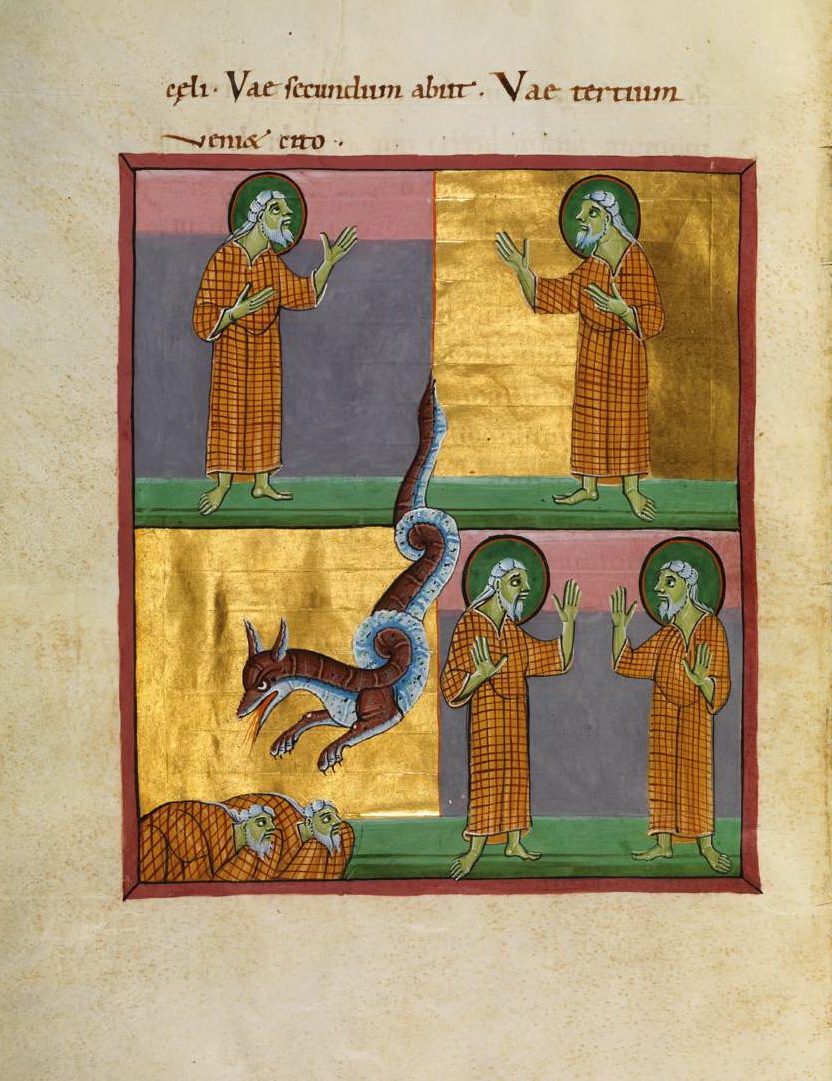
⚠ The same two witnesses appear four times on one page — the manuscript's way of telling a whole story in a single image. Medieval illuminators routinely painted one figure at several moments of a narrative within a single frame rather than splitting it into separate pictures; read left to right, top to bottom, this folio shows the two witnesses preaching (upper panels), the beast rising to attack them (center), the two of them confronted together (lower right), and finally fallen, dead, in the corner — their whole ministry and death compressed into one composition.
⚠ The fire comes from the BEAST's mouth here, not the witnesses'. The text gives the witnesses themselves the fire-breathing power (v5: 'fire pours out of their mouth and devours their enemies'); this illuminator instead puts the flame in the beast's jaws, reassigning the weapon to the attacker rather than the defenders. Whether that is a simple artistic choice, a conflation with the beast's own fearsome portrait two chapters later (13:1–10, whenever that chapter is translated), or a reading of the scene as the beast's assault overwhelming their power rather than being repelled by it, the manuscript does not say.
The Latin caption at the top of the page — 'Vae secundum abiit; Vae tertium venit cito', 'the second woe has passed; the third woe comes quickly' — is this chapter's own v14, almost verbatim. The illuminator has captioned the witnesses' whole story with the line that marks the HINGE between their death and the seventh trumpet, not a caption for the death scene alone.

Translator’s Notes
Measuring a building has meant something specific since long before this book. A man with a measuring reed walking through a future temple, room by room, is Ezekiel’s own vision (Ezekiel 40:3, not yet on these pages) — there the measuring is a promise, restoring what was destroyed down to the cubit. Zechariah is handed the identical instrument for a different purpose: to measure Jerusalem’s width and length, and is told the city will in the end need no wall at all, because God himself will be a wall of fire around it (Zechariah 2:1–5, already on these pages). John’s scene borrows the gesture from both and then does something neither does: it measures only PART of the complex — the sanctuary, the altar, the worshipers — and deliberately leaves the outer court UNmeasured, handed over to be trampled. Measuring, here, is not restoration. It is a boundary drawn around what will be protected inside a courtyard that will not be.
⚠ ‘And the angel stood, saying’ — a clause the KJV alone prints. KJV reads, ‘there was given me a reed… and THE ANGEL STOOD, saying, Rise’; every other version on this shelf has only, ‘I was given a reed… and I was told’ (ASV ‘one said’) — no angel named at all. The clause is real Greek, kai ho angelos heistēkei, but it survives only in a handful of late Byzantine minuscules and a few Latin commentators (Tyconius, Beatus) — absent from the earliest papyri and uncials, and, more tellingly, absent from the wider Byzantine majority text this book’s own textual tradition is usually most conservative about keeping. It reads like a scribe supplying a subject the sentence does not name, centuries after the fact, and Erasmus’s printed Greek text (the Textus Receptus behind the KJV) happened to pick it up from exactly that kind of late manuscript. Who does speak, then? The Greek verb is a bare participle with no stated subject — ASV’s ‘one said’ is honest about the gap, not a translation choice papering over it.
Forty-two months, first of seven times. The outer court’s trampling is timed to forty-two months — the same interval the two witnesses will prophesy next verse, counted in days instead (1,260 days = 42 months = 3½ years exactly), and the same ‘broken seven’ a much older book already put a name to: ‘an appointed time, appointed times, and a half’ (Daniel 12:7, already on these pages), where the promise was made explicit — that Revelation would ‘count out’ this same persecution-length span ‘as 1,260 days and 42 months.’ This is that counting-out, the first of several times this book will keep it (see the note at v3 below, and 12:6, 12:14, and 13:5, not yet on these pages).
⚠ Who are the two witnesses? The text never names them, and the library gives the readings without choosing. A widespread reading takes their powers as the tell: shutting the sky so no rain falls is Elijah’s own drought (1 Kings 17:1, not yet on these pages), and fire consuming enemies at a word is the exact power he calls down on two companies of soldiers, twice, in one already-shipped chapter (2 Kings 1:10, 12, already on these pages); turning water to blood is Moses’ own opening plague, worked on this same Nile once before (Exodus 7:19–20, already on these pages). Two witnesses fused out of the Law’s greatest lawgiver and the Prophets’ greatest prophet — the same pairing that stood beside Christ, transfigured, listening (Matthew 17:3, already on these pages) — is one reading; two individual end-time prophets is another; the church’s whole prophetic witness, embodied as two because Deuteronomy requires two to establish a matter (Deuteronomy 19:15, already on these pages), is a third. This translation reports all three and settles on none.
An image borrowed, then reshaped. ‘Two olive trees’ feeding a lampstand is Zechariah’s own vision (Zechariah 4:3, 11–14, already on these pages) — but Zechariah sees ONE lampstand, with seven lamps, flanked by two trees; their oil is God’s Spirit, continually supplied. John keeps the two trees but gives them TWO SEPARATE lampstands, not one shared between them — a change forced by his own book’s earlier vocabulary: a lampstand already means one congregation (seven of them, standing for seven churches, 1:20, already on these pages), so two witnesses need two lampstands, not a fraction of one. The borrowed image is genuinely reshaped, not merely repeated.
Sackcloth (v3) is mourning’s standard garment throughout the Hebrew Bible — these two prophesy dressed for a funeral that has not happened yet. And their own funeral, when it comes two verses later, is the subject of the next note.
‘The’ beast, not ‘a’ beast. This is the first time this book uses the word at all — and it arrives with the definite article already attached, to thērion, ‘THE beast,’ as if the reader is expected to already know which one is meant. It does not appear again until far later in this book (17:8, whenever that chapter is translated), where the same verb — coming up OUT OF THE ABYSS — recurs almost word for word, and its full portrait waits two chapters further still (13:1–10, whenever that chapter is translated). The Abyss itself, opened first two chapters back, was promised to be exactly this — the place ‘the beast comes up from’ — before the beast had ever been named (see the note at 9:1–2, already on these pages). A whole book’s worth of antagonist steps onto the page here for the first time, already carrying a definite article the reader has not yet earned.
⚠ ‘Their Lord,’ or ‘OUR Lord’? The great city’s crucifixion clause reads ho kyrios autōn, ‘THEIR Lord,’ in every manuscript this book’s own critical apparatus tracks — ASV, NWT, and every modern version agree. KJV alone prints ‘OUR Lord,’ a Textus-Receptus-only reading with no support in the wider manuscript tradition — the second such clause in this one chapter (see v1’s note above). The Spanish shelf splits along the identical line, across centuries and continents: RV1909 (translated from the same Received-Text lineage as the KJV) reads ‘nuestro Señor’ (our Lord); TNM (translated from the modern critical text) reads ‘su Señor’ (their Lord). Two languages, one manuscript decision, made independently and landing on the same two sides.
A great city called by two names it is not. ‘Spiritually,’ pneumatikōs (KJV/ASV ‘spiritually’; NIV ‘figuratively’; NWT ‘in a spiritual sense’) — a symbolic name, not a geographic one. The crucifixion clause makes Jerusalem the leading reading: nowhere else fits ‘where their Lord was crucified.’ Sodom names a city the prophets already used as shorthand for Jerusalem’s own corruption (‘hear the word of Jehovah, you rulers of Sodom,’ Isaiah 1:10, already on these pages; Ezekiel calls Jerusalem’s own sister Sodom outright, Ezekiel 16:46–49, not yet on these pages); Egypt names the house of slavery Israel was carried out of at the very start. ⚠ But ‘the great city’ is also this book’s own regular name for Babylon — the imperial power the rest of Revelation spends whole chapters unmasking (16:19, 17:18, 18:10, whenever those chapters are translated) — and some readers take the phrase there rather than here, reading the crucifixion line as a statement about the world's guilt in general, not this one city's. The library gives both readings and does not choose between them.
⚠ Singular, then plural, in the same verse. Two witnesses, one Greek corpse: v8 and the first half of v9 both use the SINGULAR to ptōma, ‘their corpse’ — treating the pair as a single body, a single unit of testimony even in death — then the same verse switches to the PLURAL ta ptōmata, ‘their corpses,’ for the refusal of burial. This translation keeps the shift visible rather than smoothing English grammar over it (most shelf versions render both instances ‘bodies,’ plural throughout, and the seam disappears).
This is also the payoff of a promise made one chapter back: the plural voice that commissioned John to ‘prophesy again about peoples and nations and languages and MANY KINGS’ (10:11, already on these pages) was noted there as setting up ‘the two witnesses who prophesy to exactly that scale, one chapter from here’ — and here it is, in nearly the same four-fold formula (peoples, TRIBES, languages, nations — ‘kings’ traded for ‘tribes’), watching not the witnesses’ prophecy but their corpses. The whole earth’s scale, promised for the commission, arrives instead for the funeral.
A funeral run backward. Refusing burial to an enemy’s body was itself a recognized insult across the ancient world — leaving a corpse exposed denied the dead even the minimal dignity owed by custom. Here the world goes one step further: not merely refusing burial, but treating the refusal as an OCCASION — celebrating, and sending each other GIFTS, the way a wedding or a festival is marked, not a death. The normal shape of mourning is inverted at every point: sackcloth (v3) belongs to the prophets, not their mourners; joy belongs to those who should be afraid; gifts replace grief. Two prophesying figures who tormented ‘those who dwell on the earth’ by their very presence (v10) are given, in death, the one funeral this book records with real enthusiasm.
‘Breath of life’ is not a new phrase. It is the exact Greek pairing the Septuagint uses for what God breathes into the first human, and into every creature that survives the flood (Genesis 2:7; 6:17; 7:15, already on these pages) — and it is what a much later prophet is told, four times over, to command dry bones to receive before an entire valley of them stands up as ‘an exceedingly great army’ (Ezekiel 37:5, 9–10, not yet on these pages). John’s two witnesses get the smallest possible version of that vision — two bodies, not a valley — but the same verb, the same breath, and the same command afterward, addressed not to the bones but straight to the witnesses themselves: ‘Come up here.’
‘Names of people’ — a Hebraic idiom kept, not smoothed over. The seven thousand killed in the earthquake are, literally, ‘names of men,’ onomata anthrōpōn — counting individuals by name is a censusing idiom carried straight over from the Hebrew Bible’s own counting language (compare ‘the number of names’ for a gathering of about a hundred and twenty, Acts 1:15, already on these pages). KJV/ASV both keep ‘names of men’ literally; most modern versions simplify to ‘people’ or ‘persons’ and lose the idiom.
⚠ The one earthquake judgment that lands on repentance, not defiance. Every other catastrophe in this book’s judgment sequence has ended the same way: those who survive ‘did not repent’ (9:20–21, already on these pages). Here, for the only time, ‘the rest became terrified and GAVE GLORY TO THE GOD OF HEAVEN’ — a genuine positive response, however frightened its cause. The text does not say whether it lasts.
The third woe, finally called by name. An eagle announced three woes still to come, flying through mid-heaven, six chapters back (8:13, already on these pages); the fifth and sixth trumpets were named the first two woes as they landed (9:12; 11:14, this verse). When the previous chapter shipped, its own closing note promised ‘the third woe the eagle promised is still owed… it will not arrive until just before the seventh trumpet finally sounds’ (see the note at 9:1–2, already on these pages). This is that arrival: the third woe is announced in v14, and the seventh trumpet sounds in the very next verse. Debt closed.
⚠ A famous chorus, and a plural the King James prints that its own most famous setting quietly drops. The Greek is unambiguously SINGULAR: hē basileia tou kosmou, ‘THE kingdom of THE world’ — one kingdom, one world, collapsing into a single allegiance all at once. KJV prints it PLURAL — ‘the KINGDOMS of this world are become the KINGDOMS of our Lord’ — an idiomatic loosening that reads as many separate powers each individually submitting, rather than one collapsing whole. Handel’s Hallelujah Chorus, drawing its libretto from the KJV, nonetheless sings the SINGULAR — ‘The kingdom of this world is become the kingdom of our Lord’ — matching the Greek more closely than the very translation it was compiled from. Whether that is Charles Jennens correcting the KJV by ear, by another source, or simply by the accident of setting the line to music, this project has not been able to establish; the discrepancy is real and, as far as this translation can find, unremarked-on. ASV/NIV/NWT all print the singular, matching the Greek.
⚠ A title with one clause missing — and a third KJV-only reading in this same chapter. God is named three times earlier in this book as ‘the one who is, and who was, and who is to come’ (1:4, 1:8, 4:8, already on these pages) — three participles, the third one future. Here the earliest witnesses and the modern critical text give only TWO: ‘who IS and who WAS’ — the coming has dropped out. KJV restores the third clause, ‘which art, and wast, and ART TO COME’ (Greek kai ho erchomenos) — a real Textus-Receptus reading, but one absent from the earliest surviving copies of this book and, once again, from the wider Byzantine tradition this book’s manuscripts are usually most conservative about keeping. This is the THIRD time in this one chapter the King James prints a clause its own textual family cannot otherwise support (see v1’s ‘the angel stood’ and v8’s ‘our Lord’, both above) — not a coincidence of this chapter especially, but a known weak point of Revelation’s printed Greek text generally: Erasmus, compiling the first printed edition behind the Textus Receptus, worked from a single incomplete twelfth-century manuscript for this book alone, thinner attestation than any other New Testament book received. On the shorter, better-attested reading, the effect is exact: the shape of the two-clause title matches what the previous verse just announced — the kingdom ‘HAS BECOME’ his, past tense, already accomplished. The one who was still to come, within this scene, has arrived. Whether that effect is the ORIGINAL wording or a coincidence of a shorter, corrupted one is exactly what the textual question turns on; this translation follows the earlier witnesses and reports the KJV's reading rather than silently absorbing it.
Destroying the destroyers. The chapter’s closing line pairs one Greek verb with its own participle — diaphtheirai tous diaphtheirontas, literally ‘to DESTROY those DESTROYING’ — a wordplay this translation keeps in English by repeating the same root both times.
The only ark in the New Testament. This is the sole mention of the ark of the covenant anywhere outside the Hebrew Bible’s own story — the same chest built, to the cubit, out of acacia wood and gold (Exodus 25:10–22, already on these pages), last heard of disappearing somewhere in the ruin of the first temple, centuries before this book was written. A later Jewish tradition (2 Maccabees 2:4–8, outside this project’s translated canon) has the prophet Jeremiah himself hide it in a cave on Mount Nebo before the Babylonian destruction, sealing the entrance and declaring that its place would ‘remain unknown until God gathers his people together again’ — a promise to be kept, not a loss to be mourned. John does not cite that tradition, but his own vision answers its exact shape: the ark was never destroyed and never merely misplaced. It was always in the temple — the one IN HEAVEN, opened here for the first time, with the earthly copy’s absence explained by nothing more complicated than looking in the wrong building.
The five-item catalogue that closes the chapter — lightning, voices, thunder, earthquake, hail — is this book’s standard sign that a major seal, trumpet, or bowl sequence has reached its full stop; watch for the identical list, growing by one item each time, at the end of the sequences still ahead.
Patterns worth carrying forward
Where this translation makes a real choice: keeping the singular/plural shift in ‘corpse’/‘corpses’ (v8–9) visible rather than smoothing it into one plural throughout, and reporting — without resolving — three separate, genuine identity questions this chapter raises and never answers: who the two witnesses are, whether ‘the great city’ means Jerusalem or Babylon, and why the KJV’s own most famous musical setting sings a stricter Greek than the KJV itself prints.
Echoes paid. Daniel’s ‘appointed time, appointed times, and a half’ (Daniel 12:7) is counted out here, for the first of several times, as 1,260 days and forty-two months (vv2–3). The Abyss’s promise, two chapters back, that it would one day be ‘the place the beast comes up from’ (9:1–2) is paid at v7, this book’s first use of ‘the beast’ by name. The eagle’s third woe, promised three chapters back (8:13), finally lands at v14, one verse before the seventh trumpet. And the plural commission to ‘peoples and nations and languages and many kings’ (10:11) returns almost word for word at v9, watching not the witnesses’ prophecy but their corpses.
Echoes planted. ‘The beast’ (v7) will not be named again for several chapters, and its full portrait is still owed (13:1–10, whenever that chapter is translated). The five-item catalogue that closes this chapter — lightning, voices, thunder, earthquake, hail — will recur, longer each time, at the end of every major judgment sequence still ahead.
⚠ Left open on purpose. The identity of the two witnesses; whether ‘the great city’ (v8) is Jerusalem or this book’s standing name for Babylon; and whether Handel’s librettist corrected the KJV’s plural by ear, by another source, or by accident — three questions this translation reports rather than settles.
Next installment in this book: Revelation 12, where a woman clothed with the sun gives birth while a great red dragon waits to devour her child, and war breaks out in heaven itself.