Revelation 9 — The Mister Translation
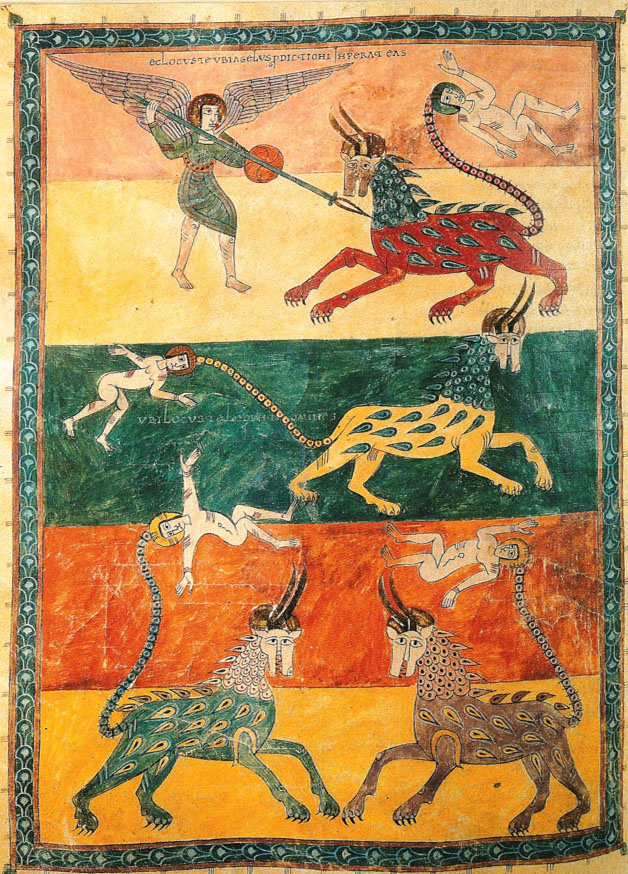
⚠ The winged, haloed figure presiding at the top is usually identified as the angel of the Abyss himself — Abaddon, or Apollyon — controlling the locusts as if he were their king (v11). The spear he levels at them is thought by some art historians to be a garbled copy of a staff of authority, redrawn as a weapon across generations of this commentary's copies.
The chapter's strangest detail — a scorpion's tail that is also a second mouth, ‘having heads’ (v19) — this illuminator renders differently: each creature's tail becomes a leash, wound around the head of a small nude figure it drags along beneath it. The sting becomes a capture.

Translator’s Notes
⚠ Who or what is ‘a star fallen from heaven’? The verb is a perfect participle — already down, not caught in the act of falling — and the star immediately acts with agency, receiving a key and unlocking a shaft. The library reports two live readings rather than settling on one: some take it as a bare image, the falling-star picture that simply marks the shaft's opening; others read it as an angel, or even Satan himself, since the language echoes Isaiah's taunt against the king of Babylon, the ‘Day Star, son of Dawn’ fallen from heaven (Isaiah 14:12, not yet on these pages) and Jesus' own words, ‘I saw Satan fall like lightning from heaven’ (Luke 10:18, not yet on these pages). The Satan entry on this site notes that his familiar biography as a fallen angel of light is itself assembled from exactly these kinds of passages — a later synthesis, not a claim this text makes outright. Compare the OTHER falling star two chapters back: Wormwood (8:10–11) is witnessed falling (a plain aorist verb) and strikes the water as an object; this star is already fallen and is given a task. Two falling-star images, back to back, doing two different kinds of work.
The key is the first one in this book that does not belong to Christ. He alone had said, three chapters earlier, ‘I hold the keys of Death and of Hades’ (1:18); here a key is given to a fallen star — the divine passive keeping God's permission behind even this, but a real transfer of access all the same.
This is also the first of seven appearances of the Abyss in this book (9:1, 2, 11; 11:7; 17:8; 20:1, 3), and its story arcs across all of them: a shaft opened here to release torment, later the place the beast comes UP FROM (11:7, already on these pages; 17:8, whenever that chapter is translated), and finally where Satan himself is thrown down and shut in for a thousand years (20:1–3). What comes out in this chapter goes back in, with company, at the end. Shelf: KJV collapses the whole two-word phrase into one English idiom, ‘the bottomless pit’; ASV and ESV keep both Greek nouns, ‘the pit/shaft of the abyss’; NIV alone capitalizes it as a place-name, ‘the Abyss’, dropping ‘pit’ or ‘shaft’ separately — the convention this translation follows.
These locusts are Egypt's eighth plague, deliberately inverted. When locusts covered Egypt, they left ‘nothing green… in tree or in plant of the field’ (Exodus 10:15) and touched no person directly. Here the locusts are ordered to do the exact opposite: spare every green plant, every tree, and strike people instead — but only the people who do not carry ‘the seal of God… on their foreheads’, the very seal four angels were told to finish placing two chapters earlier (7:3). The 144,000 sealed there are, quietly, the ones this plague cannot reach.
The description that follows in vv7–10 — horse-bodies, a sound like chariots, teeth like a lion's — is the standing shape of a locust army in the Hebrew Bible; Joel's own locust-invasion vision reaches for the identical comparisons: ‘its teeth are a lion's teeth’ (Joel 1:6), and an army ‘like the appearance of horses’ with a sound ‘like the noise of chariots’ (Joel 2:4–5, not yet on these pages). This chapter is not inventing a new monster. It is dressing an old, real terror — a locust swarm, which ancient readers would have known firsthand — in language already used to describe it at its worst.
⚠ Torment, not death, and a fixed five months. The mandate is bounded twice over: these locusts may sting like scorpions but may not kill, and the torment runs for exactly five months. Some read that figure literally against the length of a real locust season (roughly May through September); others read it as one more example of this book's fondness for a fixed, bounded period rather than an open-ended one. Either way, the effect named at v6 is a genuine inversion: ordinarily the living flee death. Here death flees the tormented, who seek it and cannot find it.
Five verses, eight comparisons — like horses, like crowns, like human faces, like women's hair, like lions' teeth, like iron breastplates, like the sound of chariots, like scorpions. John piles up simile after simile rather than settling on a single description, as if ordinary categories keep failing him. The result is a hybrid built from nearly every fearsome thing available at once — not one creature but an assembly of them.
⚠ Abaddon and Apollyon are the same name told twice, in two languages, and the Greek half may carry a second meaning. Hebrew Abaddon (‘ruin, destruction’) is not a name anywhere else it appears — it stands alongside Sheol as a near-personified word for the realm of the dead (Job 26:6; 28:22; Psalm 88:11; Proverbs 15:11; 27:20, none yet on these pages). John supplies his own Greek equivalent, Apollyon, ‘Destroyer’ — a real word, built from the ordinary verb apollymi, ‘to destroy’. But it is also a near-homophone of Apollōn, the god Apollo, who carried the cult title Parnopios, ‘the Locust-God’, at Athens (the geographer Pausanias records a bronze statue there, dedicated after the god was credited with driving locusts from the land) — and who some scholars think the emperor Domitian, John's likely contemporary, liked to be seen as. If the pun is intended, naming the locusts' own king ‘Apollyon’ while sounding like ‘Apollo’ would be a coded jab: the god an empire claims as its protector, unmasked as the Destroyer. The text itself never says so outright — it just hands the name to a reader who could catch it.
Shelf: only NIV, among every version compared here, glosses the Greek name in-line — ‘Apollyon (that is, Destroyer)’. Every other version, in both languages, leaves both proper names to stand untranslated, exactly as this translation does.
The eagle's own cry two chapters back — ‘woe, woe, woe’ for the three trumpets still to sound (8:13) — starts being paid here. The fifth trumpet, the locusts just finished, was the first woe. The sixth trumpet, beginning in the very next verse, will be the second. The third is deferred past this chapter entirely, held back until just before the seventh and final trumpet finally sounds (11:14, whenever that chapter is translated).
The golden altar returns from two chapters back, where it carried the martyrs' prayers up as incense and then sent fire back down as judgment (8:3). Now a voice comes from it directly — unnamed, but from the same vessel that has already carried the ‘how long’ of the souls under the altar (6:10) toward God. The text does not say the voice belongs to those prayers. It does not need to.
⚠ ‘The horns’ or ‘the FOUR horns’? A real textual variant. The older reading — followed here — has simply ‘the horns of the golden altar’; the Byzantine majority text, and the modern NA28 apparatus alongside it, add ‘four’, matching the literal architecture of the incense altar, which Exodus specifies had a horn projecting from each of its four corners (Exodus 30:2, already on these pages). Shelf: KJV, NIV, ESV and RV60 all print ‘four’; ASV, NVI and NWT agree with the shorter reading kept here.
A precise release for an imprecise-sounding army. The four angels bound at the Euphrates — the empire's own eastern frontier, the direction every invasion Israel ever feared came from — are released for an oddly exact appointment: ‘the hour and day and month and year’, a calendar precision this book rarely allows itself amid its cosmic imagery. And their assignment extends the ‘third’ that structured every trumpet in the previous chapter (earth, sea, rivers, sky, each struck a third, 8:7–12) into new and worse territory: for the first time, it is not the created order but a third of mankind itself that dies.
⚠ How big is ‘twice ten thousand times ten thousand’? Two hundred million, by simple arithmetic — a number so large that ancient Greek had no single word for it and had to build it out of myriads (ten-thousands) multiplied together. Shelf: KJV keeps the archaic English equivalent, ‘two hundred thousand thousand’; NIV, ESV and ASV all keep the literal multiplication, printed here (‘dos miríadas de miríadas’ in TNM); RV60 and NVI both modernize straight to the numeral, ‘doscientos millones’, two hundred million.
⚠ The horses' breastplates are color-coded to what comes out of their mouths. Fire, hyacinth, and sulfur (v17) are exactly the three plagues that follow in v18 — fire, smoke, and sulfur — as if the horses ARE what they breathe. The middle color, ‘hyacinth’ (a dark blue-violet, named for the flower), splits the shelf four distinct ways: KJV and ASV keep the literal ‘jacinth’/‘hyacinth’, as this translation does; ESV and, independently, RV60 both reach for the same alternate gem, ‘sapphire’/‘zafiro’; NIV abstracts entirely to a plain color, ‘dark blue’; and NVI abstracts to a DIFFERENT plain color, ‘púrpura’, purple. Six versions, four different solutions, to name one ancient color-word.
The tail has a head of its own. These horses out-arm even the scorpion-tailed locusts of vv3–10: where those tails could only torment, these tails are ‘like serpents, having heads’ — a second mouth, doubling the danger the text has already located in the first one.
The idols that ‘cannot see or hear or walk’ are the Hebrew Bible's standing argument against idolatry, run one more time: an object worshiped by people who can do all three things it cannot (compare Psalm 115:4–7; 135:15–17, neither yet on these pages). And ‘idols… and sexual immorality’ is the exact pairing this book already condemned twice in its opening letters — taught at Pergamum, tolerated at Thyatira (2:20). What two churches were warned against, the whole unrepentant world is still doing.
⚠ ‘Sorceries’ (pharmakōn) is literally ‘drugs, potions’ — the direct root of English ‘pharmacy’ and ‘pharmacist’. In the ancient world the line between healer, poisoner, and sorcerer was thin and often the same person, which is why one Greek word covers all three trades. Shelf: KJV, ESV, ASV and RV60 all read ‘sorceries’/‘hechicerías’, kept here; NIV and NVI both read ‘magic arts’/‘artes mágicas’; NWT and TNM stand alone with ‘spiritistic practices’/‘prácticas espiritistas’, footnoting ‘sorcery’ only as an alternate.
By this point in the book a quarter of the earth has died under the fourth seal, then a third of the earth, sea, rivers and sky under the first four trumpets, then a third of mankind itself under the fourth angels just released. The chapter that opened with a key given to unlock the Abyss closes on a harder lock: nothing that has happened has moved anyone to let go of what they were already holding.
Patterns worth carrying forward
Where this translation follows the older reading: v13's ‘the horns’ over the added ‘the FOUR horns’ of the Byzantine majority text and NA28 — a real variant, flagged rather than silently resolved.
Echoes paid. The eagle's ‘woe, woe, woe’ from 8:13 starts being cashed at v12 — this chapter's two trumpets ARE the first and second woes. The seal ‘on their foreheads’ (v4) is the very sealing four angels were completing two chapters earlier (7:3). The golden altar that carried prayers up and fire down at 8:3 now gives voice to a command (v13). And the ‘third’ that structured every trumpet at 8:7–12 escalates here, for the first time, from the created order to mankind itself (v15, v18).
Echoes planted, echoes paid. The Abyss (v1–2), opened here for the first of seven times in this book, is already the place ‘the beast’ comes up from at 11:7 (paid, one chapter later) — and, at the very end, where Satan himself is thrown down and shut in for a thousand years (20:1–3, still owed, whenever that chapter is translated). And the third woe the eagle promised has already arrived: it lands at 11:14, one verse before the seventh trumpet finally sounds (see the note there for the full accounting).
⚠ Left open on purpose. Whether the fallen star of v1 is meant to be read as a literal image, an angel, or Satan himself — the library reports the leading guesses and settles on none of them. And whether the Apollyon/Apollo wordplay is intended or coincidental is a reading, not a certainty this text states outright.
Next installment in this book: Revelation 10, where a mighty angel with a rainbow over his head sets one foot on the sea and one on the land, seven thunders speak words John is told to seal up and never write, and he is handed a little scroll to eat — sweet as honey in the mouth, bitter in the stomach.