The MisterLibrarian Bible Project
Catalogued & compared, one chapter at a time
☰ Menu
🌐 Español🗺️ Atlas

Revelation 8 — The Mister Translation
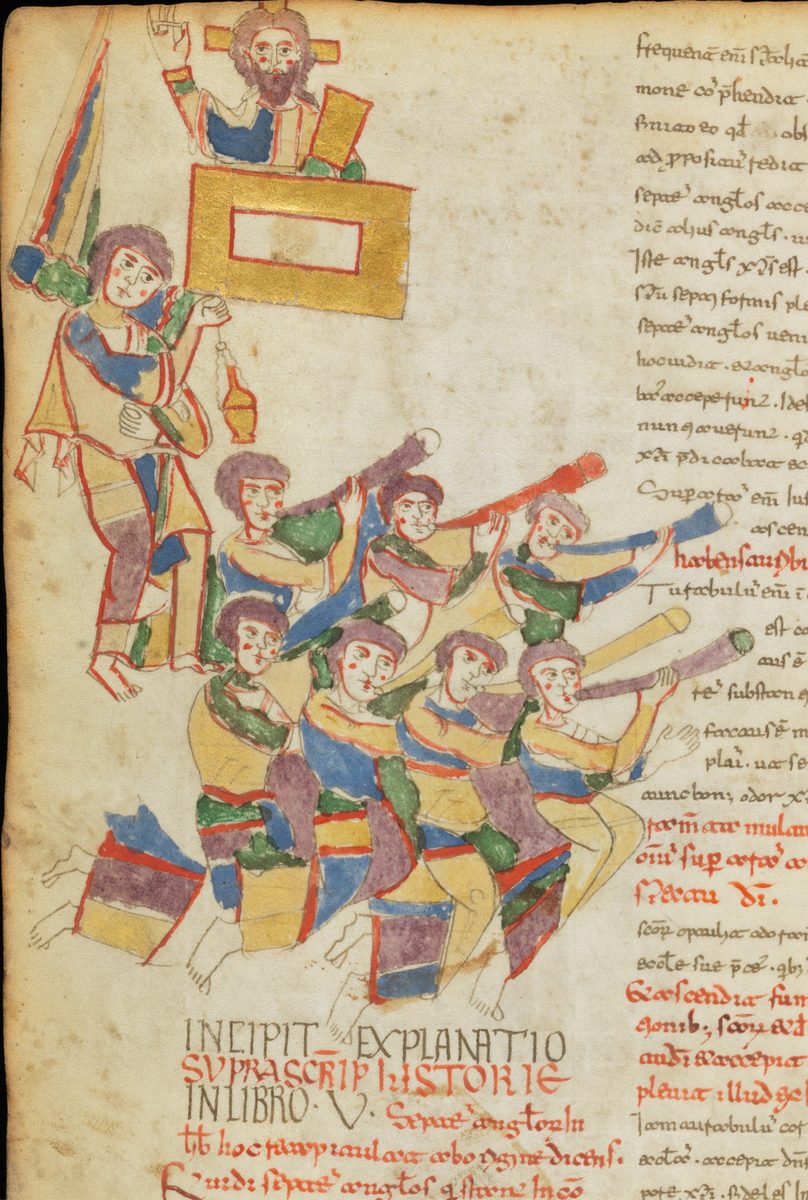
A page from an illuminated manuscript, painted in blue, gold, purple, and green against aged parchment. At the top, a haloed, bearded Christ stands behind a golden altar-like structure with a blank rectangular panel at its center, one hand raised, the other holding a book. A small vessel hangs by a cord beneath the altar. To the left, a standing figure holds a tall striped banner. Below, seven men in colorful striped tunics are arranged in a descending diagonal row, each raising a long trumpet to his lips. Beneath the image, red and black Latin text begins a new section of commentary.
Christ and the Seven Trumpets, from the Genevan Beatus
Unknown illuminator, southern Italy, 11th century · Bibliothèque de Genève, Ms. lat. 357

The trumpets are drawn together, not one at a time. This chapter sounds its first four trumpets in sequence, each with its own verse and its own disaster; the illuminator instead draws all seven angels at once, cascading down the page in a single diagonal rush — the seven simply handed out and ready (v2), or a compressed image of the whole sequence at once, is a question the picture itself doesn't answer.

The hanging vessel beneath the altar is likely this chapter's golden censer (vv3-5) — small and easy to miss, tucked under the altar's blank central panel, in a chapter where it does real double duty: first carrying incense and the saints' prayers up, then carrying fire back down.

Christ presiding is the illuminator's own framing, not this chapter's own scene. Chapter 8 itself never redescribes the one on the throne at this point in the vision; the haloed figure here draws on the book's other throne-room scenes rather than any single verse in this chapter.

Public domain · View the original
1
Καὶ ὅταν ἤνοιξεν τὴν σφραγῖδα τὴν ἑβδόμην, ἐγένετο σιγὴ ἐν τῷ οὐρανῷ ὡς ἡμιώριον.
And when he opened the seventh seal, there was silence in heaven for about half an hour.note
Y cuando abrió el séptimo sello, se hizo silencio en el cielo como por media hora.
2
καὶ εἶδον τοὺς ἑπτὰ ἀγγέλους οἳ ἐνώπιον τοῦ θεοῦ ἑστήκασιν, καὶ ἐδόθησαν αὐτοῖς ἑπτὰ σάλπιγγες.
And I saw the seven angels who stand before God, and seven trumpets were given to them.note
Y vi a los siete ángeles que están en pie delante de Dios, y se les dieron siete trompetas.
3
Καὶ ἄλλος ἄγγελος ἦλθεν καὶ ἐστάθη ἐπὶ τοῦ θυσιαστηρίου ἔχων λιβανωτὸν χρυσοῦν, καὶ ἐδόθη αὐτῷ θυμιάματα πολλὰ ἵνα δώσει ταῖς προσευχαῖς τῶν ἁγίων πάντων ἐπὶ τὸ θυσιαστήριον τὸ χρυσοῦν τὸ ἐνώπιον τοῦ θρόνου.
And another angel came and stood at the altar, holding a golden censer, and much incense was given to him, to offer it with the prayers of all the saints on the golden altar before the throne.note
Y otro ángel vino y se paró ante el altar, con un incensario de oro, y se le dio mucho incienso para añadirlo a las oraciones de todos los santos, sobre el altar de oro que estaba delante del trono.
cross-refs⤷ 6:10
4
καὶ ἀνέβη ὁ καπνὸς τῶν θυμιαμάτων ταῖς προσευχαῖς τῶν ἁγίων ἐκ χειρὸς τοῦ ἀγγέλου ἐνώπιον τοῦ θεοῦ.
And the smoke of the incense, with the prayers of the saints, rose before God from the hand of the angel.note
Y el humo del incienso, con las oraciones de los santos, subió delante de Dios de la mano del ángel.
5
καὶ εἴληφεν ὁ ἄγγελος τὸν λιβανωτόν, καὶ ἐγέμισεν αὐτὸν ἐκ τοῦ πυρὸς τοῦ θυσιαστηρίου, καὶ ἔβαλεν εἰς τὴν γῆν· καὶ ἐγένοντο βρονταὶ καὶ φωναὶ καὶ ἀστραπαὶ καὶ σεισμός.
And the angel took the censer, and filled it with fire from the altar, and threw it to the earth, and there were thunders and voices and lightnings and an earthquake.note
Y el ángel tomó el incensario, y lo llenó del fuego del altar, y lo arrojó a la tierra; y hubo truenos, y voces, y relámpagos, y un terremoto.
cross-refs⤷ 6:8
6
Καὶ οἱ ἑπτὰ ἄγγελοι οἱ ἔχοντες τὰς ἑπτὰ σάλπιγγας ἡτοίμασαν αὑτοὺς ἵνα σαλπίσωσιν.
And the seven angels who had the seven trumpets prepared themselves to sound them.note
Y los siete ángeles que tenían las siete trompetas se prepararon para tocarlas.
7
Καὶ ὁ πρῶτος ἐσάλπισεν· καὶ ἐγένετο χάλαζα καὶ πῦρ μεμιγμένα ἐν αἵματι, καὶ ἐβλήθη εἰς τὴν γῆν· καὶ τὸ τρίτον τῆς γῆς κατεκάη, καὶ τὸ τρίτον τῶν δένδρων κατεκάη, καὶ πᾶς χόρτος χλωρὸς κατεκάη.
And the first sounded, and there came hail and fire, mixed with blood, and it was thrown to the earth, and a third of the earth was burned up, and a third of the trees were burned up, and all the green grass was burned up.note
Y el primero tocó la trompeta, y hubo granizo y fuego mezclados con sangre, que fueron arrojados sobre la tierra; y la tercera parte de la tierra se quemó, y la tercera parte de los árboles se quemó, y toda la hierba verde se quemó.
cross-refs⤷ Exod 9:23
8
Καὶ ὁ δεύτερος ἄγγελος ἐσάλπισεν· καὶ ὡς ὄρος μέγα πυρὶ καιόμενον ἐβλήθη εἰς τὴν θάλασσαν· καὶ ἐγένετο τὸ τρίτον τῆς θαλάσσης αἷμα,
And the second angel sounded, and something like a great mountain, burning with fire, was thrown into the sea, and a third of the sea became blood,note
Y el segundo ángel tocó la trompeta, y algo como una gran montaña ardiendo en fuego fue arrojado al mar; y la tercera parte del mar se convirtió en sangre,
9
καὶ ἀπέθανε τὸ τρίτον τῶν κτισμάτων τῶν ἐν τῇ θαλάσσῃ, τὰ ἔχοντα ψυχάς, καὶ τὸ τρίτον τῶν πλοίων διεφθάρησαν
and a third of the creatures in the sea that had life died, and a third of the ships were destroyed.note
y murió la tercera parte de las criaturas que estaban en el mar y que tenían vida, y la tercera parte de las naves fue destruida.
10
Καὶ ὁ τρίτος ἄγγελος ἐσάλπισεν· καὶ ἔπεσεν ἐκ τοῦ οὐρανοῦ ἀστὴρ μέγας καιόμενος ὡς λαμπάς, καὶ ἔπεσεν ἐπὶ τὸ τρίτον τῶν ποταμῶν καὶ ἐπὶ τὰς πηγὰς τῶν ὑδάτων.
And the third angel sounded, and a great star fell from heaven, burning like a torch, and it fell on a third of the rivers and on the springs of water.note
Y el tercer ángel tocó la trompeta, y cayó del cielo una gran estrella, ardiendo como una antorcha, y cayó sobre la tercera parte de los ríos y sobre las fuentes de las aguas.
11
καὶ τὸ ὄνομα τοῦ ἀστέρος λέγεται· ὁ Ἄψινθος. καὶ ἐγένετο τὸ τρίτον τῶν ὑδάτων εἰς ἄψινθον, καὶ πολλοὶ τῶν ἀνθρώπων ἀπέθανον ἐκ τῶν ὑδάτων, ὅτι ἐπικράνθησαν.
And the name of the star is called Wormwood. And a third of the waters became wormwood, and many of the people died from the water, because it had been made bitter.note
Y el nombre de la estrella es Ajenjo. Y la tercera parte de las aguas se convirtió en ajenjo, y muchos hombres murieron a causa de esas aguas, porque se habían vuelto amargas.
12
Καὶ ὁ τέταρτος ἄγγελος ἐσάλπισεν· καὶ ἐπλήγη τὸ τρίτον τοῦ ἡλίου καὶ τὸ τρίτον τῆς σελήνης καὶ τὸ τρίτον τῶν ἀστέρων, ἵνα σκοτισθῇ τὸ τρίτον αὐτῶν καὶ ἡ ἡμέρα μὴ φάνῃ τὸ τρίτον αὐτῆς, καὶ ἡ νὺξ ὁμοίως.
And the fourth angel sounded, and a third of the sun was struck, and a third of the moon, and a third of the stars, so that a third of them would be darkened, and the day would not shine for a third of it, and likewise the night.note
Y el cuarto ángel tocó la trompeta, y fue herida la tercera parte del sol, y la tercera parte de la luna, y la tercera parte de las estrellas, de modo que se oscureció la tercera parte de ellos, y no brillaba la tercera parte del día, y asimismo de la noche.
13
Καὶ εἶδον, καὶ ἤκουσα ἑνὸς ἀετοῦ πετομένου ἐν μεσουρανήματι λέγοντος φωνῇ μεγάλῃ· Οὐαὶ οὐαὶ οὐαὶ τοὺς κατοικοῦντας ἐπὶ τῆς γῆς ἐκ τῶν λοιπῶν φωνῶν τῆς σάλπιγγος τῶν τριῶν ἀγγέλων τῶν μελλόντων σαλπίζειν.
And I looked, and I heard a single eagle, flying in midheaven, saying with a loud voice, ‘Woe, woe, woe to those who dwell on the earth, because of the remaining trumpet blasts of the three angels who are about to sound.’note
Y miré, y oí a una sola águila que volaba en medio del cielo, diciendo a gran voz: «¡Ay, ay, ay de los que moran en la tierra, a causa de los toques de trompeta que faltan de los tres ángeles que están para tocar!»

Translator’s Notes

Verses 1–2 · a half hour the whole book never explains · ἐγένετο σιγὴ ἐν τῷ οὐρανῷ ὡς ἡμιώριον egeneto sigē en tō ouranō hōs hēmiōrion

This half hour of silence is one of the least explained moments in the whole book, and the library reports several old guesses rather than one answer. Some read it against Jewish temple practice, where incense was offered in silence while the congregation prayed outside; some read it as heaven itself pausing in suspense before the seventh seal's contents — the seven trumpets — are revealed; some simply take it as dramatic pacing, a held breath between the sixth seal's terror and what comes next. Nothing in the text explains the pause. It only marks that there was one, and for how long.

The seventh seal does not contain a single new judgment, the way seals one through six each did. It contains the seven trumpets — the seals do not stand apart from the trumpets; the seventh seal is the trumpets, the next cycle nested inside the last.

Verses 3–5 · the same fire that carries prayers up throws judgment down · θυμιάματα… ταῖς προσευχαῖς τῶν ἁγίων thymiamata… tais proseuchais tōn hagiōn

The chapter pairs two uses of the same golden altar deliberately. First, an angel offers incense together with the prayers of the saints — likely the very prayers heard already, the martyrs under the altar crying ‘how long’ at 6:10 — and the smoke rises to God. Then the same censer is refilled, not with incense this time but with fire from the altar, and thrown back down to earth. The prayer goes up; the answer comes down, from the same vessel. The text does not spell out the connection between the two directions. It only places them back to back.

Verses 6–9 · a fourth becomes a third · χάλαζα καὶ πῦρ μεμιγμένα ἐν αἵματι chalaza kai pyr memigmena en haimati

The trumpets escalate past the seals in scale, not just in kind. The fourth seal's horseman was given power over a fourth of the earth (6:8); the first four trumpets each strike a third. The same fraction — a third — repeats seven times across this chapter alone (earth, trees, grass; sea, sea creatures, ships; rivers and springs; sun, moon, stars, day, night), a deliberate drumbeat of partial, not total, destruction. Whatever is coming, this is still not everything.

Hail and fire, mixed with blood (v7) rewrites the seventh plague of Egypt, where hail and fire came down together and struck ‘every plant of the field’ (Exodus 9:23-25) — the same combination, centuries later, aimed now at the whole earth rather than one nation.

Verses 10–13 · a bitter name, and a bird whose identity the manuscripts dispute · τὸ ὄνομα τοῦ ἀστέρος λέγεται· ὁ Ἄψινθος to onoma tou asteros legetai; ho Apsinthos

Wormwood is a real, bitter plant (Artemisia absinthium), and long before this chapter it was already the Hebrew Bible's standing image for the bitterness that follows broken covenant and coming judgment — a root bearing wormwood and gall (Deuteronomy 29:18), justice turned to wormwood (Amos 5:7), a people fed wormwood and given poisoned water to drink (Jeremiah 9:15, 23:15). This chapter does not invent a new symbol; it names a star after an old one and lets it poison what should have given life.

NVI does not just translate the name; it changes it. KJV, ASV and ESV all keep ‘Wormwood’ as a proper name, and RV60 keeps the matching Spanish botanical name, ‘Ajenjo.’ NVI alone renames the star itself ‘Amargura,’ Bitterness — trading the specific plant for the general quality it stood for, a translation choice rather than a different Greek text.

‘Eagle’ or ‘angel’? A real, well-attested textual variant, not a translation choice. KJV and RV60 both read ‘angel’, following the Textus Receptus; ASV, NIV, ESV and NVI all read ‘eagle’, following the earlier manuscripts — the reading kept here. An eagle crying human words in midheaven is, if anything, the stranger image, and stranger is usually the harder reading to have invented by accident.

Patterns worth carrying forward

Where this translation follows the earlier manuscripts: v13's ‘eagle’ over KJV/RV60's ‘angel’ — a real textual split, flagged rather than silently resolved either way.

Echoes paid. The golden altar and the prayers of the saints (v3) recall the martyrs' own cry, ‘how long,’ from 6:10 — the same prayers, now carried up by name. The ‘third’ that structures every trumpet in this chapter answers, and intensifies, the fourth seal's reach over a fourth of the earth at 6:8.

Echoes planted. The seven trumpets (v2), only now handed out, will structure every chapter through 11, whenever they are translated — this chapter sounds the first four; the fifth and sixth, and the delay before the seventh, are still ahead. And the eagle's own ‘woe, woe, woe’ (v13) names the shape the next two trumpets will take before either one sounds.

⚠ Left open on purpose. Why heaven falls silent for half an hour, and what exactly that half hour was for — the library reports the leading guesses and settles on none of them. The text gives a duration. It withholds the reason.

Next installment in this book, whenever it is translated: Revelation 9, where the fifth trumpet opens a shaft to the abyss, and the first of the eagle's three woes begins.