The MisterLibrarian Bible Project
Catalogued & compared, one chapter at a time
☰ Menu
🌐 Español🗺️ Atlas

Revelation 7 — The Mister Translation
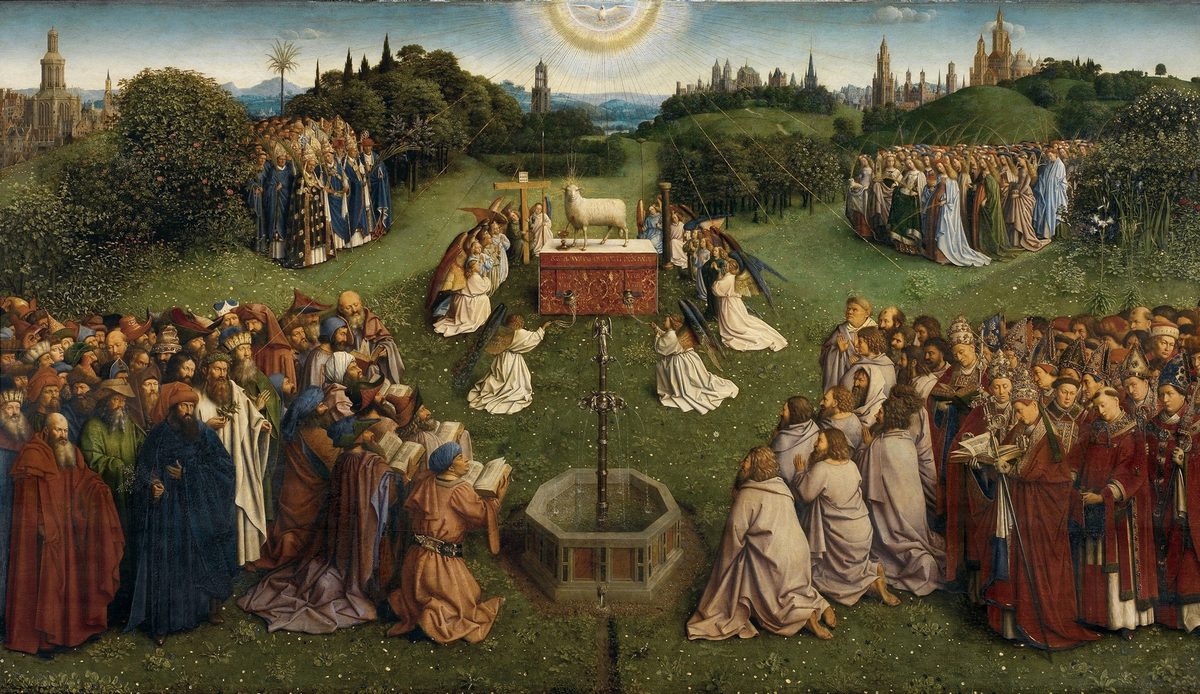
A detailed oil painting of a green meadow landscape. At the center, a white lamb stands on an altar, blood flowing from its chest into a golden chalice, beneath a radiant dove of light. Kneeling angels surround the altar holding instruments of the Passion. In front of the altar, an octagonal fountain sends water flowing toward the viewer. Four distinct crowds converge from the corners: at lower left, bearded patriarchs and prophets in robes, some holding open books; at lower right, barefoot apostles followed by popes, cardinals, and bishops in rich red vestments; at upper left, a procession of bishops and confessors in blue and gold; at upper right, a large group of women, martyrs and virgins, in white and colored robes. Distant cities and towers rise on the horizon under a blue sky.
The Adoration of the Mystic Lamb, central panel of the Ghent Altarpiece
Jan van Eyck, c. 1430–1432 · Saint Bavo Cathedral, Ghent

This panel is not an illustration of one chapter; it is several Revelation scenes fused into a single traditional composition. The lamb on the altar, blood flowing into a chalice, belongs to chapter 5's throne-room vision; the four converging crowds — prophets, apostles, bishops, virgin martyrs — are Van Eyck's own expansion of this chapter's ‘every nation and tribes and peoples and tongues’ (v9) into named medieval church categories the text itself never specifies; and the octagonal fountain at the very front, water flowing toward the viewer, reaches past this chapter's ‘springs of the water of life’ (v17) toward the river that will appear in chapter 22.

The blood becomes a Eucharistic image. Nothing in Revelation 5 or 7 puts the Lamb's blood into a chalice — that is the Mass read back onto the vision, John's slain Lamb and the altar of a fifteenth-century church service merged into one picture.

The white-robed crowd is not confined to one corner. This chapter describes a single multitude in white, palm branches in hand (v9); Van Eyck instead distributes white and colored robes across all four groups by rank and calling, an interpretive choice the text does not make for him.

Public domain · View the original
1
Μετὰ τοῦτο εἶδον τέσσαρας ἀγγέλους ἑστῶτας ἐπὶ τὰς τέσσαρας γωνίας τῆς γῆς, κρατοῦντας τοὺς τέσσαρας ἀνέμους τῆς γῆς, ἵνα μὴ πνέῃ ἄνεμος ἐπὶ τῆς γῆς μήτε ἐπὶ τῆς θαλάσσης μήτε ἐπὶ πᾶν δένδρον.
After this I saw four angels standing at the four corners of the earth, holding back the four winds of the earth, so that no wind would blow on the earth or on the sea or against any tree.note
Después de esto vi a cuatro ángeles en pie sobre los cuatro ángulos de la tierra, deteniendo los cuatro vientos de la tierra, para que no soplara viento alguno sobre la tierra, ni sobre el mar, ni sobre ningún árbol.
2
καὶ εἶδον ἄλλον ἄγγελον ἀναβαίνοντα ἀπὸ ἀνατολῆς ἡλίου, ἔχοντα σφραγῖδα θεοῦ ζῶντος, καὶ ἔκραξεν φωνῇ μεγάλῃ τοῖς τέσσαρσιν ἀγγέλοις οἷς ἐδόθη αὐτοῖς ἀδικῆσαι τὴν γῆν καὶ τὴν θάλασσαν,
And I saw another angel ascending from the rising of the sun, having the seal of the living God, and he called out with a loud voice to the four angels to whom it was given to harm the earth and the sea,note
Y vi a otro ángel que subía de donde nace el sol, teniendo el sello del Dios vivo; y clamó a gran voz a los cuatro ángeles a quienes se les había dado el poder de hacer daño a la tierra y al mar,
3
λέγων· Μὴ ἀδικήσητε τὴν γῆν μήτε τὴν θάλασσαν μήτε τὰ δένδρα, ἄχρι σφραγίσωμεν τοὺς δούλους τοῦ θεοῦ ἡμῶν ἐπὶ τῶν μετώπων αὐτῶν.
saying, ‘Do not harm the earth or the sea or the trees, until we have sealed the servants of our God on their foreheads.’note
diciendo: «No hagáis daño a la tierra, ni al mar, ni a los árboles, hasta que hayamos sellado a los siervos de nuestro Dios en sus frentes.»
4
Καὶ ἤκουσα τὸν ἀριθμὸν τῶν ἐσφραγισμένων, ἑκατὸν τεσσεράκοντα τέσσαρες χιλιάδες, ἐσφραγισμένοι ἐκ πάσης φυλῆς υἱῶν Ἰσραήλ·
And I heard the number of those who were sealed, a hundred and forty-four thousand, sealed from every tribe of the sons of Israel:note
Y oí el número de los sellados: ciento cuarenta y cuatro mil, sellados de todas las tribus de los hijos de Israel:
5
ἐκ φυλῆς Ἰούδα δώδεκα χιλιάδες ἐσφραγισμένοι ἐκ φυλῆς Ῥουβὴν δώδεκα χιλιάδες, ἐκ φυλῆς Γὰδ δώδεκα χιλιάδες,
from the tribe of Judah twelve thousand sealed, from the tribe of Reuben twelve thousand, from the tribe of Gad twelve thousand,note
de la tribu de Judá, doce mil sellados; de la tribu de Rubén, doce mil; de la tribu de Gad, doce mil;
cross-refs⤷ Gen 49:17
6
ἐκ φυλῆς Ἀσὴρ δώδεκα χιλιάδες, ἐκ φυλῆς Νεφθαλὶμ δώδεκα χιλιάδες, ἐκ φυλῆς Μανασσῆ δώδεκα χιλιάδες,
from the tribe of Asher twelve thousand, from the tribe of Naphtali twelve thousand, from the tribe of Manasseh twelve thousand,note
de la tribu de Aser, doce mil; de la tribu de Neftalí, doce mil; de la tribu de Manasés, doce mil;
7
ἐκ φυλῆς Συμεὼν δώδεκα χιλιάδες, ἐκ φυλῆς Λευὶ δώδεκα χιλιάδες, ἐκ φυλῆς Ἰσσαχὰρ δώδεκα χιλιάδες,
from the tribe of Simeon twelve thousand, from the tribe of Levi twelve thousand, from the tribe of Issachar twelve thousand,note
de la tribu de Simeón, doce mil; de la tribu de Leví, doce mil; de la tribu de Isacar, doce mil;
8
ἐκ φυλῆς Ζαβουλὼν δώδεκα χιλιάδες, ἐκ φυλῆς Ἰωσὴφ δώδεκα χιλιάδες, ἐκ φυλῆς Βενιαμὶν δώδεκα χιλιάδες ἐσφραγισμένοι.
from the tribe of Zebulun twelve thousand, from the tribe of Joseph twelve thousand, from the tribe of Benjamin twelve thousand sealed.note
de la tribu de Zabulón, doce mil; de la tribu de José, doce mil; de la tribu de Benjamín, doce mil sellados.
9
Μετὰ ταῦτα εἶδον, καὶ ἰδοὺ ὄχλος πολύς, ὃν ἀριθμῆσαι αὐτὸν οὐδεὶς ἐδύνατο, ἐκ παντὸς ἔθνους καὶ φυλῶν καὶ λαῶν καὶ γλωσσῶν, ἑστῶτες ἐνώπιον τοῦ θρόνου καὶ ἐνώπιον τοῦ ἀρνίου, περιβεβλημένους στολὰς λευκάς, καὶ φοίνικες ἐν ταῖς χερσὶν αὐτῶν·
After this I looked, and behold, a great multitude that no one could number, from every nation and tribes and peoples and tongues, standing before the throne and before the Lamb, clothed in white robes, with palm branches in their hands,note
Después de esto miré, y he aquí una gran multitud, la cual nadie podía contar, de toda nación y tribus y pueblos y lenguas, en pie delante del trono y delante del Cordero, vestidos de ropas blancas, y con palmas en las manos;
10
καὶ κράζουσι φωνῇ μεγάλῃ λέγοντες· Ἡ σωτηρία τῷ θεῷ ἡμῶν τῷ καθημένῳ ἐπὶ τῷ θρόνῳ καὶ τῷ ἀρνίῳ.
and they cry out with a loud voice, saying, ‘Salvation belongs to our God who is seated on the throne, and to the Lamb.’note
y clamaban a gran voz, diciendo: «La salvación pertenece a nuestro Dios, que está sentado en el trono, y al Cordero.»
11
καὶ πάντες οἱ ἄγγελοι εἱστήκεισαν κύκλῳ τοῦ θρόνου καὶ τῶν πρεσβυτέρων καὶ τῶν τεσσάρων ζῴων, καὶ ἔπεσαν ἐνώπιον τοῦ θρόνου ἐπὶ τὰ πρόσωπα αὐτῶν καὶ προσεκύνησαν τῷ θεῷ,
And all the angels were standing around the throne, and around the elders and the four living creatures, and they fell on their faces before the throne and worshiped God,note
Y todos los ángeles estaban en pie alrededor del trono, y de los ancianos y de los cuatro seres vivientes, y se postraron sobre sus rostros delante del trono, y adoraron a Dios,
12
λέγοντες· Ἀμήν· ἡ εὐλογία καὶ ἡ δόξα καὶ ἡ σοφία καὶ ἡ εὐχαριστία καὶ ἡ τιμὴ καὶ ἡ δύναμις καὶ ἡ ἰσχὺς τῷ θεῷ ἡμῶν εἰς τοὺς αἰῶνας τῶν αἰώνων· ἀμήν.
saying, ‘Amen. Blessing and glory and wisdom and thanksgiving and honor and power and might be to our God forever and ever. Amen.’note
diciendo: «Amén. La bendición y la gloria y la sabiduría y la acción de gracias y la honra y el poder y la fortaleza sean a nuestro Dios por los siglos de los siglos. Amén.»
13
Καὶ ἀπεκρίθη εἷς ἐκ τῶν πρεσβυτέρων λέγων μοι· Οὗτοι οἱ περιβεβλημένοι τὰς στολὰς τὰς λευκὰς τίνες εἰσὶν καὶ πόθεν ἦλθον;
And one of the elders answered, saying to me, ‘Who are these, clothed in the white robes, and from where have they come?’note
Y uno de los ancianos me preguntó, diciendo: «Estos que están vestidos de ropas blancas, ¿quiénes son, y de dónde han venido?»
14
καὶ εἴρηκα αὐτῷ· Κύριέ μου, σὺ οἶδας. καὶ εἶπέν μοι· Οὗτοί εἰσιν οἱ ἐρχόμενοι ἐκ τῆς θλίψεως τῆς μεγάλης, καὶ ἔπλυναν τὰς στολὰς αὐτῶν καὶ ἐλεύκαναν αὐτὰς ἐν τῷ αἵματι τοῦ ἀρνίου.
And I said to him, ‘My lord, you know.’ And he said to me, ‘These are the ones coming out of the great tribulation. They have washed their robes and made them white in the blood of the Lamb.’note
Y yo le dije: «Señor mío, tú lo sabes.» Y él me dijo: «Estos son los que están saliendo de la gran tribulación; y han lavado sus ropas y las han emblanquecido en la sangre del Cordero.»
15
διὰ τοῦτό εἰσιν ἐνώπιον τοῦ θρόνου τοῦ θεοῦ, καὶ λατρεύουσιν αὐτῷ ἡμέρας καὶ νυκτὸς ἐν τῷ ναῷ αὐτοῦ, καὶ ὁ καθήμενος ἐπὶ τοῦ θρόνου σκηνώσει ἐπʼ αὐτούς.
‘Therefore they are before the throne of God, and serve him day and night in his temple, and the one seated on the throne will spread his tabernacle over them.note
«Por eso están delante del trono de Dios, y le sirven día y noche en su templo; y el que está sentado en el trono extenderá su tabernáculo sobre ellos.
16
οὐ πεινάσουσιν ἔτι οὐδὲ διψήσουσιν ἔτι, οὐδὲ μὴ πέσῃ ἐπʼ αὐτοὺς ὁ ἥλιος οὐδὲ πᾶν καῦμα,
They will hunger no more, nor thirst anymore; the sun will not strike them, nor any scorching heat,note
Ya no tendrán hambre ni sed, y el sol no caerá más sobre ellos, ni calor alguno,
17
ὅτι τὸ ἀρνίον τὸ ἀνὰ μέσον τοῦ θρόνου ποιμανεῖ αὐτούς, καὶ ὁδηγήσει αὐτοὺς ἐπὶ ζωῆς πηγὰς ὑδάτων· καὶ ἐξαλείψει ὁ θεὸς πᾶν δάκρυον ἐκ τῶν ὀφθαλμῶν αὐτῶν.
for the Lamb in the midst of the throne will shepherd them, and will guide them to springs of the water of life, and God will wipe away every tear from their eyes.’note
porque el Cordero en medio del trono los pastoreará, y los guiará a fuentes de aguas de vida; y Dios enjugará toda lágrima de sus ojos.»

Translator’s Notes

Verses 1–3 · a pause, and a seal, before the seventh seal breaks · σφραγῖδα θεοῦ ζῶντος sphragida theou zōntos

Chapter 6 ended on a question — who is able to stand? — and this chapter opens by delaying the answer further still. The four winds, poised to be released, are held back; the earth, sea, and every tree wait, untouched, while a fifth angel marks a specific group first. Whatever the sixth seal's terror was building toward, this chapter interrupts it on purpose.

The seal itself is never described — only its location, the forehead, and its purpose, protection from what is coming. The image draws on a much older one: Ezekiel's man in linen marking the foreheads of those who grieve over Jerusalem's sin, sparing them from the judgment that follows (Ezekiel 9:4-6). A mark that protects by identifying, not by changing what happens to everyone else.

Verses 4–8 · twelve tribes, and one name missing · ἐκ πάσης φυλῆς υἱῶν Ἰσραήλ ek pasēs phylēs huiōn Israēl

Dan is not on this list. Every other list of Israel's twelve tribes in the Bible finds some way to reach twelve — usually by omitting Levi (set apart for priestly service, without a land allotment) and splitting Joseph into Ephraim and Manasseh. This list does the opposite: it keeps Levi, and represents Joseph's line with Manasseh named separately and Joseph himself standing in for Ephraim — which reaches twelve only by leaving out Dan entirely, the sole tribe of Jacob's twelve sons never named here. The library reports two old explanations rather than choosing one: a later Jewish and patristic tradition (Irenaeus among the earliest) held that the Antichrist would come from Dan's line, reading Jacob's own blessing over Dan as a serpent ‘by the way’ (Genesis 49:17) as an omen; a separate, older reading points to Dan's own history of idolatry, the golden calf shrine Jeroboam built at Dan itself (1 Kings 12:29). Neither explanation is stated in this text. Only the absence is.

Verses 9–12 · a number no one could count, after a number given exactly · ὄχλος πολύς, ὃν ἀριθμῆσαι αὐτὸν οὐδεὶς ἐδύνατο ochlos polys, hon arithmēsai auton oudeis edynato

The chapter deliberately sets two crowds side by side: a hundred and forty-four thousand, counted exactly, tribe by tribe (vv4-8) — and then a multitude no one could count, ‘from every nation and tribes and peoples and tongues’ (v9). The four-part formula is the same one sung of the redeemed at 5:9, in yet another order — the fourth of seven appearances, none repeating the last one's arrangement.

The palm branches (v9) carried by a crowd standing before God recall the branches of Sukkot, the Feast of Tabernacles (Leviticus 23:40), and the same branches a crowd waved before a different entrance, into Jerusalem, for a different king (John 12:13). Here the procession has already arrived at the throne it was walking toward.

Verses 13–17 · a question John cannot answer, and an old promise, quoted almost word for word · οὗτοί εἰσιν οἱ ἐρχόμενοι ἐκ τῆς θλίψεως τῆς μεγάλης houtoi eisin hoi erchomenoi ek tēs thlipseōs tēs megalēs

‘The’ great tribulation, not just ‘a’ great tribulation. KJV alone on this shelf drops the definite article the Greek supplies; ASV, NIV and ESV all keep it, ‘the great tribulation’ — a specific, singular ordeal rather than tribulation as a general category. RV60 and NVI differ from each other on a separate point: RV60 reads han salido, ‘have come out’ — already finished; NVI reads están saliendo, ‘are coming out’ — still under way.

The paradox of v14 is deliberate, not an accident of translation: robes are washed white by being washed in blood. Nothing softens the image in the Greek.

Verses 16–17 are close to a direct quotation of Isaiah's own promise: ‘they shall not hunger or thirst, neither scorching wind nor sun shall strike them, for he who has pity on them will lead them, and by springs of water will guide them’ (Isaiah 49:10). John changes the shepherd from Jehovah to the Lamb and otherwise keeps the promise nearly intact — the same comfort, given to the same kind of crowd, centuries apart.

‘Spread his tabernacle’ or ‘dwell’ or ‘shelter’? Three different choices for one Greek verb, skēnōsei, the same tent-pitching word behind John 1:14's ‘the Word became flesh and tabernacled among us.’ ASV alone keeps the literal image, ‘spread his tabernacle’; KJV reads the plainer ‘dwell among them’; NIV and ESV both abandon the tent image entirely for ‘shelter them with his presence.’ RV60 keeps the literal tent, matching ASV; NVI matches NIV/ESV's shelter-and-presence reading.

Patterns worth carrying forward

Where this translation flags rather than smooths: Dan's absence from the tribal list (vv4-8), reported with the library's two leading explanations rather than one chosen answer; and v14's washed-white-in-blood image, kept as the paradox it is in Greek.

Echoes paid. This chapter's pause — four winds held, one question from chapter 6 still unanswered — interrupts the sixth seal's terror on purpose, before the seventh seal chapter 8 will finally open. The ‘nation, tribes, peoples, tongues’ formula (v9), now in a fourth arrangement after 5:9.

Echoes planted. God tabernacling over his people (v15) anticipates the same promise, the same verb, at the New Jerusalem itself — ‘the tabernacle of God is with man’ (21:3). And v17's closing line, God wiping away every tear, is not this book's only time: the identical promise closes the whole vision at 21:4 — the same comfort, offered twice, chapters apart, to different crowds.

⚠ Left open on purpose. Why Dan is missing, and whether the hundred and forty-four thousand and the uncountable multitude are the same group seen two ways or two distinct companies — both old questions, and the library reports the live readings rather than settling either.

Next installment in this book, whenever it is translated: Revelation 8, where the Lamb opens the seventh seal, there is silence in heaven for about half an hour, and seven angels are given seven trumpets.