The MisterLibrarian Bible Project
Catalogued & compared, one chapter at a time
☰ Menu
🌐 Español🗺️ Atlas

Revelation 5 — The Mister Translation
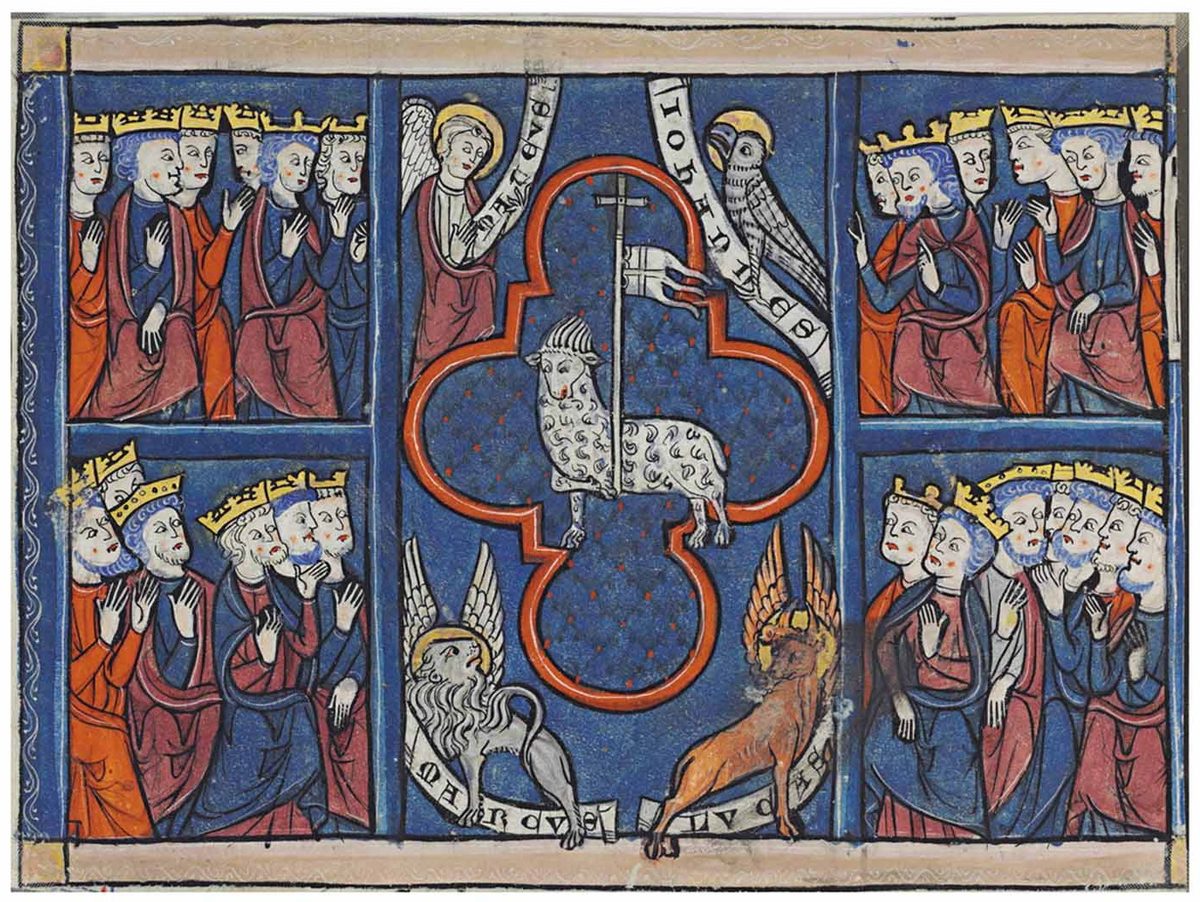
An illuminated manuscript page on vellum. At the center, inside a red quatrefoil frame, a white horned lamb stands beside a tall staff topped with a cross. In the four lobes around it are the four winged evangelist symbols: a haloed angel labeled MATHEUS at upper left, holding a scroll and offering a small book toward the lamb; a haloed eagle labeled IOHANNES at upper right; a haloed lion labeled MARCUS at lower left; and a winged ox labeled LUCAS at lower right. Four rectangular panels fill the corners of the page, each showing six crowned, richly robed elders with hands raised in prayer, twenty-four figures in total.
The Lamb of the Apocalypse, with the Four Evangelist Symbols and the Twenty-Four Elders
Unknown illuminator, late 13th century · Formerly Burckhardt–Wildt and Alan Thomas collections; sold at Christie's, present location unrecorded

The four living creatures have become the four Evangelists. This chapter never says the zōa stand for the Gospel writers — that identification is a much later Christian tradition, fixed in the West by Jerome around AD 400 (lion for Mark, ox for Luke, eagle for John, and the fourth — here a haloed angel — for Matthew). The illuminator has labeled each creature with its evangelist's name (MARCUS, LUCAS, IOHANNES, MATHEUS) directly on its banderole, folding chapter 4's throne-room vision into a piece of church tradition four centuries younger than the text itself.

Count the elders. Four panels of six each, twenty-four in total, hands raised in the gesture of acclamation rather than drawn casting actual crowns — the miniature's other half (not shown here), on the same parchment's reverse, depicts Christ breaking the seals with the Lamb beside him in a mandorla, the elders now emerging from clouds in musical worship.

This cutting has no fixed home. The manuscript it came from was dismembered in 1796 — cut apart and its leaves sold individually, a common fate for illuminated books once collectors began prizing single miniatures over whole volumes. This particular leaf is named for two of its later owners, Daniel Burckhardt-Wildt and Alan Thomas, and last surfaced at a Christie's auction; where it hangs today, if anywhere public, isn't recorded.

Public domain · View the original
1
Καὶ εἶδον ἐπὶ τὴν δεξιὰν τοῦ καθημένου ἐπὶ τοῦ θρόνου βιβλίον γεγραμμένον ἔσωθεν καὶ ὄπισθεν κατεσφραγισμένον σφραγῖσιν ἑπτά.
And I saw, in the right hand of the one seated on the throne, a scroll written on the inside and on the back, sealed with seven seals.note
Y vi, en la mano derecha del que estaba sentado en el trono, un rollo escrito por dentro y por detrás, sellado con siete sellos.
2
καὶ εἶδον ἄγγελον ἰσχυρὸν κηρύσσοντα ἐν φωνῇ μεγάλῃ· Τίς ἄξιος ἀνοῖξαι τὸ βιβλίον καὶ λῦσαι τὰς σφραγῖδας αὐτοῦ;
And I saw a mighty angel proclaiming with a loud voice, ‘Who is worthy to open the scroll and to loose its seals?’note
Y vi a un ángel poderoso que proclamaba a gran voz: «¿Quién es digno de abrir el rollo y de romper sus sellos?»
3
καὶ οὐδεὶς ἐδύνατο ἐν τῷ οὐρανῷ οὐδὲ ἐπὶ τῆς γῆς οὐδὲ ὑποκάτω τῆς γῆς ἀνοῖξαι τὸ βιβλίον οὔτε βλέπειν αὐτό.
And no one was able, in heaven or on the earth or under the earth, to open the scroll or to look into it.note
Y nadie podía, ni en el cielo ni en la tierra ni debajo de la tierra, abrir el rollo ni mirar dentro de él.
4
καὶ ἐγὼ ἔκλαιον πολὺ ὅτι οὐδεὶς ἄξιος εὑρέθη ἀνοῖξαι τὸ βιβλίον οὔτε βλέπειν αὐτό·
And I began weeping much, because no one was found worthy to open the scroll or to look into it.note
Y yo lloraba mucho, porque nadie fue hallado digno de abrir el rollo ni de mirar dentro de él.
5
καὶ εἷς ἐκ τῶν πρεσβυτέρων λέγει μοι· Μὴ κλαῖε· ἰδοὺ ἐνίκησεν ὁ λέων ὁ ἐκ τῆς φυλῆς Ἰούδα, ἡ ῥίζα Δαυίδ, ἀνοῖξαι τὸ βιβλίον καὶ τὰς ἑπτὰ σφραγῖδας αὐτοῦ.
And one of the elders said to me, ‘Do not weep. Behold, the Lion of the tribe of Judah, the Root of David, has conquered, so as to open the scroll and its seven seals.’note
Y uno de los ancianos me dijo: «No llores. Mira, el León de la tribu de Judá, la Raíz de David, ha vencido, para abrir el rollo y sus siete sellos.»
cross-refs⤷ Gen 49:9
6
Καὶ εἶδον ἐν μέσῳ τοῦ θρόνου καὶ τῶν τεσσάρων ζῴων καὶ ἐν μέσῳ τῶν πρεσβυτέρων ἀρνίον ἑστηκὸς ὡς ἐσφαγμένον, ἔχων κέρατα ἑπτὰ καὶ ὀφθαλμοὺς ἑπτά, οἵ εἰσιν τὰ ἑπτὰ πνεύματα τοῦ θεοῦ, ἀπεσταλμένοι εἰς πᾶσαν τὴν γῆν.
And I saw, in the midst of the throne and of the four living creatures, and in the midst of the elders, a Lamb standing as though slain, having seven horns and seven eyes, which are the seven spirits of God, sent out into all the earth.note
Y vi, en medio del trono y de los cuatro seres vivientes, y en medio de los ancianos, un Cordero en pie, como inmolado, que tenía siete cuernos y siete ojos, los cuales son los siete espíritus de Dios, enviados a toda la tierra.
cross-refs⤷ 4:5
7
καὶ ἦλθεν καὶ εἴληφεν ἐκ τῆς δεξιᾶς τοῦ καθημένου ἐπὶ τοῦ θρόνου.
And he came and took it from the right hand of the one seated on the throne.note
Y vino y lo tomó de la mano derecha del que estaba sentado en el trono.
8
καὶ ὅτε ἔλαβεν τὸ βιβλίον, τὰ τέσσαρα ζῷα καὶ οἱ εἴκοσι τέσσαρες πρεσβύτεροι ἔπεσαν ἐνώπιον τοῦ ἀρνίου, ἔχοντες ἕκαστος κιθάραν καὶ φιάλας χρυσᾶς γεμούσας θυμιαμάτων, αἵ εἰσιν αἱ προσευχαὶ τῶν ἁγίων·
And when he had taken the scroll, the four living creatures and the twenty-four elders fell down before the Lamb, each holding a harp, and golden bowls full of incense, which are the prayers of the saints.note
Y cuando hubo tomado el rollo, los cuatro seres vivientes y los veinticuatro ancianos se postraron delante del Cordero, cada uno con un arpa, y copas de oro llenas de incienso, que son las oraciones de los santos.
9
καὶ ᾄδουσιν ᾠδὴν καινὴν λέγοντες· Ἄξιος εἶ λαβεῖν τὸ βιβλίον καὶ ἀνοῖξαι τὰς σφραγῖδας αὐτοῦ, ὅτι ἐσφάγης καὶ ἠγόρασας τῷ θεῷ ἐν τῷ αἵματί σου ἐκ πάσης φυλῆς καὶ γλώσσης καὶ λαοῦ καὶ ἔθνους,
And they sing a new song, saying, ‘Worthy are you to take the scroll and to open its seals, for you were slain, and with your blood you purchased for God persons from every tribe and tongue and people and nation,note
Y cantan un cántico nuevo, diciendo: «Digno eres de tomar el rollo y de abrir sus sellos, porque fuiste inmolado, y con tu sangre compraste para Dios gente de toda tribu, lengua, pueblo y nación,
cross-refs⤷ 1:6
10
καὶ ἐποίησας αὐτοὺς τῷ θεῷ ἡμῶν βασιλείαν καὶ ἱερεῖς, καὶ βασιλεύουσιν ἐπὶ τῆς γῆς.
and you made them a kingdom and priests to our God, and they reign on the earth.’note
y los hiciste para nuestro Dios un reino y sacerdotes, y reinan sobre la tierra.»
11
Καὶ εἶδον, καὶ ἤκουσα φωνὴν ἀγγέλων πολλῶν κύκλῳ τοῦ θρόνου καὶ τῶν ζῴων καὶ τῶν πρεσβυτέρων, καὶ ἦν ὁ ἀριθμὸς αὐτῶν μυριάδες μυριάδων καὶ χιλιάδες χιλιάδων,
And I looked, and I heard the voice of many angels around the throne and the living creatures and the elders, and their number was myriads of myriads and thousands of thousands,note
Y miré, y oí la voz de muchos ángeles alrededor del trono y de los seres vivientes y de los ancianos, y su número era miríadas de miríadas y millares de millares,
12
λέγοντες φωνῇ μεγάλῃ· Ἄξιόν ἐστιν τὸ ἀρνίον τὸ ἐσφαγμένον λαβεῖν τὴν δύναμιν καὶ πλοῦτον καὶ σοφίαν καὶ ἰσχὺν καὶ τιμὴν καὶ δόξαν καὶ εὐλογίαν.
saying with a loud voice, Worthy is the Lamb who was slain to receive power and wealth and wisdom and might and honor and glory and blessing.’note
que decían a gran voz: «Digno es el Cordero, que fue inmolado, de recibir el poder, la riqueza, la sabiduría, la fuerza, la honra, la gloria y la alabanza.»
13
καὶ πᾶν κτίσμα ὃ ἐν τῷ οὐρανῷ καὶ ἐπὶ τῆς γῆς καὶ ὑποκάτω τῆς γῆς καὶ ἐπὶ τῆς θαλάσσης καὶ τὰ ἐν αὐτοῖς πάντα ἤκουσα λέγοντας· Τῷ καθημένῳ ἐπὶ τῷ θρόνῳ καὶ τῷ ἀρνίῳ ἡ εὐλογία καὶ ἡ τιμὴ καὶ ἡ δόξα καὶ τὸ κράτος εἰς τοὺς αἰῶνας τῶν αἰώνων
And every creature that is in heaven and on the earth and under the earth and on the sea, and all that is in them, I heard saying, ‘To the one seated on the throne and to the Lamb be blessing and honor and glory and might, forever and ever.’note
Y a toda criatura que está en el cielo, y en la tierra, y debajo de la tierra, y en el mar, y a todas las cosas que en ellos hay, oí que decían: «Al que está sentado en el trono, y al Cordero, sean la alabanza, la honra, la gloria y el dominio, por los siglos de los siglos.»
14
καὶ τὰ τέσσαρα ζῷα ἔλεγον Ἀμήν. καὶ οἱ πρεσβύτεροι ἔπεσαν καὶ προσεκύνησαν.
And the four living creatures said, ‘Amen.’ And the elders fell down and worshiped.note
Y los cuatro seres vivientes decían: «Amén.» Y los ancianos se postraron y adoraron.

Translator’s Notes

Verses 1–4 · a scroll no one is able to open · βιβλίον… κατεσφραγισμένον σφραγῖσιν ἑπτά biblion… katesphragismenon sphragisin hepta

The scroll is sealed with seven seals — not one seal to break and read, but a document that will be opened seal by seal, each break its own event, across the chapters that follow. ⚠ Written ‘on the inside and on the back’ (v1) most likely pictures a papyrus roll so full its writer had to turn it over and keep going, or a double-written legal document of the kind Roman law required to be sealed by multiple witnesses — either way, a document meant to be complete and unappealable once opened.

John weeps ‘much’ (v4) — a real, extended verb in Greek, not a moment's disappointment — because a search across the whole of creation, heaven and earth and under the earth, has failed. The chapter spends four verses establishing that failure before it answers it, so the answer in v5 lands as an actual reversal rather than a foregone conclusion.

‘Scroll’ or ‘book’? KJV and ASV both read ‘book’ throughout this chapter; NIV and ESV read ‘scroll,’ the physical object biblion actually names in the first century — a rolled papyrus or parchment, not a bound codex, which did not yet exist.

Verses 5–7 · you hear a lion, and you see a lamb · ὁ λέων… ἀρνίον ἑστηκὸς ὡς ἐσφαγμένον ho leōn… arnion hestēkos hōs esphagmenon

The chapter's central move happens between v5 and v6, and it is a deliberate mismatch between what John is told and what he sees. The elder announces a Lion — ‘the Lion of the tribe of Judah, the Root of David,’ two royal, conquering titles (Genesis 49:9-10; Isaiah 11:1,10) that promise exactly the kind of champion the search in vv1-4 seems to require. John turns to look at the Lion, and what stands there is a Lamb, standing as though slain — a slaughtered-and-risen sacrificial animal, not a predator. The conquest announced in v5 turns out to have already happened, and it was the slaying.

KJV alone drops a word Greek actually has. The text reads the Lamb hestēkos, ‘standing,’ as though slain — KJV renders only ‘a Lamb as it had been slain,’ leaving the standing out entirely; ASV, NIV and ESV all keep it. A small omission, but it is the detail that makes the image work: a slain animal that is nonetheless on its feet.

The word for ‘Lamb’ here is arnion, a diminutive — ‘little lamb’ — and it is the word this book will use for Christ twenty-eight more times, never once switching to amnos, the plain word used of Christ at John 1:29 and 1:36, Acts 8:32, and 1 Peter 1:19. Revelation's Lamb is consistently the small, vulnerable word, standing next to a throne, straight through to the wedding and the final chapters.

Verses 8–10 · a new song, and a textual crux over who is singing about whom · ἠγόρασας… ἐκ πάσης φυλῆς καὶ γλώσσης καὶ λαοῦ καὶ ἔθνους ēgorasas… ek pasēs phylēs kai glōssēs kai laou kai ethnous

Verses 9–10 carry a real, well-known textual variant, not a translation choice. KJV reads ‘hast redeemed us to God… hast made us… kings and priests… we shall reign,’ first person throughout — following the Greek text behind it. ASV, NIV and ESV all read third person — ‘persons… them… they’ — following the earlier manuscripts, which is the reading kept here. The same split holds in Spanish: RV60 reads ‘nos’ throughout, NVI reads ‘ellos.’ The elders and living creatures are singing about the redeemed, in the earlier text — not necessarily singing as members of that redeemed company themselves.

‘Every tribe and tongue and people and nation’ is a four-part formula this book will repeat, with small variations in order, six more times (7:9, 10:11, 11:9, 13:7, 14:6, 17:15) — Revelation's own standing phrase for the whole of humanity, first used here.

Verses 11–14 · the count widens, three times · Ἄξιόν ἐστιν τὸ ἀρνίον τὸ ἐσφαγμένον axion estin to arnion to esphagmenon

The chapter closes by widening its own choir three times over: first the twenty-four elders and four living creatures (v8), then ‘myriads of myriads and thousands of thousands’ of angels (v11) — a Greek phrase for an uncountable number, not a census — and finally ‘every creature… in heaven and on the earth and under the earth and on the sea’ (v13), the same three-tiered cosmos the seven-sealed scroll was declared unopenable in back at v3, only now filled with a single voice instead of a single silence.

The angels' hymn (v12) names seven things — power, wealth, wisdom, might, honor, glory, blessing — the same number as the scroll's seals, the Lamb's horns, and the Lamb's eyes in this chapter alone. And the hymn is grounded in a different reason than chapter 4's: there the twenty-four elders declared God worthy for creating (4:11); here the Lamb is declared worthy for being slain. Two worthiness-hymns, two grounds, one throne.

Patterns worth carrying forward

Where this translation sides with the earlier text over the Textus Receptus: v9-10's third-person “them…they” rather than KJV/RV60's first-person “us…we” — a real manuscript-tradition split, not a stylistic one, and flagged as such rather than silently adopting either shelf's choice.

Echoes paid. The door standing open and the throne room from chapter 4 continue directly into this scene — same setting, same twenty-four elders and four living creatures. The seven spirits of God (v6), now in a fourth setting after 1:4, 3:1, and 4:5. And chapter 4's creation-hymn to God is answered here by a redemption-hymn to the Lamb — the pairing that closing note promised.

Echoes planted. The four-part “tribe and tongue and people and nation” formula (v9), which recurs six more times before this book ends. “Kingdom and priests” (v10), already used of the redeemed at Revelation 1:6 and behind both at Exodus 19:6's ‘kingdom of priests.’ And the Lamb, standing as though slain (v6) — the single image this entire book will keep returning to, worship scene after worship scene, all the way to its final chapters.

⚠ Left open on purpose. Whether the elders and living creatures sing of themselves or of others in vv9-10 depends on which Greek text is read, and the library reports the split rather than resolving it. And exactly what the seven seals will each release — this chapter names the scroll and the one worthy to open it, and stops there on purpose.

Next installment in this book, whenever it is translated: Revelation 6, where the Lamb begins opening the seals one by one, and four horsemen ride out.