Revelation 4 — The Mister Translation
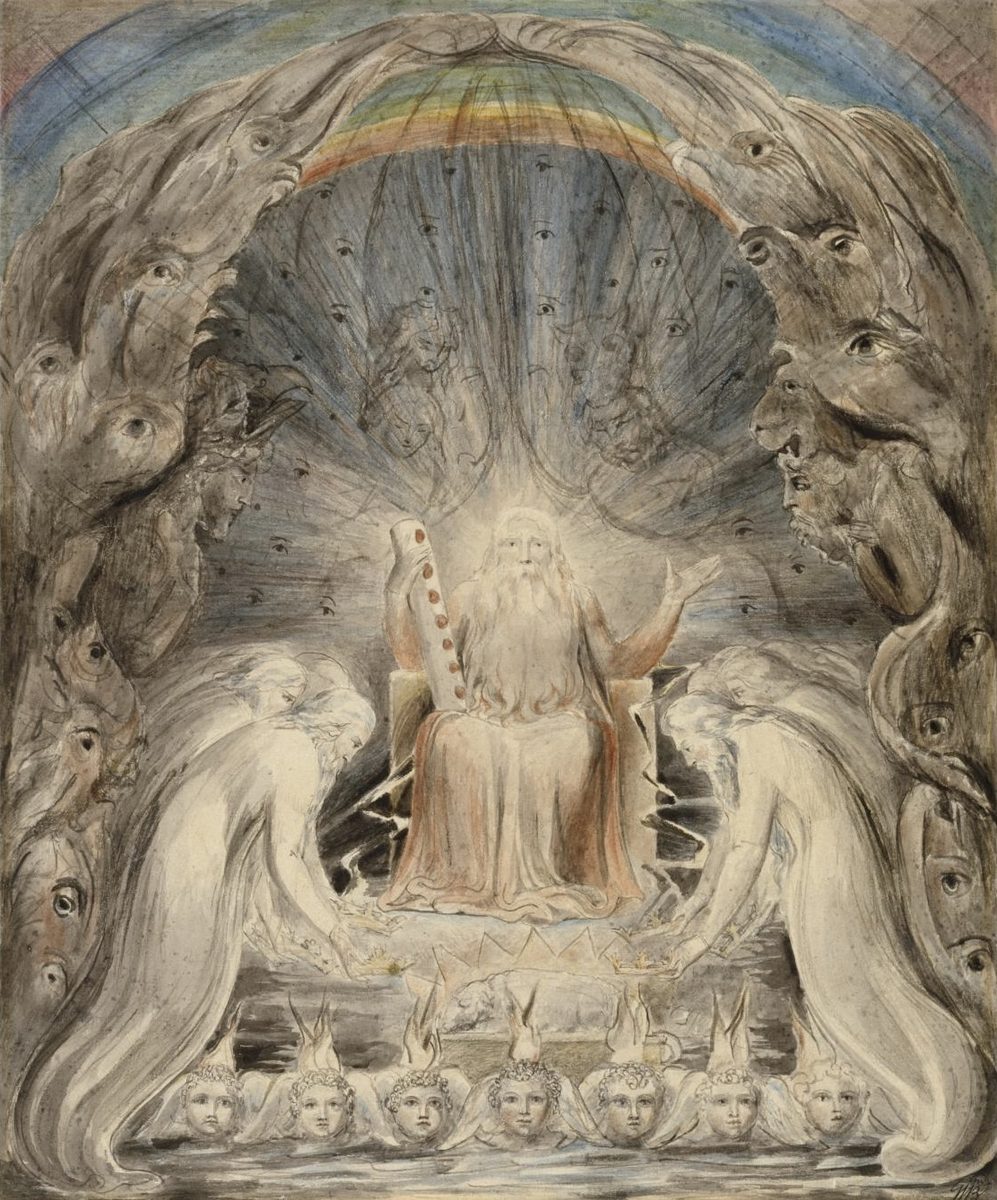
⚠ Blake drew the seven seals before the text asks for them. The scroll resting on the enthroned figure's knee already carries seven small red marks down its edge — the detail this chapter never actually mentions. That scroll and its seals belong to chapter 5, the next scene Blake never painted as a companion piece, but here it is anyway, already in the Ancient of Days' hand, one chapter early.
The eyes are not decoration. The twisting arch framing the throne on both sides is built entirely out of open eyes — Blake's solution to a description this chapter gives to the four living creatures (“full of eyes in front and behind,” v6) and stretches to cover the whole architecture of heaven around the throne, not just four animals in it. ⚠ Only two elders appear, not twenty-four — Blake's title names the full number but draws a pair bowing on each side as a stand-in for all of them, the same shorthand Christian art uses for the twelve apostles or the seventy disciples. The row of flame-headed faces along the bottom are the seven spirits of God burning as lamps before the throne (v5) — the same phrase named twice already in this book, drawn here as seven distinct small heads rather than one abstract flame. Blake made this watercolour as part of a series illustrating the whole of Revelation for his patron Thomas Butts; most of the set, including this sheet, is now split between the Tate and the Rosenbach Museum.
.jpg)
Translator’s Notes
⚠ This is the same open door Revelation 3's own closing note named as waiting here — the seven letters are complete, and the book's next movement opens on this exact image, a door standing open in heaven.
⚠ Notice what is never said: what God looks like. The one seated on the throne is never physically described — only compared, twice over, to the flash of gemstones (jasper, sardius) and to a rainbow's color (emerald). This is not a failure of the vision; it is the same restraint the whole Bible keeps around the divine form, from Moses seeing only Jehovah's back (Exodus 33:23) to Ezekiel's own throne-vision reaching for comparison after comparison and finally admitting it is only 'the appearance of the likeness of the glory of Jehovah' (Ezekiel 1:28). John inherits the restraint and keeps it.
The text never says who the twenty-four elders are. The common guess — twelve tribes plus twelve apostles, Israel and the church together — is old and attractive and nowhere stated; the library reports it as the leading reading, not as a settled fact the text itself supplies.
⚠ The seven spirits of God (v5) is not new here — the same phrase already opened this book's greeting (1:4) and named Christ's own possession, one for each of the seven congregations (3:1). This is its third appearance, and its setting has moved: from the letter's blessing, to a title Christ holds, to seven flames burning in front of the throne itself.
⚠ John is not inventing these creatures; he is combining two older visions that had never been combined before. The four faces — lion, ox, man, eagle — come from Ezekiel's own throne-vision (Ezekiel 1:5-10), but Ezekiel gives each of his four creatures all four faces at once, on one body; John instead gives each of his four creatures a single face, one creature per animal. The six wings and the endless, sleepless cry come from a different vision entirely — Isaiah's seraphim, who cover their faces and feet with two wings each and fly with the third pair (Isaiah 6:2), crying the same three words this chapter will now repeat. Two temple-visions, centuries apart, read as one scene.
⚠ KJV alone on this shelf calls them ‘beasts’ — a translation that has done real damage to how English readers picture this scene, since the word now suggests something monstrous. ASV, NIV and ESV all read ‘living creatures,’ matching RV60 and NVI's consistent ‘seres vivientes’ — the plain sense of the Greek zōa, simply ‘living things,’ with none of the KJV word's menace. ⚠ V7's second creature is a smaller divergence: KJV and ASV both read ‘calf,’ the literal moschos; NIV and ESV generalize to ‘ox.’
The elders' gesture (v10) is not merely bowing — they cast their crowns before the throne, giving up the one visible mark of their own authority in front of the one whose authority makes theirs possible at all. Nothing in the text suggests they get the crowns back before the scene ends; the point of the image is the giving, not the return.
⚠ ‘Our Lord and God’ (v11) is a striking address in Greek — ho kyrios kai ho theos hēmōn, an echo of the identical construction Thomas uses of the risen Christ, ‘my Lord and my God’ (John 20:28). Here the grounds for worship are stated as plainly as the address: creation itself — ‘you created all things, and because of your will they existed and were created.’ ⚠ This chapter's hymn is worth remembering once chapter 5 opens: there the Lamb receives worship for a second, different reason — not for making all things, but for being slain to redeem them. Creation and redemption, two songs to two thrones that turn out to be one throne.
Patterns worth carrying forward
Where this translation sides with the literal shelf: “living creatures” for zōa (vv6-8), not KJV's “beasts”; and “cast their crowns” (v10) kept as the physical, deliberate act it is in Greek rather than softened to a gesture of general homage.
Echoes paid. The open door — chapter 3's own closing note named this exact image as what would open the book's next movement, and v1 is that promise cashed. The seven spirits of God (v5), now in a third setting after 1:4 and 3:1.
Echoes planted. The twenty-four elders and their surrendered crowns, who reappear at the Lamb's own worship in chapter 5. The who was and is and is to come formula (v8), already used of God at 1:4 and 1:8, now sung rather than stated. And the ‘worthy’ hymn of v11, grounded in creation — set up to be answered, differently, by a second hymn to the Lamb grounded in redemption, whenever chapter 5 is translated.
⚠ Left open on purpose. Who the twenty-four elders represent — a leading guess, not a stated fact. And how exactly to picture creatures with a single face each drawn from a vision (Ezekiel's) where every creature had all four faces at once — the library states the source and the change and does not resolve the image further than the text itself does.
Next installment in this book, whenever it is translated: Revelation 5, where a scroll sealed with seven seals appears in the hand of the one on the throne, and only the Lamb who was slain is found worthy to open it.