Exodus 19 — The Mister Translation
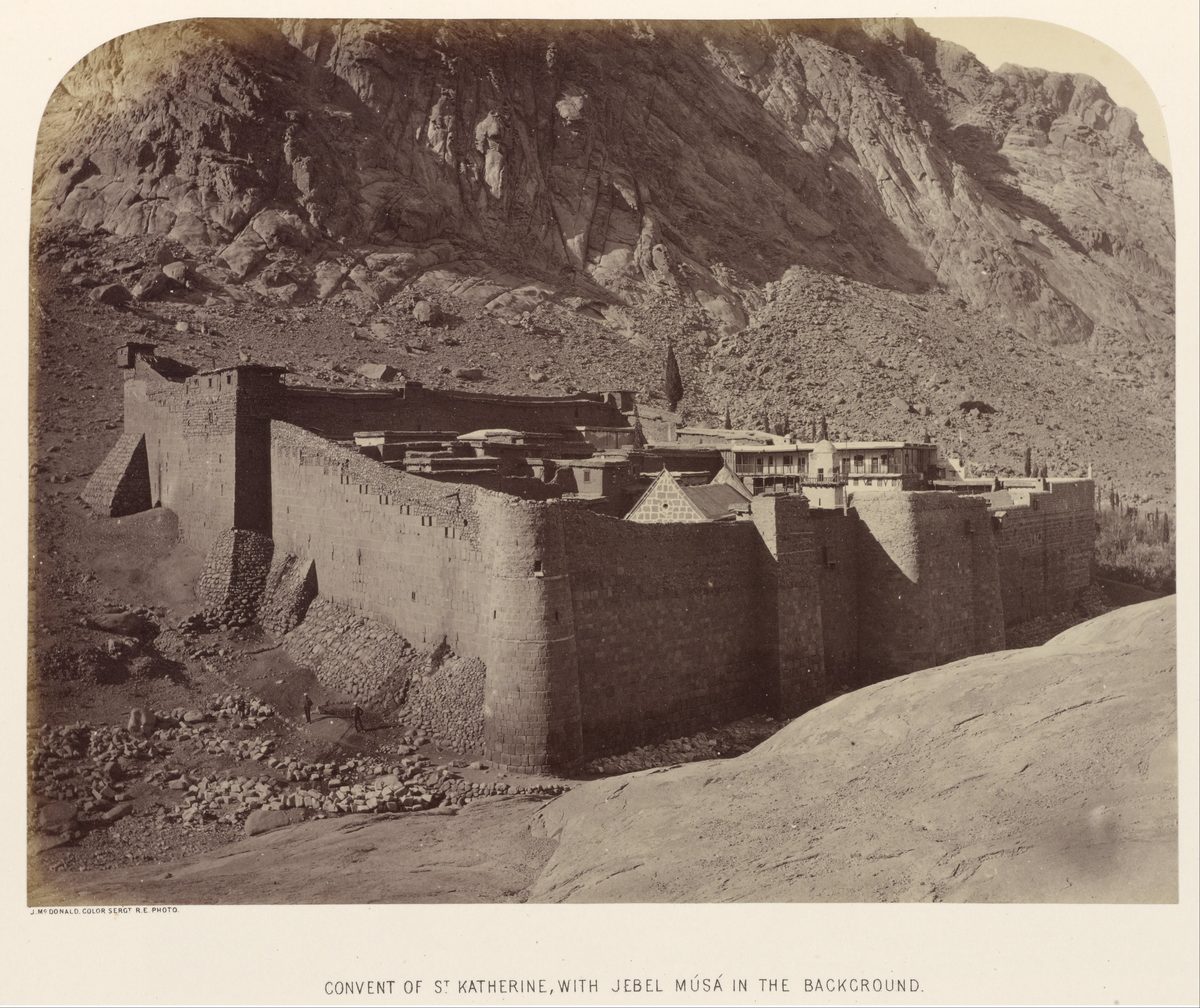
⚠ This mountain's identification with the Sinai of this chapter is a tradition, not a certainty the text itself supplies. Jebel Musa (‘Mountain of Moses’) has been venerated as biblical Sinai since at least the 4th century AD, when Christian monks first settled at its base; the monastery photographed here, St. Catherine's, has stood continuously since the 6th century and holds one of the world's oldest working libraries. But the biblical text never names which peak in the wider Sinai peninsula — or beyond it — is meant, and the identification rests on church tradition centuries after the events, not on a location given in Exodus itself. Serious alternative proposals exist, most prominently Jebel al-Lawz in northwest Saudi Arabia; none has displaced the traditional site in continuous use, veneration, or the weight of accumulated pilgrimage, but none is textually provable either.
The scale in this photograph is the point. Tiny figures at the base of walls built to withstand raiders for 1,500 years, dwarfed again by the mountain rising behind them — the same disproportion this chapter insists on between the people camped ‘in front of the mountain’ (v2) and what comes down onto its summit.

Translator’s Notes
A proposal, not yet a law
Everything in this chapter happens before a single commandment is given. Jehovah’s offer runs entirely on what has already occurred — ‘you have seen what I did to the Egyptians’ — and on an image, not a rule: he carried them here the way an eagle carries its young, on its own wings, above the danger rather than through it. The covenant that chapter 20 will spell out in law is proposed here first, and accepted first, as the terms of a relationship already in progress rather than as terms being negotiated from nothing.
⚠ ‘My treasured possession.’ Segullah is a rare word — used elsewhere of a king’s private wealth, the personal fund a monarch keeps distinct from the state treasury (compare 1 Chronicles 29:3). KJV ‘a peculiar treasure’; NIV/ESV ‘treasured possession’; RV60 ‘especial tesoro’; NVI ‘propiedad exclusiva.’ The claim is not generic favor but something closer to a king’s own private holding, among a whole earth Jehovah already owns.
⚠ ‘A kingdom of priests and a holy nation.’ The whole nation is offered a role usually reserved for a specialized class — not that Israel will each individually officiate, but that the nation as a whole will stand toward the rest of the world in the role a priest stands toward a congregation: mediating, representative, set apart. The library notes that this exact pairing resurfaces, applied to a different people entirely, in Revelation, whenever that chapter is translated.
A thick cloud, and a countdown
The instructions run in the same order both times they are given (vv10-13, repeated in action at v14-15): sanctify, wash garments, keep distance, wait three days. Do not go near a woman (v15) situates the holiness required alongside the physical ordinariness of camp life — a boundary drawn through everyday routine, not only around the mountain itself.
⚠ The death penalty for touching the mountain is carried out without human hands — stoned or shot through from a distance (v13), so that no one who executes the sentence has to cross the same boundary the sentence protects. The mountain’s holiness is treated as contagious in both directions: dangerous to approach, and dangerous to approach in order to punish someone else for approaching.
The mountain answers back
⚠ Every sense is given something at once — thunder and lightning to see and hear, a trumpet blast that has no human trumpeter to grow louder on its own, smoke like a kiln, the ground itself shaking. KJV/NIV agree on the order the phenomena arrive in; this translation keeps it. The chapter does not explain the trumpet — whose breath sustains and intensifies a sound with no visible source is left exactly as strange as the text makes it.
Moses spoke, and God answered him with a voice (v19) — not a scene of silence broken by human words alone, but a conversation conducted inside a storm, the two sounds (a man’s voice, a voice not a man’s) sustained together rather than one waiting for the other to stop.
Up and down, three times over
Moses ascends and descends this mountain repeatedly across this single chapter — at least at v3, v14, v20, and again v24-25 — and Jehovah’s instructions keep circling back to the same warning: keep the people back, sanctify the priests, do not let anyone break through. ⚠ Some readers hear in the repetition a sign of more than one telling of the same events woven together; the text itself gives no seam, only the same warning issued again as if the danger has not yet been taken seriously enough the first time.
‘Lest they break through to Jehovah to look’ (v21) — the danger named is not disobedience but curiosity, wanting to see more than has been granted. The chapter ends exactly where it started, with Moses as the one figure allowed to move freely between two sides of a line everyone else is warned, twice, not to cross.
Notes on this translation
Decisions. V5’s segullah kept as ‘treasured possession’ rather than KJV’s older ‘peculiar treasure,’ since ‘peculiar’ no longer carries its Elizabethan sense of ‘particular, one’s own’ for a modern reader. V13’s execution-by-distance (‘stoned or shot through’) kept explicit rather than generalized to ‘put to death,’ since the method is part of what the verse is saying. V16’s phenomena kept in the Hebrew’s own order rather than rearranged for English rhythm.
⚠ A note on order: chapter 19 was translated after chapter 20, filling the one gap that stood before the giving of the law — Sinai’s own sequence now reads without a seam into Exodus 20, already on these pages.