CreationBefore the FloodThe FloodAfter the FloodThe PatriarchsEgypt and the ExodusThe KingdomThe ExileThe ReturnBetween the TestamentsThe GospelsThe Apostolic Age
🕰
The Lamb opens the first six of the scroll's seven seals. Four horsemen ride out in turn — a white horse of conquest, a red horse of war, a black horse of famine, a pale horse whose rider is Death. The fifth seal reveals martyrs under the heavenly altar crying, 'how long before you will judge and avenge our blood?' The sixth brings a great earthquake and cosmic upheaval, the sky itself 'split apart like a scroll being rolled up.'
c. AD 95, continuing the seal-opening begun in chapter 5; the seventh and final seal is delayed by an interlude (chapter 7) before it opens in chapter 8.
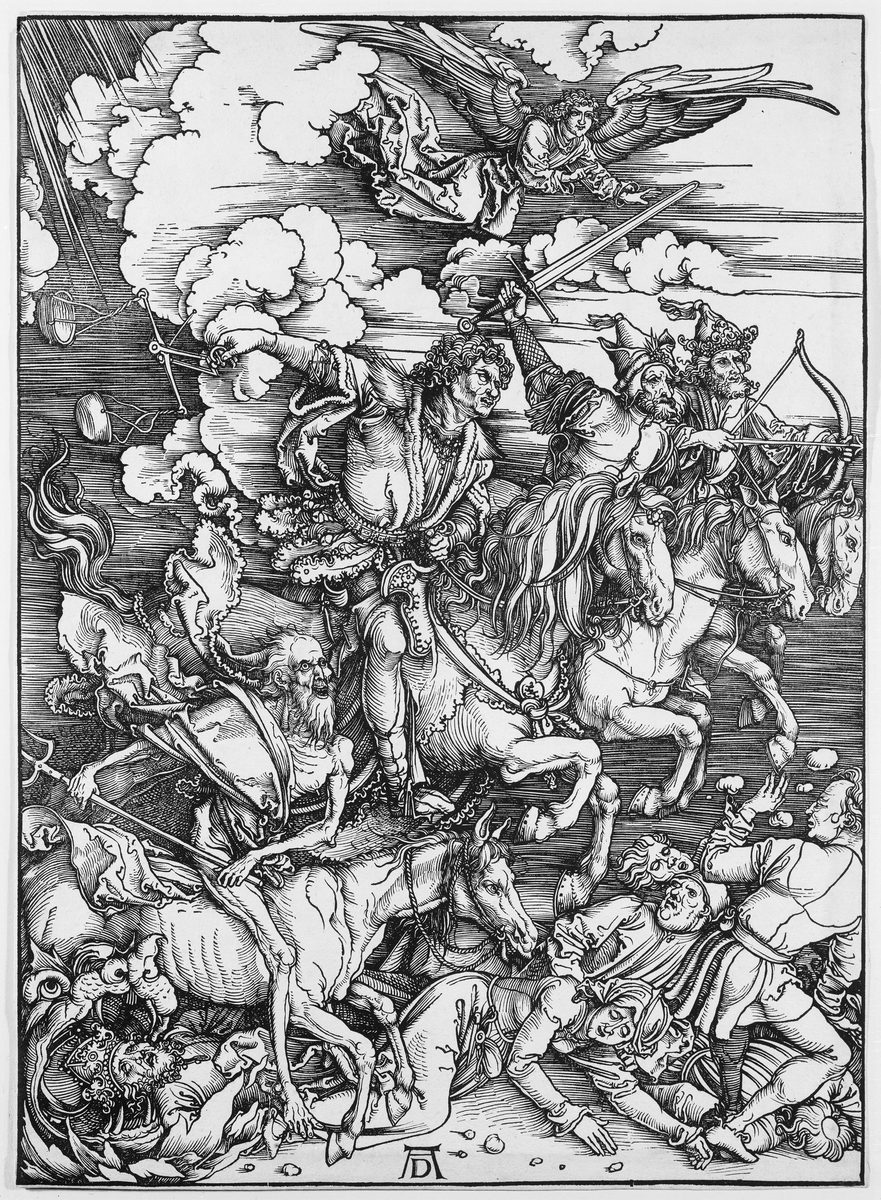
Albrecht Dürer, 1498 · Metropolitan Museum of Art, New York
⚠ Dürer compresses four separate summons into one simultaneous charge. The text opens each seal in turn, one horse and rider at a time, each announced by its own living creature's single word. The woodcut instead rides all four together as a single wave — a deliberate artistic choice, not the chapter's own sequence, and a genuinely different reading of the scene's pacing than the text supplies.
Identify them front to back. The skeletal figure at the lowest front, gripping a long fork, is Death (v8); behind him, the swordsman is the second seal's rider (v4, 'a great sword'); beside the swordsman, the helmeted figure with the small balance scales is the third seal's rider (v5, 'a scale in his hand'), easy to miss at this size; and the crowned archer at the back is the first seal's rider (v2), bow and crown exactly as written.
⚠ The angel overhead is Dürer's own addition. This chapter credits the summons to the four living creatures, not to any angel presiding above the scene — the winged figure is the artist's framing device, not a detail this text supplies.
The fallen include a bishop's mitre and a king's crown, among the ordinary bodies underfoot — this chapter's own horsemen (vv1-8) trample no one by name or rank, but the choice reads as a visual anticipation of v15's later list, kings and commoners alike, hiding from a judgment none of their stations can exempt them from.
And I saw, and behold, a white horse, and the one seated on it had a bow, and a crown was given to him, and he went out conquering, and to conquer.note
Y miré, y he aquí un caballo blanco, y el que lo montaba tenía un arco; y le fue dada una corona, y salió venciendo, y para vencer.
And another horse went out, fiery red, and to the one seated on it was given to take peace from the earth, so that people would slay one another, and a great sword was given to him.note
Y salió otro caballo, bermejo; y al que lo montaba le fue dado quitar de la tierra la paz, y que se matasen unos a otros; y le fue dada una gran espada.
And when he opened the third seal, I heard the third living creature saying, ‘Come.’ And I looked, and behold, a black horse, and the one seated on it had a scale in his hand.note
Y cuando abrió el tercer sello, oí al tercer ser viviente decir: «Ven.» Y miré, y he aquí un caballo negro, y el que lo montaba tenía una balanza en la mano.
And I heard what seemed to be a voice in the midst of the four living creatures, saying, ‘A quart of wheat for a denarius, and three quarts of barley for a denarius, and do not harm the oil and the wine.’note
Y oí una voz de en medio de los cuatro seres vivientes que decía: «Un kilo de trigo por un denario, y tres kilos de cebada por un denario; y no dañes el aceite ni el vino.»
And I saw, and behold, a pale horse, and the name of the one seated on it was Death, and Hades was following with him. And authority was given to them over a fourth of the earth, to kill with sword and with famine and with death and by the wild beasts of the earth.note
Y miré, y he aquí un caballo amarillo, y el que lo montaba tenía por nombre Muerte, y el Hades lo seguía; y le fue dada potestad sobre la cuarta parte de la tierra, para matar con espada, con hambre, con muerte, y con las fieras de la tierra.
And when he opened the fifth seal, I saw under the altar the souls of those who had been slain because of the word of God and because of the testimony they had.note
Y cuando abrió el quinto sello, vi bajo el altar las almas de los que habían sido muertos por causa de la palabra de Dios y por el testimonio que tenían.
And they cried out with a loud voice, saying, ‘How long, O Sovereign Lord, holy and true, will you not judge and avenge our blood on those who dwell on the earth?’note
Y clamaban a gran voz, diciendo: «¿Hasta cuándo, Soberano Señor, santo y verdadero, no juzgas y vengas nuestra sangre en los que moran en la tierra?»
And a white robe was given to each of them, and they were told to rest a little longer, until the number would be complete of their fellow servants and their brothers, who were about to be killed as they themselves had been.note
Y a cada uno de ellos le fue dada una ropa blanca, y se les dijo que descansaran todavía un poco de tiempo, hasta que se completara el número de sus consiervos y sus hermanos, que habían de ser muertos como ellos.
And I saw when he opened the sixth seal, and there was a great earthquake, and the sun became black as sackcloth of hair, and the whole moon became like blood,note
Y miré cuando abrió el sexto sello, y hubo un gran terremoto; y el sol se puso negro como tela de cilicio, y la luna entera se volvió como sangre,
And the kings of the earth, and the great ones, and the commanders, and the rich, and the mighty, and every slave and free person hid themselves in the caves and among the rocks of the mountains,note
Y los reyes de la tierra, y los grandes, y los jefes militares, y los ricos, y los poderosos, y todo esclavo y todo libre, se escondieron en las cuevas y entre las peñas de los montes;
and they said to the mountains and to the rocks, ‘Fall on us, and hide us from the face of the one seated on the throne, and from the wrath of the Lamb,note
y decían a los montes y a las peñas: «Caed sobre nosotros, y escondednos de la faz del que está sentado sobre el trono, y de la ira del Cordero;
⚠ Who rides the white horse? The text never says, and the library
reports two live readings rather than choosing one. The white horse, crown, and bow could echo
Parthian mounted archers — Rome's one persistent military anxiety — making this rider
a figure of conquest grouped with the next three woes: war, famine, death. Or the white horse
and crown could deliberately anticipate the rider on the white horse at 19:11, making this
first seal Christ or the gospel going out to conquer. Both readings are old, both are argued by
serious commentators on both sides, and this chapter alone does not settle which.
⚠ The third seal's price list is a famine, priced exactly. A
choinix of wheat was roughly one adult's daily bread ration; a denarius was a
laborer's daily wage (compare Matthew 20:2). The voice prices one day's food at one full day's
pay — enough for one person, nothing left for a household — while ordering the oil
and wine spared. KJV renders the measure a ‘measure’
and the wage a ‘penny’; ESV keeps the Greek terms
directly, ‘a quart’ for a ‘denarius’; NIV
converts both to modern units, ‘two pounds of wheat… for a day's wages.’ The
detail sparing oil and wine has a real, documented echo: Suetonius records that Domitian, ruling
when this book was likely written, ordered vineyards across the empire halved to make room for
grain — then abandoned the edict without enforcing it. Whether John's audience heard that
controversy in this verse is not stated; the resonance is only noted here, not claimed as the
verse's source.
⚠ ‘Pale’ or ‘yellow’? The fourth horse is
chlōros, the same word used of green grass elsewhere in the New Testament (Mark 6:39).
Every English version compared here — KJV, ASV, NIV, ESV
— reads ‘pale,’ with no disagreement; both Spanish versions compared, RV60 and NVI, read ‘amarillo’
or ‘amarillento,’ yellow or yellowish — the two language-shelves splitting from
each other rather than within themselves. Both are legitimate: chlōros spans the whole
sickly range from green to yellow to the color of a corpse.
The souls are seen under the altar — the place, in the temple's own
practice, where a sacrificial animal's blood was poured out at the base (Leviticus 4:7). Their
death is pictured as the very offering the altar was built for.
⚠ ‘How long’ is not a new cry; it is the Psalter's own
recurring question, asked of God by name in the same words (Psalm 6:3, 13:1, 79:5) long before
this scene. The martyrs are not improvising a complaint — they are praying the oldest
complaint in Israel's own hymnbook.
⚠ The answer is real, and it is also a delay. White robes, the mark of
vindication elsewhere in this book (3:5, 7:9), are given at once — but the text also tells
them to rest a little longer, until a fixed number of ‘fellow servants and
brothers’ still to be killed is complete. The chapter does not soften this: the wait has a
stated cause, and the cause is more killing still to come. The library reports the verse as
written rather than explaining away its hardest edge.
⚠ Every image in these three verses has an Old Testament address.
The sun turning black and the moon turning to blood is Joel's own language for ‘the day
of Jehovah’ (Joel 2:31) — the same verse Peter quotes at Pentecost to explain what
the crowd was witnessing (Acts 2:20). The stars falling like a fig tree shedding unripe fruit,
and the sky rolling up like a scroll, both come from a single verse of Isaiah's own oracle
against the nations (Isaiah 34:4) — two separate images there, fused into one continuous
description here. John is not inventing apocalyptic weather; he is quoting the prophets' own
vocabulary for divine judgment and letting their images do the work.
The seven classes named in v15 — kings, nobles, commanders, the rich, the mighty,
slave and free — span every rank a first-century reader could name, the same totalizing
instinct behind chapter 5's ‘tribe and tongue and people and nation’: no one's
standing exempts them.
⚠ ‘Fall on us’ is not a new cry either. It is Hosea's own
words for judgment day (Hosea 10:8) — and Jesus quotes that exact line to the women of
Jerusalem weeping for him on the road to his own execution: ‘they will begin to say to the
mountains, “Fall on us,” and to the hills, “Cover us”’ (Luke
23:30). What Jesus said would be said, this chapter now shows being said — the same words,
the same appeal to the landscape itself for the mercy of being crushed rather than seen.
The chapter's last line is a question, not an answer: who is able to stand? Nothing
in chapter 6 responds to it. Chapter 7 opens by answering it, but not yet.
Patterns worth carrying forward
Where this translation reports rather than resolves: the identity of the
white horse's rider (v2), left as a genuine, live interpretive split rather than assigned to
either reading; and the martyrs' told-to-wait (v11), kept exactly as hard as the Greek makes
it rather than softened.
Echoes paid. The Lamb (v1) opening the scroll is the same
Lamb chapter 5 found worthy to open it — the promise of
that chapter's closing note, cashed seal by seal starting here. The white robes
(v11) anticipate the great multitude's robes at 7:9, made white in the same book's own later
image (7:14).
Echoes planted. The seven-class list of v15 (kings to slaves), a
totalizing formula matching chapter 5's ‘tribe and tongue and people and nation.’
The martyrs' ‘how long’ (v10), left open until it is finally answered, chapters
from now. And the fifth and sixth seals' pairing of a question asked and a
world in terror — both still waiting, at this chapter's end, for the seventh seal
chapter 8 will finally break.
⚠ Left open on purpose. Whether the first rider is conquest itself
or Christ going out to conquer. Whether the fixed number of martyrs still to come is meant to
console or unsettle. The chapter asks ‘who is able to stand’ and does not answer
it — the library leaves the question standing exactly where the text leaves it.
Next installment in this book, whenever it is
translated: Revelation 7, where four angels hold back the four winds of the earth, and a
number is finally given — a hundred and forty-four thousand, sealed.