CreationBefore the FloodThe FloodAfter the FloodThe PatriarchsEgypt and the ExodusThe KingdomThe ExileThe ReturnBetween the TestamentsThe GospelsThe Apostolic Age
🕰
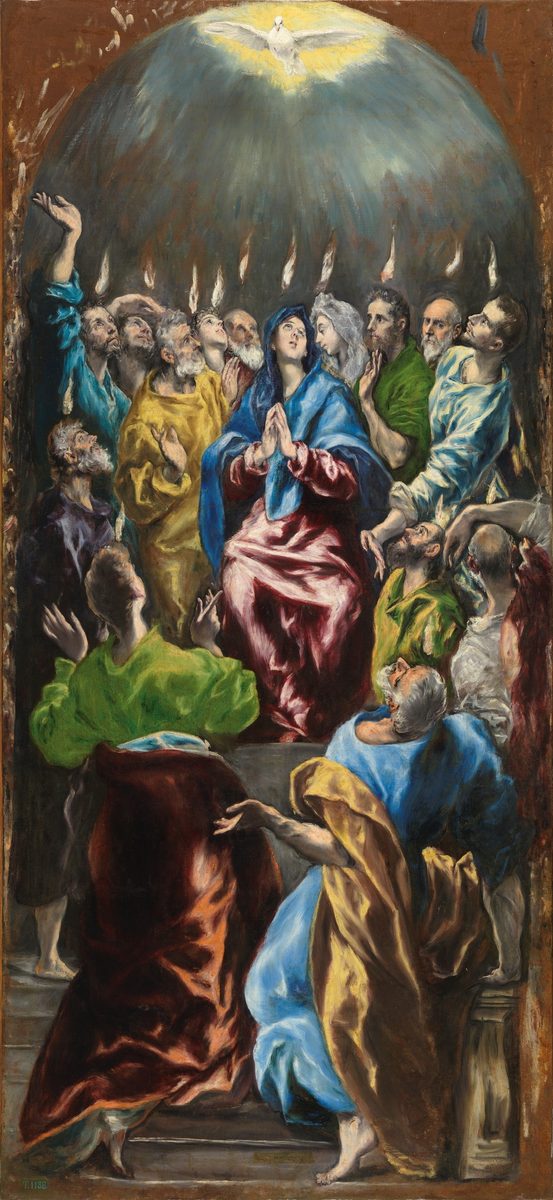
On the day of Pentecost, the Holy Spirit descends on the gathered disciples with the sound of a rushing wind and tongues of fire; they speak in other languages, understood by pilgrims from a dozen nations gathered in Jerusalem for the feast. Peter preaches the first apostolic sermon, quoting the prophet Joel and arguing from David's own psalms that Jesus is both Lord and Christ; about three thousand are baptized that day, and the chapter closes describing the earliest church's shared life — devoted to teaching, fellowship, the breaking of bread, and prayer, holding everything in common.
c. AD 30-33, exactly ten days after the ascension that closes chapter 1 — the Feast of Weeks (Shavuot/Pentecost), fifty days after Passover, traditionally read as the church's own birthday.
⚠ El Greco gets the flames exactly right — verse 3 says a tongue of fire sat on each one of them, and here they stand on individual heads rather than hovering over the group. What he adds is a DOVE, and there is no dove in Acts 2. That image belongs to the baptism (Luke 3:22) and has been carried across; the sound in this chapter comes from above but nothing is said to be seen except the fire. ⚠ And the woman at the centre is Mary. Acts 2 does not mention her: it says only that they were all together. She is in the room in Acts 1:14, named among the hundred and twenty, and the tradition moved her to the middle. The library flags both imports rather than letting them pass as the text. What the painting understands better than most is the direction of the whole chapter: every line in it goes UP, and Luke’s sound came DOWN and filled a house — the picture is the answer, not the event.
But Peter, standing with the eleven, raised his voice and declared to them, “Men of Judea and all you dwelling in Jerusalem, let this be known to you, and give ear to my words.note
Pero Pedro, puesto en pie con los once, alzó la voz y les declaró: «Varones de Judea y todos los que habitáis Jerusalén, séaos esto notorio y prestad oído a mis palabras.
‘And it will be in the last days, God says, that I will pour out from my Spirit on all flesh, and your sons and your daughters will prophesy, and your young men will see visions, and your old men will dream dreams.note
‘Y sucederá en los últimos días, dice Dios, que derramaré de mi Espíritu sobre toda carne, y profetizarán vuestros hijos y vuestras hijas, y vuestros jóvenes verán visiones, y vuestros ancianos soñarán sueños.
Men of Israel, hear these words. Jesus the Nazarene, a man publicly attested to you by God with acts of power and wonders and signs, which God did through him in your midst, as you yourselves know —note
Varones israelitas, oíd estas palabras. A Jesús el nazareno, varón acreditado públicamente ante vosotros por Dios con obras de poder y prodigios y señales que Dios hizo por medio de él entre vosotros, como vosotros mismos sabéis:
Men, brothers — it is permitted to say to you plainly about the patriarch David that he both died and was buried, and his tomb is among us to this day.note
Varones hermanos: es lícito deciros con franqueza acerca del patriarca David que murió y fue sepultado, y su sepulcro está entre nosotros hasta el día de hoy.
Therefore, having been exalted to the right hand of God and having received from the Father the promise of the Holy Spirit, he has poured out this which you both see and hear.note
Así que, exaltado a la derecha de Dios y habiendo recibido del Padre la promesa del Espíritu Santo, ha derramado esto que vosotros veis y oís.
And Peter to them: “Change your minds, and let each of you be baptized on the name of Jesus Christ for the forgiveness of your sins, and you will receive the gift of the Holy Spirit.note
Y Pedro a ellos: «Cambiad de mente, y bautícese cada uno de vosotros sobre el nombre de Jesucristo para perdón de vuestros pecados, y recibiréis el don del Espíritu Santo.
And day by day, devoting themselves with one accord in the temple and breaking bread from house to house, they were sharing food in gladness and simplicity of heart,note
Y día tras día, perseverando con un mismo ánimo en el templo y partiendo el pan por las casas, compartían el alimento con alegría y sencillez de corazón,
praising God and having favour with the whole people. And the Lord was adding day by day to the same place those being saved.note
alabando a Dios y teniendo favor con todo el pueblo. Y el Señor añadía día tras día al mismo lugar a los que iban siendo salvados.
Translator’s Notes — verse by verse
Each note explains this translation's choice and compares the seven
versions on the shelf. Quotations from copyrighted versions (NIV, TLB, NWT) are kept to short phrases for
comparison; KJV, Geneva, Douay-Rheims and ASV are public domain.
Verses 1–13 · ἦχος ὥσπερ φερομένης πνοῆς … γλῶσσαι ὡσεὶ πυρόςēchos hōsper pheromenēs pnoēs … glōssai hōsei pyros — a sound like wind, and tongues like fire
⚠ Luke is careful, twice, and every version blurs it once. There is no wind and there
is no fire. There is a sound (ēchos) like (hōsper) a violent wind being
carried along, and there are tongues as of (hōsei) fire. Both comparisons are in the Greek
and this translation keeps both. KJV “a sound as of a rushing mighty
wind… cloven tongues like as of fire” is exact and unreadable;
NIV “a sound like the blowing of a violent wind… what seemed to be
tongues of fire” keeps both too. What is easy to lose is that Luke describes what the room could
report, not what was there.
The wind-word and the Spirit-word are cousins.Pnoē (breath, blast) and
pneuma (breath, wind, spirit) are the same root, and Greek hears the pun without help — as
Hebrew does with ruach. English cannot, so the note carries it.
⚠ And glōssa means both things at once, which is the point of the whole
chapter. A tongue is the organ, the shape a flame makes, and a language. Verse 3
has fire-shaped tongues sitting on people; verse 4 has them speaking in other tongues; verse 11 has the crowd
hearing its own tongues. Luke uses one word for all three and the paragraph turns on it. This translation
keeps tongues throughout rather than switching to “languages” where it would read
more smoothly, because switching hides the hinge. ⚠ Note also what the miracle is placed in: not the
speakers’ mouths only but the hearers’ ears — “each one was hearing them in his own
language” (v6).
⚠ The list of nations has a famous problem in it, and it is not a variant. Between
Mesopotamia and Cappadocia stands Judea — which is where everyone in the scene already
is, which is not a foreign language, and which breaks a list that otherwise sweeps from Parthia round to Rome.
The apparatus records no dispute: every printed text has it. So the difficulty is Luke’s, not a
copyist’s, and the guesses are old and numerous — Armenia, India, Idumea, Syria, Lydia, or the
whole territory once ruled by a Judean king rather than the province. Tertullian read Armenia.
The library sets out that the reading is secure and the sense is not, and leaves it there.
“Sweet new wine” — and the sneer has a calendar problem.Gleukos is the sweet, barely-fermented juice of a fresh pressing. Pentecost falls in late spring,
some months before the vintage. Luke does not point this out; the mockers say the least plausible thing
available, and Peter answers the drunkenness rather than the vintage — it is nine in the morning.
KJV “new wine”;
ASV “new wine” with a margin;
NWT “sweet wine,” which is the most exact.
Verses 14–21 · ἐν ταῖς ἐσχάταις ἡμέραιςen tais eschatais hēmerais — a quotation that is dated differently from the prophet
⚠ Joel says “afterward.” Peter says “IN THE LAST DAYS.” The
Hebrew of Joel 3:1 (Joel 2:28 in English Bibles) opens wehayah acharei-khen — “and it
shall come to pass afterward” — a vague and undated connective. The Greek Old
Testament renders it literally, meta tauta, “after these things.” What Acts 2:17 reads is
en tais eschatais hēmerais, in the last days. That is not a translation of the
Hebrew and not the wording of the Greek: it is an interpretation folded into the citation, and it converts an
undated promise into a claim about what time it now is. ⚠ The library states the change and does not
adjudicate it — ancient citation did not work the way modern quotation does, and the shift may be
Peter’s, Luke’s, or a Greek text no longer extant. But no version on the shelf tells the reader
that the prophet did not write those words, and this one does.
“God says” is inserted too. Joel has the first person without an attribution
formula; the citation supplies legei ho theos. Small, and in the same direction as the first
change.
The slaves keep their word.Doulous and doulas, male and female slaves
— Joel’s Hebrew has avadim and shefachot, and this is one of the places where
“servants” softens what the sentence is doing: the Spirit is being poured on the people at the
bottom of a household, and the point is the leveling. KJV
“servants… handmaidens”; NWT “male slaves…
female slaves,” which is right.
Verses 22–28 · λύσας τὰς ὠδῖνας τοῦ θανάτουlysas tas ōdinas tou thanatou — the pangs you cannot untie
⚠ “Loosing the BIRTH PANGS of death” — and you cannot loose a pang. The
seam is a translation seam.Ōdines is specifically labour pain, and the verb
lysas is what you do to a knot or a rope. The mixture comes from Hebrew: the Psalms speak of
chevlei mavet, the CORDS of death (Psalm 18:5, and “the cords of Sheol”
in the next verse) — and Hebrew chevel means both a cord and a
birth pang. The Greek Old Testament took it the second way, and Acts inherits the Greek noun
with a verb that belongs to the Hebrew one. So the phrase is exactly intelligible once you can see both
languages at once, and slightly odd in either alone. This translation prints birth pangs and
puts the cords in the note; KJV “pains”,
ASV “pangs”, NIV “agony”
— none of which lets the reader see the join.
“Determined plan and foreknowledge” sits in the same sentence as
“you nailed up.”Hōrismenē boulē kai prognōsis — and then
aneilate, you did away with him. Luke puts the settled purpose of God and the culpability of the
hearers in one clause, joined by nothing, and offers no reconciliation. The library records that the sentence
does not attempt one.
“My flesh will pitch its tent on hope.”Kataskēnōsei — to
encamp, to tent. The Greek Old Testament’s word here for Hebrew yishkon, dwell, and it keeps a
picture the smoother “will live in hope” loses: temporary quarters, pitched somewhere, for
now.
Verses 29–36 · ἰδεῖν διαφθοράνidein diaphthoran — an argument that works in Greek
“His tomb is among us to this day.” The argument’s hinge is an address
in Jerusalem. David said it, David is buried down the road, therefore David was not talking about David.
⚠ But the argument turns on a word that means one thing in Greek and another in
Hebrew. Psalm 16:10 in Greek reads “you will not give your holy one idein
diaphthoran” — to see DECAY, corruption, a body rotting. That is what Peter
presses at v31: David’s flesh did decay, so the psalm must mean someone else. ⚠ The
Hebrew reads shachat, which the standard Jewish rendering gives as THE PIT —
the grave itself, parallel to Sheol in the line before. On that sense the verse is a prayer not to die
and not to go down to the grave, and the argument from a decayed body does not arise. Both readings of
shachat are defensible in Hebrew (the root can be pit or corruption), and the Greek translators chose
one; Peter is reasoning from theirs.
⚠ The library states this plainly because it is the kind of thing that usually goes unmentioned:
this is a New Testament argument that depends on the Greek Old Testament and is weaker on the
Hebrew. That is not a scandal — the Greek was the Bible of the people Peter was addressing in
a Greek-speaking city, and Luke wrote the speech in Greek for Greek readers. It is simply a fact about how the
argument works, and a reader entitled to know it. Every version on the shelf reads
“corruption” or “decay” here and prints “the pit” at Psalm 16, three
hundred pages apart, with nothing connecting them.
“Lord and Messiah” — and the verb is MADE.Epoiēsen: God
made him both. It is the plainest verb available and it has caused a great deal of discussion; Luke
does not qualify it, and neither does this translation. KJV “hath
made”; ASV and NWT “made.”
Verses 37–41 · ἐπὶ τῷ ὀνόματι Ἰησοῦ Χριστοῦepi tō onomati Iēsou Christou — baptized on the name of Jesus
⚠ And here is the verse Matthew 28 pointed at.Matthew 28’s note observed that the triadic baptismal formula
— Father, Son and Holy Spirit — is the only one in the New Testament, and that it sits awkwardly
beside Acts, where baptism is consistently “in the name of Jesus,” naming this verse among others as still untranslated then. It is on these pages now. Peter says epi tō onomati Iēsou Christou, and the preposition
is worth keeping: ON the name, not “in” it — on the authority of, on the
basis of. Acts will vary the preposition (en at 10:48, eis at 8:16 and 19:5) and never vary
the name. ⚠ The library reports the pattern and does not resolve it, exactly as it declined to resolve
it from the other end: no Greek manuscript of Matthew reads anything but the triad, and no passage in Acts
uses the triad at a baptism. Both facts stand.
“Change your minds.”Metanoēsate — the change-of-MIND word,
kept distinct throughout this project from metamelomai, the change of feeling that
Mark 2’s note gave to Judas. This translation renders it literally here
because it is being used as an instruction and the mechanism matters.
“Pierced to the heart.”Katenygēsan, from a verb for stabbing or
stunning — used once in the New Testament, here. It is not remorse in the abstract; it is what a sentence
does to a person.
“For the forgiveness of your sins.”Eis aphesin — and
eis can be purpose (“in order to obtain”) or ground (“on the basis of”), and
a very large argument has been built on that preposition in both directions. ⚠ The library notes that
the Greek does not settle it and that anyone claiming it does is claiming more than the word gives.
Verses 42–47 · εἶχον ἅπαντα κοινάeichon hapanta koina — four things, and everything in common
Four things, with the article on each.The teaching of the apostles,
the fellowship, the breaking of the bread, the prayers. Luke is listing known
items, not describing a mood, and this translation keeps the definite articles that most versions drop.
“Fellowship” is a money word as much as a warm one.Koinōnia is
sharing-in-common, and in Paul it regularly means a financial contribution (Romans 15:26). Verses 44-45 tell
you which sense Luke has in mind: they had hapanta koina, everything in common, and were selling
property to meet need. ⚠ And the library will note what Acts itself will note later: this is described,
not commanded, and chapter 5 will show it going wrong.
“With one accord.”Homothymadon —
chapter 1’s note called it Luke’s word for the church at its best
and it returns here on schedule, in the temple, daily.
“Simplicity of heart.”Aphelotēti — a rare word, from a root
meaning smooth or without stones, so: unencumbered, uncomplicated. It occurs only here in the New Testament.
KJV “singleness of heart” is good.
⚠ And the last clause gives the arithmetic to somebody else. “The
Lord was adding day by day…” — not the apostles, and not the preaching. Luke has
just reported three thousand from one sermon and then attributes the growth away from the sermon. The
participle sōzomenous is present and continuous, those being saved, which this translation
keeps rather than the tidier “the saved.”
Patterns worth carrying forward
Where this translation keeps the words exact / distinct: "a sound like a
violent wind" and "tongues as of fire", keeping both of Luke's comparisons
because there is no wind and no fire in the sentence; "tongues" for glōssa in all
three of its senses, so the hinge of the chapter stays visible; "sweet new wine" for
gleukos; "in the last days" printed as the citation has it, with the prophet's
own wording in the note; "male slaves" and "female slaves", not
servants; "birth pangs of death" for ōdinas, with the Hebrew cords in the note;
"decay" for diaphthora; "change your minds" for
metanoēsate, kept apart from Mark 2'smetamelomai;
"on the name" for epi tō onomati; the definite articles on all four items at
v42; and "those being saved", present and continuous.
Echoes paid.Pentecost itself —
chapter 1's note said the promise of the Father and the baptism in the Spirit
were "ten days from payment at Pentecost", and this is the payment;
homothymadon (v46) — the word
chapter 1's note called Luke's for the church at its best, back on schedule;
witnesses (v32) — martys, the legal word chapter 1 planted and Stephen will
turn into "martyr"; and baptism "in the name of Jesus" (v38) — the Acts pattern
Matthew 28's note named as standing awkwardly beside the triadic
formula, with this verse then still untranslated. It is on these pages now.
Echoes planted.Everything in common (vv44-45), described and not
commanded, which chapter 5 will show going wrong; the three thousand against the hundred
and twenty of 1:15; signs and wonders through the apostles
(v43), the engine of the next several chapters; and "all those far off" (v39), which is
the whole second half of this book in four words.
⚠ And the places the library reports rather than decides.JUDEA in the list of
nations (v9) — textually secure in every printed edition, and geographically inexplicable
between Mesopotamia and Cappadocia; the old conjectures are listed and none is adopted.
⚠ "In the last days" (v17), which is not what Joel wrote and not what the Greek Old
Testament renders — an interpretation folded into a citation, stated rather than passed over.
⚠ "See DECAY" (v27, v31) — where the argument depends on the Greek sense of
diaphthora and is weaker on the Hebrew shachat, "the pit"; the library says so, and says
why that is a fact about the argument rather than a scandal. And eis aphesin
(v38), where one preposition has carried a very large dispute in both directions and does not settle
it.
Next in this book: chapter 3 — a man lame from birth at
the Beautiful Gate, and the first miracle worked by somebody other than Jesus; "silver and gold I do not
have"; a second sermon in Solomon's Portico that finally answers the question chapter 1 refused to date;
and the first time the authorities have to decide what to do about people they have already killed
someone over.
_Prado.jpg)