CreationBefore the FloodThe FloodAfter the FloodThe PatriarchsEgypt and the ExodusThe KingdomThe ExileThe ReturnBetween the TestamentsThe GospelsThe Apostolic Age
🕰
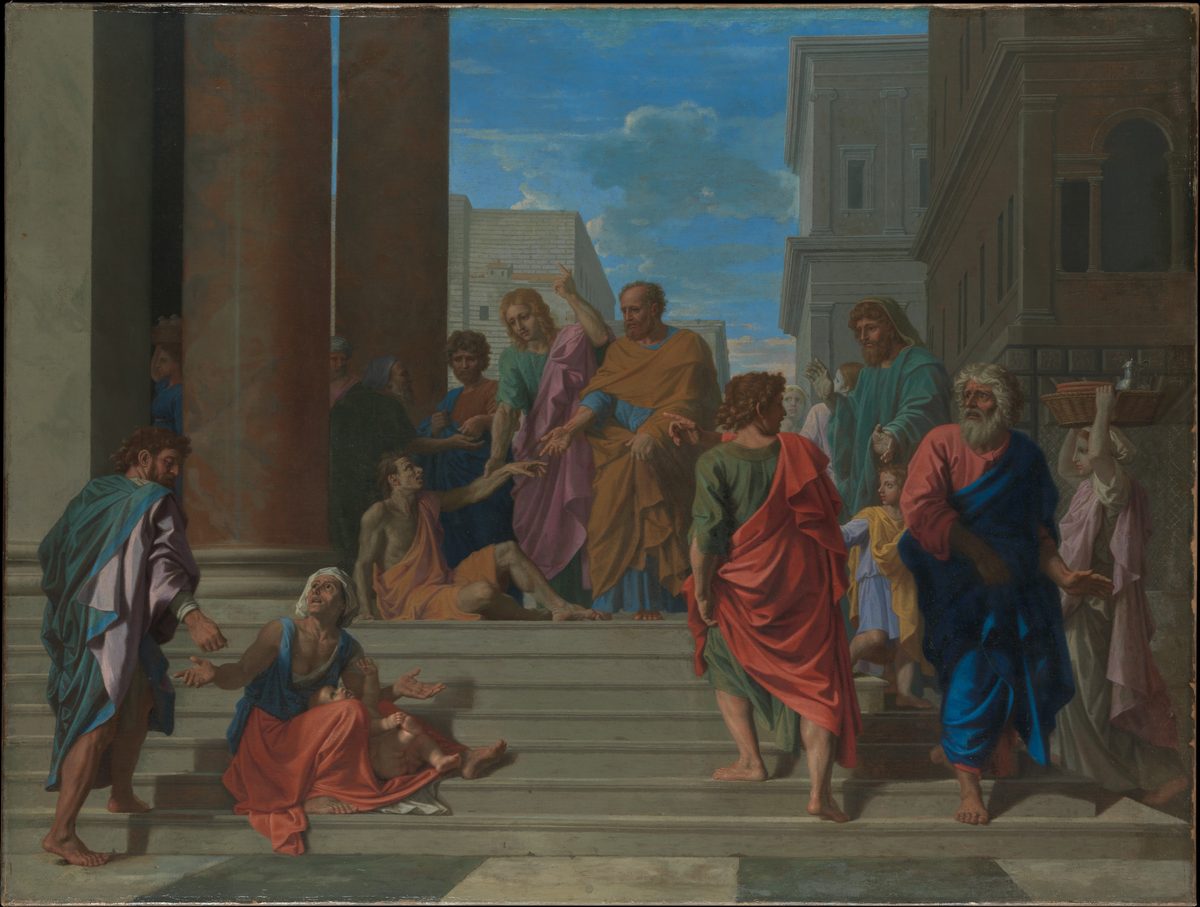
An ordinary afternoon at the temple, some time after Pentecost — a man lame from birth is healed at the Beautiful Gate, and Peter preaches a second time to the crowd it draws, in Solomon's Portico.
Undated by the text itself, beyond falling after chapter 2's Pentecost — days, weeks, or months later is all left open; the early apostolic community is shown still keeping the temple's own hours of prayer.
Nicolas Poussin, 1655 · The Metropolitan Museum of Art, New York
⚠ Poussin sets the temple as Roman civic architecture — fluted columns, coffered stone, a monumental stair — nothing here is first-century Jewish temple construction, and Poussin knew that; the setting is a classicist's idea of grandeur, not an attempt at archaeology. The composition stages the whole chapter's argument visually: Peter, on the upper step, gestures with the exact motion of someone declining something offered to him even as his other hand reaches to lift the beggar — not our own power, not our piety. The healed man's whole body leans up and out toward that hand, still in the position he was found in, not yet risen. Other beggars fill the lower steps, unhealed, watching — a crowd the single miracle does not clear.
and a certain man, lame from his mother’s womb, was being carried; they used to set him down daily at the gate of the temple called the Beautiful Gate, to ask alms of those entering the temple.note
y un hombre cojo de nacimiento era llevado en andas; lo colocaban cada día junto a la puerta del templo llamada la Hermosa, para que pidiera limosna a los que entraban en el templo.
and they recognized him, that this was the one who used to sit for alms at the Beautiful Gate of the temple; and they were filled with wonder and amazement at what had happened to him.note
y lo reconocieron, que era el que se sentaba a pedir limosna junto a la puerta la Hermosa del templo; y se llenaron de asombro y espanto por lo que le había sucedido.
And when Peter saw it, he answered the people, ‘Men of Israel, why do you marvel at this, or why do you stare at us, as though by our own power or piety we had made him walk?note
Viendo esto Pedro, respondió al pueblo: Varones israelitas, ¿por qué os maravilláis de esto? ¿O por qué ponéis los ojos en nosotros, como si por nuestro propio poder o piedad hubiéramos hecho andar a este?
The God of Abraham and Isaac and Jacob, the God of our fathers, has glorified his servant Jesus, whom you handed over and denied before Pilate, when he had decided to release him.note
El Dios de Abraham, de Isaac y de Jacob, el Dios de nuestros padres, ha glorificado a su siervo Jesús, a quien vosotros entregasteis y negasteis delante de Pilato, cuando este había decidido soltarlo.
And by faith in his name, his name has made this man strong, whom you see and know; and the faith that is through him has given him this perfect health in the presence of you all.note
Y por la fe en su nombre, su nombre ha hecho fuerte a este, a quien veéis y conocéis; y la fe que es por él le ha dado esta perfecta sanidad en presencia de todos vosotros.
whom heaven must receive until the times of restoration of all things, of which God spoke by the mouth of his holy prophets from of old.note
a quien es necesario que el cielo reciba hasta los tiempos de la restauración de todas las cosas, de que habló Dios por boca de sus santos profetas desde antiguo.
You are the sons of the prophets and of the covenant that God made with your fathers, saying to Abraham, ‘And in your offspring shall all the families of the earth be blessed.’note
Vosotros sois los hijos de los profetas, y del pacto que Dios hizo con nuestros padres, diciendo a Abraham: Y en tu descendencia serán benditas todas las familias de la tierra.
God, having raised up his servant, sent him to you first, to bless you by turning every one of you from your wickedness.’note
A vosotros primeramente, Dios, habiendo levantado a su siervo, lo envió para bendeciros, apartándoos a cada uno de vuestra maldad.
Translator’s Notes
Verses 1–8 · ἀργύριον καὶ χρυσίον οὐχ ὑπάρχει μοιargyrion kai chrysion ouch hyparchei moi — silver and gold I do not have — and a verse the manuscripts can’t agree on either
The Beautiful Gate is not named anywhere else in the New Testament, and its
exact identity among the temple’s several gates is not certain from the text alone; the
strongest ancient candidate is the great bronze Nicanor Gate on the temple’s eastern side,
which Josephus rated more valuable than the gold- and silver-plated gates around it.
⚠ V6’s command genuinely divides the manuscripts, not just the
translations. The oldest single witness (Westcott-Hort’s base text) reads simply
‘walk’; the Byzantine majority text and the modern critical standard (NA28) both add
‘rise up and’ before it — so this is not a simple old-text-versus-new-text
split, but real disagreement among the critical witnesses themselves. KJV and ESV print ‘rise up and walk’;
ASV and NIV print the bare
‘walk.’ RV60 and NVI
both keep ‘levántate y anda.’ This translation follows NA28.
Verses 9–11 · κρατοῦντος δὲ αὐτοῦ τὸν Πέτρον καὶ τὸν Ἰωάννηνkratountos de autou ton Petron kai ton Iōannēn — he held on — and a portico named for a king who never saw it
The healed man clings to Peter and John (v11) rather than simply
accompanying them — the Greek pictures a man still gripping on, not yet willing to test
his own legs too far from the ones who fixed them. The crowd’s astonishment gathers at
Solomon’s Portico, a covered colonnade along the temple’s eastern
wall that Jewish tradition traced back to Solomon’s original temple, though the structure
standing in this chapter is Herod’s, built a thousand years later on what was believed to
be the same footprint. It recurs later in Acts (5:12) and, earlier still, is the place Jesus
himself walked and was questioned in winter (John 10:23).
Verses 12–16 · τὸν παῖδα αὐτοῦ Ἰησοῦνton paida autou Iēsoun — his servant, or his Son — a single Greek word and a real fork in the shelf
Peter’s first move is a denial of credit: not our own power, not our piety. What
follows names Jesus with a Greek word, pais, that carries two entirely different
weights in English and Spanish, and translators have never agreed which one it means here.
⚠ KJV renders pais ‘Son’
at both its occurrences in this chapter (v13, v26); ASV,
NIV and ESV all render it
‘servant’ at both. The same fork appears in Spanish: RV60 reads ‘Hijo’ both times, NVI
reads ‘siervo’ both times. The word itself can mean either a child/son or a servant
depending on context; ‘servant’ connects Jesus to the Suffering Servant of Isaiah
(the Greek Old Testament uses this identical word, pais theou, for Isaiah’s
servant figure), while ‘Son’ reads the same Greek through a later, more explicitly
filial theology. This translation follows the servant reading, for the connection to Isaiah the
Greek itself invites — but the shelf splits cleanly on exactly which reading a single
word should carry, and neither side is simply wrong.
‘The Author of life’ (v15, archegos) is a striking
title in its own right — a word for a founder, originator, or pioneer, the one who goes
first and opens a way others then follow. The same word returns at Hebrews 2:10 and 12:2, of
Jesus as the ‘pioneer’ of salvation and of faith.
Verses 17–21 · χρόνων ἀποκαταστάσεως πάντωνchronōn apokatastaseōs pantōn — times of restoration — a word Origen would later stretch further than Peter meant it
“Ignorance” (v17, agnoia) is offered almost as
mitigation — Peter does not excuse the crowd, but he does not treat their guilt as the
last word either; what follows is an invitation, not only a charge.
⚠ “Times of restoration” (v21) translates a single Greek
noun, apokatastasis, that occurs nowhere else in the New Testament as a noun and has
carried an outsized theological weight ever since — it is the word later taken up by
Origen and others to argue for the eventual restoration of all things, including the damned, a
doctrine (apocatastasis) the wider church never adopted but never fully stopped arguing
about either. KJV stands alone on this shelf with
‘restitution,’ an older and more legal-sounding word; ASV, NIV and ESV all
use some form of ‘restore.’ RV60 and NVI both read ‘restauración.’ Whatever precise scope
Peter intended, the word itself named something enormous: not a repair, but everything set back
the way it was meant to be.
Verses 22–23 · προφήτην ὑμῖν ἀναστήσει κύριοςprophētēn hymin anastēsei kyrios — a prophet promised, quoted short
Peter’s citation compresses Deuteronomy 18:15-19, where Moses promises Israel a
prophet like himself whom they must heed — a passage Judaism has read messianically at
various points and that Peter here applies to Jesus directly, without argument, as though the
identification needs no defending to this audience.
Verses 24–26 · ὑμῖν πρῶτονhymin prōton — the blessing, and who gets it first
The citation of ‘in your offspring shall all the families of the earth be
blessed’ (v25) draws on the Abrahamic covenant (Genesis 22:18, itself echoing 12:3 and
18:18) — the promise this whole sermon has been building toward, now handed to a Jewish
crowd in a Jewish courtyard as a Jewish inheritance, before it is ever offered to anyone else.
⚠ “To you first” (v26) is doing real work: not to you
only, but to you first — a sequencing Paul will repeat as a settled pattern (‘to the
Jew first, and also to the Greek,’ Romans 1:16), planted here at what may be the earliest
recorded apostolic sermon after Pentecost itself.
Patterns worth carrying forward
Where this translation keeps the words exact / distinct: "servant"
for pais at both v13 and v26, rather than "Son"; "Author of life" for
archegos, matching its other New Testament occurrences (Hebrews 2:10, 12:2) rather than
varied for local flavor; "rise up and walk" at v6, following NA28 over
Westcott-Hort's bare "walk"; "ignorance" for agnoia, kept concrete rather
than softened; and "times of restoration" for the single noun apokatastasis,
not paraphrased into a verb.
Echoes paid.Restoration — chapter
1's note on Jesus declining to date "the restoration of the kingdom to Israel" said plainly that
Peter would preach it in this chapter; v21's apokatastasis is that promise cashed, in Peter's
own mouth. Witnesses (v15) — martys, the same note's word for
testimony to what was seen, now attached specifically to the resurrection. Signs and wonders
through the apostles — chapter 2's closing note called this
"the engine of the next several chapters," and this healing is its first cashing.
Echoes planted. "You acted in ignorance" (v17), a plea that will
not survive contact with the same crowd's rulers in the very next chapter, once the apostles are
arrested for saying it twice. The prophet like Moses (v22), a citation Stephen will
pick up and turn into an argument, at length, in chapter 7. And "to you first" (v26),
the sequencing this whole book will spend its second half complicating.
⚠ And the places the library reports rather than decides. Whether
pais (vv13, 26) means "Son" or "servant" — the shelf splits cleanly and this
translation states its reason for choosing servant without pretending the other reading is
unreasonable. And v6's "rise up and walk," where the earliest single witness and the standing
critical text actually disagree with each other, not just with the Byzantine tradition.
Next in this book: chapter 4 — Peter and John
arrested for the first time, and a council that cannot deny the miracle, only forbid speaking of it.