Mark 2 — The Mister Translation
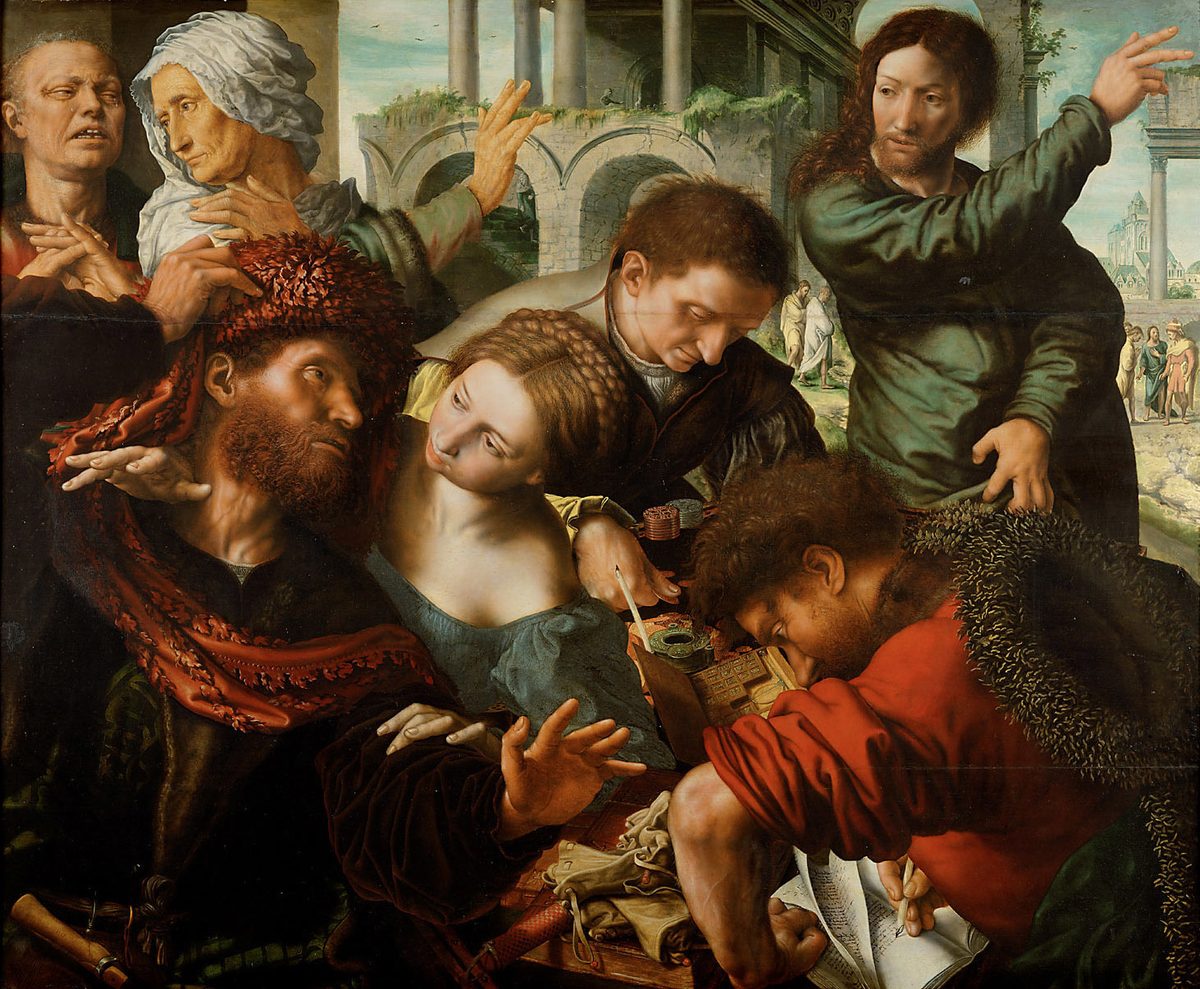
⚠ The painting is called The Calling of Saint MATTHEW, and this chapter calls him LEVI. That is not the painter’s error — it is the tradition’s, and it is the point of the note at v14: every famous picture of this scene carries the name Mark does not use. ⚠ And look at what the man is doing. Hemessen paints the instant BEFORE the response: the pen is still moving, the coins are still on the table, and the tax collector has not raised his head. Mark allows no such instant. His sentence is ‘follow me — and getting up he followed him’, one clause, no interior life, no pause for the painter to work in. What the picture gets exactly right is the setting: this is a working tax office, with the money in front and the ledger open, and Hemessen is credited with originating that kind of moralizing counting-house picture — the same painter, and the same milieu, as the unforgiving servant two Gospels away.
.jpg)
Translator’s Notes — verse by verse
Each note explains this translation's choice and compares the seven versions on the shelf. Quotations from copyrighted versions (NIV, TLB, NWT) are kept to short phrases for comparison; KJV, Geneva, Douay-Rheims and ASV are public domain.
⚠ They un-roofed the roof, and then dug. Apestegasan tēn stegēn is a cognate phrase — roughly “they un-roofed the roofing” — and then exoryxantes, having dug through, a verb used of quarrying and of gouging out an eye. Together they describe a Galilean roof exactly: beams laid across, brushwood and reeds packed between, mud-and-straw trodden on top, the sort of surface a man could break open with his hands and repair the same afternoon. ⚠ Luke, retelling this, has them go down “through the tiles” (keramōn, Luke 5:19, not yet on these pages) — a Greco-Roman roof, for readers who had never seen the other kind. Matthew (9:2) removes the roof altogether. The library notes the direction of the change: Mark has the local detail and the others have the readable version.
⚠ The mat is a poor man’s word, and both the other Gospels replace it. Krabattos — a Latin loanword (grabatus), a straw pallet, the bed of somebody who owns one blanket. It is slang, near enough, and Mark uses it five times in this Gospel without embarrassment. Matthew (9:2) and Luke both change it to klinē, an ordinary bed. ⚠ This is the clearest small instance of a thing worth knowing about Mark: his Greek is the roughest in the New Testament and it is roughest in the places the other two smooth. This translation reads mat and does not upgrade it. KJV “bed”; ASV “bed” with a margin; NIV “mat,” which is right; NWT “cot.”
“Seeing THEIR faith.” Autōn, plural. The paralysed man is not said to have any; what Jesus responds to is four men wrecking somebody’s ceiling. Mark does not say whose house it was, and it is worth noticing that the story never mentions the repair.
⚠ And then the sentence breaks in half. Verse 10 begins “But so that you may know that the Son of Man has authority on earth to forgive sins” — and never finishes, because Mark interrupts himself with narration: — he says to the paralysed man — and then the words to the man. The Greek genuinely runs this way, and Matthew 9’s note flagged the identical seam, saying Mark 2:10-11 has it too. It does. ⚠ The interesting question is who “you” is. On the natural reading it is the scribes in the room; but some have heard it as Mark addressing the reader over the scene — the one aside in the chapter where the narrator would be explaining what the argument is about. The grammar does not settle it and this translation keeps the dashes so the reader can see the join rather than a repaired sentence.
“We never saw anything like this.” The crowd’s line is flat and colloquial — houtōs oudepote eidomen, literally “thus never we saw” — and this translation keeps it plain. ⚠ Note what they are astonished by: he told a man to pick up his bedding, and they praise God. Nobody in the scene says anything about the forgiving, which was the part the scribes objected to.
⚠ Mark calls him LEVI, and the Gospel of Matthew calls him MATTHEW. Same scene, same tax booth, same two words — akolouthei moi, follow me — and a different name: Levi son of Alphaeus here, “a man called Matthew” at Matthew 9:9. Luke also reads Levi. ⚠ And the puzzle has a second half that is easy to miss: Mark’s own list of the Twelve does not contain a Levi (the fishermen are called in chapter 1; the list comes at 3:16-19) — but it does contain a Matthew, and, separately, a James son of Alphaeus. So Alphaeus has a son among the Twelve, and the tax collector Mark names is not obviously him.
The readings on offer, none of which the text settles: that one man carried two names, which was entirely ordinary (Simon/Peter, Joseph/Barnabas, Saul/Paul); that Mark records a call-story about a disciple who was never one of the Twelve; or that the first Gospel has attached the story to the apostle whose name that book carries. Matthew 9’s note observed that a man names himself in his own book and that only that Gospel’s list of the Twelve adds the label “the tax collector” (10:3), a detail Mark and Luke both omit. The library reports the difference and does not harmonize it, which is the practice throughout: the Gospels are printed as the four books they are.
“The scribes of the Pharisees.” An unusual construction — scribes belonging to the Pharisee party rather than scribes and Pharisees as two groups — and the earliest text has it, where the Byzantine tradition reads the familiar “the scribes and the Pharisees.” The harder, odder phrase is likelier to be original for the ordinary reason that copyists produce the expected formula and not the strange one.
“I did not come to call the righteous but sinners.” ⚠ The Byzantine text adds “to repentance” at the end, which is where the KJV’s longer version comes from; the words are securely in Luke’s parallel (5:32) and are absent here in the earliest witnesses. That is the classic signature of harmonization — a phrase migrating from the Gospel that has it into the one that does not. Left out, the sentence stops harder.
“The sons of the bridal chamber.” A Semitic idiom for the wedding party, the friends whose job is the celebration. Fasting at a wedding would not be piety; it would be rudeness. The answer is not that fasting is wrong but that the calendar is wrong.
⚠ “Taken away” — and the verb is not gentle. Aparthē, from apairō: to be lifted off, removed, carried away. It is the only shadow in the paragraph and it is the first hint in this Gospel that the story does not end with a wedding. Mark drops it in without comment, three words long, and goes straight back to cloth and wineskins.
⚠ “A worse TEAR” — and Mark has used this root before. Schisma, from schizō, and chapter 1’s note flagged that verb where the heavens are torn open at the baptism, saying it was planted to be paid off by the temple curtain at 15:38. Here the noun turns up in a homely parable about mending, which is either an accident of ordinary vocabulary or a third instance in a pattern. The library records it and does not press it: the word for what happens to a coat is the word Mark chose for the sky.
The patch does the damage, not the hole. The unshrunk patch shrinks and pulls the old cloth apart; the new wine still working bursts skins that have already stretched once. Both pictures are about the new thing destroying the container, and neither is about the container being bad. KJV “new cloth” loses agnaphou, which specifically means unshrunk — not yet fulled — and that is the whole mechanism. ⚠ And Mark stops there. Luke adds a line about nobody wanting the new wine after the old; Matthew adds that both are preserved. Mark leaves the picture destructive and unresolved, which is characteristic.
⚠ Mark says ABIATHAR, and 1 Samuel says AHIMELECH. The episode is 1 Samuel 21: David, on the run and hungry, comes to the sanctuary at Nob and is given the consecrated bread. The priest who gives it to him is Ahimelech. Abiathar is Ahimelech’s son: he appears in the next chapter, as the one man who escapes when Saul massacres the priests of Nob (1 Samuel 22:20, not yet on these pages), and he becomes David’s priest afterwards. So the naming is wrong in the plain sense — wrong man, and the right man’s father.
⚠ And the two Gospels that used Mark both dropped the phrase. Matthew (12:3-4) and Luke (6:3-4, not yet on these pages) tell the identical story and name no priest at all. That is not proof of anything by itself, but it is the earliest evidence there is about how the sentence read to people who had Mark in front of them, and it points one way.
⚠ The defence that is worth taking seriously, because it is Mark’s own idiom. Epi with the genitive can mean “in the time of,” which produces the error — but it can also mean “in the passage about,” and Mark uses it that way himself, later in this same Gospel: “have you not read in the book of Moses, epi tou batou — in the passage about the bush — how God said to him…” (12:26, not yet on these pages). Read the same way here, epi Abiathar archiereōs would mean “in the passage about Abiathar the high priest” — the section of 1 Samuel in which Abiathar is the notable figure — and there is no mistake, only a citation habit. Against it: the phrase most naturally reads as a date, Abiathar is not the notable figure of 1 Samuel 21 itself, and the copyists who dropped it evidently did not find the defence obvious.
So the library does what it does with Matthew’s Jeremiah: prints the text as it stands, sets out what is checkable, and declines to patch. KJV, ASV, NIV and NWT all print “Abiathar” and none tells the reader that 1 Samuel says otherwise. That silence is the thing this project exists to stop doing.
“The loaves of the Presence.” Artous tēs protheseōs — literally the bread of the setting-out, the twelve loaves kept on a table in the sanctuary and eaten by the priests when replaced (Leviticus 24:5-9, already on these pages). ⚠ And note the shape of the argument: Jesus does not say the Law permitted what David did. He says David did it. The precedent is an admitted irregularity, which is a stronger move than a loophole and a harder one to answer.
⚠ This verse is in Mark alone, and both the others cut it. “The sabbath came into being for the human being, and not the human being for the sabbath.” Matthew and Luke each retell this whole scene — the grainfields, David, the bread — and each goes straight from the David argument to “the Son of Man is lord of the sabbath” (Matthew 12:8; Luke 6:5) with verse 27 missing. Whatever the reason, the most radical sentence in the paragraph survives in one Gospel only, and it is the shortest one.
“Came into being.” Egeneto — the verb of Genesis 1 in Greek, “and there was light.” The sabbath is being spoken of as something made, with a purpose, in the same vocabulary as the rest of the week. This translation keeps came into being rather than the smoother “was made” so the creation-word stays audible.
⚠ And “the human being,” not “man.” Ho anthrōpos with the article, twice, generic: humankind, anybody. Every version on the shelf reads “man” (KJV, ASV, NWT), which in 1611 carried the generic sense and now does not; NIV has “people.” The choice matters more than usual here because the next verse turns on the same word: ho huios tou anthrōpou, the Son of Man. Greek readers hear anthrōpos three times in two sentences and the argument travels along it — the sabbath is for the anthrōpos; therefore the Son of the anthrōpos is lord of it. English that says “man… man… Son of Man” keeps the thread but has lost the generic sense; English that says “people” loses the thread entirely. This translation reads human being and puts the chain in the note, because no single English word does both jobs.
“So the Son of Man is lord EVEN of the sabbath.” Kai — even, also. The conclusion is drawn from the premise with hōste, “so, therefore,” which makes v28 depend on v27; and that dependence is precisely what disappears in Matthew and Luke, where the same sentence stands alone as a claim about the Son of Man rather than a conclusion about human beings.
Patterns worth carrying forward
Where this translation keeps the words exact / distinct: "mat" for krabattos, the poor man's pallet, not upgraded to a bed as Matthew and Luke both upgrade it; "took the roof off" and "dug through" for the cognate pair apestegasan tēn stegēn + exoryxantes, because the two verbs describe a real Galilean roof; "immediately" for euthys, kept everywhere as chapter 1 established; "authority" for exousia; "tear" for schisma, matched to the schizō of the torn heavens; "unshrunk" for agnaphou, which is the mechanism of the parable; "came into being" for egeneto at v27, keeping the Genesis verb; and "the human being" for ho anthrōpos, generic, so that its chain into "the Son of Man" is visible.
Echoes paid. Euthys (vv8, 12) — the pace chapter 1's note said would be kept on the page; exousia (v10) — the authority the synagogue noticed at 1:22, now claimed for something larger than teaching; and the anacoluthon at vv10-11 — the broken sentence Matthew 9's note said Mark has in identical form.
Echoes planted. Schisma (v21), the tearing-word begun at the baptism and waiting for the temple curtain; the bridegroom taken away (v20), this Gospel's first shadow; the Son of Man (vv10, 28), used here twice before it is ever explained; and the collision with the Pharisees, which from here does not stop.
⚠ And the places the library reports rather than decides. Levi son of Alphaeus (v14), whom the Gospel of Matthew calls Matthew — with the second half of the puzzle stated: Mark's own list of the Twelve has no Levi in it, though it has a James son of Alphaeus. ⚠ "In the time of Abiathar the high priest" (v26), where 1 Samuel 21 says the priest was Ahimelech and Abiathar is his son, who escapes the massacre a chapter later — laid out with both the evidence against it (Matthew and Luke retell the story and name no priest at all) and the real defence for it (epi + genitive can mean "in the passage about", and Mark uses it that way himself at 12:26, "epi tou batou", in the passage about the bush). And "you may know" at v10, addressed either to the scribes in the room or by Mark to his reader.
Next in this book: chapter 3 — a man with a withered hand and a question that gets no answer, the first plot to kill him formed by an unlikely coalition, the naming of the Twelve, his family coming to seize him because they think he is out of his mind, and the hardest saying about forgiveness in the Gospels.