Mark 3 — The Mister Translation
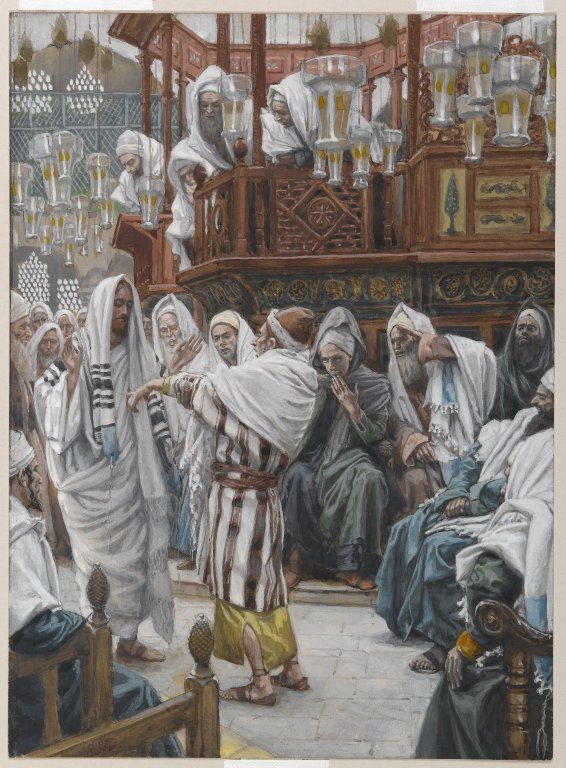
⚠ Tissot catches the exact instant of verse 5: the arm is already going out. He also gets the watching right — the chapter opens with men who are there to see whether he will do it, and almost every face in this room is turned to the same spot. ⚠ What he does not paint is the anger. Mark says Jesus looked round at them with anger, and Tissot gives him the calm face of every other picture in the series, which puts him with Matthew and Luke rather than with the Gospel he is illustrating. And one detail is worth flagging because it is the fruit of his care rather than his carelessness: Tissot travelled in Palestine and painted observant practice closely, and several of these men wear tefillin, the leather boxes bound to arm and head — which, in the practice he was documenting, are not worn on the sabbath. What first-century custom was is less certain, so the library records the tension rather than calling it an error: the most researched detail in the picture is the one that argues with the day the story turns on.
_-_James_Tissot_-_overall.jpg)
Translator’s Notes — verse by verse
Each note explains this translation's choice and compares the seven versions on the shelf. Quotations from copyrighted versions (NIV, TLB, NWT) are kept to short phrases for comparison; KJV, Geneva, Douay-Rheims and ASV are public domain.
⚠ He looks round at them WITH ANGER, and this time there is no variant to argue about. Met’ orgēs. Chapter 1’s note followed the harder reading at the leper, where the manuscripts split between orgistheis (moved with anger) and splanchnistheis (moved with compassion), and argued that no scribe invents an angry Jesus. Here the same emotion is textually secure — the apparatus records no dispute at all — which is the best corroboration that argument could get. Mark says it twice; the second time nobody tried to change it.
⚠ What Matthew and Luke do with it is the whole point. Matthew retells this scene and goes straight from the argument to “Then he says to the man” (12:13): no look, no anger, no grief. Luke keeps the looking round — the same participle, periblepsamenos — and drops the emotion out of it (6:10, not yet on these pages). And then Luke does something better than deleting: four words later he gives the fury to the opponents, who are “filled with anoia”, mindless rage (6:11). The feeling stays in the story and changes owner.
“Grieved together with them.” Syllypoumenos — the compound has syn, with, in it, and it sits in the same breath as the anger, in the present tense against the anger’s aorist. This translation keeps both and keeps them awkward, because Mark does: KJV “being grieved,” ASV “being grieved,” NIV “deeply distressed,” NWT “grieved,” and none of them carries the with.
“Hardening.” Pōrōsis is a medical word — the callus that forms over a healed fracture, or the stone-like deposit in a joint. It is not stubbornness as a mood; it is tissue that has stopped being able to feel. ⚠ And Mark will use the same root of the disciples at 6:52 and 8:17, which is worth knowing in advance: the condition he diagnoses here is not one he confines to opponents.
⚠ And the coalition that forms is the strangest sentence in the chapter. Pharisees and Herodians: religious purists and the political clients of a client king, with nothing in common except this. Mark names them together twice (here and 12:13) and never explains who the Herodians are. It takes six verses of Mark for the plot to kill him to be formed; Matthew has it at 12:14 and Luke softens it to a discussion of what to do.
The geography is the argument. Galilee, Judea, Jerusalem, Idumea, beyond the Jordan, Tyre and Sidon — the list runs the compass and includes Gentile territory. Mark does not comment; he simply gives the catchment area of a man who is still, at this point, refusing to be identified.
“Afflictions” is literally WHIPS. Mastigas — scourges, lashes; the word used of an actual flogging. Applied to disease it is the ordinary Greek idiom for what a body suffers, and it is not gentle. This translation reads afflictions and puts the picture in the note. KJV “plagues” is closer to the violence than the modern versions’ “diseases.”
⚠ The demons say it and are silenced. “You are the Son of God” — and he “rebuked them sharply that they should not make him known.” Chapter 1’s note opened this thread with the muzzled demon and the silenced leper and called it the Messianic secret. Here is its clearest form: the only characters in the Gospel so far who know what he is are unclean spirits, and they are the ones ordered to be quiet. No human being says it to his face until a Roman soldier does, at the cross.
“He made twelve.” Epoiēsen — not “appointed,” not “chose,” but the plain verb for making a thing. It is odd Greek and every version softens it (KJV “ordained,” ASV “appointed,” NIV “appointed,” NWT “formed a group of twelve”). This translation keeps made. ⚠ And note what they are made for, in Mark’s order: first “that they might be with him,” and only then that he might send them out. The being-with comes before the doing, and it is the first item.
⚠ A variant that runs the unusual direction. “Whom he also named apostles” stands in the printed critical text and is absent from Tregelles and the Byzantine tradition — so here the shorter reading is the Byzantine one, which is the reverse of the usual pattern in this Gospel. The words are securely in Luke’s parallel, so harmonization would explain their presence; the manuscripts that carry them are very good, which is why the editors print them. The library follows the critical text and records that this one is genuinely balanced.
And v16 repeats itself. “And he made the twelve” — two verses after “he made twelve.” The critical text keeps the repetition; Tregelles and the Byzantine text delete it, which is exactly what a copyist tidying an awkward sentence would do. This translation keeps the stumble.
Boanerges, and Mark translates it. The Greek transliterates something Semitic and then glosses it — Sons of Thunder — which is Mark’s standing habit (Talitha koum at 5:41, Ephphatha at 7:34, Abba at 14:36, Eloi at 15:34). ⚠ The underlying Aramaic behind the second half is not certain: the first element is plainly benē, sons, and the second is usually traced to regesh or regaz, tumult or rage rather than thunder exactly. Mark supplies a translation and the library reports that the translation is easier than the etymology. Nobody ever calls them this again.
The Cananaean is not from Canaan. Kananaios transliterates Aramaic qan’an, zealous one — which Luke simply translates as “Simon the Zealot.” The Byzantine text reads Kananitēn, which is what produced the KJV’s “Simon the Canaanite” and a great deal of confusion about a Galilean fisherman’s nationality.
⚠ His family come to take him away because they think he has lost his mind. Hoi par’ autou — literally “those from beside him,” an idiom for a man’s household or people. They come kratēsai auton, to seize him — the same verb used of the arresting party in Gethsemane. And the reason given is exestē: he is out of his mind, beside himself, standing outside himself. ⚠ Neither Matthew nor Luke has these two verses in any form. They keep the Beelzebul controversy that follows and drop the sentence that occasions it, which is the single most striking omission in the synoptic tradition and needs no explanation beyond reading it once.
⚠ And this is the first clear instance of the thing Mark does with his structure. He starts a story (the family setting out, vv20-21), interrupts it with a completely different one (the scribes and Beelzebul, vv22-30), and then finishes the first (the family arriving, vv31-35). The technique recurs through this Gospel — commentators call it intercalation, or more usefully a sandwich — and it is never decorative: the two halves interpret each other. Here the frame is his family saying he is mad and the filling is the scribes saying he is possessed, and Mark has arranged it so that the family’s verdict and the scribes’ verdict are read through one another. This translation makes no mark on the page for it; the note is where it belongs, and the reader can watch for the next one.
Mark has TWO accusations where Matthew has one. “He has Beelzebul” is a charge of possession; “by the ruler of the demons he casts out demons” is a charge of collusion. Matthew (12:24) keeps only the second. The first is the worse one, and it is the one that connects backward to v21: his family says he is mad, the scribes say he is inhabited.
Beelzebul. 2 Kings 1’s note traced how a Philistine city god, Baal-zebub, “lord of flies,” ends up as a name for the prince of demons in a form with an L. Mark does not explain the name and evidently expects it to need no explaining.
The strong man is the argument, not an aside. Nobody loots a strong man’s house until the strong man is tied up. Read as a reply to the charge, it concedes the premise — something is being plundered — and relocates the question: whose house, and who did the tying.
⚠ And the last clause is where the shelf splits, on one noun. The critical text reads that such a person is guilty of an eternal SIN (aiōniou hamartēmatos); the Byzantine text reads eternal JUDGEMENT (kriseōs), which is where the KJV’s “in danger of eternal damnation” comes from. The difference is not small: on the older reading the sentence describes a condition — a sin that does not stop — and on the later one it announces a penalty. This translation prints eternal sin, which is both the better-attested and the harder phrase, and notes that a scribe faced with the strange expression “an eternal sin” has an obvious reason to write the familiar one, while the reverse has none. ASV “eternal sin”; NIV and NWT likewise; KJV follows the later text.
“Because they were saying, ‘He has an unclean spirit.’” ⚠ Mark supplies the reason, and it narrows the saying sharply. Whatever the unforgivable thing is, the Gospel’s own gloss attaches it to a specific act: looking at a work of rescue and calling it demonic. This translation keeps v30 attached to v29 with a dash rather than starting a new paragraph, because the sentence is Mark’s explanation and not an afterthought.
⚠ The chapter’s geography is its argument. His mother and brothers are outside, twice (vv31, 32), and they send a message in rather than coming in. The crowd is sitting around him in a circle. Mark has put the blood family on the outside of a ring and the listeners on the inside of it, and then has Jesus look round at the circle — the same verb periblepsamenos he used at v5, looking round in anger — and name the inner group as his relatives. The story that began at v20 with his family coming to seize him ends with the word “mother” being given to somebody else.
What the sentence does not say. It does not say his mother and brothers are excluded; it says whoever does the will of God is included. And Mark supplies no reconciliation, no later scene, and no comment. ⚠ The library notes what the other Gospels do with the embarrassment: Matthew keeps the saying and drops the accusation of madness that set it up; Luke keeps both but rearranges so the family never looks bad. Mark keeps everything and explains nothing.
“And your sisters.” A minority of witnesses add sisters to the message at v32, and the editors are split — Nestle-Aland brackets them in, Westcott-Hort and Tregelles leave them out. Either way v35 has them: brother and sister and mother, where the list of who is outside had only brothers. The library prints the shorter message and the fuller answer, which is what the earliest text gives.
Patterns worth carrying forward
Where this translation keeps the words exact / distinct: "with anger" for met' orgēs (v5), matched to the harder reading chapter 1 followed at 1:41; "grieved together with" for syllypoumenos, keeping the syn no version on the shelf carries; "hardening" for pōrōsis, the medical callus-word, because Mark will use the same root of the disciples; "afflictions" for mastigas, literally whips; "made" for epoiēsen at v14, unsoftened, and the repetition at v16 kept; "seize" for kratēsai at v21, the Gethsemane verb; and "eternal sin" for aiōniou hamartēmatos, a condition rather than a penalty.
Echoes paid. The anger (v5) — chapter 1's note defended orgistheis at the leper as the harder reading on the ground that no scribe invents an angry Jesus, and here the same emotion is textually undisputed; the Messianic secret (v12) — opened at 1:23-25 with the muzzled demon, and now at its clearest, since the only characters who know what he is are unclean spirits and they are the ones ordered to be quiet; Beelzebul (v22) — the Philistine city-god 2 Kings 1's note traced; and the list of the Twelve (vv16-19), which chapter 2's note pointed at when it observed that Mark's own list contains no Levi. It does not.
Echoes planted. Hardening (v5), which Mark will turn on the disciples at 6:52 and 8:17; the sandwich (vv20-35), the structural habit this chapter shows for the first time clearly and which recurs throughout; Judas Iscariot, who also handed him over (v19), named at the moment of appointment; and the family, left outside and not brought back in.
⚠ And the places the library reports rather than decides. "He is out of his mind" (v21) — two verses that neither Matthew nor Luke has in any form, printed without softening, and the frame of the chapter's first sandwich. ⚠ "Eternal SIN" or "eternal JUDGEMENT" (v29), where the whole difference between a condition and a penalty rides on one noun, and where the KJV's "eternal damnation" comes from the later text. "Whom he also named apostles" (v14), a variant that runs the unusual direction — the Byzantine text is the shorter one here — and is genuinely balanced. And Boanerges (v17), where Mark supplies a translation that is easier than the etymology behind it.
Next in this book: chapter 4 — the sower, and the first long stretch of teaching in this Gospel; the reason given for speaking in parables, which is the hardest sentence about parables anywhere; a lamp, a measure, and a seed that grows while the farmer sleeps; and a squall on the lake where the disciples ask whether he cares that they are drowning.