CreationBefore the FloodThe FloodAfter the FloodThe PatriarchsEgypt and the ExodusThe KingdomThe ExileThe ReturnBetween the TestamentsThe GospelsThe Apostolic Age
🕰
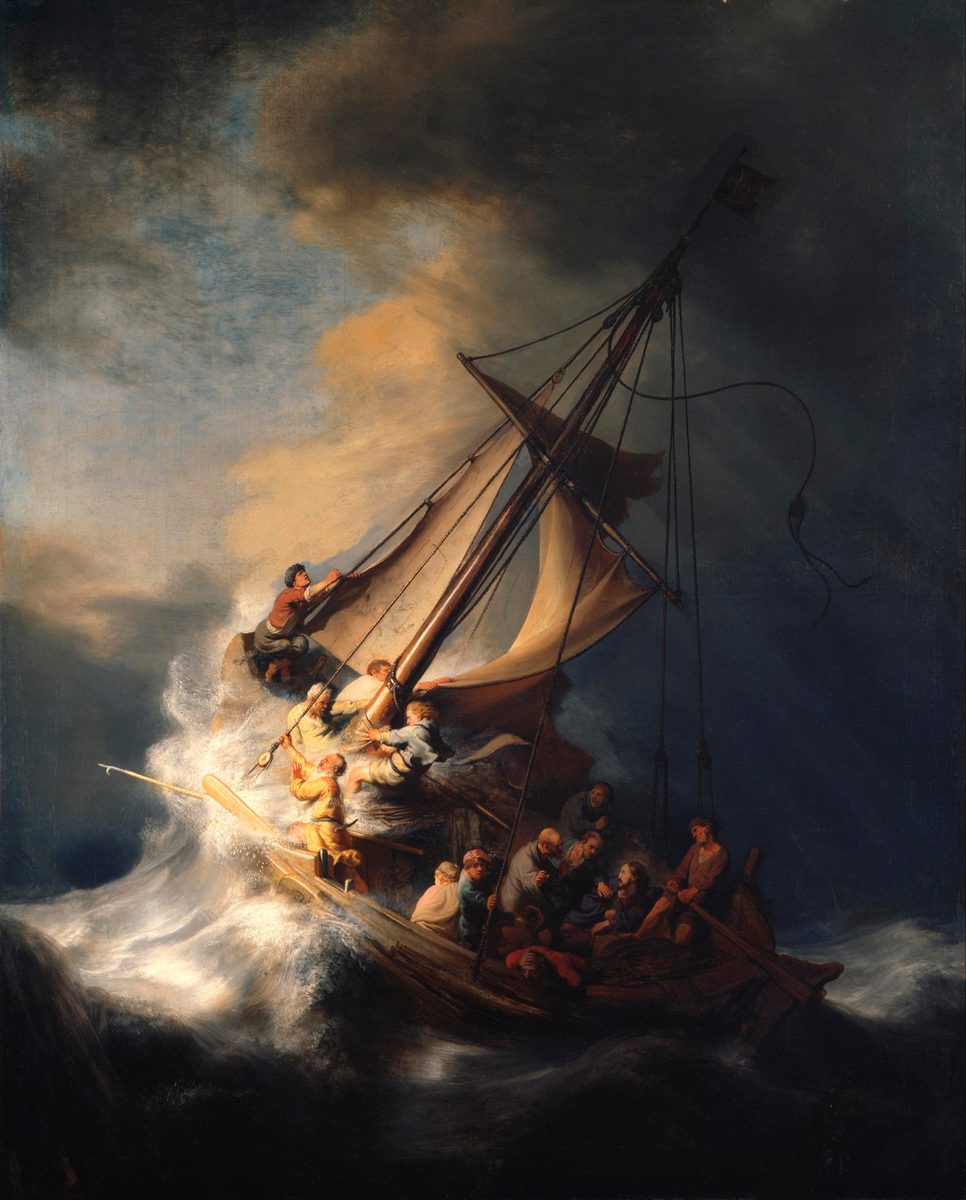
Jesus teaches from a boat in parables — the sower and the soils, a lamp meant to be seen rather than hidden, seed that grows secretly while the sower sleeps, and the mustard seed that becomes the largest of garden plants from the smallest of seeds. Crossing the sea that evening, a sudden storm terrifies the disciples; Jesus, asleep in the stern, wakes and stills it with a word: 'Peace! Be still!'
c. AD 28-29, the same parable-teaching day as Matthew 13; the storm that follows corresponds to the crossing described at the start of Matthew 8.
Rembrandt van Rijn, 1633 · Stolen from the Isabella Stewart Gardner Museum, Boston, 1990; still missing
⚠ This painting has been missing since 1990. It was one of thirteen works stolen from the Isabella Stewart Gardner Museum in Boston in the early hours of March 18, 1990 — still the largest unsolved art theft in history, and the empty frame remains on the museum's wall by the terms of Gardner's own will, waiting for the painting to come back. It is also Rembrandt's only seascape.
Count the figures. Thirteen disciples plus Jesus would make fourteen, and fourteen is traditionally how many are counted here — one more than the Twelve and their teacher strictly requires. The man at the far right, in a cap, gripping a rope and looking directly out of the canvas at the viewer rather than at the storm, is traditionally identified as Rembrandt himself, painted into his own biblical scene as a witness.
⚠ The chapter never says how many were in the boat. Mark 4:36 only adds that 'other boats were with him' — a detail with nothing to do with the number of men in this one, and easy to forget once a painting this famous has supplied a headcount the text itself never gives.
And again he began to teach beside the sea. And such a very great crowd gathered to him that he got into a boat and sat in it on the sea, and the whole crowd was beside the sea on the land.note
Y otra vez comenzó a enseñar junto al mar. Y se reunió con él una multitud tan grande que subió a una barca y se sentó en ella, en el mar, y toda la multitud estaba en tierra, junto al mar.
“And these are the ones beside the path, where the word is sown: when they hear, immediately Satan comes and takes away the word that was sown in them.”note
«Y estos son los de junto al camino, donde se siembra la palabra: cuando la oyen, enseguida viene Satanás y quita la palabra sembrada en ellos.»
“and they have no root in themselves, but are short-lived; then, when affliction or persecution arises because of the word, immediately they fall away.”note
«y no tienen raíz en sí mismos, sino que son de corta duración; luego, cuando viene la aflicción o la persecución a causa de la palabra, enseguida caen.»
“and the cares of the age, and the deceitfulness of riches, and the desires for other things enter in and choke the word, and it becomes unfruitful.”note
«y los afanes de este mundo, y el engaño de las riquezas, y los deseos de otras cosas entran y ahogan la palabra, y se vuelve infructuosa.»
“For there is nothing hidden except in order that it should be made visible, nor did anything become concealed except in order that it should come to light.”note
«Porque nada hay oculto sino para que se manifieste, ni sucedió nada escondido sino para que saliera a la luz.»
“yet when it is sown, it comes up and becomes larger than all the garden plants, and puts out large branches, so that the birds of the sky are able to nest in its shade.”note
«pero cuando se siembra, sube y se hace más grande que todas las hortalizas, y echa grandes ramas, de modo que las aves del cielo pueden anidar bajo su sombra.»
And he himself was in the stern, sleeping on the cushion. And they wake him and say to him, “Teacher, does it not matter to you that we are perishing?”note
Y él estaba en la popa, durmiendo sobre el cabezal. Y lo despiertan y le dicen: «Maestro, ¿no te importa que perecemos?»
And they feared a great fear, and said to one another, “Who then is this, that even the wind and the sea obey him?”note
Y temieron con gran temor, y se decían unos a otros: «¿Quién es este, que hasta el viento y el mar le obedecen?»
Translator’s Notes — verse by verse
Each note explains this translation’s choice and compares the seven
versions on the shelf. Quotations from copyrighted versions (NIV, TLB, NWT) are kept to short phrases for
comparison; KJV, Geneva, Douay-Rheims and ASV are public domain.
Verses 1–9 · ἔπλει … εἰς πλοῖον ἐμβάντα καθῆσθαιeplei … eis ploion embanta kathēsthai — the boat gets used
⚠ Chapter 3 kept a promise chapter 4 now cashes. At 3:9 Jesus told his disciples to keep a small boat ready for him
because of the crowd, so that they would not crush him — a detail that read, at the
time, like ordinary crowd management. Nothing happened with the boat for the rest of that
chapter. Here it is: he gets in, sits down, and teaches an entire crowd standing on the shore
while he speaks from the water. Mark plants props before he uses them.
The yield triples and escalates. Thirty, sixty, a hundred — not one
number repeated for emphasis but three, each doubling-or-more the last, for seed that lands on
ground indistinguishable from the failed ground until the crop is in. The parable does not say
how to tell good soil from bad in advance. It only reports what each one does.
“Let him hear” (v9) ends the parable exactly as it began
(v3), “Listen” — framing the whole thing as a hearing-test before it is
explained as one.
Verses 10–20 · ἵνα βλέποντες βλέπωσι καὶ μὴ ἴδωσινhina blepontes blepōsi kai mē idōsin — the hardest sentence about parables anywhere
⚠ This is the hardest sentence Mark has Jesus say, and it is harder than
Matthew’s version of the same moment.Matthew
13’s note already traced the Isaiah 6:9-10 background behind this saying — the
Hebrew’s blunt imperative to the prophet, ‘make the heart of this people fat,’
softened by the Greek Old Testament into a description, the heart ‘has grown
dull.’ Matthew’s Jesus cites that softened Greek text as fulfilled prophecy, framed
with hoti — because they already see without perceiving
(13:13). Mark’s Jesus never quotes Isaiah at all. He simply states, in his own voice, a
purpose clause — hina, so that — using Isaiah’s
vocabulary without Isaiah’s citation formula: parables are given so that outsiders will
see and not perceive, hear and not understand, lest they should turn and be
forgiven. Every version on this shelf keeps the purpose intact — KJV “lest at any time they should be converted, and their sins should be
forgiven them,” ASV “lest haply they should turn
again, and it should be forgiven them,” NIV “otherwise
they might turn and be forgiven” — and RV60/NVI do the same in Spanish. No version on either shelf softens Mark's
hina into Matthew's hoti; that difference belongs to the Greek text Mark
wrote, not to any translator's later choice.
The library reports two readings of what this means, and adopts neither: that parables are
themselves a further, deserved hardening of those already resistant; or that Mark states as
purpose what Matthew states as description, and the practical difference between the two may be
smaller than the grammar makes it sound. ⚠ What Mark's version does not do is what
Matthew's does — give itself the cover of being a quotation rather than Jesus's own
stated reason.
“The mystery,” singular. Mark gives the Twelve one
mystērion; Matthew's parallel gives them
mystēria, plural — a small difference, likely without much weight, but this
translation keeps each Gospel's own number rather than harmonizing them.
What follows (vv13-20) is Jesus explaining his own parable point by point — something
he does for almost no other parable in any Gospel. The explanation is not obscure. The reason
for needing one, just given, is the obscure part.
Verses 21–25 · μήτι ἔρχεται ὁ λύχνοςmēti erchetai ho lychnos — two sayings that live elsewhere too
⚠ Neither saying in this unit stays put. The lamp under a basket
recurs at Matthew 5:15, inside the Sermon on the Mount, with no
connection to parables at all. The measure you measure recurs at Matthew 7:2, attached to judging other people, again with no
parables in sight. Mark ties both to this moment, hearing and understanding; Matthew
ties them to two entirely different moments. Sayings this portable were plainly used more than
once, by more than one arrangement of the same teacher's material — the library reports
where else each one surfaces rather than picking a single original setting.
Read where Mark puts them, the logic runs forward from v11: something has been hidden (the
mystery, given to the Twelve and not the crowd) precisely so that it can later come to light
(v22). The lamp is not a general principle about honesty. It is, here, a statement about the
parables themselves — concealment with an expiration date.
“Lamp” or “candle”?KJV
alone reads “candle” here, an anachronism for a first-century oil lamp; every other
version compared, ASV and NIV
included, reads “lamp.” The container it must not be hidden under is a
“bushel” in KJV/ASV, a
dry-measure basket about the size to smother a small flame; NIV
generalizes to “bowl.”
Verses 26–29 · ὡς ἄνθρωπος βάλῃ τὸν σπόρονhōs anthrōpos balē ton sporon — a parable no other Gospel kept
The Growing Seed is found only here. Matthew and Luke both keep the
sower and the mustard seed, the parables on either side of this one; neither keeps this one.
Whatever its source, only Mark thought it belonged in the finished book.
⚠ The farmer contributes almost nothing. He scatters, he sleeps, he
rises, and “he does not know how” the seed sprouts and grows. The earth is what
“bears fruit by itself” — automatē, the word behind the English
automatic. The only work given to the man is the last verse: when the grain is ready,
he reaps. A kingdom-parable with no technique in it, only patience and a harvest he did not
cause.
Verses 30–34 · κόκκῳ σινάπεωςkokkō sinapeōs — the smallest seed a Galilean farmer would have planted
“Smaller than all the seeds on the ground” is a farmer's
claim, not a botanist's — proverbially the smallest seed a first-century Galilean sower
would actually have sown, not a claim ranking every seed on earth (orchid seeds, unknown to
that audience, are smaller still). The point is the contrast the parable actually makes: the
smallest seed anyone present had ever planted becomes, of every plant they grew, the
largest — big enough for birds to nest in its shade, the same phrase Ezekiel uses of the
mighty cedar that shelters every kind of bird (Ezekiel 17:23; 31:6). A garden herb given the
imagery of a cedar of Lebanon.
Verses 33-34 close the whole unit the way it opened: parables to the crowd, in public,
pitched to what they were able to hear; everything unpacked afterward, in private, to
the disciples alone. The chapter's own method is stated as its final sentence.
Verses 35–41 · Σιώπα, πεφίμωσοsiōpa, pephimōso — the same command given to a demon and a sea
⚠ ‘Be muzzled’ has one prior use in this book, and it was not
addressed to weather. At 1:25, Jesus rebukes
(epetimēsen) an unclean spirit and orders it, phimōthēti, be muzzled. Here he
rebukes (epetimēsen, the identical verb) the wind and orders the sea,
pephimōso, the same root. Mark does not editorialize about what kind of thing a storm
is. He has Jesus speak to it exactly as he spoke to a demon, and lets the repetition make the
claim.
“Does it not matter to you” is a real question, not simply
panic — the disciples are experienced fishermen on their own working sea, and the boat is
already filling (v37) before anyone wakes him. KJV
“carest thou not”, NIV “don't you
care”, NWT “do you not care” — every
version keeps the accusation aimed at him, not just at the storm.
⚠ Not every version keeps the muzzle.RV60
reads “Calla, enmudece” — the second word from the same root as “mudo,”
mute, keeping the same forceful silencing image as the Greek; NVI
generalizes to “¡Cálmate!”, “calm yourself,” losing the command-to-silence
entirely. This translation follows the Greek and RV60 rather than the smoother reading.
The chapter that opened with a crowd straining to hear a story about hearing ends with the
disciples themselves failing the same test — “why are you cowardly, do you still
have no faith” (v40) — and asking, in the very last line, the question the whole
chapter has been posing sideways since v1: who is this?
Patterns worth carrying forward
Where this translation keeps the words exact / distinct: "so
that" for hina at v12, the purpose clause kept as a purpose clause rather
than softened toward Matthew's descriptive "because"; "the mystery" (v11)
kept singular, against Matthew's plural, rather than harmonized; "be
muzzled" for pephimōso (v39), matched to the identical verb used of the
unclean spirit at 1:25; and "does it not matter to
you" (v38), keeping the accusation aimed at Jesus rather than softened into plain
alarm at the storm.
Echoes paid. The boat kept ready at 3:9 is the boat used here (v1) — a detail planted three
chapters back and only now spent. The rebuke-and-muzzle pairing (v39)
repeats 1:25's exact verbs, this time aimed at wind and sea
rather than an unclean spirit.
Echoes planted. The disciples' own fear and lack of
understanding (v40) — the hearing-test the parables posed to the crowd,
failed here by the Twelve themselves, and a thread this Gospel will keep pulling. The
question that closes the chapter, “who is this?” (v41), left
open rather than answered.
⚠ And the places the library reports rather than decides.Whether v12's purpose clause hardens the already-hard or creates the hardness it
describes — both readings are old, both are argued, and this chapter alone
does not settle which. Where the lamp and measure sayings originally belonged
(vv21-24), since both surface in entirely different settings in Matthew. And how
exactly the seed "grows, he does not know how" (v27) — a parable that
describes a process without explaining it, on purpose.
Next in this book: chapter 5 — a man living
among the tombs, possessed by a legion; a herd of pigs; a synagogue leader's dying daughter;
and a woman who has spent everything on doctors, reaching for the edge of a cloak in a
crowd.