CreationBefore the FloodThe FloodAfter the FloodThe PatriarchsEgypt and the ExodusThe KingdomThe ExileThe ReturnBetween the TestamentsThe GospelsThe Apostolic Age
🕰
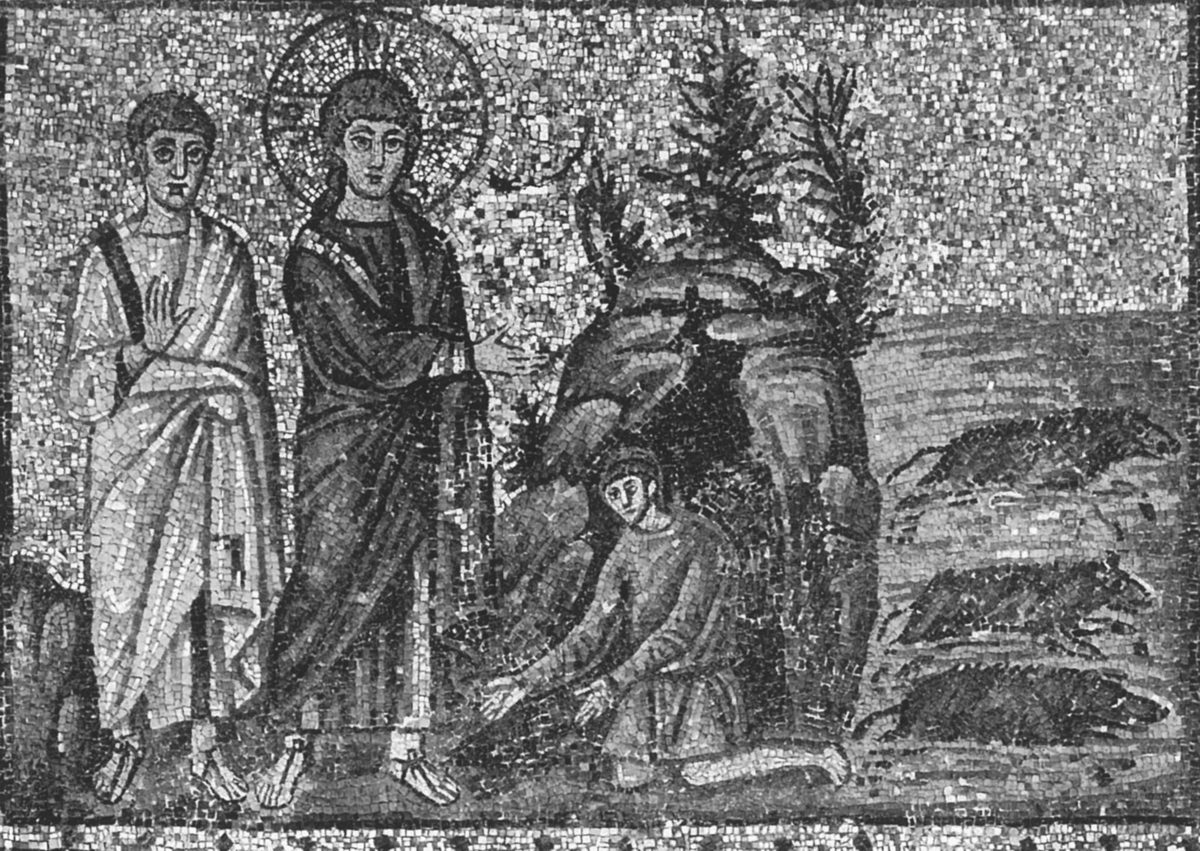
Crossing to the region of the Gerasenes, Jesus casts a legion of demons out of a man living among the tombs and into a herd of pigs, which rush into the sea and drown. Back across the lake, a synagogue ruler named Jairus begs him to heal his dying daughter; on the way, a woman who has bled for twelve years touches his cloak and is healed. Word comes that the girl has died, but Jesus raises her anyway: 'Talitha cumi — Little girl, I say to you, arise.'
c. AD 28-29, corresponding to the same two miracle stories told in Matthew 8-9, here given in fuller detail — Mark names the demoniac's legion and the drowned herd's count, about two thousand pigs, details Matthew omits.
Unknown mosaicist, late 5th century AD · Basilica of Sant'Apollinare Nuovo, Ravenna
⚠ This is one of the oldest surviving pictures of any Gospel miracle — a wall mosaic from Ravenna's Basilica of Sant'Apollinare Nuovo, built around 500 AD, decades before the Byzantine empire's own Justinianic mosaics a few streets away. Christ is shown young and beardless, in the earliest Western convention for his image, a full generation before the bearded type that later became standard. The kneeling man and the dark shapes on the shore are the whole scene reduced to its bones: the man delivered, and what became of the pigs. ⚠ The mosaic's own church tells the region's later religious history in miniature — built under the Arian Ostrogothic king Theodoric, it was rededicated to Nicene orthodoxy within a generation, and its original mosaic cycle survives largely intact along both walls of the nave, one of the most complete such cycles anywhere from this period.
because he had often been bound with shackles and chains, and the chains had been torn apart by him, and the shackles broken in pieces, and no one had the strength to subdue him.note
porque muchas veces había sido atado con grillos y cadenas, y las cadenas habían sido despedazadas por él, y los grillos hechos pedazos, y nadie tenía fuerza para someterlo.
And he gave them permission. And the unclean spirits came out and entered the pigs, and the herd rushed down the steep bank into the sea, about two thousand of them, and they were drowned in the sea.note
Y se lo permitió. Y saliendo los espíritus inmundos, entraron en los cerdos, y la piara se precipitó por el despeñadero al mar, unos dos mil, y se ahogaban en el mar.
And they come to Jesus, and they see the man who had been possessed by demons, sitting there, clothed and in his right mind — the very man who had had the Legion — and they were afraid.note
Y vienen a Jesús, y ven al que había estado poseído por los demonios, sentado, vestido y en su sano juicio —al mismo que había tenido la Legión— y tuvieron miedo.
And he did not permit him, but says to him, “Go home to your own people, and report to them how much the Lord has done for you, and how he has had mercy on you.”note
Y no se lo permitió, sino que le dice: «Vete a tu casa, a los tuyos, y cuéntales cuánto ha hecho el Señor por ti, y cómo tuvo misericordia de ti.»
and begs him earnestly, saying, “My little daughter is at the point of death. Come and lay your hands on her, so that she may be made well and live.”note
y le ruega con insistencia, diciendo: «Mi hijita está a punto de morir. Ven y pon las manos sobre ella, para que sane y viva.»
And they laughed at him. But he put them all outside, and took the father of the child and the mother and those who were with him, and went in where the child was.note
Y se reían de él. Pero él, echando fuera a todos, toma al padre de la niña y a la madre y a los que estaban con él, y entra donde estaba la niña.
And he strictly ordered them that no one should know this, and he told them to give her something to eat.note
Y les ordenó estrictamente que nadie lo supiera, y dijo que le dieran de comer.
Translator’s Notes — verse by verse
Each note explains this translation’s choice and compares the seven
versions on the shelf. Quotations from copyrighted versions (NIV, TLB, NWT) are kept to short phrases for
comparison; KJV, Geneva, Douay-Rheims and ASV are public domain.
⚠ The region's own name is disputed, and the dispute is old.KJV/RV60 read
“Gadarenes,” following the Textus Receptus; ASV,
NIV and NVI read
“Gerasenes,” following the earlier manuscripts — the reading kept here. A
third candidate, Gergesa, shows up in some witnesses too. The geography explains the
argument: Gerasa (modern Jerash) sits some thirty miles from the lake, an odd anchor for a
story that ends with pigs running downhill into the water in the same verse; Gadara is closer,
about six miles off; a small site directly on the shore, sometimes identified as Gergesa,
fits the terrain best of all. This translation follows the earlier text and lets the
geographical awkwardness stand rather than solving it by picking the tidiest name.
⚠ Nobody could bind him, and Mark makes sure the reader knows it took real,
repeated effort to fail. Shackles and chains, more than once, torn apart from the
inside — the description exists to establish a specific kind of strength before Jesus
ever speaks a word to him.
“Legion” is a loaded word to put in an unclean spirit's mouth
in a Roman province: a legion was some five to six thousand soldiers, the empire's own unit
of occupying force, borrowed here to describe the size of the crowd inside one man. The word
choice is not neutral in a region that had Roman legions stationed nearby.
⚠ The negotiation itself is strange and Mark does not smooth it. The
spirits beg to stay in the region (v10), then beg to enter the pigs (v12) — a request
Jesus grants without recorded comment — and the herd's destruction (about two thousand,
v13) is the direct, immediate result. The text does not explain why the second request is
allowed when the first is not, or comment on the pigs' owners at all.
Verses 14–20 · ὕπαγε εἰς τὸν οἶκόν σου… καὶ ἀπάγγειλονhypage eis ton oikon sou… kai apangeilon — the one man Jesus tells to talk
⚠ The town is more afraid of the healed man than the possessed one.
Verse 15 names the fear directly, at the exact moment the man is sitting, dressed, and sane
— not while he was breaking chains among the tombs. What frightens them is not danger
but a change in kind they cannot account for, and their response is to ask Jesus to leave
(v17), the only request in this chapter he does not argue with.
⚠ This is the one clear exception to the silence Mark has kept building since
chapter 1. Every other cleansed or delivered person in this Gospel so far has been
told to say nothing, or has spread the word against instruction. Here Jesus does the
opposite on purpose: “go home… and report” (v19). The man is a Gentile, in
Gentile territory, with no synagogue audience and no crowd of scribes reading Messianic
claims into a healing — the one setting in the Gospel so far where public proclamation
costs nothing politically, and Jesus lifts the usual restriction exactly there.
The Decapolis (v20) — ten Greek cities east of the Jordan — is
named as the man's own mission field, the first person in this Gospel commissioned to preach
who is neither a fisherman nor a disciple Jesus called in person.
Verses 21–24 · τὸ θυγάτριόν μου ἐσχάτως ἔχειto thygatrion mou eschatōs echei — a ruler falls at the feet of a man his own institution distrusts
Jairus is named — unusual in Mark, where most people Jesus heals
go unnamed — and titled archisynagōgos, a synagogue ruler, one of the very
class of official who has already been arguing with Jesus since chapter 2 and plotting
against him since chapter 3. He falls at Jesus's feet anyway, in public, for his daughter.
⚠ “My little daughter” — thygatrion, a
diminutive, the kind of word a parent uses rather than an official. The urgency in v23 is
medical and immediate: at the point of death, not merely ill. The crowd that follows
(v24) is the same crowd that will delay him for the rest of this scene.
Verses 25–34 · τίς μου ἥψατο τῶν ἱματίωνtis mou hēpsato tōn himatiōn — touched by a crowd, touched by one woman
⚠ Twelve years of bleeding (v25) sits inside a story about a
twelve-year-old girl (v42) without Mark ever remarking on the coincidence — two lives
measured by the same number, one running out as the other has just begun.
The woman's condition made her ritually unclean under the law (Leviticus 15:25-27, now on these pages), which
means every person she brushed against in this crowd (v27) she technically made unclean in
turn — a detail the text does not spell out but the original audience would have felt
immediately. She touches Jesus anyway, from behind, expecting to go unnoticed.
“Who touched my garments?” against the disciples' —
almost incredulous — “you see the crowd pressing you” (v31) draws the exact
line this scene is built on: a crowd presses Jesus by accident, constantly; one person
touches him on purpose, once, and the story stops for her alone. Power
(dynamis) leaving him (v30) is described almost physically, a quantity that moves and
can be perceived leaving, not a metaphor for attention.
“Daughter” (v34) is the only time in this Gospel Jesus calls
a grown woman by this word — the same relationship-word Jairus has just used of the
girl he is racing home to. Mark does not comment on the echo. It simply sits between the two
halves of one interrupted errand.
Verses 35–43 · Ταλιθα κουμtalitha koum — three witnesses, one phrase left untranslated on purpose
⚠ “Peter and James and John” (v37) appear together here for
the first time as a set — the same three, and only these three, Jesus will
take up the mountain at the transfiguration (9:2) and further into the garden at Gethsemane
(14:33). This scene is the first time Mark marks them out as a distinct inner group, before
either of the later scenes gives a reason why.
The mourners' laughter (v40) at “the child is not dead but
sleeping” is not politeness failing; it is people who have just been wailing (v38)
switching instantly to scorn for a claim they take as obviously false — and Jesus puts
all of them outside before he does anything else.
“Talitha koum” is Aramaic, the language Jesus actually spoke,
kept untranslated in the Greek text and then translated immediately afterward — the
same pattern this Gospel already used for “Boanerges” at 3:17. Mark preserves the actual sound of what was said before
explaining it, twice now, as if the original words themselves are part of what is being
reported.
⚠ The order to keep silent (v43) returns immediately after the one
chapter that just broke it — a Gentile in Gentile territory was told to proclaim
everywhere (v19); a Jewish official's daughter, raised in a Jewish household, is met with the
opposite instruction. The text draws the line differently each time and never states the
rule connecting the two decisions.
Patterns worth carrying forward
Where this translation keeps the words exact / distinct: "Gerasenes"
(v1) over KJV/RV60's "Gadarenes," following the earlier manuscripts rather than the
Textus Receptus; "Legion" (v9) kept as the loaded Roman military term it
is, not softened to a generic "many"; "Daughter" (v34) kept as the same
relationship-word Jairus uses of his own child (v23), not varied for elegance; and
"Talitha koum" (v41) preserved in Aramaic and then translated, matching
this Gospel's own treatment of "Boanerges" at 3:17.
Echoes paid. The inner three, Peter and James and
John (v37), named together here for the first time before either later scene explains
why; the silence command (v43), returning immediately after the one
chapter that broke it for a Gentile audience (v19); and power going out from
him (v30), described as something that moves and can be perceived leaving, not a
metaphor.
Echoes planted. Peter, James, and John will be taken up the mountain
at the transfiguration and further into Gethsemane — the same three, marked out
first in this ordinary house in Capernaum. The twelve years shared by the
woman's affliction and the girl's age (vv25, 42), left uncommented. And the
Decapolis mission (v20), the first person in this Gospel sent to preach
who was neither called in person nor a fisherman.
⚠ And the places the library reports rather than decides. Which
region this chapter is actually set in (v1), a genuine and old textual crux, not a
translation choice. Why the spirits' second request is granted when the first is refused
(vv10-13), left without comment in the Greek. And why silence is commanded here (v43) but
lifted entirely at v19, two decisions in one Gospel with no stated rule connecting them.
Next in this book: chapter 6 — Jesus
rejected in his own hometown; the Twelve sent out two by two with nothing for the
journey; the death of John the Baptist, told in full as a flashback in the middle of
another story; and five thousand fed from five loaves and two fish.