Matthew 28 — The Mister Translation
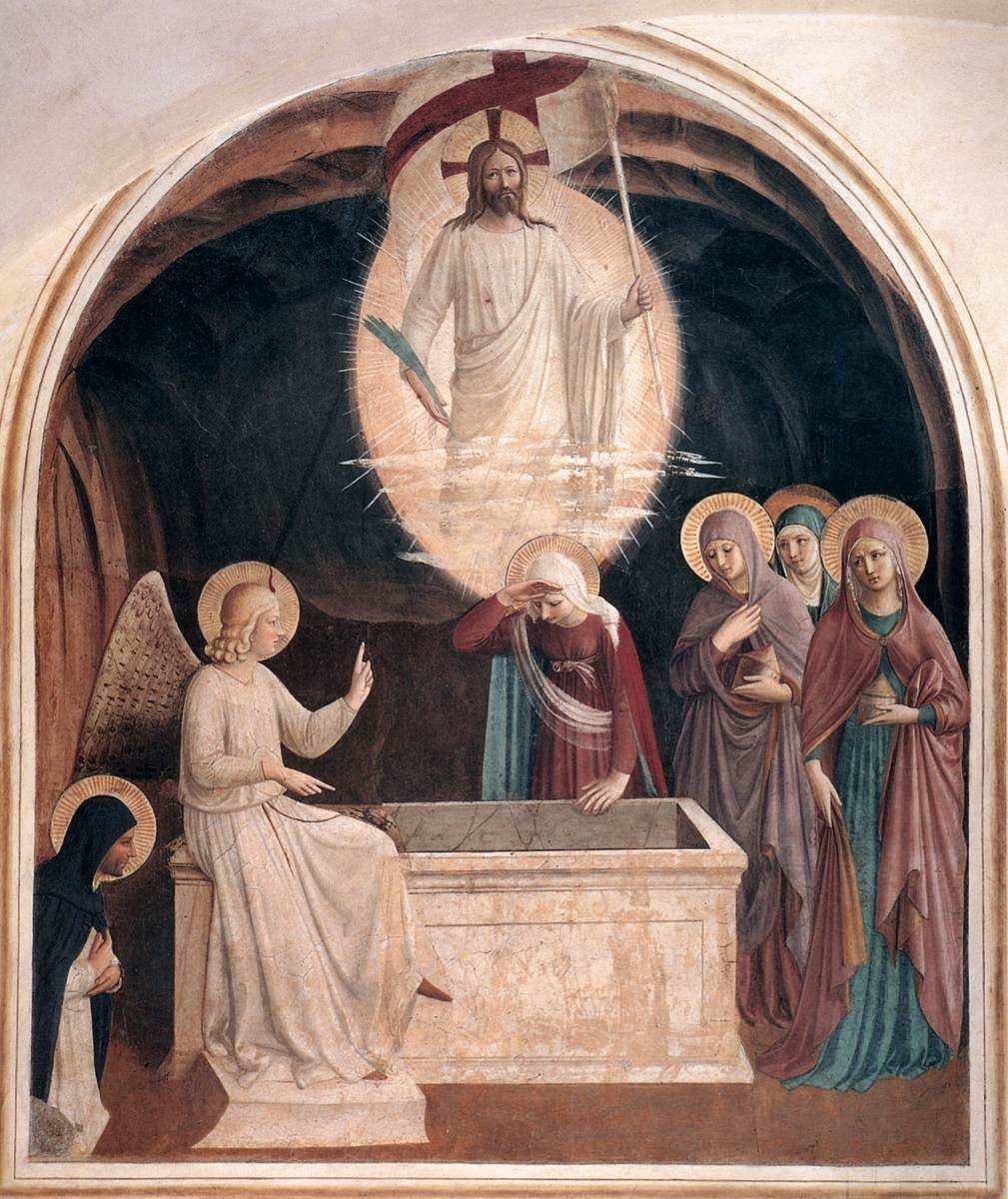
⚠ The angel is SITTING, and that is Matthew’s detail alone. He rolls the stone away and then sits on it (v2); no other Gospel has him sit down, and Fra Angelico paints the posture rather than the action. The lid is off and the box is visibly empty, which is the errand of v6 — the stone is not moved to let him out, since he is already gone, but so that the women can look in. ⚠ Two things here are not in Matthew, and the second is deliberate. The risen Christ hovering above the tomb is not this chapter’s scene — Matthew has him meet the women on the road (v9), not appear over the grave. And the kneeling friar at the lower left, generally identified as St Dominic, is thirteen centuries early: these frescoes were painted on the walls of the friars’ own cells at San Marco as aids to prayer, and the Dominican in the corner is the viewer, put into the picture on purpose. He is the only figure not looking at the tomb.
_-_WGA00542.jpg)
Translator’s Notes — verse by verse
Each note explains this translation's choice and compares the seven versions on the shelf. Quotations from copyrighted versions (NIV, TLB, NWT) are kept to short phrases for comparison; KJV, Geneva, Douay-Rheims and ASV are public domain.
⚠ The shaking, and the whole family of the word. Seismos — and this is where the thread chapter 8’s note started finally arrives. That note observed that Matthew calls the storm on the lake an earthquake where Mark and Luke both use lailaps, the ordinary word for a squall. The full pattern is larger than that note said, and worth setting out once, here at the end: the noun seismos stands at 8:24 (the sea), 24:7 (the earthquakes of the birth pangs), 27:54 (what the centurion saw) and here; the verb seiō stands at 21:10 (the whole city “shaken” when he rides in), 27:51 (the earth at the death) and at v4 below (the guards). Seven in Matthew, against one each in Mark, Luke and Acts. ⚠ So the pattern is not a set of three, as chapters 8 and 27 both said — those notes have been corrected. It is a single word-family Matthew runs from a lake to a city to the earth to a row of soldiers, and in every case something that is supposed to be immovable is not.
The messenger sits on the stone. He rolls it away and then sits on it — ekathēto epanō autou. Matthew is the only Gospel that has him sit down, and the posture is the point: the stone the priests sealed is now furniture. ⚠ Note also what the stone is not moved for. It is not rolled away to let him out; v6 has him already gone. It is rolled away to let the women look in.
⚠ “He was raised” — passive, and Matthew keeps it passive. Ēgerthē, not the middle or active “he rose.” The subject of the action is left unstated, which is this Gospel’s standing way of saying God without saying God — the same reticence as the “kingdom of the heavens” and as 26:64’s “the Power.” Every version on the shelf has an active or intransitive verb somewhere in this chapter (KJV “he is risen”; NIV “he has risen”), and ASV’s “he is risen” with a margin, and NWT “he was raised up,” which is the exact one. This translation reads he was raised.
“Fear and great joy.” Matthew puts them in one phrase and does not rank them. He also gives the women the errand: they are the first to be told, the first to be sent, and the first to be believed by nobody — the last detail is Luke’s, not his, and the library notes the borrowing rather than importing it.
“Greetings.” Chairete is the everyday Greek hello — literally “rejoice,” and used as unremarkably as “good morning.” It is the word the soldiers used at 27:29, “Hail, king of the Jews,” and the word Judas used in the garden at 26:49. Its third and last appearance is this one, and it is the only one that is not a lie. KJV “All hail” is a little grander than the Greek; this translation keeps it plain.
They take hold of his feet. Ekratēsan — the same verb used of the mob that “seized” him in the garden (26:50) and of the men who “took hold” of him before Caiaphas. Its last use in the Gospel is two women holding onto his feet. ⚠ And prosekynēsan — knelt, prostrated — is the verb the magi used at 2:11, which this Gospel has now bracketed: foreigners at the beginning, women at the end, the eleven eight verses later.
“My brothers.” Said of the men who ran (26:56). Matthew does not narrate a reconciliation, or an apology, or a rebuke; he has Jesus use the family word and gives them an address in Galilee. The library notes that the absence of a reconciliation scene is itself the statement.
⚠ Silver changes hands twice in this Gospel, and both times to arrange a story. Argyria hikana, “a sufficient sum of silver” — the same word as the thirty pieces at 26:15 and 27:3-10. The first payment bought a man; this one buys an account of what happened, and Matthew uses the vague hikana, “enough,” where he had been exact about thirty. He is not interested in the amount the second time.
⚠ The story they are told to tell would convict them. “His disciples came by night and stole him while we were sleeping” — which is a soldier confessing that he slept on watch, an offence that could be capital under Roman discipline. Hence v14: the priests undertake to “persuade” the governor and make them amerimnous, free of worry. ⚠ Matthew leaves the hole in the story visible and does not point at it, which is the same technique as the false witnesses of 26:60: the reader is trusted to notice.
“Among the Jews, to this day.” Matthew is reporting that a rival explanation was in circulation when he wrote — and the honest reading of the sentence is that it tells us more about Matthew’s situation than about the guards. He is writing for people who have heard the other version and need an answer to it, and the existence of the counter-story is evidence that something needed explaining. ⚠ The phrase “among the Jews” also needs the same care as 27:25, and for the same reason: this Gospel is an argument inside Judaism, by a writer who quotes its scriptures on every page, and reading a phrase like this as though it were written from outside — as a Gentile church looking at an alien people — is the misreading that made a weapon of the previous chapter. Justin Martyr, a century later, has the same claim in a debate with a Jewish interlocutor; the library records that the argument is old and that its later use was not innocent.
Eleven, and a mountain. Matthew counts them: hoi hendeka. And he ends where he has staged every major revelation — on a mountain, as with the Sermon (5:1), the transfiguration (17:1) and the last discourse (24:3). He does not say which one, and there is no tradition worth reporting.
⚠ And here is the word chapter 14 promised, in the last place anyone would put it. “They knelt before him — but some of them doubted.” Edistasan, from distazō, and chapter 14’s note said this verb would sound only once more in the whole New Testament, at the very end of this book. It does: the word occurs twice in the entire New Testament, at 14:31, where Peter is sinking, and here. ⚠ And it is not the word for unbelief. Apistia is unbelief; distazō is to be of two minds, to waver — what someone does who has already seen the evidence and hesitates anyway. The first time it earned “you of little faith, why did you doubt?” This time there is no rebuke at all: the sentence moves straight from the doubting to the giving of all authority, and the commission is handed to the group that contains them.
What the Greek does not settle. Hoi de edistasan can mean “but some doubted” or “but they doubted” — the construction can distinguish a subgroup or simply resume the same subject, and Greek grammars argue both. KJV “but some doubted”; ASV the same; NWT “but some doubted”; NIV “but some doubted” with a footnote. This translation reads some of them, which is the majority reading and the gentler one, and records that “they worshipped, though they wavered” — all eleven — is fully available in the grammar and is the harder sentence.
⚠ “All authority” — and three earlier chapters have been waiting for it. Edothē moi pasa exousia. Chapter 7’s note flagged exousia where the crowds noticed he taught “as one having authority, and not as their scribes” (7:29) and said the word was planted where the book could reach it. Chapter 21’s note paid part of it, where the men who held the official kind demanded to see his credentials. And chapter 11’s note said 11:27’s “all things have been handed over to me” was this Gospel’s first claim of universal authority and not its last, naming this verse. All three land here. ⚠ And the verb is passive again: it was given. The last sentence of the book about his authority is a sentence about receiving it.
“Make disciples” — and the verb has been used twice already, both times in the passive. Mathēteusate, the imperative. Mathēteuō occurs three times in Matthew and nowhere else in the Gospels: at 13:52, of the scribe “who has been made a disciple of the kingdom”; at 27:57, of Joseph of Arimathea, who “had been made a disciple”; and here, where for the first time it is an active command given to people. Two men are made disciples and then the made are told to make.
⚠ “All the nations” — and this is the border chapter 10 said would be thrown open. Panta ta ethnē. At 10:5-6 the Twelve were sent with a hard restriction, stated twice: go nowhere among the ethnē, only to the lost sheep of the house of Israel. Chapter 10’s note set that against this verse and said the Gentile mission the chapter forecloses was waiting to be thrown open at the end of the book. Same word, opposite instruction, eighteen chapters apart, and Matthew offers no reconciliation of the two. The library reports both and observes that the book is willing to end on a reversal it never explains.
⚠ The baptismal formula: what the manuscripts say, and what the argument actually rests on. “Baptizing them into the name of the Father and of the Son and of the Holy Spirit” is the only triadic baptismal formula in the New Testament, and it sits awkwardly beside Acts, where people are consistently baptized “in the name of Jesus” (Acts 2:38; 8:16; 10:48; 19:5 — the first of these now on these pages). Because of that, it has been argued that the longer formula is a later liturgical expansion. ⚠ The library’s duty here is to be precise about the evidence, and the evidence is one-sided in a way the argument’s popularity can obscure: there is no Greek manuscript of Matthew that reads anything else. Not one — the apparatus records no variant at this point at all. The case for a shorter original rests entirely on the fact that Eusebius, in the fourth century, several times quotes the verse in a short form (“in my name”), while elsewhere quoting it in full. That is a real datum about how one writer cited the verse and it is not manuscript evidence, and treating the two as equivalent is the error to avoid in either direction. So: the reading is printed, the Acts pattern is recorded, and the state of the evidence is stated rather than a conclusion drawn from it. Eis to onoma is “into the name,” not “in” — a transfer of ownership in the commercial idiom of the period, paid into an account. ASV and NWT both read “into,” which is the exact rendering; KJV and NIV “in.”
⚠ And the book ends where it began, in the same three words. “I am with you” — egō meth’ hymōn eimi. At 1:23 Matthew stopped to translate a name for his readers, as he rarely does: Emmanuel, meth’ hēmōn ho theos, God with us. Chapter 1’s note called it an inclusio and said the book opens on “God with us” and closes on “I am with you always”, and that everything between is bracketed by that presence. The bracket closes here, on the same preposition and the same pronoun-shape, and it is the last thing in the Gospel. ⚠ Twenty-eight chapters of a name being explained.
“Until the completion of the age.” Synteleias tou aiōnos — Matthew’s own phrase, which chapter 24 discussed at length and which this translation has kept distinct from “the end” throughout. It closes the book on the same vocabulary the discourse used, and the promise is bounded by it rather than by anything else.
What Matthew does not have. No ascension — that is Luke’s and Acts’. No appearance to Peter by name, no meal, no wounds shown, no last look at Judas. The risen Jesus says four sentences and the Gospel stops mid-air, with him still speaking and still on the mountain. ⚠ A small variant records how uncomfortable that was: the Byzantine tradition adds “Amen” at the end, and KJV prints it. The earliest text does not, and this translation leaves the book unclosed, because that is how it was written.
And a note on what this page completes. This is the last verse of Matthew, and Matthew is the first book of the New Testament that this project has translated end to end. The apparatus consulted throughout has been the critical Greek text with the Byzantine tradition reported at every point where it differs and matters; the seven-version shelf has been compared in every chapter; and the running total of what the library reports rather than decides now stands at several dozen places across the book. That is the point of it. A translation that never shows you a place where it could have gone the other way is not being careful with you.
Patterns worth carrying forward — and the end of the book
Where this translation keeps the words exact / distinct: "a great shaking" for seismos, matched to 8:24; "he was raised" for ēgerthē, passive, with the agent left unstated as this Gospel prefers; "knelt before" for proskyneō, matched to the magi at 2:11; "some of them doubted" for edistasan, with the harder "they wavered" recorded; "make disciples" for mathēteusate, active where 13:52 and 27:57 were passive; "into the name" for eis to onoma, not "in"; and "completion of the age" for synteleia tou aiōnos, Matthew's own phrase, kept distinct from "the end" throughout the book.
Echoes paid — and this chapter pays off seven chapters at once. "I am with you" (v20) — the inclusio chapter 1's note named: the book opens on Emmanuel, "God with us", and closes on the same preposition, twenty-eight chapters of a name being explained; distazō (v17) — the verb chapter 14's note said would sound only once more in the whole New Testament, and it is here, with no rebuke this time; "all authority" (v18) — the exousia chapter 7's note planted at 7:29, part-paid at 21:23, and named by chapter 11's note as the answer to 11:27; "all the nations" (v19) — the hard border of 10:5-6 thrown open, exactly as chapter 10's note said it would be, with no reconciliation offered; mathēteuō (v19) — 27:57's passive turned active; seismos (vv2, 4) — the family chapter 8's note started tracing; and chairete (v9) — the greeting used by Judas at 26:49 and the soldiers at 27:29, here for the third time and the first time honestly.
⚠ The seismos word-family runs through the whole book. The noun stands at 8:24, 24:7, 27:54 and 28:2, and the verb at 21:10 (the city shaken when he rides in), 27:51 and 28:4 (the guards) — seven in Matthew against one each in Mark, Luke and Acts. A single word-family run from a lake to a city to the earth to a row of soldiers, and every time something that is supposed to be immovable is not.
⚠ And the places the library reports rather than decides. The baptismal formula (v19) — the only triadic one in the New Testament, standing awkwardly beside Acts, where baptism is consistently "in the name of Jesus". Here the evidence needs stating precisely rather than summarized: no Greek manuscript of Matthew reads anything else, and the apparatus records no variant at this point at all. The case for a shorter original rests on Eusebius quoting the verse in a short form several times in the fourth century while quoting it in full elsewhere — a real datum about one writer's citation habits, and not manuscript evidence. The two are not equivalent and the library does not treat them as such in either direction. Hoi de edistasan (v17) — "some doubted" or "they wavered", both available in the grammar. And "among the Jews" (v15), which needs the same care as 27:25 and for the same reason: this is an argument inside Judaism, by a writer quoting its scriptures on every page, and reading it as though written from outside is the misreading that made a weapon of the previous chapter.
The book is finished. Matthew is the first book of the New Testament this project has translated end to end — 28 chapters, from a genealogy to four sentences on a mountain, with the critical Greek text as the base, the Byzantine tradition reported wherever it differs and matters, and the seven-version shelf compared in every chapter. There is no ascension here and no closing "Amen" in the earliest text: the Gospel stops with him still speaking. ⚠ The one thing this translation has tried hardest to do is show its own working — every place a reading could have gone the other way is on the page, named, with what each option costs. A translation that never shows you those places is not being careful with you.
Next: the library returns to the Hebrew Bible and to the other books already begun. Jeremiah stands at chapters 1 and 18–23; Genesis and Exodus are further along; and sixty-five other books have a first chapter waiting for a second.