Matthew 24 — The Mister Translation
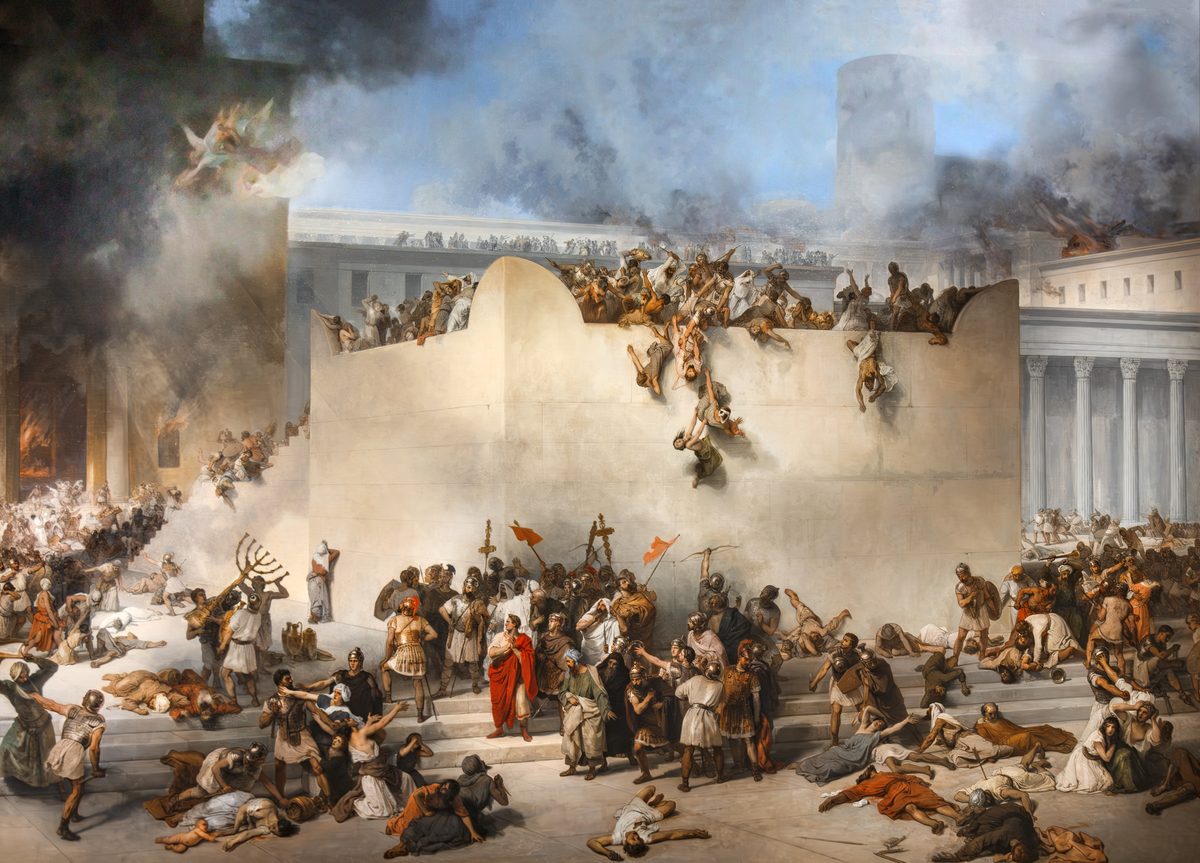
⚠ This is verse 2 painted — “not one stone will be left here on another” — and the detail that anchors it is at the far left: men carrying off a seven-branched menorah and the temple vessels, which is the scene carved on the Arch of Titus in Rome, where it can still be seen. Hayez fills the canvas with the things the chapter does not describe and the historians do: the standards, the bodies on the steps, the men thrown from the wall. Note the smoke at the upper left, where he has put winged figures — a nineteenth-century allegorical instinct the Gospel text does not license, and worth seeing as his addition rather than Matthew’s. Begun in 1860 and finished in 1867 (oil on canvas, about 183 × 282 cm); Hayez gave it in 1868 to the Venice academy where he had trained half a century earlier, and it hangs there still. ⚠ Commons credits the photographer, not the painter, on this file; the attribution here is Hayez.
_La_distruzione_del_tempio_di_Gerusalemme_-Francesco_Hayez_-_gallerie_Accademia_Venice.jpg)
Translator’s Notes — verse by verse
Each note explains this translation's choice and compares the seven versions on the shelf. Quotations from copyrighted versions (NIV, TLB, NWT) are kept to short phrases for comparison; KJV, Geneva, Douay-Rheims and ASV are public domain.
He walks out of the house he just called desolate. Three verses ago the temple was "left to you" (23:38); now he leaves it, a disciple points at the masonry, and the answer is that none of it will be left standing. Herod's temple was one of the largest building projects in the empire and still unfinished; the stones in the surviving retaining wall run to tens of tonnes. In AD 70 the Romans burned and dismantled it.
⚠ And here is the difficulty the whole chapter inherits: how many questions are the disciples asking? They ask (1) when will these things be, (2) what is the sign of your parousia, and (3) and of the completion of the age. In Greek the second and third share one article, which is a real grammatical argument that the disciples take the temple's fall and the end of the age to be one event — and much of the chapter's interpretive history turns on whether Jesus answers on their assumption or corrects it. Readings: that the whole discourse concerns AD 70; that it concerns the end; that it moves from one to the other at some point (v15? v29? v36?); or that it holds both together deliberately in the prophetic manner, where a near horizon and a far one are described in one sweep. The library sets these out and does not choose, and flags where each reading would put its seam.
Parousia. Not "coming" but presence, or an arrival that results in presence — in ordinary Greek it is the official visit of a king or governor to a city, with the welcome and the honours that went with it. ⚠ Matthew uses the word four times and all four are in this chapter (vv3, 27, 37, 39); it appears nowhere else in the Gospels. KJV ASV NIV all read "coming," which is defensible but blurs it into the ordinary verb erchomai that the chapter also uses (vv30, 42, 44); NWT reads "presence" and keeps them distinct, which is tighter and is followed here. Synteleia tou aiōnos is the "completion of the age" — syn-teleia, a bringing-to-an-end together, and Matthew is the only evangelist who uses the phrase.
The first answer is a warning against reading signs. Wars, famines, earthquakes, persecution, apostasy, false prophets — and the refrain is not yet: "the end is not yet" (v6), "the beginning of birth pangs" (v8). ⚠ Everything in this paragraph is something a reader in any century can point at, which is why it has been pointed at in every century; the passage's own use of it is to forbid the inference. Note the four imperatives: do not be led astray, do not be alarmed, endure, and (v14) preach.
Birth pangs. Ōdines is specifically labour pain, and the metaphor is standard prophetic vocabulary for the anguish preceding a new age (Isaiah 26:17; Jeremiah 22:23; Hosea 13:13). Its force is that pain of this kind is productive and not terminal — which is exactly the opposite of what a reader collecting disasters usually wants it to mean.
Two words worth keeping distinct. "The love of the many will grow cold" is psygēsetai, from psychō, to breathe or blow cool — a physical verb, used only here in the New Testament, and the noun family behind psychē. And ⚠ a small textual point that explains a familiar phrase: the KJV's "famines, and pestilences, and earthquakes" has a third item the earliest manuscripts do not; the critical text reads limoi kai seismoi, famines and earthquakes. The Byzantine addition is loimoi, pestilences — which differs from limoi, famines, by a single letter and rhymes with it, the classic profile of a scribe's ear supplying a familiar pair.
The one place the chapter names a book. "The abomination of desolation spoken of through Daniel the prophet" — the phrase is from Daniel 11:31 and 12:11 (and 9:27, not yet on these pages), and both of those chapters are on these pages, so the reader can go and look. ⚠ Daniel's own phrase had a first fulfilment everyone in the first century knew about: in 167 BC Antiochus IV set up an altar to Zeus in the temple and sacrificed on it, and the Maccabean literature uses the same words for it. So the passage is invoking something that had already happened once, which is part of why "when" is so hard.
"Let the reader understand." ⚠ This is an aside outside the speech — the one place in this discourse where the writer stops reporting and addresses the person holding the book. Whether it means "reader of Daniel" or "reader of this Gospel" is disputed, and the shelf simply prints it without comment. This translation italicizes it and sets it off with dashes so the seam is visible rather than smoothed into Jesus' own words. It is also, incidentally, evidence that Matthew expected to be read rather than only heard.
The flight instructions are concrete, local and short-range. Do not go back into the house; do not turn back for a cloak; pray it is not winter, and not a Sabbath. ⚠ These are not instructions for the end of the world — you cannot outrun that to the mountains — and they are one of the strongest arguments that at least this part of the discourse concerns the Judean war. Eusebius reports that the Jerusalem church left for Pella before the siege closed; whether that tradition depends on this passage or independently confirms it is not decidable. Note the Sabbath detail, which tells you something about Matthew's first readers: the difficulty is assumed to be real for them.
"Cut short." Ekolobōthēsan — literally to dock or mutilate, to cut a thing off short; the shelf's "shortened" is right but tamer. The mercy in the sentence is grammatical: the days were cut short, in the aorist, before the reason is given.
The test is not the miracle. False christs "will give great signs and portents" — the same word-pair the Old Testament uses of Moses — so the criterion cannot be wonders. It is location: anyone who tells you where he is (the wilderness, the inner rooms) is lying, because the parousia is not the kind of thing you get told the location of.
Lightning, east to west. The comparison is about visibility and simultaneity, not speed or direction: nobody has to be informed that lightning happened. ⚠ Note the geography though — "from the east… as far as the west" is the axis of the Mediterranean world, and the same phrase describes the direction armies came from.
The corpse and the vultures. Ptōma is a fallen body; aetoi means eagles, and Greek used it for carrion birds as well, which is why versions split: KJV DRB read "eagles," NIV NWT read "vultures." ⚠ Eagles do not gather at corpses and griffon vultures do, so "vultures" is the better zoology; but the eagle was the standard on every Roman legion, and readers from the second century on have heard that in the line. This translation prints "vultures" and records the pun the word cannot help making. The saying is proverbial in form and grim in effect: you will not need directions to find the place.
Almost every phrase here is a quotation. Sun darkened, moon without light, stars falling, powers shaken — these are the stock images of the Day of Jehovah in Isaiah 13:10 and 34:4 and Joel 2:10, and in the prophets they describe the fall of cities and empires, not the physical end of the sky. ⚠ That is the single most important fact for reading v29, and it cuts both ways: it means the language does not by itself require a cosmic end, and it also means the language was always used of something enormous. The library states the convention and lets the reader weigh it.
The Son of Man on the clouds. Daniel again — 7:13, where "one like a son of man" comes with the clouds of heaven and is given dominion. Matthew has been building this since 8:20, where the title's first use was a man with nowhere to sleep, and chapter 8's note promised it would return here on the clouds. ⚠ Note the direction of travel in Daniel: the figure comes to the Ancient of Days to receive a kingdom, not down to earth. Whether Matthew keeps that direction or reverses it is argued, and it matters for what v30 describes.
And "beat their breasts." Kopsontai is the gesture of formal mourning, not fear — a Zechariah 12:10-12 allusion, where the tribes of the land mourn for one they have pierced. KJV "mourn" is accurate and loses the action.
The fig tree, kept in leaf. Chapter 21's note said the withered fig tree (21:19) was waiting for this one, and here it is with the sense reversed: there the leaves were a lie, here they are a reliable sign. It is a parable about reading a season, not a date — the branch tells you summer is near, and nothing more precise than near.
⚠ "This generation will not pass away until all these things happen." This is the hardest sentence in the chapter and the library will not pretend otherwise. Genea most naturally means the people alive at the time of speaking, and Matthew has used it that way repeatedly — "an evil and adulterous generation" (12:39), "all these things will come upon this generation" (23:36), only nine verses before this chapter began. The readings, with what each costs: (1) it means the contemporaries, and "all these things" refers to the temple's fall, which happened within about forty years — this fits genea and fits the chapter's Judean detail, and requires vv29-31 to be read as prophetic language for that event. (2) Genea means "race" or "kind" (a possible but strained sense, and not how Matthew otherwise uses it). (3) It means the generation alive when the final signs begin, "this" pointing forward. (4) It is a prediction whose terms were not met as stated — which some hold and others regard as impossible. ⚠ C. S. Lewis called this saying “the most embarrassing verse in the Bible” — in The World’s Last Night (1960), and of Mark’s wording (13:30) rather than Matthew’s, though the sentence is the same. His own argument is worth having here, because it is about the two verses side by side: the admission of ignorance stands three verses later, and copyists who could see the apparent failure preserved both anyway — which Lewis took as evidence that the record had not been tidied. The library reports all four readings and votes for none, and notes that the very next verse in Matthew says nobody knows the day.
⚠ Three words with a very long history, and they are a textual question first. "About that day and hour nobody knows — not the angels of the heavens, nor the Son — but the Father only." The phrase oude ho huios is present in the earliest and best manuscripts (Sinaiticus, Vaticanus, Bezae among them) and absent from the Byzantine tradition, which is why KJV and GNV do not have it here while ASV, NIV and NWT do. ⚠ Note the direction of the evidence, because it is unusually clear: a scribe with a high Christology has an obvious motive to drop the clause, and no scribe has a motive to add it. That asymmetry is why the critical editions print it, and why this translation does. The parallel at Mark 13:32 has it in every witness, which also tells against the idea that it was imported.
And then what it means, which is a different question. The library will not adjudicate it, but it will set out the shape: the sentence has been read as evidence that the Son's knowledge was genuinely limited in the incarnation (the classical kenotic and much of the Reformed and modern reading); as a statement about the Son's economic role rather than his nature, i.e. that it was not his to reveal (a patristic line, and one Athanasius argues at length); and as an idiom of authority — "not mine to announce" rather than "unknown to me." What is worth saying plainly is that the verse is not a marginal curiosity that translation can soften: it is in the text, on the best evidence, and it says what it says.
Noah, and the point of the comparison. ⚠ The comparison is not that the world was wicked. Read v38: they were "eating and drinking, marrying and giving in marriage" — ordinary life, and the fault named is only that "they did not know." The days of Noah are invoked for obliviousness, not depravity, which is why the paragraph ends in instructions to stay awake rather than to reform.
⚠ "One is taken along and one is left" — and which one you want to be. Paralambanetai is to take alongside, to take with one; aphietai is to leave, let go, forgive. A very widespread modern reading takes the one taken as saved and the one left as abandoned. But the sentence sits immediately after a flood that "came and took them all away" — and there the taking is the judgement and the ones left are Noah's family. Both readings are held by serious readers; the library gives them and notes that the immediate context favours the second, which is the opposite of the popular one, and that the passage's actual instruction is not about which group to join but about staying awake.
Everything turns into practice. After forty verses of signs, the discourse's actual demand is one word: grēgoreite, stay awake — a wakefulness verb, not vigilance about dates. And note the reason given: because you do not know. The not-knowing of v36 becomes the ground of the ethic, which is the reverse of how end-times reading usually works.
The thief, and the householder who would have stayed up. Dioruchthēnai is literally "to be dug through" — the walls were mud brick, and burglars went through them rather than through doors. The image is domestic and slightly comic, and it became fixed in the apostolic writings: "the day of the Lord comes like a thief" (1 Thessalonians 5:2; 2 Peter 3:10; Revelation uses it twice).
The slave in charge, and the test of a delay. The question is not whether the master returns but what the steward does with the interval — "my master is taking his time" (chronizei) is the wicked slave's premise, and everything he then does follows from it. Note that his offence is against the fellow slaves: he beats them and eats with drunkards. The eschatology lands as a question about how you treat the household.
⚠ And a word the shelf flinches at. Dichotomēsei auton — he "will cut him in two," a real and attested punishment. KJV "shall cut him asunder" keeps it; NIV's "will cut him to pieces" keeps it; NWT reads "punish him with the greatest severity," which is an interpretation rather than the word. ⚠ It also creates a genuine oddity nobody has fully solved: a man cut in two cannot then be assigned a portion with the hypocrites and weep. Proposals include that the phrase is idiomatic for "cut off, separate," that the parable simply breaks its own frame at the end to reach for the standard formula, or that Matthew has fused two endings. This translation prints the violent verb and records that the sentence does not quite hold together — which is itself information.
Patterns worth carrying forward
Where this translation keeps the words exact / distinct: "presence" for parousia (with NWT), kept distinct from the ordinary erchomai, "come," which this chapter also uses; "completion of the age" for synteleia tou aiōnos, Matthew's own phrase; "birth pangs" for ōdines, because the metaphor is productive and not merely painful; "famines and earthquakes" without the Byzantine "pestilences"; "grow cold" for psygēsetai, a physical verb; "cut short" for ekolobōthēsan, which means docked; "vultures" for aetoi, with the Roman eagle recorded in the note; "beat their breasts" for kopsontai, an action and not a mood; "stay awake" for grēgoreite; "dug through" for dioruchthēnai; and "cut him in two" for dichotomēsei, where NWT interprets instead of translating.
Echoes paid. The desolate house (v1) — he walks out of the temple three verses after calling it left to them (23:38); Daniel (v15) — named outright, and both of the chapters the phrase comes from are on these pages (11:31, 12:11); the Son of Man on the clouds (v30) — the title whose first use at 8:20 was a man with nowhere to sleep, exactly as chapter 8's note promised; the fig tree (v32) — the withered one of 21:19 with its sign-value reversed, as chapter 21's note said; "this generation" (v34) — the phrase of 23:36 and 12:39, which chapter 23 planted here; and the weeping and grinding of teeth (v51) — the formula last used at 22:13.
Echoes planted. Grēgoreite, "stay awake" (v42), which the next chapter's ten virgins and then Gethsemane will both turn on; the faithful and sensible slave (v45), whose talents-and-accounting logic chapter 25 continues without a break; and the delay itself (v48), which is the engine of every parable that follows.
⚠ And five places the library reports rather than decides. The disciples' question (v3), where one shared article may fuse the temple's fall and the end of the age, and where each reading would put the discourse's seam at a different verse. "Let the reader understand" (v15), an aside from the writer, addressed to a reader of Daniel or of this Gospel. "This generation" (v34) — four readings set out with what each costs, including the one that concedes the terms were not met. "Nor the Son" (v36) — a textual question with unusually clear evidence (no scribe has a motive to add it), then a doctrinal question the library describes and does not settle. And "one taken, one left" (vv40-41), where the popular reading and the immediate Noah context point in opposite directions.
Next in this book: chapter 25 — the same discourse, still running: ten girls with lamps and a bridegroom who is late, five of them caught without oil and a door that closes; three slaves given five, two and one talents, and the one who buried his; and then the sheep and the goats, where the criterion turns out to be food, water, clothes and a prison visit, and where neither group recognized who they were dealing with.