CreationBefore the FloodThe FloodAfter the FloodThe PatriarchsEgypt and the ExodusThe KingdomThe ExileThe ReturnBetween the TestamentsThe GospelsThe Apostolic Age
🕰
Three parables close the Olivet Discourse. Ten virgins wait for a bridegroom, five prepared with oil and five not. A master entrusts his servants with talents before a journey, and judges them on his return by what they did with them. The Son of Man, coming in glory, separates all the nations like a shepherd separating sheep from goats — judged entirely by how they treated 'the least of these my brothers.'
c. AD 30, continuing the same Mount of Olives discourse as chapter 24, delivered the same evening.
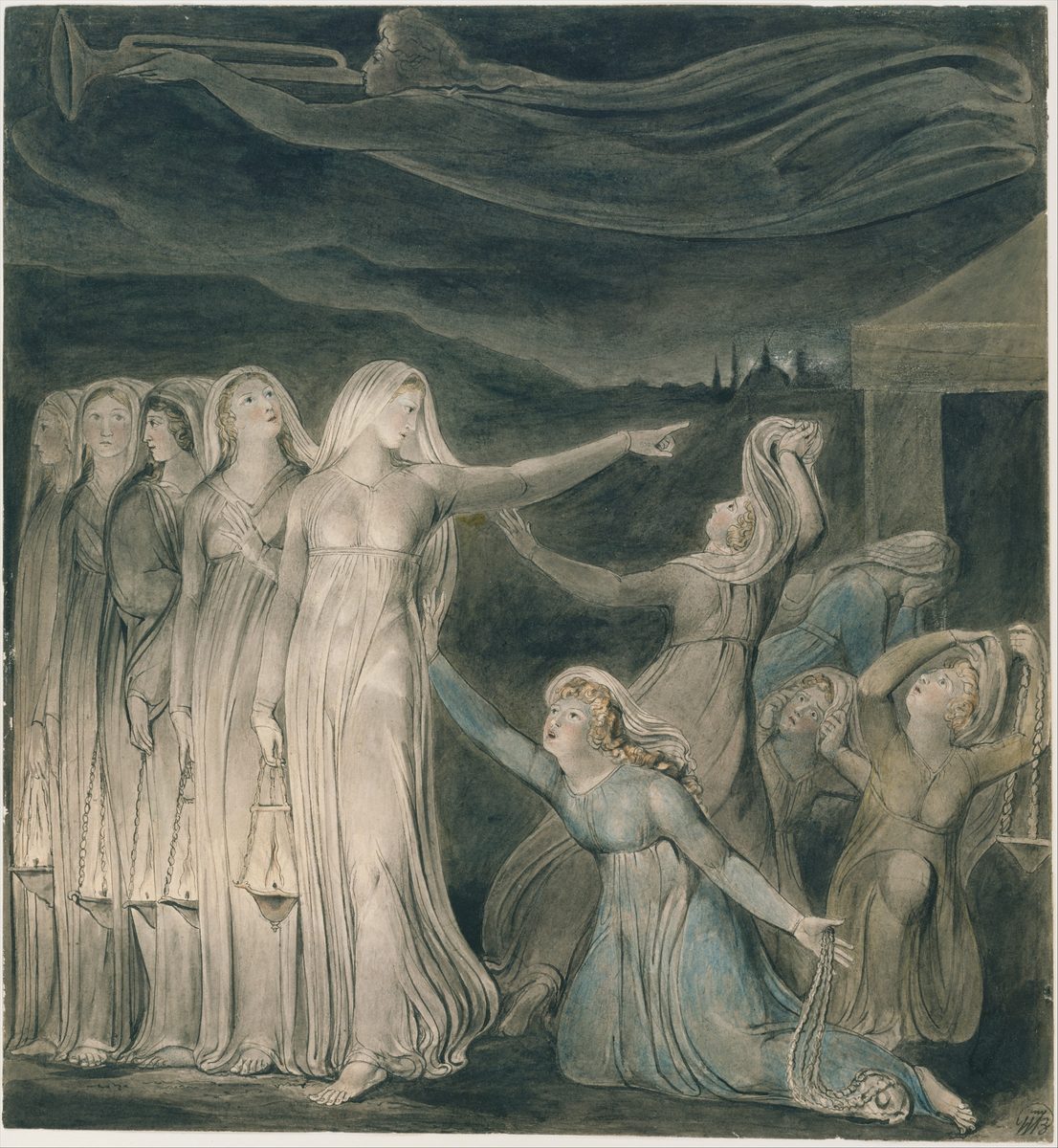
William Blake, c. 1799–1800 · Metropolitan Museum of Art, New York
Blake makes the whole parable a matter of posture: the sensible five stand vertical in a row with their lamps lit, and the foolish five collapse — kneeling, crouching, arms flung up. And the pointing arm is not a welcome; it is verse 9, go to the sellers, a refusal. ⚠ Note the trumpeter across the top, because it is not in this chapter at all: the trumpet belongs to 24:31, one chapter earlier. Blake has read the two chapters as one discourse, which is what they are, and imported the sound — the Met’s own reading treats the wise five as already listening for it. The door at the far right is verse 10. ⚠ And it is small: watercolour with pen and ink over graphite, about 36 × 33 cm, which is a sheet you could hold in two hands, painted to read as though it were the size of a wall. One of the large set of biblical subjects Blake made between 1799 and 1809 for Thomas Butts, a government clerk of modest means who bought Blake’s work when almost nobody else would. The Metropolitan Museum released the file under CC0.
καὶ προσελθὼν ὁ τὰ πέντε τάλαντα λαβὼν προσήνεγκεν ἄλλα πέντε τάλαντα λέγων· Κύριε, πέντε τάλαντά μοι παρέδωκας· ἴδε ἄλλα πέντε τάλαντα ἐκέρδησα
And the one who had received the five talents came bringing another five talents, saying, ‘Master, you handed over five talents to me; look, I have made another five talents.’note
Y el que había recibido los cinco talentos se acercó trayendo otros cinco talentos, diciendo: ‘Señor, cinco talentos me entregaste; mira, he ganado otros cinco talentos’.
His master said to him, ‘Well done, good and faithful slave! You were faithful over a few things; I will put you in charge of many. Enter into your master’s joy.’note
Su señor le dijo: ‘¡Bien, esclavo bueno y fiel! En lo poco fuiste fiel; te pondré al frente de mucho. Entra en el gozo de tu señor’.
His master said to him, ‘Well done, good and faithful slave! You were faithful over a few things; I will put you in charge of many. Enter into your master’s joy.’note
Su señor le dijo: ‘¡Bien, esclavo bueno y fiel! En lo poco fuiste fiel; te pondré al frente de mucho. Entra en el gozo de tu señor’.
And the one who had received the one talent came and said, ‘Master, I knew you, that you are a hard man, reaping where you did not sow and gathering where you did not scatter;note
Y se acercó el que había recibido un talento y dijo: ‘Señor, te conocía: que eres hombre duro, que siegas donde no sembraste y recoges donde no esparciste;
For to everyone who has, it will be given, and he will have more than enough; but from the one who does not have, even what he has will be taken away.note
Porque a todo el que tiene se le dará, y le sobrará; pero al que no tiene, aun lo que tiene se le quitará.
Then the king will say to those at his right, ‘Come, you blessed of my Father, inherit the kingdom prepared for you from the founding of the world.note
Entonces el rey dirá a los de su derecha: ‘Venid, benditos de mi Padre, heredad el reino preparado para vosotros desde la fundación del mundo.
Then they too will answer, saying, ‘Lord, when did we see you hungry or thirsty or a stranger or naked or sick or in prison, and did not serve you?’note
Entonces también ellos responderán, diciendo: ‘Señor, ¿cuándo te vimos hambriento o sediento o forastero o desnudo o enfermo o en la cárcel, y no te servimos?’
And these will go away into eternal punishment, but the righteous into eternal life.”note
Y estos irán al castigo eterno, pero los justos a la vida eterna».
Translator’s Notes — verse by verse
Each note explains this translation's choice and compares the seven
versions on the shelf. Quotations from copyrighted versions (NIV, TLB, NWT) are kept to short phrases for
comparison; KJV, Geneva, Douay-Rheims and ASV are public domain.
Verses 1–13 · παρθένοι … ἐκλείσθη ἡ θύραparthenoi … ekleisthē hē thyra — ten girls, and a door
"Virgins," and why this translation says girls.Parthenos does mean a virgin,
and it is the word at 1:23's quotation of Isaiah. But in a wedding
context it is simply the ordinary word for an unmarried young woman — the bridal party — and English
"virgins" now carries a weight of sexual reference the parable does not use: nothing in the story turns on
chastity, and the difference between the two fives is oil. KJVASV read "virgins," NIV "virgins" with
"bridesmaids" in some editions, NWT "virgins." This translation reads
girls and puts the word in the note, which is the reverse of the usual practice and is
stated so the reader can weigh it.
Foolish and sensible.Mōrai and phronimoi — and
phronimos is the Gospel's word for practical shrewdness, used of the man who built on rock
(7:24), of the serpents the disciples are told to imitate
(10:16) and of the "faithful and sensible slave" eleven
verses before this chapter (24:45). It is not intelligence; it is
foresight about how things actually work.
⚠ The bridegroom is late, and everyone falls asleep. Read v5 carefully: "while the
bridegroom was taking his time" — chronizontos, the same verb the wicked slave
used as his excuse at 24:48 — "they all became drowsy and
slept." Both groups. The parable does not fault the sleeping, which is worth stating because the moral
drawn from it is usually vigilance: what separates the two fives is a decision taken before the
waiting began, and the sleep is common ground. Note too that the sensible ones refuse to share, and are
not criticized for it: some things cannot be lent at the last minute, which is the parable's actual
claim.
The door.Ekleisthē hē thyra — and then "I do not know you," which is the
formula from the end of the Sermon (7:23), where it also answers people
calling him "Lord, lord." ⚠ And v13's closing imperative is grēgoreite,
stay awake — the exact word chapter 24 ended its own argument on
(24:42), which chapter 24's note said would return here. The
Byzantine text adds "in which the Son of Man comes" to the end of v13; the earliest manuscripts do not
have it, and KJV's "wherein the Son of man cometh" is that addition.
Verses 14–30 · τάλαντα … σκληρόςtalanta … sklēros — an enormous sum, and a slave who was not wrong about his master
The amounts are not modest, and English has lost the word. A talent
was a weight of silver worth roughly six thousand denarii — about twenty years of a labourer's wages. So
the smallest share here is two decades of income, and the largest is a century of it; the dictionary entry
for this word was written at 18:24, where the debt was ten
thousand talents. ⚠ Note what English did with it: "talent" in the sense of a natural gift
descends from this parable — the metaphor is so old it has swallowed the coin, and modern readers
hear "use your abilities" in a sentence about money. The Greek says silver, and v27 says bankers and
interest.
"To each according to his own ability."Kata tēn idian dynamin — the
distribution is unequal and calibrated, and the two who invested get identical commendations
(vv21, 23 are word-for-word the same). The reward is not proportional to the amount returned. That is the
parable's answer to the obvious complaint about unfairness, and it is easy to miss because the sentences
are so alike that the eye skips one.
⚠ And the third slave is not simply lying about his master. He calls him
sklēros — hard, harsh, the word for unyielding — "reaping where you did not sow,"
and the master's reply does not deny it: "You knew that I reap where I did not sow?" He argues
from the slave's own premise rather than correcting it. Whether the master is meant to be an accurate
picture of God, or deliberately not (a reading that takes the parable as an indictment of an exploitative
system, with the buried talent as refusal rather than sloth) has been argued at length; the library sets
out both and notes that the framing sentence at v14 is "it is like a man going abroad," not "like God."
The charge finally laid is not dishonesty but fear — "I was afraid" (v25) — and the verdict names
laziness, though what the slave actually did was take the one action that guaranteed no loss.
The line that came from chapter 13. "To everyone who has, it will be given" (v29) is
the principle stated bare at 13:12, in the explanation of why he
speaks in parables — and chapter 13's note said this story would build an entire narrative around it.
Here it is, with the accounting attached.
Verses 31–40 · τὰ ἔθνη … τῶν ἐλαχίστωνta ethnē … tōn elachistōn — the nations, the goats, and who "the least" are
Not a parable, quite. It opens with one simile (a shepherd separating a flock) and
then stops being figurative: there is a throne, and a verdict, and the criteria are itemized. Matthew has
put it at the end of the last discourse, and it is the last thing Jesus teaches in this Gospel before the
passion begins.
Sheep and goats, and why they are separated at all.Eriphoi are young goats,
and mixed flocks were normal — goats were often penned separately at night because they are less tolerant
of cold. So the image is a routine evening task, not a dramatic one, which is part of its force. Note
that the animals are not separated by appearance: a shepherd knows which is which, and neither
group in the story does.
The six items, and their ordinariness. Food, water, welcome, clothes, care in
sickness, a visit in prison. ⚠ There is nothing religious in the list — no belief, no worship, no
confession — which is the single most commented-on fact about the passage, and this translation prints the
list plainly and lets it stand.
⚠ "One of these least ones of my brothers" — the crux, and a detail the shelf can settle.Elachistos is the superlative of mikros, "least" or "smallest," and Matthew has used the
mikros family of the vulnerable inside the community
(18:6, 10, 14) and adelphos, "brother," of disciples
(23:8). Hence the two readings: (1) the least are the
poor and afflicted generally, so the nations are judged by their treatment of the needy;
(2) the least are Christ's own disciples — the missionaries of
10:40-42, where a cup of cold water given to a "little one" is
rewarded — so the nations are judged by how they received the messengers. ⚠ One textual detail cuts
against tidiness in either direction: v40 says "these least ones of my brothers," and v45, giving
the same verdict in reverse, says only "these least ones," dropping the qualifier. The library reports the
readings, prints the asymmetry rather than harmonizing it, and does not vote.
And the thing both groups say. ⚠ "When did we see you?" — asked by the
righteous at v37 and by the cursed at v44, in almost the same words. Neither group knew. That is the point
the structure is making and it is made by symmetry: the surprise is mutual, and nobody in the scene was
keeping score.
Verses 41–46 · κόλασιν αἰώνιονkolasin aiōnion — two words the library will not settle
The asymmetry in v41 is deliberate and easy to miss. The blessed inherit a kingdom
"prepared for you from the founding of the world"; the cursed go into a fire "prepared for the devil
and his angels." The two destinations are not described as symmetrical preparations, and the second
one names a different intended occupant. Whatever weight that carries, it is in the text.
⚠ Aiōnios. The adjective of aiōn, an age. It is applied to
both outcomes in the same sentence (v46), which is the strongest argument that whatever it means,
it means the same thing twice. But what it means is genuinely contested: "everlasting" in duration, or
"of the age to come" in quality — the Greek Old Testament uses it of things that demonstrably ended
(the Aaronic priesthood, the Passover ordinance), and the New Testament uses it of life that is
emphatically unending. The shelf mostly reads "eternal" or "everlasting" and does not flag the question;
NWT reads "everlasting."
⚠ And kolasis. Not the ordinary word for punishment
(timōria, retribution) but a word whose root sense is pruning, and which in some Greek
usage carries the idea of correction rather than mere penalty — though by the first century it is used
plainly of punishment, and 1 John 4:18 pairs it with fear. KJVASV read "everlasting punishment," NIV
"eternal punishment," NWT "everlasting cutting-off," which is a doctrinal
rendering (the Watch Tower Society denies conscious eternal torment) and is flagged as one — it is
defensible from the root and is not what the word plainly means in first-century use.
Where that leaves the sentence. ⚠ These two words are the textual ground of a very old
three-way argument: eternal conscious punishment (the majority historic reading); annihilation, where the
punishment is everlasting destruction rather than everlasting experience; and the universalist
reading, where kolasis is remedial and aiōnios is age-qualified. Each has held serious
readers from the early centuries on — Augustine argued the first at length precisely because others
around him held the third. The library's job here is to say what the Greek does and does not settle: it
puts one adjective on both destinies, it chooses a noun that is not the standard word for retribution, and
it does not define either term. This translation prints "eternal punishment" and "eternal life," flags
both words, and does not vote.
And the last thing he teaches. After five discourses, the final criterion is not
doctrine, or vigilance, or productivity — the three previous parables were about all three. It is
whether anyone got fed. The library will observe that and leave it.
Patterns worth carrying forward
Where this translation keeps the words exact / distinct: "girls" for
parthenoi in a wedding context, against the whole shelf's "virgins," because nothing in the story
turns on chastity — the word is given in the note so the choice is auditable;
"sensible" for phronimoi, matched to 7:24,
10:16 and 24:45;
"taking his time" for chronizontos, the wicked slave's own excuse at
24:48; talents left as the coin, with the note that
English took the word out of this parable and turned it into ability;
"hard" for sklēros, which the master does not deny; and "eternal
punishment" for kolasin aiōnion, with both words flagged rather than resolved.
Echoes paid.Grēgoreite, "stay awake" (v13) — the word
chapter 24 ended on at 24:42, exactly as its note said;
chronizō, the delay (v5) — the wicked slave's premise at
24:48, now the condition everyone in the parable is under;
"I do not know you" (v12) — the Sermon's answer to people saying "Lord, lord"
(7:23); talents (v15) — the coin whose
arithmetic was set out at 18:24; "to everyone who
has" (v29) — the bare principle of 13:12, which that
chapter's note said this story would build around; the outer darkness and the
grinding of teeth (v30) — last used at
22:13; and "the least" (v40) — the
mikros family of 18:6 and the cup of water given to a little
one at 10:42.
Echoes planted. The throne of glory (v31), which will be answered by
a man on trial before a different court in two chapters; the Son of Man in his glory
(v31), whose next appearance is under interrogation; and the fact that this is the last teaching
in the Gospel — from here Matthew narrates.
⚠ And four places the library reports rather than decides. The master
of the talents (vv24-27), who does not deny being hard, and whether he is meant as a picture of God at
all. "These least ones of my brothers" (v40) — the poor generally, or Christ's own
disciples — with the detail that v45 drops "of my brothers" printed rather than harmonized.
Aiōnios (v46), applied to both destinies in one sentence, and meaning either duration or the
quality of the age to come. And kolasis (v46), a word rooted in pruning rather than retribution,
which is the textual ground of a three-way argument the library describes and does not enter.
Next in this book: chapter 26 — the discourses are over and
the narrative closes in. A jar of ointment broken over his head and an objection about the poor; thirty
pieces of silver; a supper where bread and a cup are given new names; Gethsemane, where the cup he offered
two ambitious brothers becomes the one he asks to be spared; a kiss, a sword, a fleeing disciple; and two
trials running at once — one inside the high priest’s house and one in the courtyard, where a
man who swore he would never deny him does it three times before a rooster.