CreationBefore the FloodThe FloodAfter the FloodThe PatriarchsEgypt and the ExodusThe KingdomThe ExileThe ReturnBetween the TestamentsThe GospelsThe Apostolic Age
🕰
Jesus enters Jerusalem on a donkey to shouts of 'Hosanna to the Son of David,' fulfilling Zechariah's prophecy of a humble king. He clears the temple of money-changers, and the next morning curses a fruitless fig tree, which withers at once. Confronted about his authority, he answers with the parable of the two sons and the parable of the wicked tenants who kill the vineyard owner's son.
c. AD 30, the Sunday before Passover — the opening of what tradition calls Holy Week, the final days before the crucifixion.
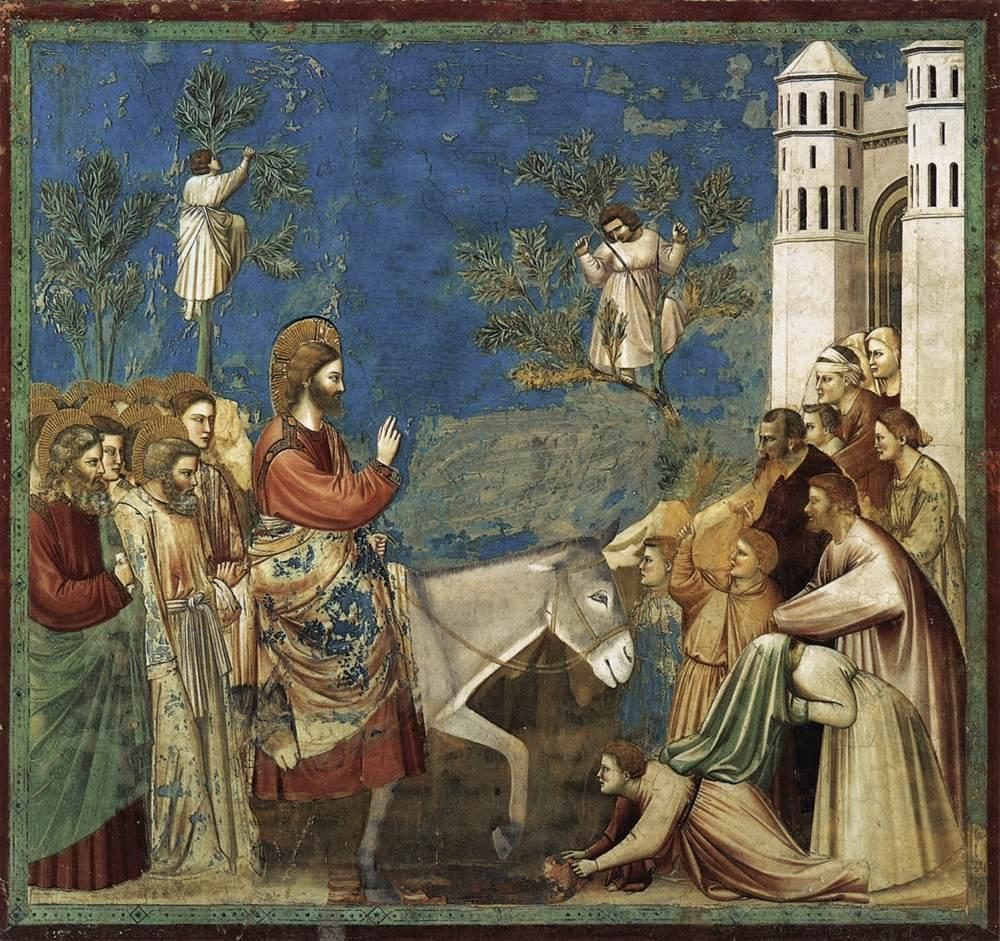
⚠ Count the animals. Giotto paints one donkey — and Matthew is the only evangelist who has two (vv2, 7), because he reads Zechariah’s Hebrew parallelism as naming a beast and a colt rather than saying one thing twice. Nearly the entire visual tradition quietly sides with Mark, Luke and John, and this fresco is a fair sample of it: the picture everyone has in their head is not the one Matthew wrote. Everything else here is his text, though — the cloaks going down in the road, the boys up in the trees cutting branches (v8), the city coming out through the gate. Painted about 1304-06 in the Scrovegni Chapel; the flaking in the blue is real, and the fresco is roughly seven hundred years old.
saying to them, “Go into the village opposite you, and immediately you will find a donkey tied and a colt with her. Untie them and bring them to me.note
diciéndoles: «Id a la aldea que está enfrente de vosotros, y en seguida hallaréis una asna atada y un pollino con ella. Desatadlos y traédmelos.
And the crowds going ahead of him and those following were crying out, saying, “Hosanna to the Son of David! Blessed is the one who comes in the name of Jehovah! Hosanna in the highest!”note
Y las multitudes que iban delante de él y las que le seguían gritaban, diciendo: «¡Hosanna al Hijo de David! ¡Bendito el que viene en el nombre de Jehová! ¡Hosanna en las alturas!»
And Jesus went into the temple and drove out all those selling and buying in the temple, and he overturned the tables of the money-changers and the seats of those selling the doves,note
Y Jesús entró en el templo y echó fuera a todos los que vendían y compraban en el templo, y volcó las mesas de los cambistas y los asientos de los que vendían las palomas,
But when the chief priests and the scribes saw the wonderful things he did, and the children crying out in the temple and saying, “Hosanna to the Son of David!”, they were indignantnote
Pero al ver los principales sacerdotes y los escribas las cosas admirables que hizo, y a los niños que gritaban en el templo diciendo: «¡Hosanna al Hijo de David!», se indignaron
and said to him, “Do you hear what these are saying?” And Jesus says to them, “Yes. Have you never read: Out of the mouth of infants and nursing babies you have prepared praise?”note
y le dijeron: «¿Oyes lo que estos dicen?» Y Jesús les dice: «Sí. ¿Nunca leísteis: De la boca de los pequeñuelos y de los que maman preparaste alabanza?»
And seeing a single fig tree by the road he came to it, and found nothing on it except leaves only, and he says to it, “May no fruit ever come from you again.” And immediately the fig tree withered.note
Y al ver una sola higuera junto al camino, fue hacia ella y no halló en ella nada sino solo hojas, y le dice: «Que nunca más salga fruto de ti». Y al instante la higuera se secó.
And Jesus answered and said to them, “Truly I tell you, if you have faith and do not doubt, you will do not only what was done to the fig tree, but even if you say to this mountain, ‘Be lifted up and thrown into the sea,’ it will happen.note
Y Jesús respondió y les dijo: «De cierto os digo: si tenéis fe y no dudáis, no solo haréis lo de la higuera, sino que si decís a este monte: ‘Quítate y échate al mar’, sucederá.
And when he came into the temple, the chief priests and the elders of the people came to him as he was teaching and said, “By what authority are you doing these things? And who gave you this authority?”note
Y cuando llegó al templo, se le acercaron mientras enseñaba los principales sacerdotes y los ancianos del pueblo, diciendo: «¿Con qué autoridad haces estas cosas? ¿Y quién te dio esta autoridad?»
And Jesus answered and said to them, “I will ask you one question too, and if you tell me, I will also tell you by what authority I do these things.note
Y Jesús respondió y les dijo: «Yo también os haré una sola pregunta, y si me la respondéis, también yo os diré con qué autoridad hago estas cosas.
The baptism of John — where was it from? From heaven, or from men?” And they were reasoning among themselves, saying, “If we say ‘From heaven,’ he will say to us, ‘Why then did you not believe him?’note
El bautismo de Juan, ¿de dónde era? ¿Del cielo, o de los hombres?» Y ellos razonaban entre sí, diciendo: «Si decimos ‘Del cielo’, nos dirá: ‘¿Por qué, pues, no le creísteis?’
Which of the two did the will of the father?” They say, “The first.” Jesus says to them, “Truly I tell you that the tax collectors and the prostitutes are going ahead of you into the kingdom of God.note
¿Cuál de los dos hizo la voluntad del padre?» Dicen: «El primero». Jesús les dice: «De cierto os digo que los recaudadores de impuestos y las prostitutas os van delante al reino de Dios.
For John came to you in a way of righteousness, and you did not believe him — but the tax collectors and the prostitutes believed him; and you, having seen it, did not even change your minds afterwards and believe him.note
Porque vino Juan a vosotros por camino de justicia, y no le creísteis — pero los recaudadores de impuestos y las prostitutas le creyeron; y vosotros, aun viéndolo, ni os pesó después para creerle.
Hear another parable. There was a man, a householder, who planted a vineyard and put a fence around it and dug a winepress in it and built a tower; and he leased it to tenant farmers and went abroad.note
Oíd otra parábola. Había un hombre, un dueño de casa, que plantó una viña y la cercó con una valla y cavó en ella un lagar y edificó una torre; y la arrendó a unos labradores y se fue al extranjero.
They say to him, “He will destroy those wretches wretchedly, and will lease the vineyard to other tenants, who will give him the fruits in their seasons.”note
Le dicen: «Destruirá miserablemente a esos miserables, y arrendará la viña a otros labradores que le den los frutos en sus temporadas».
Jesus says to them, “Have you never read in the Scriptures: The stone the builders rejected — this one has become the head of the corner. This came from Jehovah, and it is marvellous in our eyes?note
Jesús les dice: «¿Nunca leísteis en las Escrituras: La piedra que los edificadores desecharon, esta ha venido a ser cabeza del ángulo. De parte de Jehová sucedió esto, y es admirable a nuestros ojos?
and though they sought to seize him, they were afraid of the crowds, since they held him to be a prophet.note
y aunque buscaban prenderlo, temieron a las multitudes, porque lo tenían por profeta.
Translator’s Notes — verse by verse
Each note explains this translation's choice and compares the seven
versions on the shelf. Quotations from copyrighted versions (NIV, TLB, NWT) are kept to short phrases for
comparison; KJV, Geneva, Douay-Rheims and ASV are public domain.
Verses 1–11 · ὄνον … καὶ πῶλονonon … kai pōlon — two animals, and a shout with no standing behind it
⚠ Matthew has two animals, and he is the only one who does. Mark, Luke and John all
have a single colt. Matthew has a donkey and a colt with her (v2),
brings both (v7), and says he sat "on them." The reason is visible in the quotation he supplies at v5:
Zechariah 9:9 in Hebrew uses synonymous parallelism — "on a donkey, and on a colt, the foal of a
beast of burden" — where the second line restates the first and there is one animal.
⚠ The readings offered: that Matthew has taken the parallelism as two beasts, which is what the plain
Greek says and what the whole visual tradition then declines to paint (Giotto's fresco above, like nearly
every other, shows one donkey); or that he is being scrupulously literal about a prophecy and the second
animal walks alongside; or that a colt still with its mother would have to be brought with her. The
library gives the readings and does not choose. What it will not do is quietly translate away one of the
two animals, which several modern versions manage by rendering v7's "on them" as "on the cloaks."
"Gentle."Praüs — the same word as the third beatitude, "blessed are the
praeis" (5:5), and Matthew's own word for himself at 11:29. KJV
reads "meek," which has drifted toward weakness; the point is a king arriving without cavalry.
Hosanna. Not a word of praise, though it has become one. Hōsanna
transliterates Hebrew hoshi'a-na — "save, please" — a cry for help, from
Psalm 118:25, and the next line the crowd shouts ("Blessed is the one who comes in the name of Jehovah")
is verse 26 of the same psalm. ⚠ Note that the shelf divides on whether to translate it or keep it: the
KJVASVNIV all transliterate, while NWT renders
the meaning ("save, we pray"). Both are defensible and this translation keeps the transliteration with the
sense in the note, because by Matthew's time it plainly functions as an acclamation and the crowd is not
asking to be rescued from anything in particular.
The title, one last time from the right sort of people. "Hosanna to the
Son of David" — and chapter 20's note said this was coming. The title has been shouted
by two blind men (9:27), a Canaanite woman
(15:22), two more blind men
(20:30), and now by crowds and then by children in the temple
(v15) — never once by anyone with standing to confer it, and every time over somebody's objection. Here
the objectors are the chief priests.
And a verb Matthew keeps for hinges. "The whole city was shaken" —
eseisthē, from seismos, an earthquake. Matthew has used that root of the storm on the
lake (8:24) and will use it at the crucifixion and at the empty tomb.
Jerusalem does what the sea did.
Verses 12–17 · σπήλαιον λῃστῶνspēlaion lēstōn — a cave of bandits, and two prophets spliced
What was actually being sold, and why it was there. The money-changers
(kollybistai) existed because the temple tax had to be paid in a particular coinage and pilgrims
arrived with everything else; the dove-sellers existed because the Law prescribes doves as the offering of
the poor (Leviticus 12:8). Neither trade was illegitimate in itself, which is what makes the scene hard
rather than simple — and Matthew reports no accusation of overcharging. What follows the overturning is
the detail Matthew alone adds: "blind and lame people came to him in the temple, and he healed
them" (v14). The trading floor is cleared and the people the temple's own regulations kept at a distance
walk in.
Two quotations, welded. "My house will be called a house of prayer" is Isaiah 56:7 —
and Isaiah's next words, which Matthew does not quote and Mark does, are "for all the peoples."
"A cave of bandits" is Jeremiah 7:11, from the Temple Sermon, where the charge is that
people commit theft and adultery and murder and then shelter in the temple as if it were a hideout.
⚠ Lēstēs is the point of the second quotation and the shelf mostly loses it: it does not mean a
pickpocket or a swindler but a brigand, an armed robber — the word used of the two men
crucified beside him (27:38), and the word Josephus uses of insurgents.
KJV "den of thieves" and NIV "den of
robbers" both suggest commercial dishonesty; the charge is closer to this has become a bandits'
hideout. And spēlaion is a cave, not a building.
Children, and a psalm about infants. Against the priests' indignation he quotes
Psalm 8:2 — "out of the mouth of infants and nursing babies you have prepared praise" — which in the
Greek Old Testament reads ainon, praise, where the Hebrew has "strength" (oz). ⚠ Matthew
follows the Septuagint, and the argument only works in Greek. That is worth stating plainly rather than
smoothing over: the quotation as used here depends on the translation Matthew read.
Verses 18–22 · συκῆsykē — the one thing in the Gospels that Jesus destroys
It is the only destructive miracle in the Gospels, and Matthew does not soften it.
Mark adds "for it was not the season for figs," which makes the episode stranger, not gentler; Matthew
omits that and simply says the tree had nothing but leaves. ⚠ The fig tree is a standing prophetic image
for Israel and for its fruitlessness (Jeremiah 8:13, "no figs on the fig tree"; Hosea 9:10; Micah 7:1),
and the placement is Matthew's argument — a temple full of activity and no fruit, then a tree full of
leaves and no fruit, in that order. Mark makes the point unmissable by wrapping the temple scene inside
the fig-tree story; Matthew tells them in sequence and lets the reader do it.
The mountain again. "If you say to this mountain, be lifted up and thrown into the
sea" — the same proverb for the impossible as 17:20, where it was
a grain of mustard seed against a mountain. Here the qualifier is different and worth noticing: not
a little faith but faith "and do not doubt" (diakrithēte, literally to
be divided in two, to be at odds with oneself). And they are standing on the Mount of Olives, looking at
the Dead Sea.
Verses 23–27 · ἐν ποίᾳ ἐξουσίᾳen poia exousia — the authority question, and the answer they cannot give
The word the whole Gospel has been circling.Exousia — authority, the right
to act. The crowds noticed it in the very first discourse: he taught "as one having exousia, and
not as their scribes" (7:29), and chapter 7's note flagged the word as
waiting for the last sentence of the book, "all exousia has been given to me" (28:18). Here the
men who hold the official kind of authority ask him to produce his credentials, in the building they
administer, the morning after he overturned its furniture.
The counter-question is not evasion; it is a trap with only bad exits. Where was
John's baptism from? If from heaven, they have to explain their own unbelief. If from men, they have to
say so in front of a crowd that held John to be a prophet — and Matthew tells us the actual reason for
their answer in v26: phoboumetha ton ochlon, "we are afraid of the crowd." So "we do not know" is
not ignorance, and Matthew has just shown us the calculation behind it. ⚠ Note the shape of the refusal
that follows: he does not say I will not tell you; he says "neither do I tell you," which makes
the withholding symmetrical. They declined to answer a question they knew the answer to, and get the same
treatment.
Verses 28–32 · μεταμεληθείςmetamelētheis — two sons, and the most tangled variant in the Gospels
⚠ The manuscripts cannot agree which son said what, and the answer flips with them.
There are three arrangements in the evidence. (1) The first son refuses and then goes; the second agrees
and does not — and the answer to "which did the father's will?" is the first. That is the
text printed here. (2) The first son agrees and does not go; the second refuses and then goes — answer:
the last. (3) A third group has the sons in the second order but gives the answer as
"the first," which produces the reading that the son who said yes did the father's will, and is
almost certainly a copying error, though some have argued it is a deliberate anti-Jewish or ironic
reading. ⚠ The Spanish shelf is the clearest possible demonstration of this: the older
RV has the refusing son first and answers "el primero," while the
TNM has the agreeing son first and answers "el segundo" — two witnesses,
opposite orders, opposite answers, each internally consistent. Whichever arrangement is original, the
point survives all three, which is presumably why the scribes felt free: doing beats saying.
The verb, which is not the usual one. The son who turns around
metamelētheis — from metamelomai, to regret, to have a change of feeling — not
metanoeō, the standard word for repentance that Matthew has used since John's preaching
(3:2). It is a softer, more emotional word; it is what Judas does in
27:3. And it lands twice: on the son in v29, and on the priests in v32, who "did not even
metamelēthēte afterwards." The charge is not that they failed to reason correctly. It is that
nothing moved.
And the second of three. "The tax collectors and the prostitutes are going ahead of
you into the kingdom of God" — Matthew's usual phrase is "the kingdom of the heavens,"
and this is the second of only a handful of departures.
Chapter 12's note flagged three (19:24, 21:31, 21:43); the first
landed at 19:24, and the remaining two are both in this chapter.
⚠ Note also proagousin — a present tense, "are going ahead," not "will go": it is happening
while he says it.
Verses 33–46 · κεφαλὴν γωνίαςkephalēn gōnias — the tenants, and a stone the builders threw away
The parable opens by quoting a song. "Planted a vineyard, put a fence around it, dug
a winepress in it and built a tower" is Isaiah 5:1-2 almost word for word from the Greek — the Song of the
Vineyard, where the vineyard is explicitly "the house of Israel" and the complaint is that it yielded
wild grapes. ⚠ So the audience knows the genre before the plot starts, which is why v45 can say they
understood he was speaking about them. Isaiah's version indicts the vineyard; Matthew's indicts the
tenants — the leaseholders, not the vines. That shift is the whole parable, and it is the reason
v43 says the vineyard is reassigned rather than destroyed.
The stone. Psalm 118:22-23, quoted from the Greek — and note that the crowd's
"Hosanna… blessed is the one who comes" at v9 came from verses 25-26 of the same psalm, three
verses later. Within one chapter Matthew has the crowd sing the psalm's end and Jesus quote its middle
against the authorities. ⚠ Kephalē gōnias is literally "head of the corner," and what that means
architecturally is genuinely uncertain: a foundation cornerstone that sets the building's lines, or the
capstone at the summit of an arch. The shelf splits — KJVASV "the head of the corner," NIV
"the cornerstone," NWT "the chief corner stone." This translation keeps
the literal "head of the corner" and leaves the architecture unsettled, because it is.
"A nation producing its fruits."Ethnos in the singular, and the sentence has
carried more freight than almost any other in the Gospel. ⚠ It has been read as the church replacing
Israel, and that reading has a long and in places murderous history that this library will name rather
than skirt. It has also been read as a change of tenants and not of vineyard — the leaseholders
replaced, the vineyard the same — which is what the parable's own machinery says, and as a judgement on
a particular leadership rather than a people, which is who v45 says understood themselves to be
addressed. The library sets out the readings and does not vote. It does note that the criterion named in
the verse is fruit, not identity.
⚠ And a verse that some editions bracket. Verse 44 — "the one who falls on this stone
will be shattered; and on whomever it falls, it will crush him to powder" — is missing from a small but
early group of witnesses (Codex Bezae, part of the Old Latin, the Sinaitic Syriac), and some editors have
judged it an insertion from Luke 20:18. The text this translation follows prints it, and the shelf prints
it; the doubt is recorded here rather than in a bracket. It fuses two more stone-passages onto the psalm:
Isaiah 8:14's stone of stumbling and Daniel 2:44's stone that grinds the kingdoms to powder.
Patterns worth carrying forward
Where this translation keeps the words exact / distinct:both animals
in vv2, 7 and "he sat on them," rather than resolving the difficulty by translation;
"gentle" for praüs, matched to the third beatitude; Hosanna
transliterated with "save, please" in the note (with KJV/ASV,
while noting NWT translates it); "a cave of bandits" for
spēlaion lēstōn — an armed-robbers' hideout, not a den of shoplifters, and the same noun as the
two men crucified beside him; "changed his mind" for metamelomai, kept distinct
from metanoeō, "repent"; and "the head of the corner" for
kephalē gōnias, leaving the architecture unsettled because the Greek does.
Echoes paid.Son of David (vv9, 15) — the title's fourth and fifth
cries, after 9:27, 15:22 and
20:30, exactly as chapter 20's note promised, and again over an
objection; "the one who comes" (v9) — John's own question from prison,
"are you the one who is to come?" (11:3), shouted back at him
word for word, as chapter 11's note said it would be; eseisthē, "shaken" (v10) —
the earthquake-root Matthew keeps for hinges, first used of the storm at
8:24; this mountain (v21) — the proverb from
17:20, with doubt substituted for littleness of faith;
exousia (v23) — the word the crowds noticed at 7:29, now
demanded as a credential; and the kingdom of God (vv31, 43) — the second and third of the
departures chapter 12's note flagged, which means that promise is
now paid in full.
Echoes planted.Lēstēs, "bandit" (v13), waiting for two
crosses; metamelomai (v29), waiting for Judas; the fig tree (v19), waiting for
the one in the Olivet discourse whose leaves are a sign; and exousia (v23), still waiting for
the last sentence of the book.
⚠ And four places the library reports rather than decides. The two
animals (vv2, 7) and how Matthew is reading Zechariah's parallelism. The two sons
(vv28-31), where three manuscript arrangements give two different answers and the Spanish shelf's two
witnesses land on opposite sides. "A nation producing its fruits" (v43), whose
supersessionist reading has a history this library names rather than skirts, set beside the reading the
parable's own machinery supports. And verse 44, absent from a small but early group of
witnesses and possibly imported from Luke.
Next in this book: chapter 22 — a wedding feast nobody
invited will come to, and a guest without a garment; the coin with Caesar's face on it; the Sadducees'
riddle about seven brothers and the answer that turns on a tense ("I am the God of Abraham");
the two commandments the whole Law hangs on; and a question about David's son that nobody could answer,
after which nobody dared ask him anything.