Leviticus 12 — The Mister Translation
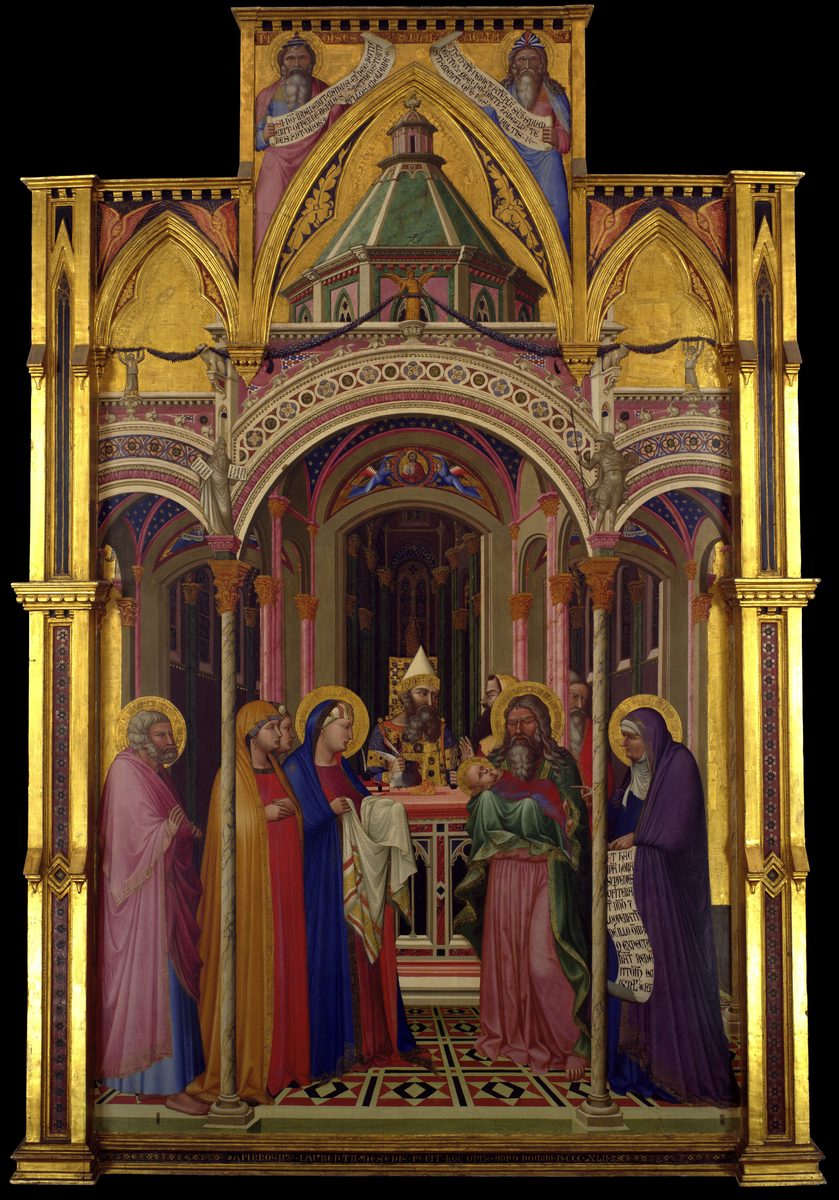
This chapter’s last verse, painted. Lorenzetti shows the moment verses 6–8 legislate — and he paints the cheaper option: there is no lamb anywhere in the panel, only the birds, one of them plainly visible on the altar under the priest’s hands. That is the offering of a family who could not afford a lamb, which is exactly what Luke reports of this one. ⚠ The setting is a fourteenth-century Italian fantasy rather than a reconstruction: the temple is Gothic, the priest wears a bishop’s mitre, and the whole scene is staged in the architecture of Lorenzetti’s own Siena.

Tazria — ‘when a woman conceives seed’, and the seven days
The chapter opens on a verb strange enough that the whole Torah portion is named after it. Tazria is a causative form of zara, the ordinary verb for SOWING — the same root behind the seed-bearing plants of Genesis 1:11 (already on these pages) and the sowing-seed of Leviticus 11:37. Applied to a woman it is unusual, and the shelf splits on whether to keep the strangeness or smooth it. KJV and ASV both keep it — ‘if a woman have conceived seed’ — while NIV writes ‘a woman who becomes pregnant’ and NWT ‘if a woman becomes pregnant.’ This translation keeps the seed, because the word is doing something: it puts the woman in the position the earth holds in Genesis 1, the one that brings forth of its own kind. ⚠ On the Spanish shelf the same flattening happens twice over — RV60 and NVI both simply have ‘conciba’ — but TNM prints ‘queda embarazada’ in the text and then footnotes the literal alternative, ‘concibe descendencia’: the only member of either shelf that lets the reader see the odd word underneath.
The seven days are defined by comparison, not by description: she is unclean ‘as in the days of her monthly separation’ (niddah). The law being cross-referenced is Leviticus 15, now on these pages, so this chapter is leaning on a rule the reader is assumed to know already — and it does the same thing at v5. What matters here is what the comparison implies: this is the ordinary, expected, non-culpable kind of uncleanness. Nothing has gone wrong. A healthy birth produces it.
Circumcision on the eighth day — one verse, dropped into the middle of the mother’s law
Verse 3 is an interruption, and a famous one. The chapter is about the mother; for a single verse it turns to the son, gives the circumcision rule, and then returns to her purification as if nothing had happened — v4 picks up exactly where v2 left off. Nothing in the surrounding law needs it. The commandment itself is not new here either: it was given to Abraham centuries earlier, with the same eight-day clock (Genesis 17:12, already on these pages), so this is a reminder rather than a first legislation.
⚠ What the placement does say is that the mother’s uncleanness does not postpone the boy’s circumcision. Her seven days and his eighth day run on the same calendar and meet: the rite happens the day after her first period ends, while she is still twenty-six days short of the sanctuary. The one ceremony in the chapter that must happen on time is the child’s, and her condition does not delay it — which also quietly settles a question the chapter never raises, that the CHILD is not unclean. Only the mother is. Luke leans on that distinction when he writes, oddly, of ‘the days of their purification’ (Luke 2:22, already on these pages), a plural this chapter does not license.
‘The blood of her purity’ — the second stage most translations erase
There are two stages here, not one long one, and the Hebrew names the second with a phrase that ought to stop a reader: demei tohorah, ‘bloods of PURITY’. The first seven days are uncleanness of the ordinary contagious kind. The thirty-three days that follow are something else: she is still bleeding, still barred from the sanctuary and from holy things — and her blood is called pure. It is not the same status, and the text does not use the same word for it.
⚠ That is the distinction almost every English version loses, and the loss is easy to miss because the versions read so smoothly. KJV and ASV keep the noun — ‘the blood of her purifying’ — though ‘purifying’ turns a state into a process. NIV goes further, dropping the phrase entirely for ‘wait thirty-three days to be purified from her bleeding,’ and NWT similarly has her ‘cleansing herself from the blood.’ Both are readable and both quietly reverse the sense: the Hebrew does not say she is being cleansed FROM this blood, it calls the blood itself pure. The scholarly reading follows the plain grammar — Baruch Levine puts it flatly, that discharges after the initial period ‘are unlike menstrual blood and are not regarded as being impure.’ This translation keeps ‘the blood of her purity’ and lets the strangeness stand.
What the second stage restricts is narrow and specific: no holy thing, no sanctuary. It says nothing about her house, her husband, her food or her ordinary company. The whole apparatus of tame and tahor is a set of rules about APPROACH — who may come near the sanctuary and when — and this chapter, read for what it actually restricts, is a five-week and eleven-week exemption from a building, not a verdict on a woman.
Why does a daughter double the days? The text never says — and every answer on offer is a later reader’s
Seven days and thirty-three for a son; fourteen and sixty-six for a daughter. Exactly double, both halves, and no reason given. This is the hardest verse in the chapter and the honest thing to report first is the silence: Leviticus states the numbers and moves on. Every explanation that exists was supplied afterwards, by readers working backwards from the figures.
They are worth naming, because knowing they are guesses is the point. Philo and several rabbis reasoned from Greek medical theory that a male fetus takes forty days to form and a female eighty, so the purification mirrors gestation — sophisticated for its era, and resting on embryology that is simply wrong. The Book of Jubilees tied the numbers to the creation of Adam and Eve instead. Some medieval commentators read the doubling as atonement for Eve. ⚠ That last line of reading is the one with a documented afterlife: it was used to argue that a daughter’s birth adds more impurity to the world than a son’s, and from there that women are constitutionally further from the holy. It should be said plainly that this is a reading imposed on the verse, not drawn from it — and that the chapter itself contradicts it two verses later.
⚠ Because when the text finally reaches the cost, it refuses to charge a daughter more. Verse 6 sets the offering ‘for a son, OR for a daughter’ — one lamb, one bird, identical — and v7 closes the law with the same evenhandedness, ‘whether a male or a female.’ If the doubled days meant a daughter’s birth were a greater defilement, the sacrifice is exactly where that would show, and it does not. Whatever the numbers are tracking, the atonement is the same for both. The text will not explain the asymmetry, and it will not let it become a price.
A sin-offering for having a baby — and the dispute over what chattat even means
A woman who has done nothing wrong brings a sin-offering. That sentence is the strongest single argument in the whole Torah about what the word means. There is no sin here, no error, not even the ‘through error’ the graduated law of Leviticus 4 (already on these pages) is built around — there is a birth. And the offering prescribed is the same one that chapter prescribes for a person who has genuinely transgressed.
⚠ This is the verse behind the best-known modern challenge to the traditional English rendering. Jacob Milgrom argued that chattat should be read ‘purification offering’ rather than ‘sin offering’ precisely because of cases like this one, where ritual impurity carries no moral fault at all; NIV keeps ‘sin offering’ in its text but footnotes the alternative at this very verse. The counter-argument is that chattat and chata, ‘to sin’, share a root, and a purely ritual rendering severs a link the Hebrew is making. This translation keeps ‘sin-offering’ and flags the disagreement, as it did at Leviticus 4 — but this chapter is where the difficulty is sharpest, and a reader who finds ‘sin-offering’ jarring here has understood the problem rather than missed it.
⚠ Note also which offering is the large one. The lamb is the BURNT-offering — the gift, ascending whole — and the bird is the sin-offering. The costly animal is the one that expresses thanks; the purification costs a pigeon. ASV alone keeps v7’s closing image literally, ‘cleansed from the fountain of her blood’ (meqor dameha, a spring or source); KJV has ‘the issue of her blood’ and NIV ‘her flow of blood,’ both turning a source into a symptom. The Spanish shelf loses it uniformly — RV60 and NVI both print ‘flujo de sangre’.
The concession that tells you a family’s income — and the one Luke reports
The chapter’s last verse is a means test, and it is the reason this short law is quoted more often than most of Leviticus. If she cannot afford a lamb, two birds will do — and the two birds now carry BOTH offerings, one burnt, one for sin. The concession is stated without commentary and without any suggestion that the cheaper offering is worth less: Leviticus 1 (already on these pages) had already established that the poor person’s bird is received exactly as the rich man’s ox is.
⚠ Which is what makes a single line in Luke land the way it does. When Mary and Joseph bring the infant Jesus to the temple, Luke records what they offered: ‘a pair of turtle-doves or two young pigeons’ (Luke 2:24, already on these pages). He quotes this verse, and he does not explain it. He does not need to — any reader who knew the law knew what the two birds meant, because the law says so in the sentence directly above them: if she cannot afford a lamb. The family of the Messiah came with the offering of the poor, and the way you learn that is by reading Leviticus.
Notes on this translation
Decisions. Hebrew and English Leviticus 12 both run 1–8 — no versification split, checked against the Masoretic text rather than assumed. A single Masoretic paragraph break falls at the end of v8, closing the chapter as one unbroken unit. ‘Conceives seed’ keeps the causative of zara at v2 rather than smoothing it to ‘becomes pregnant’, because the sowing verb is what gives the Torah portion its name and what puts the woman where Genesis 1 puts the earth. ‘The blood of her purity’ renders demei tohorah as the noun phrase it is (vv4, 5) rather than as a process of being cleansed — the Hebrew calls this blood pure, and versions that reverse that are making a decision, not a translation. ‘The fountain of her blood’ keeps meqor (v7) as a source rather than a flow. ‘Sin-offering’ is kept for chattat, with the live scholarly dispute flagged in the note where it bites hardest.
Echoes paid. The clean/unclean vocabulary set out one chapter earlier at Leviticus 11:47 — tame and tahor, a system about approach rather than morality — put to work here on a person rather than an animal; the eighth-day circumcision commanded to Abraham at Genesis 17:12; the graduated sin-offering of Leviticus 4 and the disputed name that chapter’s own note flagged; and, above all, the promise made in Leviticus 1’s note that the poor person’s two birds would be marked when their echo came — it comes here, at v8, and it is the offering Luke 2:24 reports.
Echoes planted. The niddah comparison this chapter twice leans on without explaining (vv2, 5) is legislated at Leviticus 15, now on these pages; and the phrase ‘the days of her purification’ returns, in the plural and with a puzzle attached, at Luke 2:22.
⚠ A note on order: Leviticus stands complete on these pages, chapters 1–27.