Luke 2 — The Mister Translation
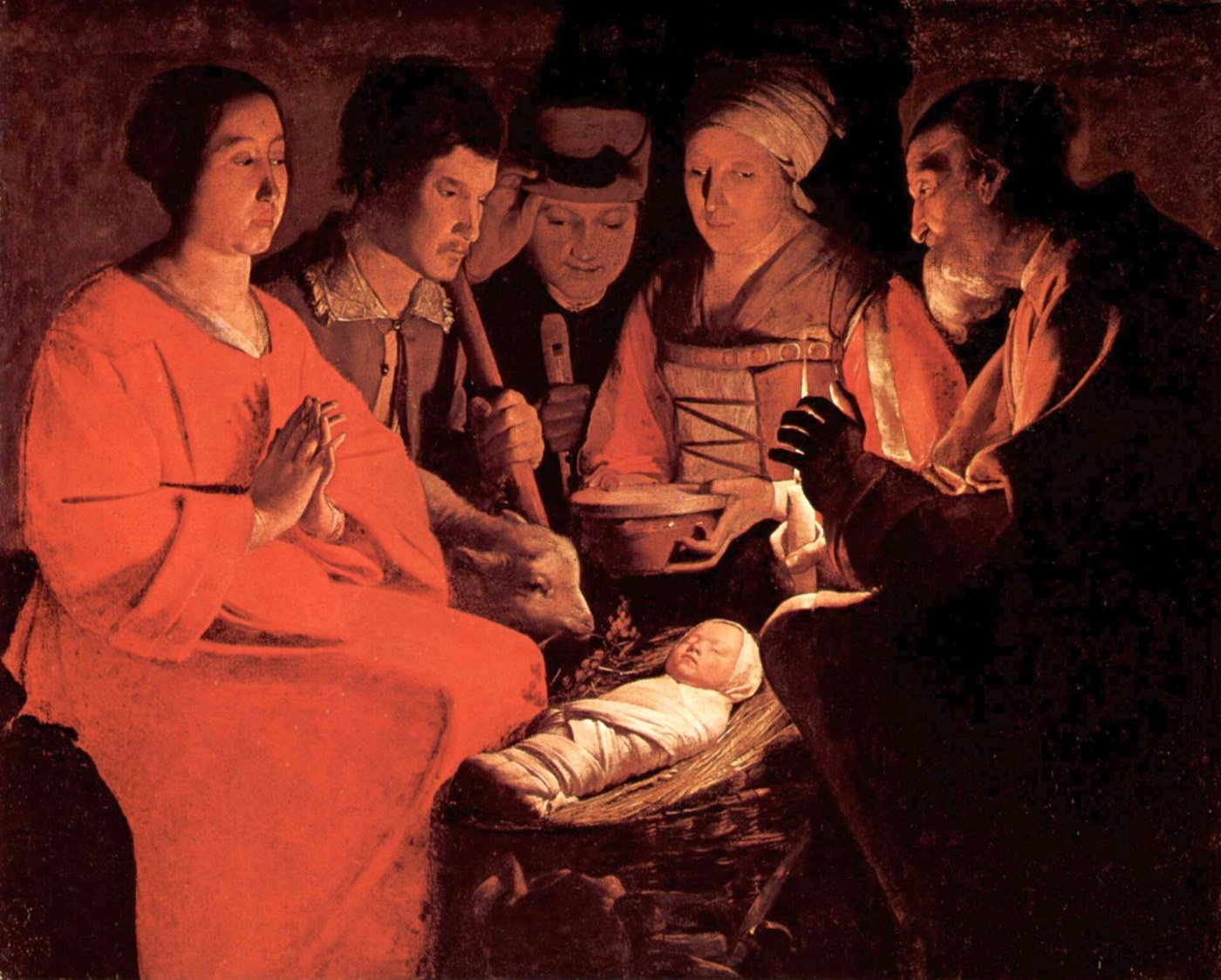
⚠ Look at what is missing. No stable. No ox. No star, no angels, no shepherds’ field seen through an archway. And no haloes — if the title were removed you could not say from the picture which of the five adults is Mary and which is a farm worker who came in from a night shift. La Tour has painted the whole scene as an ordinary room containing ordinary people, which is closer to what Luke’s Greek describes than four hundred years of nativity sets are.
The baby is the argument. He is wrapped — bound tight in white cloth, arms in, only the face out, exactly as the Greek esparganosen says and exactly as any newborn of that world was bound. It is the least sentimental infant Jesus in European painting, and it is the accurate one.
⚠ The whole picture is lit by one candle, and a man is shielding it with his hand. That is La Tour’s signature move — the cupped hand, the flame behind flesh, the fingers glowing red. Here the man doing it is Joseph, who says nothing in this chapter and is given no line anywhere in any Gospel. The painter hands him the light source and one job: keep it from going out.
One honest caveat. The crib is woven straw, more basket than trough, and the room is a seventeenth-century Lorraine interior with seventeenth-century clothes. La Tour is not reconstructing first-century Bethlehem. He is doing something the note on verse 7 argues Luke was also doing: putting the birth indoors, among people, with the animals close enough to touch.

Translator’s Notes
1–5 — ⚠ The census, and the hardest historical problem in the Christmas story
Luke dates the birth twice, and the two dates do not fit. He puts it under a registration “made while Quirinius was governing Syria” — and Publius Sulpicius Quirinius is well attested as legate of Syria in AD 6, when he conducted a census of Judea after Archelaus was deposed. Josephus describes it and the revolt it caused. But Luke has already placed John’s conception “in the days of Herod king of Judea” (1:5), and Herod died in 4 BC. Matthew puts the birth under Herod too. That is a gap of at least nine years, and it is the single most-discussed historical problem in the infancy narratives.
⚠ The main proposed solution is a point of grammar, and it is not fanciful. Luke writes hautē apographē prōtē egeneto hēgemoneuontos tēs Syrias Kyrēniou. Prōtē normally means first. But prōtos followed by a genitive can mean before — John 1:15 uses exactly that construction (prōtos mou, “he was before me”). Read that way the sentence says this registration happened before Quirinius governed Syria, and the difficulty evaporates. Whether Greek will bear it here is genuinely argued: the construction is real, and its application to this sentence is contested.
The other proposals, honestly. That Quirinius held an earlier Syrian command (possible, not attested); that Luke means an earlier stage of a long registration; or that Luke simply got it wrong — which is what a large share of historians conclude, and which a translation cannot settle either way. This page prints “the first registration, made while Quirinius was governing Syria” because that is the ordinary reading of the Greek, and prints this note because the ordinary reading has a problem in it.
Two smaller things. Oikoumenē is not “the world” but the inhabited [land] — in Roman usage, the empire; the phrase is imperial self-description, not geography. And Mary is betrothed and travelling, which in first-century terms is already unusual enough that Luke says it without explaining it.
6–7 — ⚠ There is no inn in this verse, and Luke has a word for inn
The Greek is katalyma, and it means a guest room. It occurs three times in the New Testament. Twice it is the upper room of the Last Supper — “where is my katalyma, where I may eat the Passover with my disciples?” (Luke 22:11; Mark 14:14). The third is here.
⚠ And Luke does have a word for a commercial inn. He uses it in the next chapter but three. Pandocheion — literally the all-receiving place — is where the Samaritan takes the beaten man and pays the pandocheus, the innkeeper (Luke 10:34–35). Luke knew the word. He did not use it here. Whatever was full in Bethlehem, Luke did not call it an inn.
What that changes. A first-century Judean village house typically had a family room, a raised sleeping platform, a lower area where the animals were brought in at night — and mangers cut into the floor between the two. Luke’s other use of phatnē is 13:15, where it is what an ox is untied from on the sabbath: a stall in the place people live. So the picture the Greek gives is not a family turned away into a stable behind a hotel. It is a house so full that the guest room had no space, and a baby put down where a baby could safely be put down — in the family room, in the feeding trough. No innkeeper appears anywhere in the chapter. He is an invention of the mystery plays.
The shelf has begun to move on this, recently. KJV, ASV and DRB all print “inn.” NIV now prints “because there was no guest room available for them.” This page follows the Greek and the NIV.
“Manger” is French for “to eat.” It entered English meaning the trough, and has since come to mean the whole scene, which is why it can be printed without anyone picturing what it is. Printed here as feeding trough, which is less atmospheric and is what the word means.
And the swaddling word occurs twice in the New Testament, both in this chapter (vv7 and 12). Sparganoo is the ordinary thing done to any newborn — which is exactly why it can serve as a sign at verse 12 only in combination with the trough. The angel does not say “you will find a baby wrapped up”; every baby was wrapped up. The sign is the address.
8–14 — ⚠ One letter decides what the angels sang
The most famous variant in the Christmas story is a single final sigma. The angels say epi gēs eirēnē en anthrōpois eudokias — genitive — or eudokia — nominative. That is the whole difference, and it produces two different sentences:
Genitive (the older manuscripts, and this page): three phrases, two of them paired — “peace among people of [God’s] good pleasure,” that is, the people God has favoured. The peace has an address.
Nominative (the Byzantine text, and the King James): four phrases — “peace on earth, good will toward men,” a wish extended to everybody. Which is the line on the Christmas cards.
⚠ The word decides it. Eudokia occurs nine times in the New Testament, and everywhere else it is God’s good pleasure, not human goodwill: “according to the eudokia of his will” (Ephesians 1:5), “so it was well-pleasing before you” (Matthew 11:26), “God is the one working in you… for his eudokia” (Philippians 2:13). Nothing in the usage supports “goodwill among men” as a human quality, which is how the KJV line is now almost always heard.
And most of the shelf has already moved. KJV “good will toward men” is now alone: ASV “among men in whom he is well pleased,” DRB “to men of good will,” NIV “to those on whom his favor rests.” A four-century-old line is being quietly retired, and it is worth knowing what it is being retired for.
Two more things in this paragraph. The angel euangelizomai-s — he gospels them — and the noun for what appears next is stratia, an army, not a choir. And the whole announcement is delivered to men doing night shifts in a field, which Luke reports without comment and which was the point.
15–20 — Mary does not treasure. She puts things together.
Verse 19 has two verbs and the second is the interesting one. Mary synetērei these things — kept them, held them safe, the same verb Mark uses of Herod “keeping John safe” (6:20) — symballousa them in her heart. Symballō is to throw together: to compare, to put side by side, to work out. It is the verb behind the word symbol.
“Treasured” and “pondered” are not wrong, and they are softer than the Greek. The picture is not devotional reverie. It is somebody holding several pieces of information that do not yet fit — an angel, a betrothal, a census, shepherds arriving in the night with a story — and setting them next to each other to see what they make. Printed here as putting them together.
And notice who carries the news. Verse 17: the shepherds made known what they had been told. The first people to tell anyone about this birth are the men from the fields, and Luke gives them the verb he gives to angels three verses earlier.
21–24 — ⚠ “Their” purification, and a sacrifice that prices the family
Luke writes “the days of their purification” — plural. Leviticus 12 (already on these pages) prescribes purification for the mother only; the child is not unclean. So the plural is grammatically odd, and some manuscripts quietly change it to “her.” The harder reading is normally the older one, and it is what stands in the earliest copies. Whether Luke means Mary and Joseph, or Mary and the child, or is simply writing loosely about a family observance, cannot be settled here. It is left plural.
⚠ And verse 24 tells you what the family could afford. Leviticus 12:8 (already on these pages) sets the offering at a lamb and a bird — and then adds a concession: if she cannot afford a lamb, she shall bring two turtle-doves or two young pigeons. Luke reports the two birds. He does not comment. The detail is doing the work by itself, and it is the second time in three chapters he has priced a household without saying anything about it.
25–32 — The Nunc Dimittis is a manumission, and English hides it
Three words in one line, and they belong together. Simeon says: now you apolyeis your doulos, despota.
Doulos is a slave, not a servant — owned labour. Despotēs is the slave’s owner; it occurs ten times in the New Testament and most of those are literal slave-masters being told how to behave (1 Timothy 6:1–2, Titus 2:9, 1 Peter 2:18). And apolyō is the verb for letting go — Luke uses it of Pilate releasing a prisoner (23:16, 23:18, 23:20) and of a man dismissing a wife (16:18).
⚠ So the sentence is a slave asking his owner to sign the papers. Not “let your servant depart” as a gentle euphemism for dying, but the vocabulary of manumission, applied to a man who has been told he cannot die yet and has just been shown the reason he can. KJV prints “Lord” for despota, which loses the pair completely; ASV prints “Lord” and footnotes “Master”; NIV has “Sovereign Lord.” Printed here as Master… slave… releasing, so the three words stay in the same room.
“My eyes have seen your salvation” is neuter in Greek. To sōtērion — the saving thing, the means of rescue — not the person. He is holding a baby and calls it a what.
And the reach of verse 32 is worth stopping on. A light for revelation to the ethnē — the nations, the gentiles — and glory for your people Israel. Both halves, in an infancy narrative, in the temple, said by a man who is not a priest and holds no office at all.
33–35 — ⚠ “His father” — and a sword that is not the ordinary sword
⚠ The earliest text says “his father and his mother were marvelling.” The Byzantine manuscripts read “Joseph and his mother.” That is a small change with an obvious motive — calling Joseph his father sits awkwardly beside chapter 1 — and it happens again ten verses later, where verse 43’s “his parents did not know” becomes “Joseph and his mother did not know.” Two corrections, the same instinct, in one chapter. The older reading is printed here both times, and Luke plainly did not share the discomfort: at verse 48 he lets Mary herself say “your father and I.”
⚠ And the sword is the wrong size. The ordinary New Testament word for a sword is machaira — a short blade, twenty-six passages, the thing Peter draws in the garden. Simeon says rhomphaia: the long Thracian sabre, a two-handed weapon. It occurs seven times in the New Testament and six of them are in Revelation — the sword out of the mouth of the one on the throne. This is its only other appearance, spoken over a mother in a temple. No version distinguishes them, because English has one word; the size is entirely in the Greek.
“For the falling and the rising of many.” Not two groups necessarily — the Greek allows one movement, down and then up, for the same people. Simeon does not say which he means.
36–40 — Anna, and how old she actually was
⚠ Verse 37 will bear two readings and they differ by about sixty years. The Greek is chēra heōs etōn ogdoēkonta tessarōn: a widow until eighty-four years — meaning she is now eighty-four — or a widow for eighty-four years, which with seven years of marriage from her mid-teens would put her past a hundred. Heōs ordinarily means until, so “now eighty-four” has the better of it; but Luke likes a number that echoes, and eighty-four is seven times twelve. Printed as until eighty-four years, with the other reading noted rather than buried.
She is called a prophētis, and the word is not decorative. The feminine of prophet; the Greek Old Testament uses it of Miriam, Deborah and Huldah. Luke gives her the title flatly, in a sentence, without argument.
⚠ And her tribe is one of the lost ones. Asher was among the northern tribes deported by Assyria in 722 BC and, in the standard account, never came back. Luke names a woman of Asher, standing in the temple in Jerusalem seven centuries later, with a genealogy she evidently knew. He offers no explanation, and the detail is either an accurate memory or a deliberate one.
Verse 38 gives her a verb the chapter has used of the shepherds. She spoke about him to everyone waiting. Luke’s first two announcers of this child are night-shift labourers and a very old woman, in that order.
41–50 — ⚠ “My Father’s ___”: the noun Luke did not write
Verse 49 has a hole in it, and every translation fills the hole. The Greek is en tois tou patros mou dei einai me — literally in the [things/places] of my Father I must be. There is no noun. Greek can use en tois + a genitive for at someone’s place, which gives “in my Father’s house”; it can also carry “among my Father’s affairs,” which gives “about my Father’s business.”
KJV “I must be about my Father’s business” · ASV “in my Father’s house,” with business in the margin · NIV “in my Father’s house.” The setting favours the house — he is in the temple and his parents have been looking everywhere else. This page prints house, and records that the Greek does not actually say it.
⚠ The other thing in verse 49 is the pronoun in verse 48. Mary says your father and I have been searching; Jesus answers about my Father. The reply is not a correction of a fact; it is a swap of one word in her sentence. Neither Luke nor Jesus comments, and verse 50 says flatly that they did not understand it.
And the small human detail nobody preaches. They travelled a full day before checking. Synodia is a travelling company — a village moving together — and a twelve-year-old in it is simply somewhere in the crowd. Then three days of searching. Luke uses odŭnōmenoi at verse 48, the word for being in pain.
51–52 — The chapter closes its own bracket, and a word that will not decide
Verse 51 answers verse 19. At 2:19 Mary synetērei these things; at 2:51 she dietērei them — a different compound of the same verb, closing the frame around everything between. Thirty-two verses apart, and both times the object is the same: all these things — the registration, the trough, the shepherds, Simeon, the sword, the boy in the temple. Luke tells you twice that somebody was keeping the account.
⚠ “Increased in wisdom and hēlikia” — and the word means both age and height. Luke uses it for height at 19:3 (Zacchaeus was “small in hēlikia”) and John uses it for age at 9:21 (“he is of hēlikia” — he is old enough, ask him). At 12:25 even Luke’s own usage is disputed: adding a cubit to your hēlikia is either a span of life or a foot and a half of height. KJV and NIV both print stature, and this page follows them; but a reader should know the verse may say he simply got older.
“Was subject to them.” Hypotassomenos, a military word for being placed under order — the participle is continuous. It is the last thing Luke says about eighteen years.
Patterns worth carrying forward.
⚠ Two of the best-known things in this chapter are not in it. There is no inn — the word is katalyma, a guest room, and Luke’s word for a commercial inn (pandocheion) turns up eight chapters later in the Good Samaritan. And there is no innkeeper at all; he arrives with the mediaeval mystery plays. The manger is a feeding trough in a house, which is where Luke’s other use of the word puts it (13:15, the ox untied on the sabbath).
⚠ The angels’ line turns on one letter. Eudokias (genitive) gives “peace among people he has favoured”; eudokia (nominative) gives the King James “good will toward men.” The word is used nine times in the New Testament and everywhere else it is God’s good pleasure, not a human quality. KJV is now alone on the shelf.
⚠ The same theological instinct edits the text twice. At verse 33 the older manuscripts say “his father and his mother” and the Byzantine ones say “Joseph and his mother”; at verse 43 “his parents” becomes “Joseph and his mother.” Ten verses apart, the same discomfort, twice. Luke did not share it — at verse 48 he lets Mary say “your father and I.”
Words that are doing more than they look. Simeon’s three at verse 29 are the vocabulary of manumission — slave, owner, release. His sword at verse 35 is the two-handed rhomphaia, which appears six more times in the New Testament and all six are in Revelation. Mary at verse 19 does not treasure but puts together, the verb behind symbol. And the family’s offering at verse 24 is the one Leviticus 12 allows to those who cannot afford a lamb.
Renderings chosen. Guest room and feeding trough at v7. Peace among people he has favoured at v14. Master… slave… releasing at v29, kept together on purpose. His father at v33 and his parents at v43, following the older text. My Father’s house at v49, with the note recording that the Greek has no noun there at all.
Worth not skipping. The first people told are on a night shift. The second is a woman of a tribe that had been gone for seven hundred years. The parents travel a full day before checking. And Luke gives Simeon the reach of the whole book in one line — a light for the nations, and glory for Israel — in the mouth of a man with no office.
⚠ A note on order: Luke has stood on these pages at chapter 1 only, and this is chapter 2 — so for once the jump and the sequence are the same move. Next in sequence is Luke 3, where John the Baptist arrives with a genealogy that runs the other way from Matthew’s and does not stop at Abraham.