Leviticus 1 — The Mister Translation
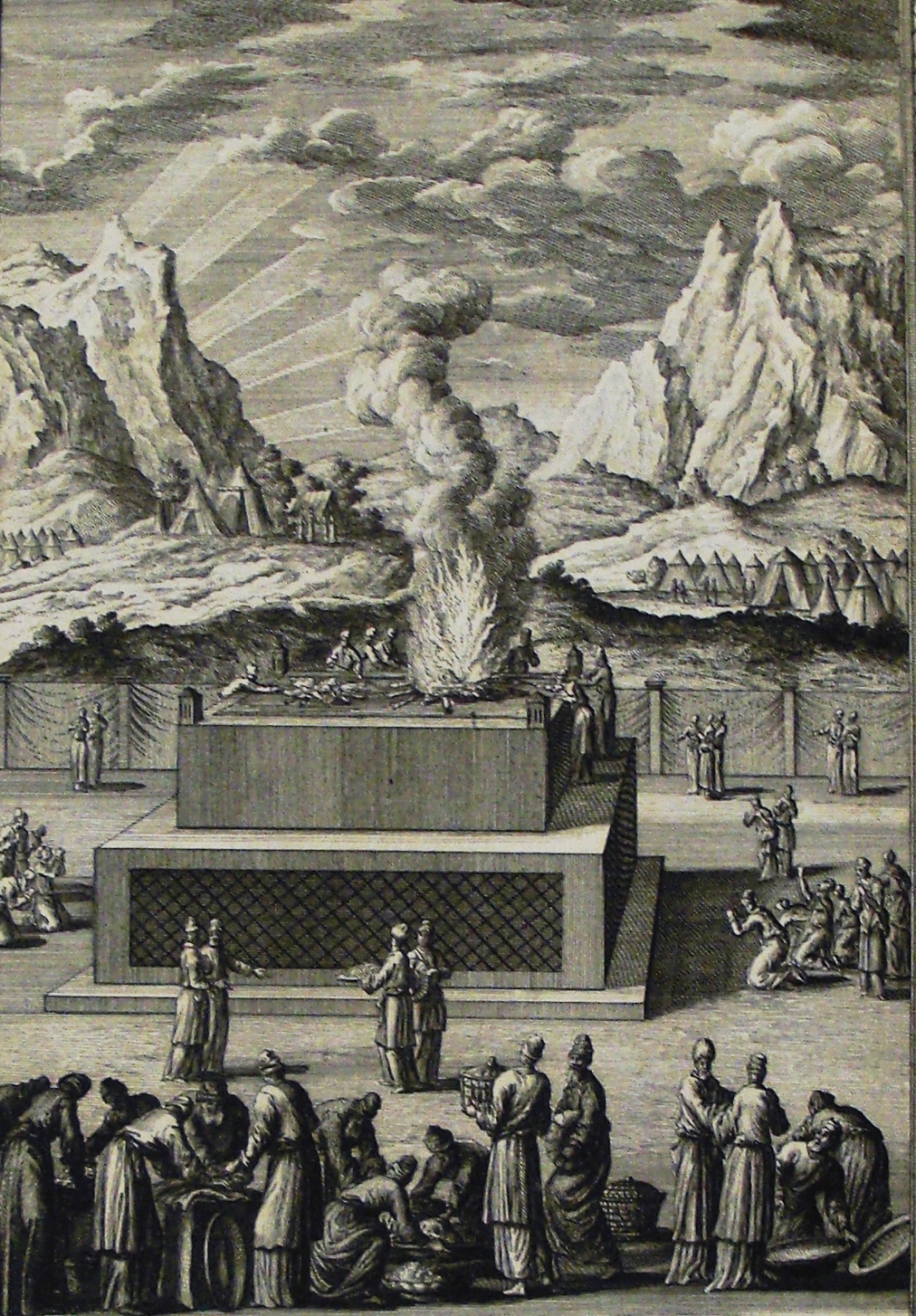
The engraver puts the whole chapter's structure into one frame without staging a single verse literally: the fire that consumes 'all of it' (v9, v13, v17) rises continuously at the center, while the small clustered groups at ground level stand in for the whole procession of individual offerers this chapter addresses one at a time — herd, then flock, then bird — each bringing 'his own offering' rather than a single national sacrifice. The mountains behind the camp place the scene exactly where the text does: at Sinai, before the tent of meeting, tents pitched in view of the peak the law was just given on.

Translator's Notes — verse by verse
Leviticus opens the manual of worship: how a redeemed people may draw near to the holy God now dwelling in their midst. Quotations from copyrighted versions (NIV, TLB, NWT) are kept to short phrases for comparison; KJV, Geneva, Douay-Rheims and ASV are public domain.
The book named for its first word. As with every book of the Hebrew Bible, the Jewish tradition calls Leviticus by its opening word: Vayiqra, "And he called." It is a gentler verb than the "spoke" that follows — God does not merely issue commands into the tent, he calls Moses in, by name, the way you call someone you know. It is the very verb of the burning bush, where "God called to him from within the bush, Moses, Moses!" (Exodus 3:4) — the same voice, now speaking from the tent that voice had told him to build. Where most of the shelf prints the small-caps substitute for the divine name, this translation keeps the Name itself: Jehovah called (ASV agrees, printing "Jehovah" here natively).
The small aleph. In the Torah scroll, the last letter of that first word — the א (aleph) of vayiqra — is written smaller than the letters around it, a scribal tradition our oldest manuscripts already carry (you can see it above). The rabbis read meaning into it: without the aleph the word would be vayiqar, "and he chanced upon" — the cooler verb used of God's meeting the pagan seer Balaam (Numbers 23:4). Moses, the tradition says, in his humility wanted to write only vayiqar, "God happened to meet me," and God insisted on the aleph of intimate calling — so Moses wrote it, but small. Whether or not that is the reason, the small letter is really there in the text, and it opens the book on exactly its theme: not a God stumbled upon, but a God who calls.
Worship as drawing near. The word for "offering" here is qorban, and it is built on the root qarav, "to draw near, to approach." An offering is not first of all something destroyed; it is that which is brought near — the way a person, who cannot simply walk into the presence of holiness, sends a gift near in his place. The whole sacrificial system is framed at its first mention not as appeasement but as approach. (The word survives untranslated on Jesus' own lips: "Corban," Mark 7:11.)
The offering that goes up. The first sacrifice given a law is the olah, the burnt-offering — literally the "ascending" offering (from alah, "to go up"), because, uniquely, the whole animal goes up in smoke and none of it is eaten. Douay-Rheims, following the Latin, calls it a holocaust — the Greek holokauston, "wholly burnt." It is the offering of total self-gift, and the very first burnt-offering in the Bible was Noah's, on the altar he built when the flood receded (Genesis 8:20).
Without blemish, hand laid on. The animal must be tamim, "without blemish" — the same word God asked of Abraham's walk: "walk before me and be blameless" (17:1). The whole, unflawed victim mirrors the whole, unflawed life. Then the worshipper "lays his hand on the head" of it — samakh, to lean, to press down firmly, not merely touch: the gesture identifies him with the animal, this dies in my place. And so it "makes atonement for him" — kipper, from the root "to cover." Its plainest use in the Bible so far was the pitch that covered Noah's ark against the judging waters (kopher, 6:14): the ark that covered Noah and the offering that covers the sinner share one root.
A soothing aroma. The rite closes on a phrase that will become the refrain of the whole book: the priest turns it all to smoke, "a burnt-offering, an offering by fire, a soothing aroma to Jehovah" (reyach nichoach; KJV "a sweet savour"). The word nichoach shares its root with nuach, "to rest" — the root behind Noah's name — and its first appearance in scripture is exactly there: when Noah's burnt-offering rose, "Jehovah smelled the soothing aroma" and swore in his heart never again to curse the ground (8:21). What Noah did once, at the end of the world, Leviticus now makes Israel's daily worship.
The same rite, a smaller animal. The law now steps down from the herd (an ox or bull) to the flock — a sheep or a goat. The ritual is deliberately repeated almost word for word — Hebrew law, like Hebrew narrative, says things fully rather than cross-referencing — with one new detail: this one is slaughtered "on the north side of the altar." The repetition is the point: the pattern that governs the wealthy man's bull governs the herdsman's goat exactly the same. What is beginning here is a descending scale of cost, and it is a mercy — the door of the tent is not only for those who can bring the most.
And if you have almost nothing. The scale reaches its bottom rung: a person who owns no livestock at all may bring birds — "turtledoves or young pigeons" (KJV "turtledoves, or of young pigeons," the birds anyone could catch or buy for a copper). The priest does the whole rite by hand — he "pinches off" the tiny head (malaq, a bird needs no knife), drains the blood against the altar wall, removes the crop, and tears it open by the wings without dividing it in two. And the verdict on it is word-for-word the verdict on the bull: "a burnt-offering, an offering by fire, a soothing aroma to Jehovah." The poorest person's two birds smell exactly as sweet to God as the rich man's ox.
The offering Mary brought. This bottom rung is not a footnote of history. When Mary and Joseph came to the Temple to present the infant Jesus, they brought — Luke is careful to tell us — "a pair of turtledoves or two young pigeons" (Luke 2:24), naming this very verse: the law's provision for those who could not afford a lamb (Leviticus 12:8, now on these pages). The family of the Messiah came with the offering of the poor. This translation will mark such echoes as they come; it does not force them.
Patterns worth carrying forward
Where this translation keeps the words exact / distinct: "offering" for qorban (the "drawing near" root kept audible in the note, not flattened to "sacrifice"); "burnt-offering" for the ascending olah (with Douay's holocaust on the shelf); "without blemish" for the sacrificial sense of tamim — Abraham's own word; "soothing aroma" for reyach nichoach (the KJV's lovely "sweet savour" noted); and "slaughter" for shachat (שָׁחַט, the altar verb) — kept carefully distinct from its near-twin shachat (שָׁחַת, "to ruin"), the flood's boomerang word that only sounds the same.
Echoes paid. The soothing aroma of Noah's first altar (Genesis 8:21); the tamim demanded of the offering as it was of Abraham's walk (17:1); kipper, "to cover," reaching back to the pitch on Noah's ark (6:14); and vayiqra, "and he called," the very verb of the burning bush (Exodus 3:4). Echo planted: the offering of the poor (the two birds, v. 14) — paid forward to the family of Jesus at the Temple (Luke 2:24), and to the letter to the Hebrews, which reads the whole apparatus as a shadow of a single, final offering.
Leviticus 2, the grain offering (minchah), the one bloodless sacrifice: fine flour, oil, and frankincense, with no leaven and no honey, but never without salt — "the salt of the covenant of your God" — is now on these pages too, along with Leviticus 19. Leviticus 3, the peace-offering — divided three ways between altar, priest, and the offerer’s own table, and closing on the flat rule never to eat fat or blood — is now on these pages too. Leviticus 4, the graduated sin-offering — its blood rite scaled to who sinned, from the anointed priest down to the ordinary person — is now on these pages too. Leviticus 5, three ways to be guilty before you even know it, a sin-offering graded to what a person can afford, and the guilt-offering that pays a neighbor back in cash before Jehovah is offered anything at all — is now on these pages too. Leviticus 6, the same offering laws restated for the priests who run the altar rather than the worshippers who approach it — the fire that must never go out, the one grain-offering with no eaten portion because it is the priest’s own — is now on these pages too. Leviticus 7, closing out the whole seven-chapter offering-law section with a formal colophon — the priests’ own economics of who is paid from which sacrifice, the peace-offering’s three occasions and three deadlines, and the two portions permanently taxed for the priesthood, breast waved and thigh contributed — is now on these pages too. Leviticus 8, the narrated ordination of Aaron and his sons at last — Exodus 29’s own instructions finally carried out gesture by gesture, blood touched to ear and thumb and toe, hands filled with the offering itself before it ever reaches the altar — is now on these pages too. Leviticus 9, the eighth day — Aaron finally performing every ritual himself, once for his own household and again for the whole nation, ending in fire from before Jehovah and a camp that shouts for joy and falls on its face — is now on these pages too. Leviticus 10, the very next moment — the same fire that consumed Leviticus 9’s offering consuming two of Aaron’s own sons instead, Aaron’s silence, and the priesthood’s first working day ending in instruction, mourning, and a quiet dispute over an uneaten offering — is now on these pages too. Next installment in this book: Leviticus 11 — the clean and the unclean, and the verb this whole book turns on — is now on these pages too.