The Old Testament
This is where the project begins — in the Hebrew of the Tanakh, the Scriptures Jesus and the apostles called simply "the Law and the Prophets." Most of this library's work lives here: the five books of Moses, the histories, the poetry and wisdom, and the prophets. This page is the reference desk for the Hebrew Scriptures — what the collection is and how it is arranged, the text we translate from and the scribal marks we keep, the older witnesses the notes weigh, and the one decision that marks nearly every page: rendering the divine Name as Jehovah, not "the LORD." It's a living page — updated as the method takes shape.

What it is, and how it's arranged
Two names for one library. Christians call it the Old Testament; the Jewish tradition calls it the Tanakh — an acronym for its three parts: Torah (the Law), Nevi'im (the Prophets), and Ketuvim (the Writings). It is the same collection of Scriptures, counted two ways: 39 books in the common Christian reckoning, or 24 in the Jewish, which groups the material differently (the twelve Minor Prophets are one scroll, "The Twelve"; Samuel, Kings, and Chronicles are one book each). Written over roughly a thousand years, almost entirely in Hebrew, with a few passages in Aramaic (parts of Daniel and Ezra).
The order differs, too. The Jewish Tanakh runs Law → Prophets → Writings and ends on Chronicles, looking toward a return. The Christian Old Testament regroups the same books by kind — Law, History, Poetry and Wisdom, Prophets — and ends on Malachi, looking forward to a coming messenger. This translation follows the familiar Christian book-order for navigation, while noting the Hebrew arrangement where it matters (the placement of Daniel among the Writings, for instance).
The source text — the Masoretic Text
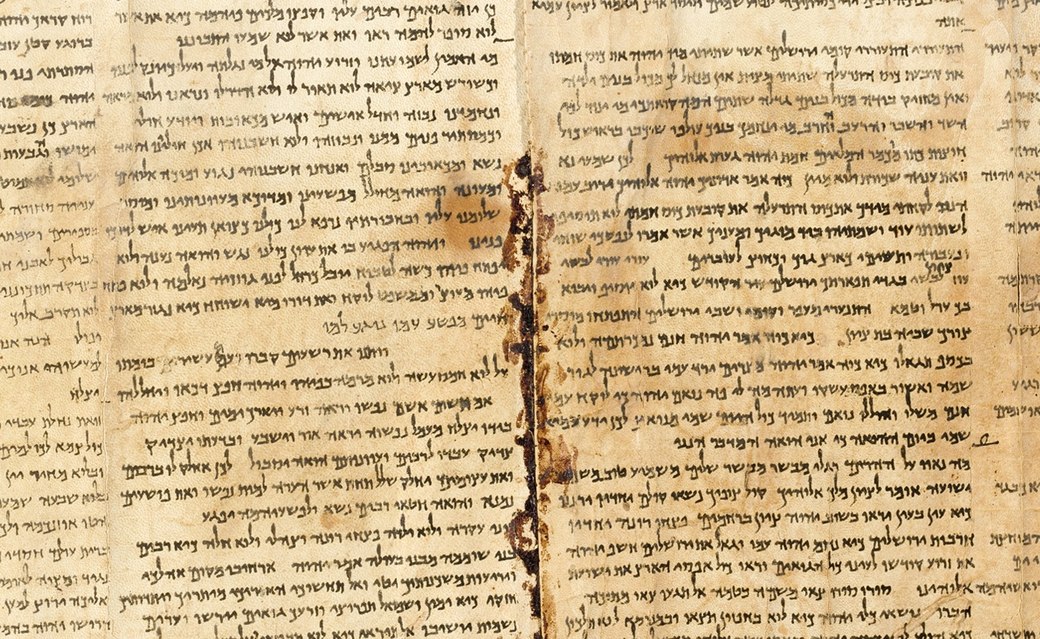
The Hebrew is translated from one remarkably stable traditional text: the Masoretic Text, the edition fixed and safeguarded by the Masoretes, generations of Jewish scribe-scholars working from roughly the 7th to the 10th centuries AD. Hebrew was first written with consonants only; the Masoretes added, above and below the ancient letters, a precise system of vowel points and cantillation marks (the te'amim, which double as musical and punctuation signs) — preserving not just the letters but exactly how the text was to be read and chanted. Their standardization was so thorough that medieval manuscripts a continent apart agree letter for letter.
This project translates the digital Hebrew of Mechon-Mamre (the Leningrad/Aleppo tradition), and it deliberately keeps the scribes' own marks visible rather than smoothing them away:
- The scroll's paragraph breaks — petuchah {פ} ("open") and setumah {ס} ("closed") — are shown where the text marks them.
- Ketiv / qere — the places where the tradition writes one thing (ketiv) and reads another (qere) are kept and noted, not silently harmonized.
- The famous oddities of the letters are preserved and explained — the shrunken small aleph that opens Leviticus (Vayiqra, 1:1), the two inverted nuns that bracket the Song of the Ark in Numbers (10:35–36), the oversized and dotted letters elsewhere: ancient scribal signals the tradition has carried for two millennia.
The witnesses the notes consult
The Masoretic Text is the base, but it is not the only ancient copy. Where a reading is disputed the notes weigh the older and independent witnesses — always noted, never silently adopted (the Masoretic reading stands unless the note argues otherwise):
How do we know the Hebrew text is reliable?
The worry is natural: if the oldest complete medieval manuscripts of the Masoretic Text date from around the 10th–11th centuries AD, how do we know they preserve what was written a thousand years and more before? Two things answer it.
- The Masoretes were fanatical copyists. They counted the letters of each book, marked its middle letter and middle word, and recorded the tally in the margins, so that a single dropped letter would betray itself. Their whole craft was built to transmit an already-fixed text without drift — and it worked: their manuscripts agree with one another to an astonishing degree.
- The Dead Sea Scrolls let us check. When the Qumran scrolls surfaced in 1947, they handed us Hebrew Bible manuscripts a thousand years older than anything previously known. The verdict, most famously on the Great Isaiah Scroll: substantially the same text. The differences are mostly spelling and small variants; the book you read is the book they read.
Honesty requires the other half, too. In a few books the ancient versions preserve a genuinely different edition — the Septuagint of Jeremiah, for instance, is about a seventh shorter than the Hebrew and arranged differently, and some Qumran copies match it; the Samaritan Torah has its own harmonizing expansions. This translation follows the Masoretic Text but flags such divergences where they matter, laying out the readings with their pedigrees rather than pretending the tradition is seamless.
The Name: why this translation says "Jehovah"
The defining decision of this Old Testament is what to do with the personal name of God. Some 6,800 times the Hebrew writes four consonants — יהוה, YHWH, the Tetragrammaton ("four letters"). Out of reverence, the Jewish reading tradition long ago stopped pronouncing it, saying Adonai ("my Lord") aloud instead; the Masoretes marked this by pointing the written YHWH with the vowels of Adonai — a standing "read it as Lord" instruction (a qere perpetuum). Following that tradition, most English Bibles print "the LORD" in small capitals wherever the name stands — a title in place of the Name.
This translation does the opposite: it keeps the Name visible, rendering it Jehovah — the traditional English form (the ASV and the New World Translation use it too; Tyndale and the King James translators knew it). The form Jehovah itself comes from reading YHWH's consonants with Adonai's borrowed vowels; scholars reconstruct the original pronunciation as Yahweh. This library uses "Jehovah" as the established English name, not as a claim about exact pronunciation — and it never prints "the LORD" for the Name, not even inside a quotation, so the reader always sees where the personal name of God actually stands. That single choice shapes the whole translation, and it is the Hebrew Scriptures' counterpart to the neutrality problem the Greek Scriptures open on.
What carries through — the method
Everything that makes this a librarian's Bible and not a preacher's holds from the first verse of Genesis: an essentially literal rendering in natural modern English (vault, not "firmament"; side, not "rib"); the seven-version shelf — NIV, KJV, Douay-Rheims, Living Bible, 1599 Geneva, ASV, and NWT — compared under every chapter; the neutrality rule, laying out contested readings (the sons of God in Genesis 6, the date of the Exodus, the authorship of the Torah) with their pedigrees and casting no vote; the echo system, flagging a word or motif when it first appears and paying it off when it returns; and the honesty habits — hapax and uncertain words called uncertain, anachronisms and source-critical seams shown, not sanded. The Library grows a dictionary, an encyclopedia, an atlas, a chronology, and a concordance built from this translation's own English as the chapters arrive.
The Hebrew Scriptures begin at the beginning — Genesis 1.
"In the beginning God created the heavens and the earth." From the seven days and the garden through the flood, Babel, and the call of Abraham, the first book lays the ground the whole Bible builds on. Browse everything published so far in the Table of Contents.
Read Genesis 1 → Table of Contents →