Matthew 11 — The Mister Translation
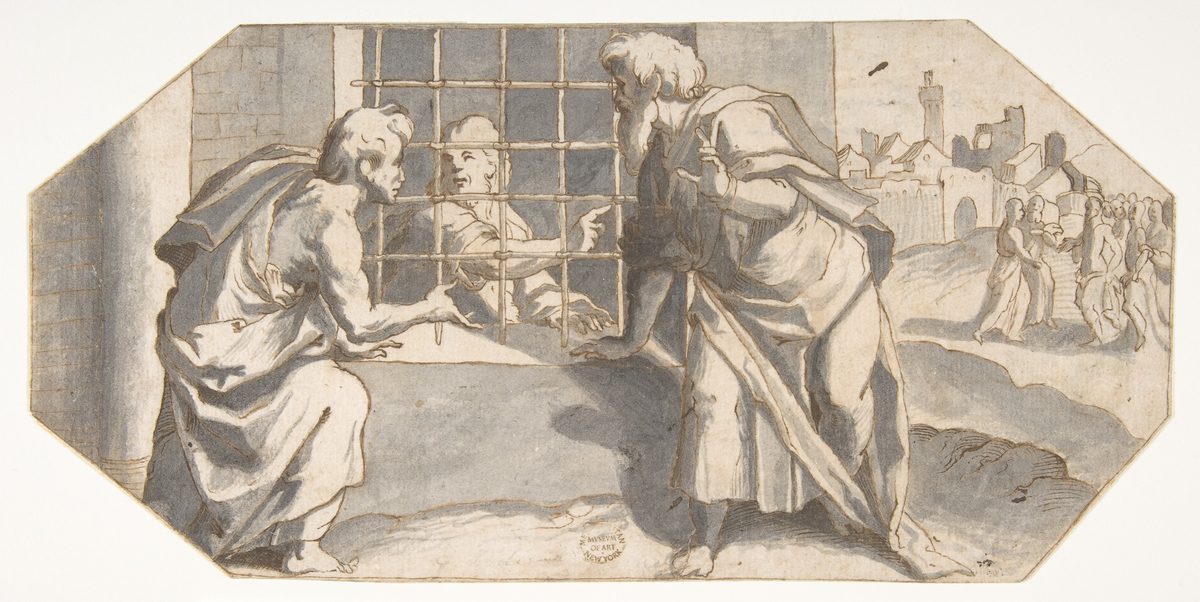
A design drawing rather than a finished painting — the elongated, corner-clipped octagon is the shape used for a 'sopraporta' or ceiling spandrel in an Italian interior scheme, not a standalone picture. ⚠ It stages the SENDING rather than the arrival: John's own hand and face are the only parts of him the grating lets through, gesturing his two disciples on their way, while a line of small figures already threads toward the town where they will meet the one they have been sent to ask about.

Translator’s Notes
⚠ A word Matthew uses nowhere else. Every other time this Gospel mentions John’s same imprisonment it uses the ordinary word for a jail, phylakē (14:3, 10, not yet on these pages). Here, once only, Matthew reaches for desmōtērion — literally ‘the place of bonds’ (from desmos, a chain or fetter), a harsher and more physical word. It is used exactly once in this entire Gospel, at the one moment John’s own faith is under strain.
The deeds ‘of the Christ.’ Matthew writes tou christou, ‘of THE CHRIST,’ in his own narrating voice — a title, not a name, and one no character in the story has yet used of Jesus aloud. The confession is the narrator’s, offered quietly before anyone in the scene says it.
⚠ ‘The one who is to come’ — a phrase, not a guess. Ho erchomenos was already a recognizable way of naming the expected one (compare Psalm 118:26, ‘blessed is he who comes in the name of Jehovah,’ which the crowds will shout word for word at the gates of Jerusalem, 21:9). John is not asking Jesus to identify himself in the abstract; he is asking whether Jesus is THAT one, by name.
⚠ The deeds themselves answer out of Isaiah, without a citation formula. ‘The blind receive sight and the lame walk… the deaf hear’ tracks Isaiah 35:5–6 almost word for word (Hebrew: az tippakachnah einei ivrim, ve’oznei cheirshim tippatachnah — ‘then the eyes of the blind shall be opened, and the ears of the deaf unstopped’), and ‘the poor have good news brought to them’ is Isaiah 61:1’s own verb, levaser, ‘to bring good news,’ the same passage Luke has Jesus read aloud in the Nazareth synagogue and declare fulfilled (Luke 4:18–21, not yet on these pages). Jesus never says ‘as it is written’; he simply lists the deeds, in Isaiah’s own vocabulary, and lets John draw the conclusion himself. ‘Lepers cleansed’ and ‘the dead raised’ go beyond either Isaiah passage — his own ministry running ahead of the citation, not merely fulfilling it point for point.
“Happy” again, not “Blessed.” Makarios at v6 is the same word and the same rendering this translation settled on at the Beatitudes (Matthew 5:3–11) — kept consistent here rather than reverting to the more familiar ‘blessed’ of KJV/Geneva/Douay.
⚠ A question this translation does not resolve. Why does the man who baptized Jesus and named him ‘the one coming after me’ (3:11) now ask, from prison, whether he was right? Readings differ and none is forced by the text: that prison strips away certainty a free man can afford; that John expected the axe already laid to the root and the winnowing fork already in hand (3:10–12) and instead sees a healer, not yet a judge; or simply that a locked cell is where doubt visits everyone, prophets included. The text records the question and Jesus’ answer — not John’s reasons.
Three questions, the same shape, three different answers. Jesus repeats ‘what did you go out to see’ three times and lets each image correct the last: not a reed (the ordinary Jordan-valley marsh plant, bending with every gust — not John, whose message never moved for anyone), not a man in soft clothing (the fabric of comfort and of royal courts, the opposite of camel’s hair), but a prophet — and then more than a prophet.
⚠ ‘More than a prophet’ because he is also the SUBJECT of prophecy. Every other prophet spoke the word; John is the one a previous prophet spoke ABOUT. That is the entire argument of v10, and it is why the compliment outranks the category.
⚠ A spliced quotation, met once already on this site — but read differently here. The words are Malachi 3:1 with a phrase of Exodus 23:20, the identical composite Mark 1:2–3 opens his whole Gospel with (see that note for the fuller treatment, including the ‘attributed to Isaiah’ puzzle Mark alone carries). Two differences are worth naming precisely. First, direction: the Hebrew of Malachi 3:1 has God speaking in the FIRST person — hinneni sholeach mal’akhi, ufinnah derekh lefanai, ‘behold, I send my messenger, and he will clear THE WAY BEFORE ME’. But Matthew (like Mark and Luke) reads ‘before YOUR face… your way before you’ — SECOND person, applied to Jesus — because that direction comes from Exodus 23:20, hinneh anokhi sholeach mal’akh lefanekha, ‘behold, I send an angel BEFORE YOU’ (God to Israel, of the angel guiding the wilderness journey). The composite quotation takes its FORM from Exodus and its CONTENT (a messenger who prepares a way) from Malachi. Second, unlike Mark’s shorter opening form, this fuller version (shared with Luke 7:27) adds an emphatic ‘I’ (egō, matching Exodus’s explicit anokhi where Malachi has none) and doubles ‘before you…before you’ at both ends of the sentence — a fuller, more emphatic recitation than Mark’s.
⚠ None greater, yet the least greater still — a statement about ERAS, not persons. ‘Amen I say to you’ is kept identical here to its uses in chapter 10 (vv15, 23, not yet quoted in this translation’s prior notes but consistent with the convention since ch.5). The paradox is not a put-down of John’s character; it measures two different eras against each other. No one born under the old arrangement stood higher than John — and the smallest place inside the kingdom he announced still outranks him, because it belongs to what he could only point toward.
⚠ One of the New Testament’s most argued single verses, and this translation does not close the argument. Biazetai can be read two directions at once, and the difference is not a shade of meaning but an opposite claim. Read as MIDDLE voice, it says the kingdom itself FORCES ITS WAY forward — an unstoppable advance, with the biastai its eager, forceful entrants, seizing it in the same positive spirit a determined crowd storms a gate. Read as PASSIVE, it says the kingdom SUFFERS VIOLENCE — under active assault, the biastai now its violent opponents, plundering (harpazousin, the verb for snatching or ransacking) what is not theirs. ⚠ Its nearest relative argues for the middle sense: Luke’s parallel saying reads unambiguously as reflexive, ‘everyone is FORCING THEIR WAY into it’ (Luke 16:16, not yet on these pages) — no one disputes that one. But Matthew’s own immediate context — a generation about to be accused, four verses later, of refusing to dance OR mourn no matter what is played to them (vv16–19) — reads more naturally as violence done TO the kingdom than momentum FROM it. KJV, ASV, and the NWT all print the passive, ‘suffereth violence’; this translation follows them as the primary reading and flags Luke’s parallel as the strongest argument the other way.
‘Until John’ — a hinge stated outright. ‘All the prophets and the Law prophesied UNTIL John’ names, in Jesus’ own mouth, the very division this translation has been tracking since 3:2: the old order of promise closing, the new order he is announcing already begun.
⚠ The identification is offered, not imposed. ‘IF you are willing to receive it’ makes the Elijah-identification conditional on the hearer, not a demand. It rests on Malachi’s own closing promise — the last two verses of the Hebrew Bible’s Malachi (3:23–24, Hebrew numbering; English 4:5–6): hinneh anokhi sholeach lakhem et Eliyah hanavi, lifnei bo yom Adonai haggadol vehannora, ‘behold, I will send you Elijah the prophet before the coming of the great and terrible day of Jehovah’ — and it is the same identification John’s costume already argued silently, camel’s hair and a leather belt matching 2 Kings 1:8’s description of Elijah exactly (see the note there). Jesus will make the same identification again, more explicitly still, to Peter, James and John coming down from a mountain (17:10–13, not yet on these pages).
⚠ Deliberately unfinished grammar. The Greek of v16 is a participle without a clean finite verb — ‘like children sitting in the marketplaces, WHO CALL OUT…’ — left hanging until v17’s ‘saying’ finally completes the sentence one verse later. This translation prints the seam rather than smoothing two verses into one tidy clause.
Neither tune pleases them. A funeral dirge (mourning) and a wedding song (piping) exhaust the two moods a marketplace game could offer, and this generation refuses to dance to either — which is the whole point of pairing John’s asceticism (‘neither eating nor drinking’) with the Son of Man’s opposite habit (‘eating and drinking’) in the two verses that follow. One is called demon-possessed for FASTING; the other is called a glutton for NOT fasting. The charge changes to fit whichever is standing in front of them — and ‘a friend of tax collectors and sinners’ repeats, almost to the word, the very charge already made over Matthew’s own dinner table two chapters earlier (9:11).
⚠ A real textual variant, and the two Gospels now disagree on it. This translation’s base Greek text reads ‘wisdom is vindicated by her DEEDS’ (ergōn); the Byzantine majority text instead reads ‘her CHILDREN’ (teknōn) — harmonizing Matthew to Luke’s parallel, which reads ‘children’ (teknōn) without any such variant at all (Luke 7:35, not yet on these pages). So on the reading followed here, Matthew and Luke record the SAME proverb with genuinely different nouns: wisdom proved right by what she DOES, or by the people she PRODUCES. Both are printed as what each Gospel’s own best-attested text actually says, not harmonized into agreement.
Wisdom, personified — and the same Greek word returns later, meaning something narrower. Sophia here is a WOMAN who acts and is vindicated, standing in the Hebrew Bible’s own tradition of Wisdom calling out in the marketplace (Proverbs 1, already on these pages, and 8–9, not yet in Greek dress); this is worth remembering the day this site’s dictionary entry for the word, written first from 1 Corinthians 1, calls it merely ‘the reasoned understanding a Greek education existed to produce.’ One Greek noun, two very different lives across two different New Testament authors.
Three towns named, one silent gap. Chorazin and Bethsaida (see the entries) are named alongside Capernaum, ‘his own city’ (4:13) and the base of the whole Galilean ministry — yet not one specific miracle at Chorazin is narrated anywhere in the four Gospels. The charge that ‘most of his mighty works’ happened there stands on record with nothing behind it that survives; whatever was done went as unrecorded as it apparently went unrepented.
The standard is the outsider, and it convicts the insider. Tyre and Sidon (see the entries) were, in the Hebrew Bible’s own long memory, wealthy pagan trading powers — Amos’s and Ezekiel’s targets, not models of piety. Naming them as cities that WOULD have repented, and Sodom (Genesis 18–19) as a city that WOULD have survived, is the sharpest possible reversal: Galilean towns that heard and saw the most respond worse than history’s own bywords for judgment.
⚠ A king of Babylon’s own boast, turned on a fishing town. ‘Will you be exalted to heaven? You will go down to Hades’ echoes, almost line for line, Isaiah’s taunt against the king of Babylon: hashamayim e’eleh… akh el she’ol turad, ‘I will ascend to the heavens… yet you will be brought down to Sheol’ (Isaiah 14:13–15, not yet on these pages). The same rhetorical shape — self-exaltation answered by a fall to the underworld — is lifted from an empire’s tyrant and set over a Galilean lake town that never called itself anything at all. Hadēs here is the same word this site’s dictionary already glosses from Revelation 1:18: the Greek Bible’s rendering of Sheol, the grave-realm, not yet the fiery hell of later imagery.
⚠ A verb that carries its own name-pun, if the reader knows to listen for it. Exomologeomai is the Greek Old Testament’s standard rendering of Hebrew yadah/hodah, ‘to praise, give thanks’ — the same root the Psalms open on (‘GIVE THANKS to Jehovah,’ Hebrew hodu, Psalm 118:1 and elsewhere), and the identical root Leah names her fourth son from: ‘this time I will PRAISE (odeh) Jehovah’ — Judah (Genesis 29:35, already on these pages). Jesus’ prayer opens on the very word a matriarch once turned into a name, generations before that name headed a line this same Gospel traces all the way to its own genealogy.
⚠ Infants against the wise — on purpose. Nēpioi, ‘infants,’ are set directly against sophōn kai synetōn, ‘the wise and the understanding’ — the very people equipped to grasp such things are the ones from whom they are hidden, and the ones with no equipment at all are the ones who receive them. The Father’s pleasure (v26) is stated as the reason, and nothing beyond it is offered.
⚠ A claim this Gospel makes only here, in language that sounds like a different one. ‘No one FULLY KNOWS (epiginōskei, the intensified form of the ordinary verb) the Son except the Father, nor does anyone fully know the Father except the Son’ is an exclusive, mutual claim of knowledge between Father and Son that reads more like John’s Gospel than anything else in the Synoptics — long enough remarked on that it carries a nickname among readers of the New Testament, ‘the Johannine thunderbolt out of a Synoptic sky.’ Luke’s parallel differs in two small but real ways: it opens with Jesus ‘rejoicing in the Holy Spirit’ before the prayer begins (Luke 10:21, not yet on these pages, an introduction Matthew lacks), and phrases the claim as knowing WHO the Son and the Father ARE rather than knowing them outright — a slightly softer form of the same exclusive claim.
The Gospel’s gentlest invitation, addressed to the exhausted. ‘Come to me, all who labor and are heavy-laden’ has no parallel anywhere else in the four Gospels — material found only in Matthew, offered right after the harshest words in the chapter, the woes on three towns that saw the most and repented the least.
⚠ ‘Meek’ — the identical word, claimed by the one who first promised it. Praus is the SAME Greek word already met once: ‘Happy the MEEK, for they shall inherit the earth’ (Matthew 5:5). There it named a beatitude to be pursued; here, six chapters later, Jesus applies it to himself — the only two places in this Gospel the word appears, first as a virtue promised a reward and then as a virtue claimed by the one making the promise.
A YOKE, not merely a burden. Zygos was, in the rabbinic idiom of Jesus’ own day, a standing way of talking about a body of teaching taken on — ‘the yoke of the Torah,’ ‘the yoke of the kingdom.’ ⚠ A well-documented literary parallel, outside this project’s own canon and so not quoted here as Scripture, is worth naming as background: the wisdom book of Sirach (Ben Sira), writing perhaps two centuries earlier, has Wisdom herself issue a nearly identical invitation — draw near, put your neck under the yoke, and find rest for the soul. Whether or not Matthew knew that specific text, ‘take my yoke and learn from me’ speaks in a vocabulary Jewish wisdom teaching already had ready to hand.
⚠ A word one letter from his own title. Chrēstos, ‘kind, easy to wear, well-made,’ and christos, ‘anointed,’ were near-homophones in first-century pronunciation — close enough that ‘Chrestus’ turns up as a variant spelling of ‘Christus’ in later Roman writing (Suetonius’s Life of Claudius). Matthew does not exploit the resemblance; it is simply there, in the sound of the last word this chapter gives him.
Patterns worth carrying forward
Where this translation keeps the exact / distinct words: “the prison” for desmōtērion in the reading text, with the word’s harsher underlying sense (‘the bond-house,’ used nowhere else in this Gospel) carried in the note rather than forced into an English neologism; “Amen I say to you” kept identical to its uses since chapter 5; “the kingdom of the heavens” kept plural, as at every occurrence since 3:2; “Happy” for makarios, matching the Beatitudes rather than reverting to the more familiar ‘Blessed’; and the doubled ‘before you…before you’ of the Malachi/Exodus splice kept in full, rather than trimmed to Mark’s shorter opening form of the same quotation.
Where it goes its own way: the PASSIVE reading of v12’s biazetai (‘the kingdom suffers violence’) printed as the primary text, with Luke’s clearly middle-voice parallel flagged as the strongest argument for the opposite sense, rather than silently picking one; the base text’s ‘her deeds’ kept at v19 even where it disagrees with Luke’s own ‘her children’ for the identical proverb, rather than harmonizing the two Gospels into agreement; and the genuinely unfinished participial grammar of v16 left broken across the verse boundary into v17’s ‘saying,’ rather than smoothed into one tidy sentence.
Echoes paid. John’s camel’s-hair costume, a silent claim at 3:4, becomes an explicit identification from Jesus’ own mouth here (‘he himself is Elijah,’ 11:14); the Malachi/Exodus splice that opened Mark’s whole Gospel returns here on Jesus’ own lips rather than the narrator’s; the charge ‘a friend of tax collectors and sinners’ (11:19), already implicit over Matthew’s own dinner table two chapters back, is now stated outright; and meek (5:5), a beatitude promised a reward, is now a virtue Jesus claims for himself (11:29).
Echoes planted. ‘The one who is to come’ (11:3) will be shouted back at him, word for word, by crowds at the gates of Jerusalem (21:9); the Elijah identification offered conditionally here (‘if you are willing to receive it,’ 11:14) will be repeated more plainly still on a mountain coming down from the transfiguration (17:10–13, not yet on these pages); the ergōn/teknōn variant at v19 is now a live, unresolved disagreement with Luke’s own version of this identical saying, waiting for whatever a future Luke 7 makes of it; and ‘all things have been handed over to me by my Father’ (11:27) is this Gospel’s first claim of universal authority — not its last. It answers, at the very end of the book, ‘all authority has been given to me’ (28:18), the Great Commission’s opening words and this chapter’s own closing claim, spoken in almost identical language, thirty-one chapters apart.
Next in this book: chapter 12 — grain plucked and a withered hand healed on the sabbath, and the Beelzeboul charge planted back at 9:34 and named at 10:25 finally spoken out in full.