Revelation 22 — The Mister Translation
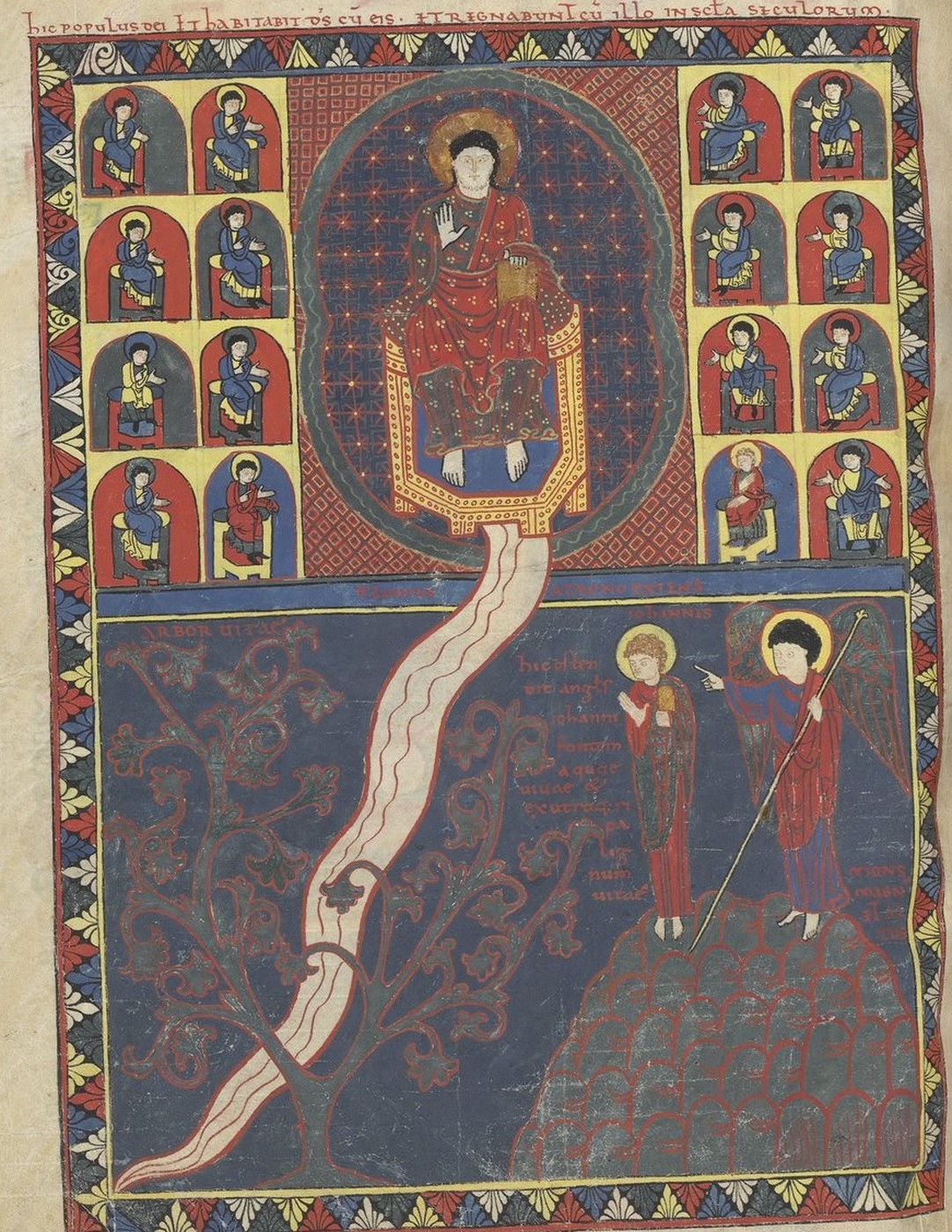
⚠ Look at where the river starts. Verse 1 says it comes out from the throne of God and of the Lamb, and Stephanus Garsia has painted exactly that and nothing more clever: the water is a broad white band pouring from under the throne in the upper register, through the frame, and down across the whole lower half of the page. The two registers are not two scenes. They are one plumbing diagram.
The tree is labelled, in case you miss it — ARBOR VITAE, in red, at the left. It is drawn as a scrolling vine growing along the bank rather than as a trunk, which is one way of solving verse 2’s famously awkward syntax: the tree is somehow in the middle of the street and on both sides of the river at once. A vine can do that. A trunk cannot.
And John is in the picture, named. The angel with the long rod points across the water at a smaller figure labelled IOHANNES — the man who is being shown all this, standing on a rock, at the edge, being pointed at. He is not the subject of the vision; he is the one having it explained to him, which is the posture the whole chapter puts him in, including the moment eight verses later when he tries to worship the angel and is told to stop.
⚠ This is a different Beatus from the one on the previous chapter. Revelation 21 here carries the Valcavado Beatus, copied in Spain in 970. This is Saint-Sever, made in Gascony a century later for a French abbey — the same commentary by Beatus of Liébana, the same tradition of enormous illustrated copies, a different scriptorium and a different hand. Two chapters, two Beatus manuscripts, a hundred years and the Pyrenees apart.

Translator’s Notes
1–5 — The river, the tree, and a word that occurs once more in the Bible — at Peter’s denial
The tree of life closes a bracket the book opened at 2:7. To the one who overcomes I will give to eat from the tree of life, which is in the paradise of God — the first promise made to the first church, and here it is, growing on both banks. Xylon is not the ordinary word for a living tree (that is dendron); it means wood, timber, the cut thing — which is also why the New Testament uses it for the cross. Nothing in this chapter presses that, and the word is sitting there.
“For the healing of the nations.” Therapeia — the word behind therapy; it is what a doctor does. In a book that has spent nineteen chapters on the nations as the problem, the last thing said about them is that there are leaves for them.
⚠ And “no longer any curse” uses a word found once more in the New Testament. Katathema is a hapax, but its verb is not: Matthew 26:74, where Peter, cornered in the courtyard, began to curse and to swear — and the cock crowed. The only other appearance of this root in the whole New Testament is the worst moment of a man’s life, and here the noun is abolished. Neither text knows about the other; the concordance does.
“They will see his face.” Set against Exodus 33:20, already on these pages, you cannot see my face, for no one shall see me and live. Four words, and they close the oldest impossibility in the Bible without arguing about it.
6–11 — “Do not seal it up” — the reverse of the order Daniel got
⚠ Daniel is told the opposite. Shut up the words and seal the book until the time of the end (Daniel 12:4). John is told do not seal up the words of the prophecy of this book, for the time is near. Same image, opposite instruction, and the reason given is the same in both: the timing. Whatever else Revelation is, it is not presenting itself as a locked document.
John tries to worship the angel, and is stopped — for the second time. It happened already at 19:10, in almost the same words. The angel calls himself a syndoulos, a fellow slave, which is the same noun the chapter uses of the worshippers at verse 3. Twice in three chapters the book has its seer make the same mistake and get the same correction, which is either careless editing or a point being made twice.
⚠ Verse 11 is the strangest sentence in the book. Let the one doing wrong still do wrong… let the righteous still do righteousness. Four imperatives, two of them apparently telling wrongdoers to carry on. It is not encouragement; the force is closer to there is no more time to change — the door-closing of verse 10’s “the time is near” put in the mouth of the angel. Every version renders it flatly and none softens it, which is right; it is meant to be uncomfortable.
12–14 — ⚠ Wash their robes, or keep his commandments? The King James is alone here
⚠ Verse 14 exists in two forms and they are not close in meaning.
Makarioi hoi plynontes tas stolas autōn — blessed are those who wash their robes. That is the reading of every critical text and, crucially, of the Byzantine majority text as well.
Makarioi hoi poiountes tas entolas autou — blessed are those who do his commandments. That is the Textus Receptus, and so KJV.
Read them aloud and the mechanism is obvious: plynontes tas stolas and poiountes tas entolas are four syllables apart in the same rhythm. This is how manuscripts drift. ASV and NIV both print “wash their robes”; the KJV stands alone on this shelf.
⚠ And the internal evidence is decisive, which is rarer than it sounds. Plynō occurs three times in the New Testament: Luke 5:2, where fishermen wash nets — and Revelation 7:14, they washed their robes and made them white in the blood of the Lamb. The same verb and the same noun, already in this book, fifteen chapters earlier. The phrase at 22:14 is not a rare oddity; it is a quotation of the book itself, and no scribe inventing a phrase would reach for it.
The stakes are not small, and it is worth saying plainly what they are: one reading makes the blessing depend on being washed, the other on keeping commands. Whole arguments about grace and works have been conducted on a verse where the two sides were, in part, reading different Greek.
“I am coming quickly” — three times in this chapter (vv7, 12, 20), plus en tachei, “soon,” at verse 6, and twice earlier in the book (2:16, 3:11). It is the last thing the book’s speaker says before the benediction, and it has now been quickly for nineteen centuries. The translation does not soften tachy, which means quickly and not certainly.
15 — The list again, and the word from the pharmacy
Verse 15 is verse 21:8 rearranged, and one item is worth stopping on. Pharmakoi — dealers in drugs and potions, and so sorcerers, the two trades being one job. It is the word behind pharmacy, and the family occurs five times in the New Testament, four of them in this book. KJV and ASV print “sorcerers,” NIV “those who practice magic arts.” Kept literal here, as at 21:8.
“Outside are the dogs.” Not an animal remark. In this vocabulary a dog is a scavenger, a thing outside the household, and the word has been used as an insult across the whole ancient Mediterranean — including, uncomfortably, by Jesus in the mouth of a conversation he then loses (Matthew 15:26–27). The list is printed as it stands.
16–17 — “Come” four times, and the water is still free
Verse 16 is the only place in Revelation where Jesus speaks in his own name. Egō Iēsous — the name, flatly, in the first person, after twenty-one chapters of titles: the Lamb, the one like a son of man, the faithful witness, the word of God. It arrives eight verses from the end.
The morning star closes another bracket. To the one who overcomes… I will give him the morning star (2:28) — and here the speaker says he is it. The two occurrences in Revelation are its first promise and its last self-description.
⚠ Four invitations in one verse, and they are not all the same word. The Spirit and the bride say erchou; the hearer says erchou; the thirsty one is told erchesthō. Two imperatives addressed outward and one addressed to whoever is listening — the verse turns from calling him to calling you halfway through, without marking it.
And the water is dōrean — for nothing. That makes three chapters running on these pages: hatred given for no reason at John 15:25, water given for no charge at 21:6, and again here in the last invitation in the Bible. Fourteen occurrences in the New Testament and the book ends on one of them.
18–19 — ⚠ The warning against adding, and the words that were added to it
This is the most-quoted warning in the Bible and the most misapplied. It is about this book — tou bibliou toutou, the scroll John has just written — not about the Bible, which did not exist as a single volume for centuries after. Similar warnings stand at Deuteronomy 4:2 and in ordinary Greek book-curses of the period; it was a normal thing to write at the end of a document that copyists would handle.
⚠ And then the irony, which is documented and exact. When Erasmus produced the first printed Greek New Testament in 1516, he had one manuscript of Revelation, and it was missing its last leaf. So for the closing verses he did the only thing available: he translated them back into Greek out of the Latin Vulgate, inventing wording that exists in no Greek manuscript at all. Those verses went into the Textus Receptus, and from there into the King James.
⚠ One of them is in this very passage. At verse 19 the Greek reads apo tou xylou tēs zōēs — from the TREE of life. Every Greek witness reads it, including the Byzantine majority text. KJV prints “out of the book of life,” which is Erasmus’s Latin working its way back through. ASV and NIV both have “tree.”
So the sentence that forbids taking words away from the book has, in the most influential English Bible ever printed, a word that was put into it — not by malice, by a printer’s deadline and a missing page. That is not an argument against the King James, which is a great translation of the text it had. It is an argument for knowing which text you are holding.
20–21 — The last sentence in the Bible, and nobody is quite sure what it is
“Come, Lord Jesus.” This is almost certainly the Greek of a prayer the first churches said in Aramaic: Marana tha, our Lord, come — which Paul leaves untranslated at 1 Corinthians 16:22, writing to Greeks who evidently knew it. The oldest surviving Christian prayer, and it is two words long.
⚠ And the last line of the Bible does not have a settled text. The manuscripts end four different ways, and the versions follow them: with all (the reading printed here) · ASV “with the saints. Amen” · NIV “with God’s people. Amen” · KJV “of our Lord Jesus Christ be with you all. Amen.”
Nothing turns on it. That is rather the point: the very last words of the Bible are a benediction whose exact wording the manuscripts never agreed on, and the difference between the readings is the difference between all, the saints, and you. This page prints the shortest, which is usually the oldest, and leaves the Amen off because the earliest text does. Every reading is a blessing on somebody.
Patterns worth carrying forward.
⚠ Two variants in this chapter are worth more than most whole books of textual notes. Verse 14 is wash their robes in every critical text and in the Byzantine majority text, and do his commandments only in the Textus Receptus behind the KJV — two phrases four syllables apart in the same rhythm, and the internal evidence is decisive because they washed their robes is already in this book at 7:14. And verse 19 reads tree of life in every Greek witness; the KJV’s book of life comes from Erasmus back-translating the missing last leaf of his only manuscript out of the Latin Vulgate in 1516.
⚠ Which makes the passage quietly self-referential. The sentence that forbids adding to the book contains, in the most influential English Bible ever printed, a word that was added to it — by a printer’s deadline and a missing page, not by anyone’s intent.
Brackets the book closes here. The tree of life, promised to the first church at 2:7, is growing on both banks at 22:2. The morning star, promised at 2:28, is what the speaker says he is at 22:16. And I am coming quickly, said at 2:16 and 3:11, is said three more times in this chapter and is the last thing the speaker says.
Words that arrive loaded. Katathema at v3 is a hapax whose verb appears once more in the New Testament — at Peter’s denial (Matthew 26:74). Therapeia at v2 is the word behind therapy. Dōrean at v17 is the third appearance on these pages in a week, after John 15:25 and Revelation 21:6. And xylon is not the ordinary word for a living tree; it is timber, the cut thing.
Renderings chosen. Wash their robes at v14 and tree of life at v19, following the Greek in both places and saying in the notes exactly what the King James has instead. Curse at v3, fellow slave at v9, drug-workers at v15 as at 21:8, quickly for tachy without softening, and with all at v21, the shortest and probably oldest of four endings.
Worth not skipping. Daniel was told to seal the book; John is told not to. John tries to worship the angel and is stopped, for the second time in three chapters. Verse 11 tells the wrongdoer to carry on, and means that the time for changing is over. And the last words of the Bible are a benediction the manuscripts never quite agreed on.
⚠ A note on order: this is the last chapter of the Bible. Revelation on these pages has been filling in from both ends — the letters and the seals from the front, the new Jerusalem from the back — and the middle chapters are the remaining gap.