Revelation 21 — The Mister Translation
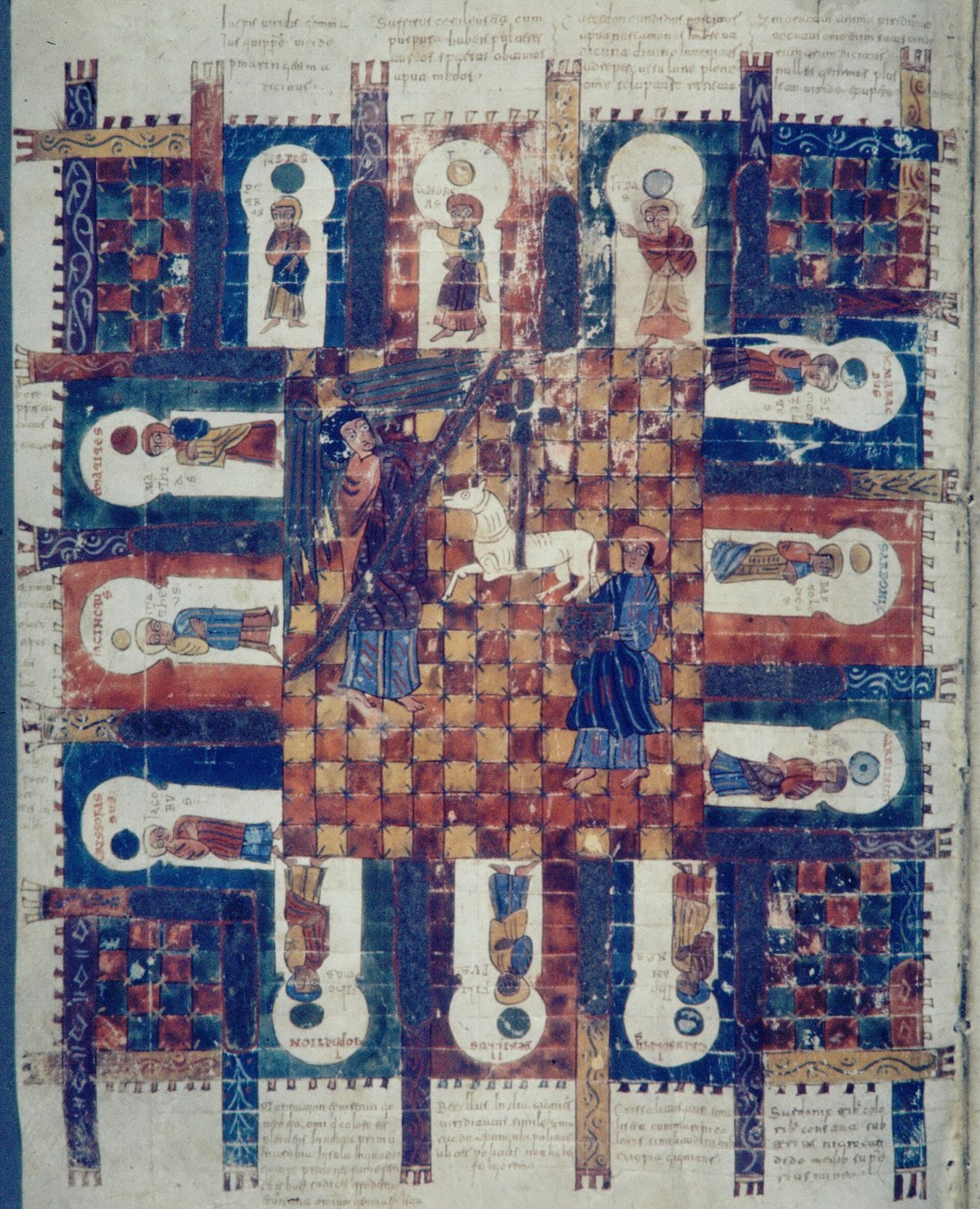
⚠ This is not a picture of a city. It is a plan. Oveco drew it flat, from directly above, with no perspective and no horizon — a square grid with twelve arched gates around the edge, three to a side, exactly as verse 13 lays them out. The bands of colour framing the grid are the twelve foundation stones, each labelled; the Latin at the top of the page is the commentary on the first of them, iaspis uiridis gemma, the green gem jasper.
Which is the right decision, and a rare one. Later painters gave the New Jerusalem towers and streets and a sky. This chapter does not describe a view; it reports a set of measurements and names — 12,000 stadia each way, 144 cubits of wall, twelve tribes on the gates, twelve apostles on the foundations. A tenth-century Spanish monk read that and drew a diagram. It is closer to the text than anything with a horizon in it.
At the centre, the Lamb — and the man with the long rod is the angel of verse 15, measuring. John stands opposite him. The three figures are inside the grid, not looking at it from outside, which is also what the chapter says: nobody views this city; you are either in it or you are not.
⚠ And the manuscript is Spanish, which matters here. Beatus of Liébana wrote his commentary on Revelation in the Asturias around 776, and for three centuries Spanish monasteries copied it in enormous illuminated editions — the Beatos, the most distinctive body of manuscript painting Europe produced before Gothic. This copy is signed and dated: Oveco, 970, at the monastery of Valcavado in Palencia, which no longer exists.

Translator’s Notes
1–2 — ⚠ “New” in this book is always one word, and never the other one
Greek has two words for new and Revelation uses only one of them. Neos is new in time — young, recent, the latest one. Kainos is new in kind — of a sort that was not there before, fresh as against worn out.
⚠ Counted, not assumed: kainos occurs nine times in Revelation and neos occurs zero times — in a book of 405 verses, and in a New Testament where neos turns up twenty-seven times elsewhere. A new song (5:9, 14:3), a new name (2:17, 3:12), the new Jerusalem (3:12, 21:2), and here a new heaven and a new earth. The word is consistent because the claim is: not a later world, a different kind of one. English has one word for both and cannot show it.
⚠ “And the sea is no more” — and note the tense. The two earths “went away” in the past; the sea is not, present. And this lands on a book that has mentioned the sea twenty-six times: the beast comes up out of it (13:1), it gives up its dead (20:13), merchants weep over it (18:17). For a writer on Patmos, an island, the sea is the thing between him and everyone he is writing to. Whatever else it means, the sentence is not about oceanography.
The city arrives dressed. Kēkosmēmenēn — adorned, arranged, put in order; it is the participle of the verb behind cosmos. She is not built here. She comes down already finished.
3–4 — God pitches a tent, and the verb has been used once before — at the start of John
⚠ The noun and the verb in verse 3 are the same word, and no English version keeps them together. Hē skēnē tou theou… kai skēnōsei met’ autōn — the tent of God… and he will tent with them. It is the word for the wilderness tabernacle, the portable sanctuary that moved when the camp moved.
Nobody on the shelf keeps the pair. KJV, ASV and DRB print “tabernacle… shall dwell”; NIV “dwelling place… will dwell.” Four versions, four unrelated word-pairs, and the noun-and-verb identity gone in every one.
⚠ And the verb belongs to two books only. Skēnoō occurs five times in the New Testament: Revelation 7:15, 12:12, 13:6, here — and John 1:14. Nowhere else. This library already translated that verse: “And the Word became flesh and pitched his tent among us” (John 1:14). So the same verb opens the Gospel and closes the Bible, and this page renders it the same way in both places, which is the only reason an English reader can see it at all.
“They will be his peoples” — plural, in the oldest text. The covenant formula all through the prophets is singular: they shall be my people. The Byzantine manuscripts here read the singular too. The plural is the harder reading and it is what the earliest copies have, and it fits verse 24, where the nations are still nations inside the city. ⚠ And on the shelf, ASV stands alone with “they shall be his peoples”; KJV, DRB and NIV all print the singular. That is twice in a fortnight that the ASV has been the one keeping a distinction the rest drop.
⚠ “Wipe away” is not a tender word. Exaleiphō is the verb for erasing — wiping out a record. It occurs five times in the New Testament: blotting out sins (Acts 3:19), cancelling the handwritten record of debt (Colossians 2:14), not blotting a name out of the book of life (Revelation 3:5), and twice of tears (7:17 and here). The gesture is the one that removes an entry, not the one that comforts a child; the tears are being struck off a ledger.
5–6 — “I am making all things new” — and a word this library met last week
The order of the Greek matters slightly and most versions keep it. Idou kaina poiō panta — look, NEW I am making everything. The emphasis falls on kaina, not on panta: the sentence is not “I am making everything” but “what I am making of everything is new”. And the verb is present, not future — I am making, in a chapter otherwise full of futures.
“They have happened.” Gegonan is plural and perfect: not “it is done” (KJV, and a fine line) but these things have come to be, with the result standing. The plural has no clear antecedent, which is part of why it is translated as a singular so often.
⚠ “For nothing” is the word from John 15. Dōrean — gratis, as a free gift, for no charge. This library met it four days ago at John 15:25, where it means the opposite direction: they hated me dōrean, for no reason. Fourteen occurrences in the New Testament, and outside that one verse it is always the vocabulary of grace — justified freely (Romans 3:24), and here the water given freely. The same word for a gift with no price and for hatred with no cause.
7–8 — ⚠ The list opens with the cowardly — and that word was in Jesus’ last words to his friends
⚠ Tois deilois heads the list, and it is not a word about crime. Every other item in verse 8 names something done: murder, sexual immorality, drug-working, idolatry, lying. The first names something felt — cowardice, timidity, the failure of nerve. For a book written to churches under pressure to sacrifice to Caesar, that order is not accidental: the first thing on the list is the thing most likely to happen to the reader.
⚠ And the word family occurs five times in the New Testament, one of them four days old on these pages. The disciples in the storm are deiloi (Matthew 8:26, Mark 4:40); God did not give a spirit of deilia (2 Timothy 1:7); here, tois deilois. And the fifth is John 14:27 — the second half of the sentence that closes the farewell discourse: do not let your heart be troubled, neither let it be cowardly. That verb occurs nowhere else in the New Testament. So the last thing said to the disciples on the last night and the first category in this list are the same word, and a reader with one Bible open at two places is entitled to notice.
“Drug-workers.” Pharmakoi — the word behind pharmacy. It means a dealer in drugs and potions, and by an easy extension a sorcerer, because the two trades were not separated. KJV and ASV print “sorcerers”; NIV “those who practice magic arts.” Kept literal here because the literal is stranger and more precise than either.
⚠ And a note on what this verse has been used for. Lists of the excluded have been read off the page and applied to neighbours for as long as there have been readers. Two things are worth holding at once: the list is in the text and this translation does not soften it, and the same chapter ends with the gates standing open and the nations walking in. Verse 8 and verse 25 are twenty verses apart in one vision, and no reading that uses one to silence the other is reading the chapter.
9–14 — The bride turns out to be a city, and the city is a list of names
The angel promises a woman and delivers architecture. “Come, I will show you the bride” — and what John is shown is a city with a wall. Revelation does this deliberately: the other woman in the book is also a city (Babylon, chapter 17), announced the same way by an angel with a bowl. The two visions are built as a matched pair, down to the phrasing.
⚠ Twelve and twelve, and the second twelve is new. The gates carry the names of the twelve tribes; the foundations carry the names of the twelve apostles. Nothing in the chapter reconciles them or ranks them — they are simply both structural, one at the entrances and one underneath. It is the most economical statement of continuity in the New Testament and it is made entirely in masonry.
Three gates on each side is the layout of the wilderness camp in Numbers 2 (already on these pages), where the tribes are posted three to a side around the tabernacle. The tent of verse 3 and the plan of verse 13 come from the same chapter of Israel’s memory.
15–21 — ⚠ The city is a cube, and there is only one other cube in the Bible
Verse 16 says the length, the breadth and the height are equal. Twelve thousand stadia each way — roughly 1,400 miles, or 2,200 kilometres. A cube that size laid on the Mediterranean world would cover it from Britain to Persia, and would reach the same distance upward. The figure is not a survey. It is 12 × 1,000, and the wall at verse 17 is 144 cubits, which is 12 × 12. The dimensions are the same number in every direction because the number is the point. KJV and ASV print “twelve thousand furlongs,” which was a live English unit in 1611 and is now a horse-racing term; NIV keeps “stadia” and adds the conversion in a footnote. Kept as stadia here, with the distance in this note, because the round Greek number is the thing that matters.
⚠ And the only other cube in the Bible is the Holy of Holies. 1 Kings 6:20: the inner sanctuary of Solomon’s temple, twenty cubits by twenty by twenty. That is the room one man entered once a year. This chapter takes its proportions and expands them until they are the size of the known world — which is the same argument verse 22 makes in words, and it is made here first, in numbers, seven verses earlier.
“A human measure, which is an angel’s.” The Greek is as abrupt as that, and commentators have wrestled with it since Irenaeus. It may mean the angel used ordinary human units; it may mean human and angelic measures are the same here. The versions all translate it and none of them explains it. Left abrupt.
The twelve stones recall the high priest’s breastplate — Exodus 28:17–20 (already on these pages) sets twelve stones in four rows, one for each tribe. ⚠ The two lists overlap and do not match, and several of the Greek stone-names cannot now be identified with certainty against modern mineralogy: what a first-century reader heard by chalkēdōn or hyakinthos is genuinely uncertain. The renderings here are the traditional English ones, and they are guesses with a long pedigree rather than identifications.
22–24 — ⚠ No sanctuary — and the nations are still there
“I saw no sanctuary in her.” The Greek is naos, not hieron. The hieron is the whole temple complex, courts and porticoes and all; the naos is the building at the centre, the house itself. John does not say there was no religion. He says the one room the whole structure existed to house is not there, because what it housed is now the city. KJV, ASV and NIV all print “temple,” because English has one word; the distinction is entirely in the Greek.
⚠ And then verse 24, which is where the chapter becomes an argument. The nations will walk by her light, and the kings of the earth bring their glory into her. The ethnē — the gentiles, the nations — are still nations, still walking, still outside enough to be coming in. And in this same book the kings of the earth have been the enemy throughout (6:15, 17:2, 18:3, 19:19).
⚠ And the King James has three words here that the Greek does not. KJV prints “and the nations of them which are saved shall walk in the light of it” — a restriction that comes from the Textus Receptus and is in no early manuscript. ASV and NIV print simply “the nations shall walk.” So the version that has shaped English religious imagination more than any other quietly narrows this verse, and it narrows it in exactly the direction the argument runs. That is worth knowing before anyone settles the question by quoting it.
Readers have gone two ways with this for eighteen centuries and both are quoting the chapter accurately. One reads verses 24–26 with verse 3’s peoples, plural, as a horizon wider than the list at verse 8. The other reads verse 27 — nothing common will ever enter — as the boundary that verses 24–26 operate inside. The chapter contains both sentences and does not rank them. Neither does this page. What a translation can do is decline to soften either one, and the note is here so that nobody has to take the softening on trust.
25–27 — Gates that are never shut, and a word from the purity laws
“Her gates will never be shut by day — for there will be no night there.” The logic is doing something the sentence half hides: a city shuts its gates at night, so a city with no night has no occasion to shut them. The security of the place is not that it is closed. It is that there is nothing left to close against — which the second half of verse 27 then qualifies, and the qualification is the whole argument of the previous note.
⚠ “Nothing common” is a technical word, not an insult. Koinos means shared, ordinary, in common use — and in the Levitical system that is precisely what makes a thing unfit for the sanctuary: not evil, just not set apart. It occurs once in Revelation, here. KJV prints “any thing that defileth”; NIV “anything impure.” Both are reasonable and both make it sound like dirt. The word is the one Peter argues with God about on the roof at Acts 10:14 — I have never eaten anything common — and loses.
And the last word of the chapter is a book with names in it. After a wall of jasper, gates of pearl and a street of gold, the thing that determines who is inside turns out to be a list — which is what the gates and foundations were carrying in verses 12 and 14 as well. This city is described in jewels and organised by names.
Patterns worth carrying forward.
⚠ The word for “new” is a decision the whole book keeps. Kainos nine times, neos never — against twenty-seven uses of neos elsewhere in the New Testament. New in kind, not new in time, every single time. English has one word and cannot show it.
⚠ Two threads this library planted itself get paid here. Skēnoō, to pitch a tent, occurs in only two books — and one of them is John 1:14, where these pages already render it “pitched his tent among us.” The same phrase is used at verse 3, so the Gospel’s first chapter and the Bible’s last vision share a verb in English as well as in Greek. And dōrean at verse 6 is the word from John 15:25, four days old on this site, where it meant hatred given for no reason; here it is water given for no charge.
⚠ And the list at verse 8 opens with a word from the upper room. Tois deilois, the cowardly — the same family as deiliatō in John 14:27, a verb that occurs nowhere else in the New Testament. The last thing said to the disciples that night is the first category here. Every other item in the list is something done; the first is something felt, and it is the one most likely to happen to a reader being pressed to sacrifice to Caesar.
The measurements are the argument. 12,000 stadia in every direction — about 1,400 miles — and 144 cubits of wall: 12×1,000 and 12×12. A cube. The only other cube in the Bible is the Holy of Holies (1 Kings 6:20), the room one man entered once a year. Verse 22 says in words what verse 16 has already said in numbers.
Renderings chosen. New everywhere for kainos, with the note carrying what English drops. Tent and pitch his tent at v3, matched to John 1:14. Wipe away at v4, with the note that the verb is the one for erasing a record. For nothing at v6. The cowardly and drug-workers at v8, both literal and both stranger than the usual renderings. Sanctuary at v22, because the Greek is naos and not hieron. And common at v27, which is a purity term and not an insult.
Worth not skipping. The angel promises a bride and shows a city. The gates carry the twelve tribes and the foundations carry the twelve apostles, and nothing in the chapter ranks them. The gates never shut because there is no night to shut them against. And the chapter holds verse 8 and verse 24 twenty verses apart without reconciling them — which is a fact about the text, not a gap in the translation.
⚠ A note on order: this chapter was translated ahead of sequence — a jump to the most-searched chapter in the book. The chapter directly after it, Revelation 22, finishes both the vision and the Bible; the book’s middle has been filling in from the front.