John 15 — The Mister Translation
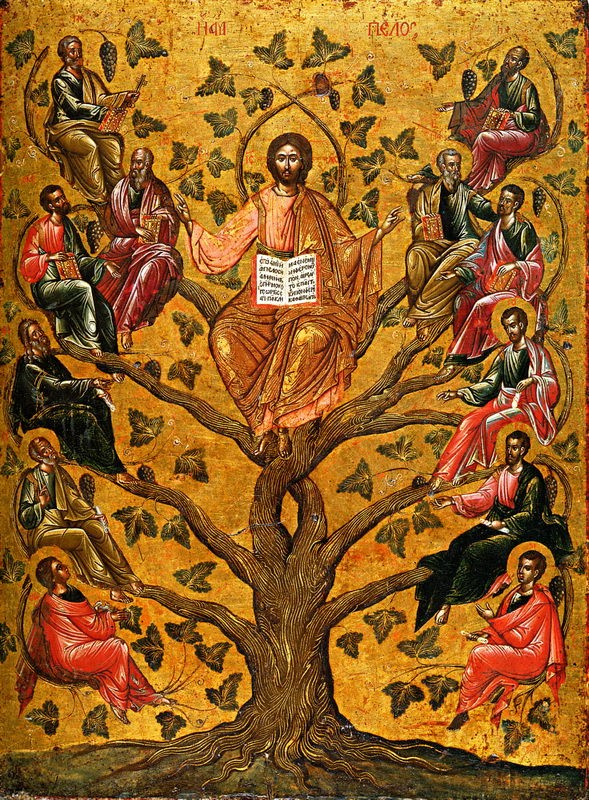
Most pictures of this chapter paint a vineyard. This one paints the sentence. Verse 5 says I am the vine, you are the branches — and here the branches are people, seated in the crooks of the wood, each with a book. The Greek word is written in red across the gold at the top: ἡ ἄμπελος, the vine. The icon is labelled with the noun it is about.
Count the figures. There are twelve. The chapter they are sitting in was spoken to eleven — Judas walked out at 13:30, and the previous chapter’s note on “you are already clean” turns on his absence. This type of icon is not a picture of that night; it is a picture of the apostolic college, which is why the count is the traditional twelve rather than the number of men actually in the room. Both facts are worth holding at once: the icon is exactly right about the metaphor and quietly wrong about the scene.
⚠ And notice what is at the bottom. Western paintings of this passage tend to crop at the fruit. The icon paints the root — a thick, twisted, unglamorous trunk coming out of the dirt, taking up the whole lower third. Everything above it is gold. That is a reading of verse 4 (the branch cannot bear fruit by itself) put into the composition rather than into a caption.
.jpg)
Translator’s Notes
1–3 — ⚠ “The true vine”, and a three-word pun no translation keeps
“True” here does not mean truthful. Alēthinos is John’s word for the genuine article as against the copy, and he uses it nine times: the true light (1:9), the true worshippers (4:23), the true bread from heaven (6:32), and here the true vine. Israel is a vine all through the prophets — Psalm 80, Isaiah 5, Jeremiah 2, Hosea 10 — and in every one of those passages the vine disappoints. The adjective is doing that work: not the honest vine but the real one.
⚠ And the one tending it is, in the other Gospels, the villain. The Greek is geōrgos, a man who works land. It appears nineteen times in the New Testament, and in Matthew 21, Mark 12 and Luke 20 — the parable of the vineyard — the geōrgoi are the tenants who beat the servants and kill the son. John gives the same word to the Father. (John has a separate word for a gardener, kēpouros, and uses it at 20:15 of the man Mary mistakes Jesus for. It is not this one.)
⚠ Now the pun, which is the reason verse 3 exists. Three words in two verses, and in Greek they are almost the same word:
airei — he takes away. kathairei — he prunes clean. katharoi — you are clean. The second is the first with a prefix; the third is the adjective of the second. So verse 3 is not a change of subject. It is the punchline: and you have already had that done to you. This page prints “prunes clean” and “clean” so at least two of the three survive into English. No version on this shelf keeps all three, and no English word does the work of both airō and kathairō.
⚠ And airō is genuinely ambiguous. It means lift and it means take away — John uses it for both. Some argue that a first-century vinedresser lifted trailing branches off the ground so they could fruit, which would make verse 2 an act of rescue rather than removal. It is a real argument about a real horticultural practice, but the word is doing something else eleven chapters earlier: “the Lamb of God who takes away the sin of the world” (1:29). Printed here as “takes away,” with the other reading on the record.
Verse 3 is answering something said two chapters ago. At the footwashing Jesus said “you are clean — but not all of you” (13:10–11), and John explains that he meant the one who would hand him over. Judas has now left the room (13:30). “Already you are clean” is what is left to say when the exception has walked out.
⚠ The shelf, and one version comes out ahead. For geōrgos, KJV, ASV, DRB and GNV all print “husbandman,” a word no living English speaker uses; NIV has “gardener,” which is readable and is the wrong trade. On the pun, KJV and GNV say “purgeth” then “clean”; NIV says “cuts off… prunes” then “clean”; both break the link. Only ASV keeps it — “he cleanseth it… already ye are clean” — one more instance of the rule this library keeps rediscovering: follow whoever is tighter on the merits, not whoever usually is.
4–8 — “Abide in me”: the word the previous chapter kept planting
Menō — remain — appears eleven times in these five verses. John 14 used it three times and never as a command: the Father remaining in the Son (14:10), the Spirit remaining beside them (14:17), Jesus remaining beside them (14:25). Here it turns into an imperative and stays one. John uses the verb forty times, more than any other book in the New Testament, and this is where it concentrates.
The rendering is kept as “remain” at every occurrence rather than moving between “abide,” “dwell,” “stay” and “live in” as the context suggests. KJV is consistent too, with “abide” — a good word in 1611 and a word almost nobody now uses in speech. That is the trade-off in one line: the KJV keeps the thread and loses the register; most modern versions keep the register and cut the thread.
⚠ Klēma, the word for a branch here, occurs four times in the New Testament and all four are in this chapter (vv2, 4, 5, 6). It is specifically a vine-shoot, not a tree-limb; the general word for a branch is klados. Whatever else the image is doing, it is not a generic tree.
Verse 6 is in the past tense in Greek — he was thrown out, he dried up — which is not a prediction but the ordinary Greek way of stating what always happens, the way English says “that never worked.” The versions all quietly move it to the present, which is right in English and worth knowing about.
And “apart from me you can do nothing” is a horticultural claim, not a moral one. Chōris is separated from. A cut branch does not do less; it does none.
The shelf on klēma. KJV, ASV and NIV all say “branch,” which is the general word — and Greek has a general word (klados) that John did not use. Spanish does better: Reina-Valera prints pámpano, which means specifically a vine-shoot.
9–11 — The order of the conditional, and a joy that gets filled up
Read verse 10 in the order Greek puts it. If you keep my commandments, you will remain in my love — keeping first, remaining second. The same order stood at 14:15. It is the opposite of how the sentence is usually preached, where love comes first and obedience follows as its proof; here obedience is what remaining consists of. And the second half applies it to Jesus himself: he keeps his Father’s commandments and remains in his Father’s love, in exactly the same construction.
“That your joy may be filled full.” Plērōthē is a container verb — filled to the top, not increased. KJV has “that your joy might be full,” which is exactly right and which four hundred years of use have worn smooth enough that readers no longer hear the image in it.
12–15 — “Greater love”, and a promotion from slave to friend
Meizona — greater — for the third time in two chapters. The believer will do greater works (14:12); the Father is greater than I (14:28); no one has greater love than this. It is a plain comparative each time, and a fourth is coming at verse 20.
“Lay down his life” is a phrase this Gospel has used before, of one person. Tithēmi tēn psychēn occurs at 10:11, 10:15, 10:17 and 10:18 — every one of them the good shepherd, laying it down for the sheep. Here the same idiom is handed to whoever is listening. The “greater love” of verse 13 is famous as an epitaph for soldiers; in its own paragraph it is a description of what the speaker is about to do that night, offered as the pattern for what they are to do for each other.
⚠ “No longer slaves… I have called you friends.” Doulos is a slave, not a servant — the word for owned labour — and philos is a friend. The reason given is information: the slave does not know what his master is doing, and everything heard from the Father has been told. Friendship, in this sentence, is defined by having been let in on the plan.
And then the condition, which sits awkwardly and is meant to. Verse 14: you are my friends if you do what I command you. A friendship with an instruction attached is not what modern English means by the word, and the chapter does not resolve it — verse 15 immediately gives a reason that has nothing to do with obedience. This translation leaves both standing.
⚠ And the whole shelf softens doulos. KJV, ASV, DRB and GNV all print “servants,” and the Spanish versions print siervos. A servant is employed; a doulos is owned. This page prints slaves, because the promotion in this verse is only as large as what it is a promotion from.
16–17 — “You did not choose me” — and the two threads spliced together
The word order is emphatic and every version keeps it. Ouch hymeis me exelexasthe — not you me chose. A rabbi’s pupils chose their teacher; the sentence is denying the ordinary arrangement.
“I appointed you” is the same verb as “lay down.” Ethēka is the aorist of tithēmi, the verb of verse 13 — to place, to set down, to lay. He lays down his life and he places them where they are to stand, in two sentences, with one verb.
⚠ And the chapter’s two words meet here. Fruit that remains — karpos and menō in one phrase, the two threads of the whole passage tied off in three words. Karpos has appeared eight times in this chapter, three of them in verse 2 alone.
18–21 — “If the world hates you”, and a change of tense that is easy to miss
Look at the two tenses in verse 18. The world hates you — present. It has hated me — perfect, a completed thing whose result stands. The hatred aimed at them is current weather; the hatred aimed at him is already a finished fact with consequences still running. English can print both and nobody notices; Greek makes the difference structural.
“The world would love its own.” The verb here is phileō — the verb behind philos, friend, from four verses earlier. The world befriends what belongs to it; he has just called them friends. The same root, used twice in one paragraph for two entirely different belongings.
“A slave is not greater than his master” is meizōn again, the fourth in two chapters — and he is quoting himself: he said it at the footwashing (13:16), where it meant they should wash feet. Here it means they should expect what he got.
22–25 — ⚠ “They hated me for nothing” — and the one word this Gospel has been used to justify
A small oddity first. Verses 22 and 24 both read eichosan, “they would have had” — a form with a -osan ending that belongs to spoken Hellenistic Greek rather than to the literary language. It occurs nowhere else in the New Testament: twice, in this chapter, and then never. It is one of the small marks that this Gospel’s Greek is a real dialect and not a school exercise.
⚠ “For nothing” is the word that everywhere else means “as a free gift.” Dōrean occurs fourteen times in the New Testament, and outside this verse it is almost always the vocabulary of grace: justified freely by his grace (Romans 3:24), let him take the water of life freely (Revelation 22:17), freely you received, freely give (Matthew 10:8). Here the same word means gratuitously in the other direction: hatred with nothing behind it, given away for no reason. The quotation is from Psalm 35:19 or 69:4, where the Greek Old Testament uses this exact word.
⚠ And a phrase that has to be handled carefully: “their law.” The speaker is a Jew, quoting a Jewish psalm, to Jewish disciples, and calling the Jewish scriptures their law — the law of the people opposing him. It is a rhetorical distancing inside an argument among Jews, not a statement about a religion from outside it. That distinction was lost for most of Christian history: this chapter’s language about a hating “world” and about “their law” was read as licence, and it fed centuries of persecution that this text on its own terms gives no ground for. The translation is left exactly as it stands, because softening it would hide what was actually available to be misused. The note is here instead.
The shelf flattens it, understandably. KJV and ASV print “they hated me without a cause”; NIV “without reason.” All three are accurate, and none of them can show a reader that this is the word behind “justified freely” and “take the water of life freely.” That is not a failure of translation; it is what a concordance is for.
26–27 — ⚠ The verse the Eastern and Western churches split over
This is the verse behind the Filioque, and the Greek of it is not in dispute. To pneuma tēs alētheias ho para tou patros ekporeuetai — the Spirit of truth who comes out from the Father. The Nicene Creed took the participle of that verb from this verse. In the Latin West a phrase was added — qui ex Patre Filioque procedit, “who proceeds from the Father and the Son” — and the addition became one of the stated causes of the split between East and West in 1054.
⚠ What is worth noticing is that both sides could quote this verse honestly. The same sentence says whom I will send you from the Father and who comes out from the Father. A sending by the Son and a coming-out from the Father, in one line. The Eastern argument is that the verse names the Father alone as the source and the addition changes the creed; the Western argument is that the Son’s sending is in the verse too. The verse does not settle it, and this page does not either.
The verb, plainly. Ekporeuomai is not a technical term — it is to go out, to come forth. John uses it once more, at 5:29, of the dead coming out of their tombs. Everything metaphysical that has been built on it was built later, and this translation prints the ordinary word so a reader can see how much weight was put on how little.
⚠ And the pronoun does it again. Ekeinos — masculine — with pneuma, a neuter noun, as its antecedent. Exactly as at 14:26, and again at 16:13. Three times in three chapters, which is enough to be a habit rather than a slip.
The shelf splits on the verb, and recently. KJV and ASV print the creedal “proceedeth,” which imports the whole later argument into the sentence. NIV prints “goes out from the Father” — the plain verb — and also uses “Advocate” here: the same two choices this page makes. Reina-Valera and NVI both keep procede.
Patterns worth carrying forward.
The debt from the last chapter is paid here. Menō was planted three times in John 14 and never as a command. It appears eleven times in five verses here, and every one of them is an imperative or the condition of one. This is the concentration the whole verb has been building toward.
⚠ Two words are effectively unique to this chapter. Klēma, the vine-shoot, occurs four times in the New Testament and all four are here. Eichosan, the vernacular past form at verses 22 and 24, occurs nowhere else at all.
⚠ The pun in verses 2–3 is the argument. airei / kathairei / katharoi — takes away, prunes clean, you are clean. Verse 3 is the punchline of verse 2, and it is also the answer to “you are clean, but not all of you” at 13:10, now that Judas has left the room. This page keeps two of the three in English; nothing on the shelf keeps all three.
Words that come loaded from elsewhere in this Gospel. Geōrgos, the one who tends the vine, is the word the Synoptic parable gives to the tenants who kill the son — John gives it to the Father. Tithēmi tēn psychēn, to lay down a life, has been the good shepherd’s phrase since chapter 10 and is handed over here. And dōrean, “for nothing” at verse 25, is the New Testament’s ordinary word for a free gift, used once in the opposite direction.
Renderings chosen. Remain for menō everywhere, as in chapter 14. Prunes clean at v2 and clean at v3, to save what can be saved of the pun. The one who tends it for geōrgos, because John’s word for “gardener” is a different one he uses at 20:15. Comes out from for ekporeuetai at v26, rather than the creedal “proceeds,” so a reader can see the plain verb the whole argument was built on.
Worth not skipping. A slave is promoted to a friend on the grounds of having been told things. “Greater love” is a description of what the speaker is about to do, not a maxim. The world befriends its own with the verb behind the word “friend.” And verse 26 is one sentence with two halves that a thousand years of argument could not get to agree.
⚠ A note on order: two threads are open in this book — the discourse continues at John 16, where the Advocate returns for the last time and the “little while” begins, and the earlier gap is still open: John 9–13 are not yet on these pages, which is where the book’s own sequence resumes.