Zechariah 2 — The Mister Translation
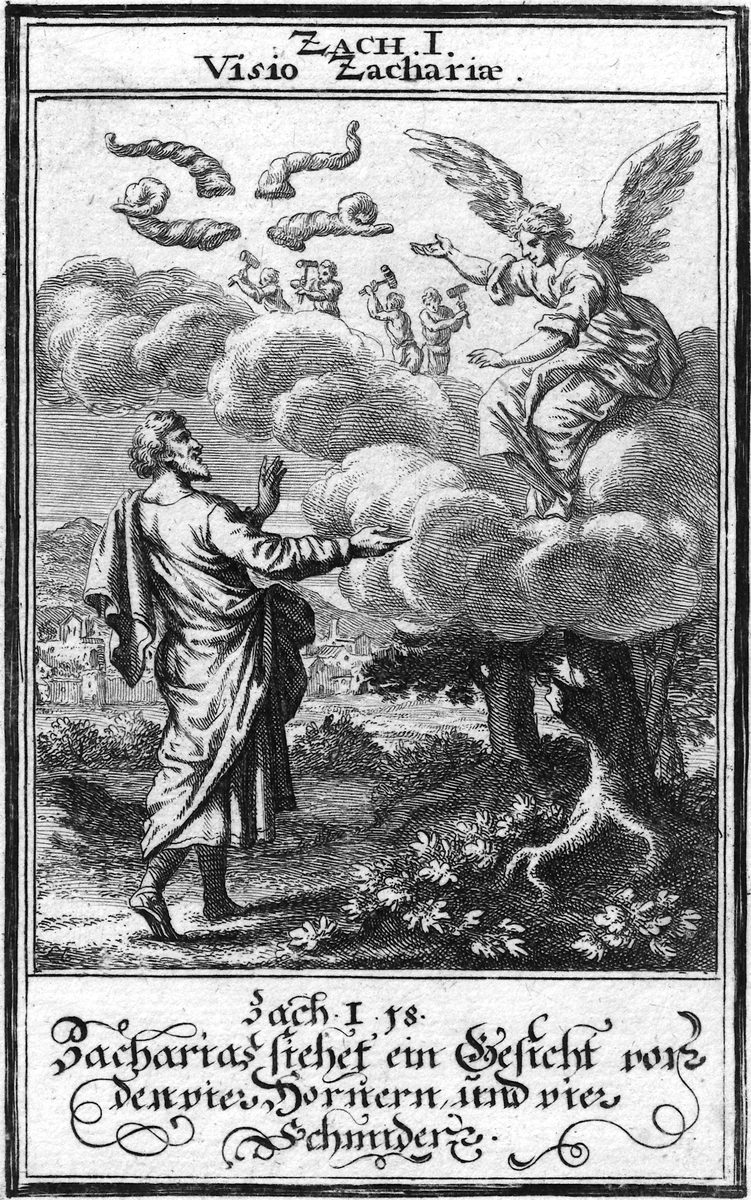
⚠ Christoph Weigel the Elder was a Nuremberg engraver whose Biblia Ectypa (1695) illustrated the whole Bible scene by scene, one of the most widely copied German print Bibles of its era. His own caption, in the German verse under the frame, numbers this “Zach. I, 18” — following the ENGLISH/Vulgate chapter count, which places the four-horns vision at the tail end of chapter 1 (see the note on 1:16-17 above). This translation follows the Masoretic count instead, where the same vision opens chapter 2 — so a 320-year-old German engraving and this translation number the identical picture two different ways, for the same reason.
.jpg)
Translator’s Notes
Zechariah’s SECOND night vision picks up exactly where the first left off. The horseman’s patrol reported a world “at rest” while Jerusalem still mourned (1:11); now the vision explains why — four horns, a stock image in Hebrew for raw power (a king’s or a nation’s qeren is “exalted”; smashing one is the ancient shorthand for humbling it), have scattered Judah, Israel, and Jerusalem in every direction (v2). ⚠ The vision deliberately does not name them. Later apocalyptic will attach a horn to a specific empire — each of Daniel’s horns is tied to an identifiable kingdom (Daniel 8, not yet on these pages) — but here the four horns are simply THE FOUR, an abstraction standing for every power that has ever broken this people, without singling one out for blame.
Then comes the answer: four craftsmen, matched exactly to the four horns, sent “to terrify them, to throw down the horns of the nations” (v4). ⚠ These too are unnamed — not Cyrus, not Darius, not any historical agent, just craftsmen with tools enough to counter whatever scattered Judah. The balance is the whole point of the vision: whatever power broke this people, an equal and opposite power is already commissioned to break it. KJV and ASV both read v2 almost identically to this translation, “the horns which have scattered Judah, Israel, and Jerusalem” — a rare verse where the shelf does not diverge at all.
⚠ The THIRD vision opens with a different measuring instrument than the one chapter 1 promised. There, the closing image was a builder’s qav, “a measuring line stretched out over Jerusalem” for rebuilding (1:16). Here the word is chevel middah, “a cord of measure” — a surveyor’s tool for taking a city’s actual dimensions, its width and its length (v6), not for laying one straight construction line. The two visions are linked but not identical: chapter 1 promises the cord of building; chapter 2 sends it out to take the city’s measure — and the measurement, as verse 8 will show, turns out to make the whole project pointless.
The angels’ relay message reverses what a measuring line usually means. A city surveyed for its width and length is a city about to be walled — but the word sent back is the opposite: Jerusalem will be inhabited perazot, “like open country,” without walls at all, because the coming population of people and livestock will outgrow whatever could be built (v8). KJV “Jerusalem shall be inhabited as towns without walls”; ASV “as villages without walls.” ⚠ In its place: “I myself will be a wall of fire around her, and I will be the glory within her” (v9). The Hebrew literally calls the fire itself a chomah — the same word this project has already met as the standing masonry wall of a city (Jericho’s falls flat; the Red Sea itself is called a chomah on either flank, Exodus 14:22, already on this shelf) — so the verse is not merely promising protection, it is naming fire as the city’s literal fortification, no stone required. And “the glory” (kavod) inside her is the same weighty presence Ezekiel watches depart the temple in a vision roughly contemporary with this one (Ezekiel 1:28, already on this shelf) — except here it fills not a building but an entire unwalled city.
⚠ A much later vision describes almost exactly this same picture. The last book in this whole library answers it directly: a city with “a great and high wall” (Revelation 21:12, already on this shelf) that is nonetheless never shut, because “the city has no need of the sun or of the moon to shine on her, for the glory of God lit her up” (Revelation 21:23). Fire instead of stone, then glory instead of the sun — the same reversal, five centuries apart. Even the measuring itself recurs: the angel with “a golden reed, so that he might measure the city” (Revelation 21:15) is doing, almost verse for verse, what the man with the cord of measure does here.
⚠ Hoy is the same one-syllable cry this project has already met as a funeral wail — Isaiah’s “ah, I will get relief from my adversaries” opens with the identical word (Isaiah 1:24, already on this shelf). Here it does the opposite job: not mourning, but an urgent hail, “Ho! Ho!” — calling the exiles still living in Babylon to run. “The land of the north” is Babylon by direction of travel, not literal geography (every invasion of Israel in this period actually came down FROM the north, along the trade routes past the Euphrates, which is why the phrase became shorthand for the empire regardless of its true compass bearing from Jerusalem). The personified pair — “you who dwell with the daughter of Babylon” told to flee to safety with Zion — sets a whole city against a whole city, the same “daughter of Zion” figure who will sing three verses later (v14). KJV “Ho, ho, come forth, and flee from the land of the north”; ASV “Ho, ho, flee from the land of the north”; NIV smooths the interjection away entirely, “Come! Come!”
⚠ Verse 12 shifts from clear narration into one of the book’s genuine cruxes: “Jehovah of armies, who SENT ME.” Sent whom? The verse never says. Every voice so far has belonged either to Zechariah the narrator or to Jehovah speaking in the first person (“I myself,” v9); this is neither — an unnamed “me,” commissioned and sent, reporting Jehovah’s own words about protecting his people. Readers have filled the gap differently: Zechariah himself, functioning as a formal witness against the nations; the interpreting angel of vv7–8; or, in a long messianic tradition, a distinct heavenly emissary who can say “Jehovah of armies” has sent him and then, without a seam, keep speaking as Jehovah in the very next clause (“touches the pupil of HIS eye,” not “my eye” — a third-person slip inside a first-person oracle that is itself part of the puzzle). This translation leaves the gap open, as the Hebrew does.
The idiom itself is a genuine philological uncertainty: bavat ayin occurs exactly once in the whole Hebrew Bible, and its root is disputed between “the gate/opening of the eye” and an imitative word for a tiny reflected image — not the more familiar ishon (“the little man of the eye,” e.g. Deuteronomy 32:10, already on these pages), a different Hebrew word usually flattened into the same English idiom. This translation reads “the pupil of his eye” rather than the traditional “apple of his eye,” since apples have nothing to do with the Hebrew at all — the phrase is an old, unrelated figure of English speech that happened to land on the same verse. KJV and ASV both keep “the apple of his eye”; NWT already reads “the pupil of my eye” — smoothed, per its own translators’ note, into the first person, which is the SAME interpretive move this note flags as one possible reading of the crux above, made silently rather than argued for.
“I will dwell (shakhanti) among you,” twice repeated (vv14, 15) — the same claim as the wall of fire and the glory (v9), now spoken directly to the daughter of Zion rather than reported by a messenger. And the promise widens past Israel entirely: “many nations will join themselves to Jehovah on that day and become MY people” (v15) — a universalist note struck early, generations before it becomes a major theme of the book’s own second half.
The chapter’s last line reverses everything that came before it. Seventeen verses of angels talking, Jehovah declaring, the prophet asking questions — and then: “Be silent, all flesh, before Jehovah, for he has roused himself from his holy dwelling” (v17). No answer is called for. A near-identical command closes a much shorter book that has not yet reached these pages: “Jehovah is in his holy temple — let all the earth keep silent before him” (Habakkuk 2:20, not yet on these pages). Two prophets, writing in different centuries, land on the same closing gesture: when God finally moves, the correct response is not more words. ASV “Be silent, all flesh, before Jehovah”; KJV “Be silent, O all flesh, before the LORD.”
Patterns worth carrying forward
Where this translation keeps the exact / distinct words: “horns” for qeren (v1), the plain power-symbol left deliberately unnamed; “a cord of measure” for chevel middah (v5), kept distinct from chapter 1’s own qav even though most versions collapse both into one English “measuring line”; “a wall of fire … the glory within her” for chomat esh … ulechavod (v9), naming the fire itself a wall rather than softening it into a mere metaphor of protection; and “the pupil of his eye” for bavat ayin (v12), kept apart from the more familiar ishon and from the traditional but inexact “apple.”
Echoes paid. The measuring line promised for REBUILDING at 1:16 (qav) is now sent out to actually measure the city (2:5, chevel middah) — and discovers the city has already outgrown the whole project. And the comfort-root nacham that ran through chapter 1 (vv13, 17) falls silent here: this chapter answers “how long?” not with more comforting words but with fire, glory, and a fleeing people.
Echoes planted. The eight night visions continue: next comes the FOURTH vision — the cleansing of the high priest Joshua and the crowning of “SPROUT” (tzemach, 3:8; 6:12) — then the lampstand and two olive trees (ch4), Zechariah’s vision of the two leaders of Haggai’s own day as “the two sons of oil.” And the great messianic seams of the book’s second half are still ahead: the humble king on a donkey (9:9), the thirty pieces of silver (11:12–13), the one “whom they pierced” (12:10), the shepherd struck and the sheep scattered (13:7).
Next installment in this book: Zechariah 3 — the high priest Joshua, accused before “the Accuser” and reclothed in clean garments, and the first promise of a coming SPROUT.