Revelation 10 — The Mister Translation
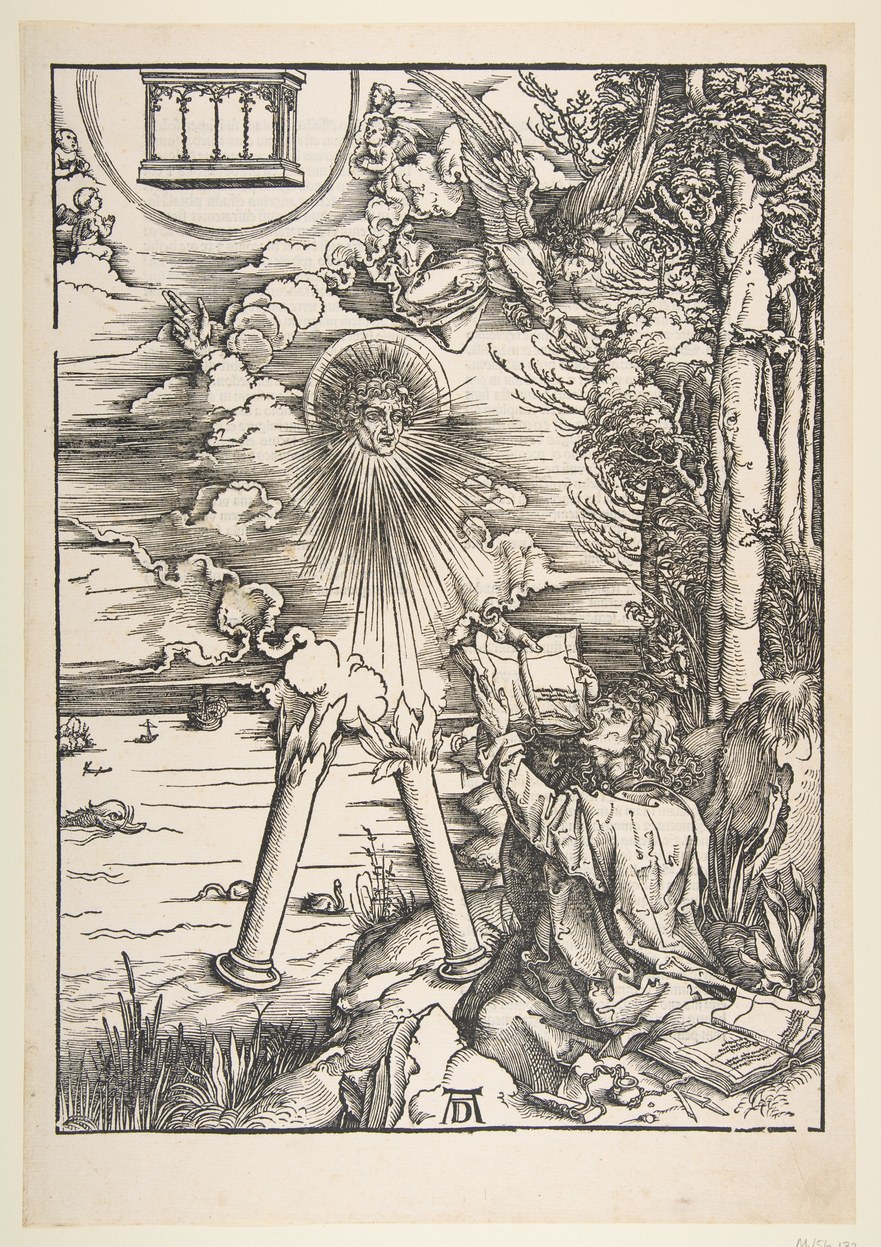
⚠ Dürer takes 'pillars of fire' completely literally, and dissolves the rest of the angel to do it. The text describes one integrated figure — a being who sets his feet, holds a scroll, raises a hand, and swears an oath (vv1–6) — but this woodcut gives him no connected body at all: two freestanding stone columns plant themselves directly on the shore, a radiant disembodied head floats above them, and a separate cloud-wrapped, winged form hovers higher still. Whether this is meant as one impossible figure the eye can't quite assemble, or three, is a genuine ambiguity of the composition, not the text.
The small circular medallion in the upper-left corner, framing a miniature colonnaded structure, does not obviously correspond to anything in this chapter — this print is one plate in a longer series, and the detail may belong to the book's larger visual program rather than to this scene specifically; this library reports what it shows without claiming certainty about what it means.
John himself is shown already receiving the book at the very moment of the angel's appearance, rather than in the separate approach-ask-receive sequence the text actually gives him (vv8–9) — the same kind of compression Dürer used two chapters earlier, riding four separate summonses as one simultaneous charge (see the note at 6:1–8, already on these pages). At his feet, an inkwell and quill lie unused beside another open book — plausibly the pen John was told to seal up rather than use, two verses earlier (v4), set down within reach of the very moment he's commanded to write nothing at all.

Translator’s Notes
⚠ Is this angel Christ? The description borrows real pieces of him: a face ‘like the sun’ matches the risen Christ almost word for word (‘his face was like the sun shining in its strength’, 1:16, already on these pages), and the rainbow recalls the one already circling God’s own throne (4:3, already on these pages) — though there it wraps the whole throne, here it sits on one figure’s head, and the feet here are pillars of fire, not the fine bronze of 1:15. Two details argue the other way, more plainly. First, the Greek itself: this is ‘ANOTHER mighty angel’ (allon angelon ischyron) — the identical phrase, minus ‘another’, already named a figure who is unmistakably not Christ, proclaiming ‘who is worthy to open the scroll’ while the Lamb still waits to be found (5:2, already on these pages). Second, this angel swears an oath (v6) — the very thing Christ himself forbids his followers, in the same breath naming heaven, earth, and one’s own head as things too sacred to swear by (Matthew 5:34–37, already on these pages). This translation reports both readings and settles on neither; the text itself never says.
The little scroll he holds, already open, is the chapter’s other real puzzle — see the note at v8 below for the word itself splitting even within this one chapter’s own manuscripts.
⚠ Sealed on purpose, in a book named for unveiling. This whole document calls itself an apokalypsis — an unveiling, a pulling-back of the curtain (see the note at 1:1, already on these pages) — and here, once, that curtain is pulled back further only to be dropped again: John is told to hear the seven thunders, start to write, and then seal up exactly what he heard and never write it. The book that discloses nearly everything keeps this one thing to itself. No content is even hinted at; the silence is the point.
⚠ ‘No more delay’, or ‘time will be no more’? One Greek word, chronos, and a real translation choice, not a manuscript variant — the Greek text itself is not in question, only what the word means in context. Read alongside v7’s ‘but’ (the mystery of God WOULD be finished, in the days of the seventh trumpet), the sentence reads most naturally as an end to WAITING, not an end to time as such — this translation’s choice, ‘no more delay’. Shelf: ASV, NIV, ESV, and NWT (‘there would be no more delay’) all agree; KJV, the Geneva Bible, and the Douay-Rheims all print the older, literal ‘time… no longer’ — the reading behind the famous apocalyptic phrase ‘time shall be no more’. The Spanish shelf splits the identical way: TNM reads ‘ya no habrá más demora’ (no more delay); RV60 keeps the literal ‘el tiempo no sería más’ (time would be no more).
The oath itself is sworn by the Creator of heaven, earth, and sea in one breath — the same three-part inventory Egypt’s first plagues struck in reverse order (see the notes two chapters back, 8:7–12, already on these pages) — now invoked as the guarantee that what comes next is certain, not merely likely. And what the mystery’s completion is called, v7’s verb euēngelisen, is literally ‘he GOSPELED’ — the same verb family as ‘good news’ itself, folded into a sentence about trumpets, judgment, and an ending. Even here, the word the text reaches for is good news.
⚠ The Greek itself wavers on what to call this scroll, inside a single chapter. Everywhere else it is biblaridion, a genuine diminutive — ‘a LITTLE scroll’ (vv2, 9, 10). At v8 alone, the oldest and best manuscripts read plain biblion — the exact word, with no diminutive at all, used for the great sealed scroll of chapter 5 that only the Lamb was found worthy to open (5:1, already on these pages). Scholars disagree over what follows from this: some read it as the very same scroll, now fully opened, handed on for one more task; most read a smaller scroll modeled on the larger one, echoing its shape without being it. The text itself never clarifies which — and the one verse where the words nearly collide (v8) is the verse where a real textual choice has to be made.
Eating a scroll is not a new image. Centuries earlier, a prophet on a foreign riverbank was handed a scroll and commanded, ‘eat what I give you’, then found it ‘sweet as honey’ in his mouth (Ezekiel 2:9–3:3, not yet on these pages) — before that same prophet went out to speak to a people who would not listen, and the sweetness soured. John’s scroll follows the identical order — sweet in the mouth first, bitter in the stomach after — but adds the second half Ezekiel’s account never states outright: the taste changes only once the message has actually been swallowed and starts doing its work.
⚠ ‘They’ said it — who? Every voice in this chapter has been singular until now: the angel, then the voice from heaven. Verse 11’s legousin is plural, with no new speaker introduced — an unmarked shift the text does not explain. Peoples, nations, languages, and kings is close to a stock phrase in this book (it recurs at 11:9, already on these pages; 13:7, 17:15, whenever those chapters are translated), naming the whole reach of a prophetic commission that stretches well past the seven congregations this letter was originally addressed to (1:11, already on these pages). The eating of the scroll was not the end of the assignment. It was the qualification for a bigger one.
Patterns worth carrying forward
Where this translation makes a real choice: ‘no more delay’ for v6’s chronos ouketi estai, siding with ASV/NIV/ESV/NWT/TNM against the older ‘time… no longer’ of KJV/Geneva/Douay/RV60 — a translation judgment call, not a manuscript variant, flagged and argued for rather than silently adopted.
Echoes paid. The face ‘like the sun’ and the rainbow both reach back to Christ’s own description (1:16) and the throne’s (4:3); the phrase ‘another mighty angel’ (v1) deliberately echoes the non-Christ ‘mighty angel’ of 5:2; and the great sealed scroll of 5:1 returns, unsealed, in the one verse (v8) where the Greek itself drops ‘little’ and calls it by the same bare name.
Echoes planted. The seven thunders’ sealed words (v4) are never unsealed anywhere in this book — the one door this Unveiling never opens. And v11’s commission to ‘peoples and nations and languages and many kings’ sets up the two witnesses who prophesy to exactly that scale, one chapter from here.
⚠ Left open on purpose. Whether the mighty angel of v1 is Christ or a created angel who merely echoes him — the library reports the case both ways and settles on neither. And whether v8’s bare ‘the scroll’ is chapter 5’s own scroll handed on, or a smaller one merely modeled on it, is a scholarly disagreement this text does not resolve.
Next installment in this book: Revelation 11, where two witnesses prophesy in sackcloth for 1,260 days, are killed by the beast that comes up from the Abyss this chapter opened, and rise again in full view of the nations — and the seventh trumpet finally sounds, paying the third woe this chapter left owing.