Jeremiah 18 — The Mister Translation
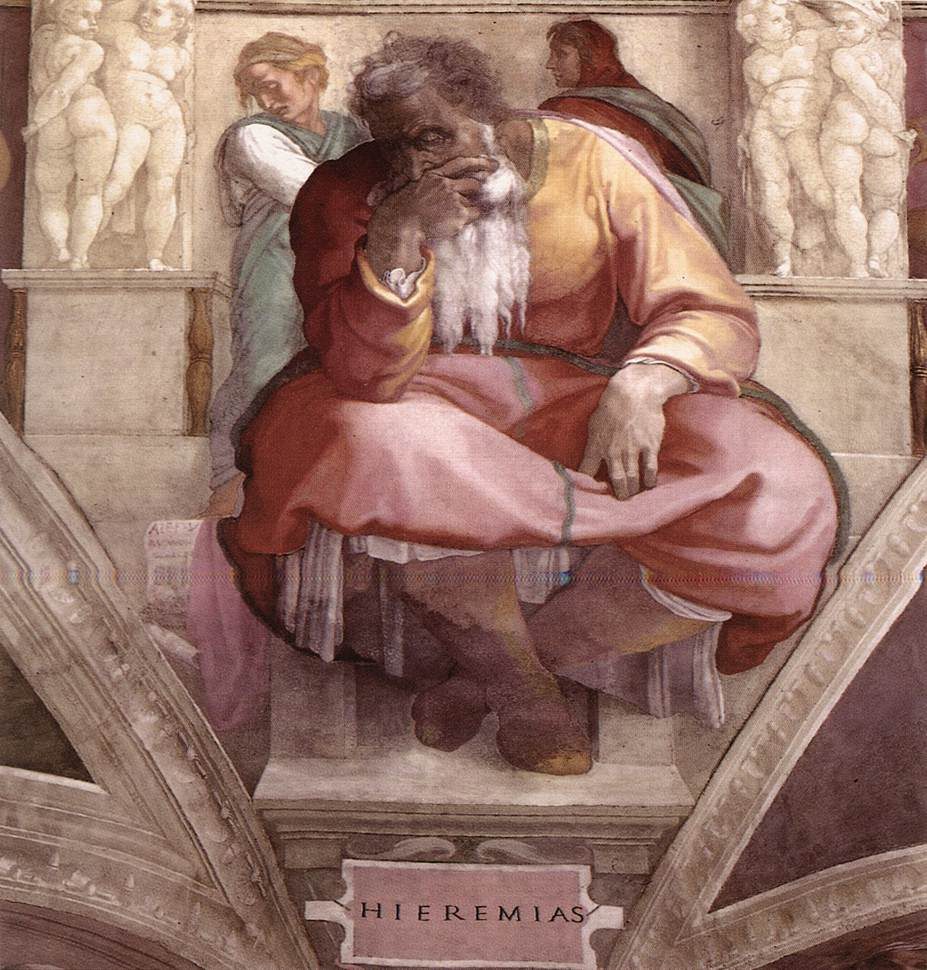
⚠ NOT this chapter's scene, and placed here as a placeholder, honestly labeled as one. Michelangelo's Jeremiah, on the Sistine Chapel ceiling, is a solitary character study — among the most reproduced and most melancholic of his seven Sistine prophets, often read as the most inward and exhausted of the set, seated at the end of the ceiling nearest the altar — not a narrative depicting the potter's house. The pose (a hand pressed to the beard, eyes lowered) is traditionally read as brooding grief, the opposite of the active WATCHING this chapter actually describes — Jeremiah going down to the potter's house and observing the wheel at work. Kept here for its own fame until a real depiction of that scene turns up.

Where this sits. Jeremiah is sent out of the palace district and down to a workshop. That direction is literal: a pottery needs clay beds, water and fuel, and a kiln is a smoke-and-fire hazard, so the trade sat at the city’s lower edge — the same industrial quarter he is sent back to in the next chapter, out through the Potsherd Gate onto the valley of Ben-Hinnom (19:2). Two sign-acts, one address. This chapter also carries the fourth of Jeremiah’s five “confessions” — the private complaints scattered through chapters 11 to 20, which surface here at verses 18–23; the fifth and rawest is chapter 20, already on these pages, where a night in the stocks earns Pashhur a new name.
The two stones. The Hebrew for what he is working at is ovnayim — not “wheel” but a dual form of even, “stone”: literally the two stones. The word is a photograph of the machine. A potter’s wheel of this period is a pair — a lower stone turned by hand or foot driving an upper stone on a pivot and socket, with the clay riding on top — and the older versions hear the dual: KJV “he wrought a work on the wheels”, ASV “he was making a work on the wheels”, both plural, where NIV modernises to the single “wheel”. We have rendered it flatly as the two stones, because the number is the information. ⚠ The only other place ovnayim occurs in the Bible is Exodus 1:16, where it is the birth-stool the Hebrew mothers crouch on: one dual word for the potter’s twin stones and for the two stones of childbirth, and both of them places where a life is given its shape. Everything the metaphor needs is in the potter’s craft itself.
Two verbs to hold on to. First, the vessel is ruined — nishchat, and that is the flood’s verb: the earth that “ruined itself” in Genesis 6:11-13. KJV and NIV both soften it to “marred”, which is what a craftsman would say; the Hebrew is harsher and it is a word this project has already met. Second, and easy to walk past: the potter turned back and made it again — shuv, the prophets’ repentance-verb. The first turning in this chapter is not the nation’s. It is the potter’s.
The commission comes back. When Jeremiah was called, he was given six verbs for the job: to uproot and to tear down, to destroy and to overthrow, to build and to plant (1:10). Five of the six are standing here — uproot, tear down and destroy in verse 7, build and plant in verse 9 — and we have used the same English words in both chapters on purpose, so the echo is audible rather than merely claimed. What was a young man’s job description is now God’s own operating rule.
Relent. nacham is a root this site has carried since Genesis: the hope buried in Noah’s name (5:29) and, one chapter later, God’s regret over having made humankind (6:6). Here it is neither a name nor a mood but a stated policy, twice. KJV and ASV render it “I will repent”, NIV “I will relent”; we follow the second, because in English “repent” now implies wrongdoing, and the Hebrew here is about a decision changing, not a sin confessed.
This is the hinge of the chapter, and it cuts both ways. The potter image is often read as pure sovereignty — the clay has no say. But the oracle built on it is conditional, and the condition is the clay’s: if that nation turns back… then I relent (v8). Nothing here is fixed yet. ⚠ And verse 10 is the same machinery running the other direction — a promised good withdrawn from a nation that stops listening. So this is not a soft chapter about second chances; it is a hard chapter about the future being genuinely open, in both directions, right up until it is not.
The metaphor turns on them. Four times the workman has been called ha-yotser, “the potter” (vv 2, 3, 4, 6). In verse 11 God uses the same word of himself, as a participle, with a different object: hineni yotser aleikhem ra’ah — “look, I am forming evil against you.” The potter is still at the wheel; what is on the wheel now is this. KJV catches it with a craftsman’s word — “I frame evil against you, and devise a device against you” — and the verb is yatsar, the same root that formed the man out of dust in Genesis 2:7.
Four devices. chashav and its noun machashavah run through this chapter four times, and the sequence is the plot in miniature: the evil God devised and can drop (v8); the device God is now devising (v11); our own devices, which the people prefer (v12); and finally — seven verses later — “let us devise devices against Jeremiah” (v18). God devises, the people counter-devise, and then they aim one at the man who told them about it. We have kept one English root across all four so the chain holds together.
One word for an answer. Verse 12 opens with a single Hebrew word, no’ash, and the shelf spreads out over how to say it: KJV “There is no hope”; ASV “It is in vain”; NIV “It’s no use”; NWT “It is hopeless!” We have left it as the bare Hopeless, because the Hebrew is one flat word and the effect is a shrug. ⚠ Note precisely what is being refused. God has just said the outcome is still open (v8) and named the way out — turn back… make your ways good (v11), the third turning in the chapter. “Hopeless” is not a report on their situation. It is a verdict on the offer, and it is wrong.
⚠ What were the entrenched practices? This chapter never says. Its only specific charge is verse 15 — they “burn incense to worthlessness” — the prophets’ standard shorthand for an idol, with no god named. The name comes from the chapters on either side: it is Baal at 2:8, 19:5, 23:13 and 32:35, and the next chapter locates “the high places of Baal” in the valley of Ben-Hinnom with children burned there (19:5). So the identification is fair — but it is borrowed from the neighbours of this chapter, not read out of it.
Verse 14 is the hardest sentence in the chapter, and the versions do not agree. The Hebrew is compressed — ha-ya’azov mi-tsur sadai, sheleg Levanon, roughly “does it forsake, from the rock of sadai, the snow of Lebanon?” — and every difficulty is in that one word sadai, “field”, which fits a rock badly. Three readings, with their pedigrees, and no vote from us: (1) KJV supplies a human subject — “Will a man leave the snow of Lebanon, which cometh from the rock of the field?”; (2) ASV and the Jewish Publication Society tradition keep the snow as the subject — “doth the snow of Lebanon fail from the rock of the field?”; (3) many modern editors read sadai as a slip for Sirion, the Sidonian name for Hermon given at Deuteronomy 3:9, which yields a clean pair of mountains — and NIV smooths in that direction with “its rocky slopes”. ⚠ That third option is an emendation of the consonants, not a translation of them, and it should be labelled as such wherever it is met. The sense survives all three: the snow does not desert the mountain, and the cold stream does not abandon its channel. Nature keeps its post. My people did not.
The word that ties the halves together. The second line asks whether the cold waters are uprooted — yinnateshu, which is the very verb God used in verse 7 of what he might do to a nation. We have rendered both as uproot, so that the reader can see the joint: the thing God reserves the right to do to kingdoms is the thing that never happens to a river.
Worthlessness. La-shav is the charge sheet, and it is a slur rather than a description — emptiness, futility, the same word as the “vain” of taking the divine name in vain. On what the practices actually were, see the note above and the entry on Baal.
Verse 17, and a second genuine crux. Oref v’lo panim er’em is three words and two defensible readings, because the verb can be pointed as either “I will see” or “I will make them see”. KJV and ASV take the second — “I will shew them the back, and not the face”, God turning away — while the Jewish Publication Society takes the first: “I will look upon their back, and not their face”, God watching them run. We have followed the first, but the other is fully available in the consonants. ⚠ Either way the line is built to hurt, because it is the priestly blessing turned inside out: may Jehovah make his face shine upon you (Numbers 6:25). What is withdrawn is the face.
The establishment answers, and it answers institutionally. The plotters name three offices and their three products — instruction (torah) from the priest, counsel from the wise, the word from the prophet. That list is the whole apparatus of guidance in Judah, and the sentence is a claim of permanence: these will not fail, so this one man is dispensable. It is also, read against the chapter, an argument from exactly the confidence the potter image was aimed at.
“Strike him with the tongue.” KJV “let us smite him with the tongue”. ⚠ The idiom is genuinely ambiguous and the ambiguity is worth keeping: it can mean let us attack him by talking — slander, the campaign of a whispering city — or let us strike at his tongue, silence the organ that is causing the problem. Both are grammatically open; the second sits uncomfortably close to what actually happens to him in the chapters ahead.
The pit. They have “dug a pit” for his life (v20), and it is a figure of speech here — a hunter’s trap, paired with the hidden snares of verse 22. It does not stay a figure of speech. In chapter 38 the officials will lower Jeremiah by ropes into a genuine cistern with no water in it, and he will sink in the mud. ⚠ And note what he pleads in the same breath: remember how I stood before you to speak good for them, to turn your wrath away. He had been the one interceding for this city — so insistently that God had twice told him to stop (7:16; 14:11). Evil repaid for good is not a figure of speech either.
Say plainly what these three verses are. A prophet asks God to starve his neighbours’ children, widow their wives, and cut down their young men in battle — and then asks God not to forgive them. It is one of the imprecatory prayers, and there is a long tradition of handling it by looking away. We are not going to translate it gently and hope no one notices.
Four things that are true about it, none of which is an excuse. It is a prayer, not a programme: he asks God for this rather than organising it, and the distinction is not nothing. It follows a plot on his life — verse 23 says their counsel against him is for death, and he knows it. The sentence he asks for is, almost word for word, the sentence already announced over Judah in this book (famine, sword), so what he is really praying is do what you said. And it is placed here by the book’s own editor, immediately after the offer of mercy was refused with a shrug.
⚠ And here is the part not to smooth over. Three verses earlier he was pleading his record as an intercessor — I stood before you… to turn your wrath away from them (v20). Now he asks that their guilt not be covered and their sin not be blotted out. That is the same man, on the same page, asking for the opposite of what he used to ask for; the book records the collapse and offers no editorial comment on it. A reader who knows “Father, forgive them, for they do not know what they are doing” will hear how far apart the two prayers are, and that distance is real. This library’s job is to make sure you can see both, in the words their authors actually used, and not to resolve it for you.
Patterns worth carrying forward
Where this translation sides with the literal shelf: “as the clay in the potter’s hand, so are you in my hand” — kept almost word for word, because it cannot be improved; the four devices kept on one English root so the chain from God’s plan to the plot against Jeremiah stays visible; “strike him with the tongue” left as the idiom is.
Where it goes its own way: the two stones for ovnayim (KJV/ASV “the wheels”, NIV “the wheel”) — the dual is the information, and it is the same word as Exodus’ birth-stool; ruined for nishchat (KJV/NIV “marred”), keeping the flood’s verb audible; relent for nacham (KJV “repent”, which now implies wrongdoing); the bare Hopeless for the single word no’ash (KJV “There is no hope”, NWT “It is hopeless!”); and uproot used in both verse 7 and verse 14 so the reader can see they are one verb.
Echoes paid and planted. Paid: the commission of 1:10 — five of its six verbs standing again in verses 7 and 9; nishchat, the flood’s ruin-verb (6:11); nacham, the relent-root, from Noah’s page (5:29) and paid again in chapter 20; yatsar, the potter’s verb that formed the man from dust (2:7), here turned around to form evil against you (v11); and the priestly blessing’s shining face (Numbers 6:25), inverted at verse 17. Planted: the potter’s house and the Potsherd Gate, waiting one chapter for a fired flask that cannot be mended (19:11) — the physics of the two sign-acts is the whole argument, and it now has its own entry under the potter; the pit dug for his life, waiting for the real cistern of chapter 38; and worthlessness (v15), whose unnamed god is named next door as Baal.
⚠ And one thing left unresolved on purpose. Verse 14’s rock of the field and verse 17’s back and not the face are both genuine cruxes where the consonants carry more than one defensible reading. Both notes give the readings with their pedigrees and neither casts a vote; the emendation to Sirion is labelled an emendation, which is what it is.
Next installment in this book: Jeremiah 19 — the same potter’s clay, now fired: a flask bought and smashed at the Potsherd Gate over the valley of Ben-Hinnom, where the high places of Baal stood and children were burned; the sermon that puts Jeremiah in the stocks in chapter 20, already on these pages.