CreationBefore the FloodThe FloodAfter the FloodThe PatriarchsEgypt and the ExodusThe KingdomThe ExileThe ReturnBetween the TestamentsThe GospelsThe Apostolic Age
🕰
Jehovah's opening case against Judah: the loyal love of the bridal-and-wilderness years remembered, then a lawsuit over a devotion abandoned for cracked cisterns, foreign rivers, and gods made of wood and stone.
⚠ Undated within the chapter itself, unlike ch. 1's precise year. Conventionally placed early in the forty-year ministry the superscription describes, likely still within Josiah's reign -- the opening argument the call of ch. 1 leads directly into. The text gives no anchor of its own; this library does not choose a firmer date than that.
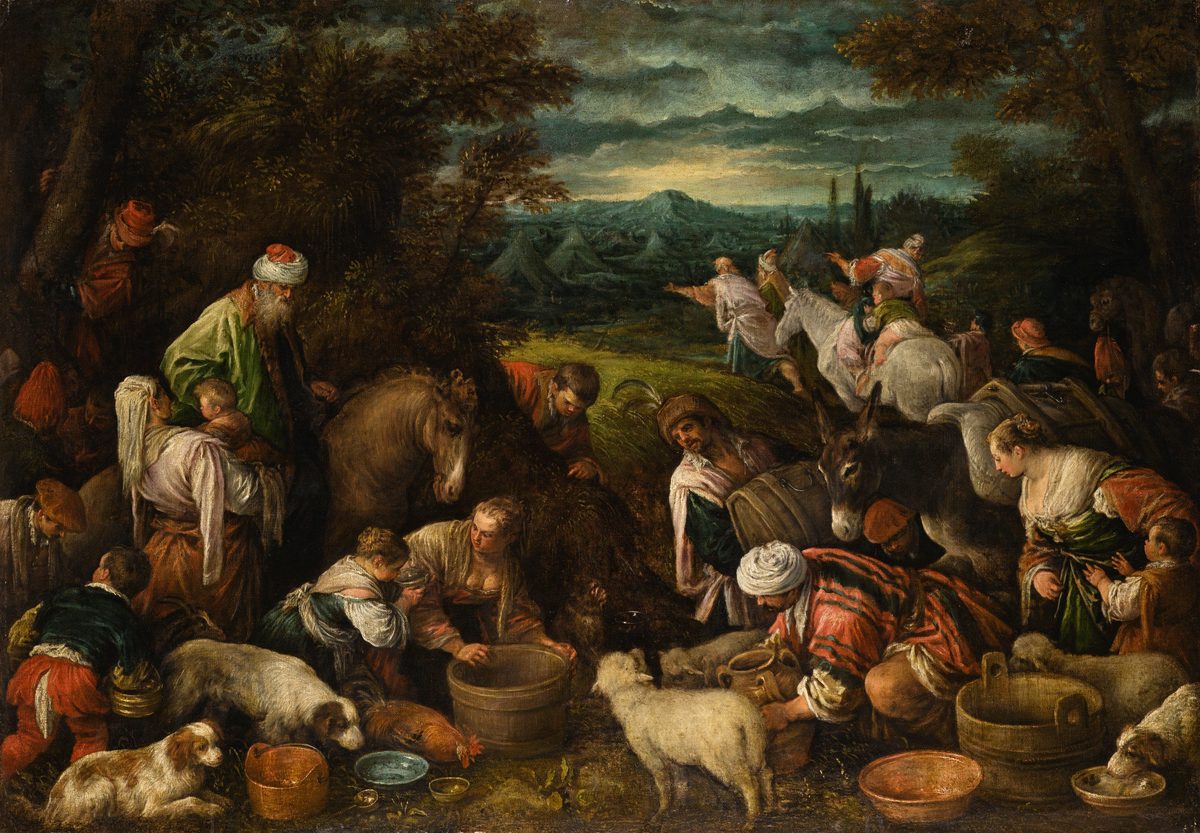
Jacopo Bassano, c. 1575 · Gemäldegalerie Alte Meister, Dresden
⚠ This chapter opens on a memory, not a vision: the ‘bridal days’ when Israel followed Jehovah through the wilderness with nothing sown (vv2, 6). Bassano, a Venetian painter known for folding whole flocks and working animals into his biblical scenes, paints that wilderness not as empty desert but as a functioning, crowded camp — water drawn, animals watered, children carried, tents pitched in the distance. No single verse of this chapter names this exact moment; the painting stands for the whole remembered period the lawsuit’s opening exhibit appeals to, not one scene within it.
Go and proclaim in the hearing of Jerusalem: Thus says Jehovah: I remember the loyal love of your youth, the love of your bridal days — how you followed me in the wilderness, in a land not sown.note
Ve y proclama a oídos de Jerusalén: Así ha dicho Jehová: Recuerdo el amor leal de tu juventud, el amor de tus días de desposorio — cómo me seguiste en el desierto, en tierra no sembrada.
They did not say, ‘Where is Jehovah, who brought us up out of the land of Egypt, who led us through the wilderness, through a land of deserts and pits, through a land of drought and deep darkness, through a land no one crosses and where no one lives?’note
Y no dijeron: ‘¿Dónde está Jehová, que nos hizo subir de la tierra de Egipto; que nos condujo por el desierto, por tierra de desiertos y de fosas, por tierra seca y de sombra de muerte, por tierra por la cual no pasó varón, ni allí habitó hombre alguno?’
And I brought you into a fruitful land, to eat its fruit and its goodness — but you came in and defiled my land, and made my inheritance an abomination.note
Y os traje a tierra de abundancia, para que comieseis su fruto y su bien; y entrasteis, y contaminasteis mi tierra, e hicisteis mi heredad una abominación.
The priests did not say, ‘Where is Jehovah?’ Those who handle the law did not know me; the shepherds rebelled against me; the prophets prophesied by Baal and went after things that do not profit.note
Los sacerdotes no dijeron: ‘¿Dónde está Jehová?’ Y los que tenían la ley no me conocieron; y los pastores se rebelaron contra mí; y los profetas profetizaron por Baal, y anduvieron tras lo que no aprovecha.
For my people have done two evils: they have abandoned me, the fountain of living waters, to dig for themselves cisterns — broken cisterns that hold no water.note
Porque dos males ha hecho mi pueblo: me dejaron a mí, fuente de aguas vivas, para cavarse cisternas — cisternas rotas que no retienen agua.
And now, what have you to do with the way to Egypt, to drink the waters of the Nile? Or what have you to do with the way to Assyria, to drink the waters of the River?note
Ahora, pues, ¿qué tienes tú en el camino de Egipto, para beber agua del Nilo? ¿Y qué tienes tú en el camino de Asiria, para beber agua del río?
Your own evil will discipline you, and your apostasies will reprove you. Know, then, and see, that it is evil and bitter for you to forsake Jehovah your God, and that the fear of me is not in you, declares the Lord Jehovah of armies.note
Tu maldad te castigará, y tus rebeldías te condenarán; sabe, pues, y ve cuán malo y amargo es que dejes a Jehová tu Dios, y que no haya temor de mí en ti, dice el Señor, Jehová de los ejércitos.
For long ago I broke your yoke, I tore off your bonds, and you said, ‘I will not serve!’ — yet on every high hill and under every green tree you sprawled, playing the whore.note
Porque desde muy atrás rompí tu yugo, rasgué tus ataduras, y dijiste: ‘¡No serviré!’ — y sin embargo, sobre todo collado alto y debajo de todo árbol frondoso te echabas como ramera.
How can you say, ‘I am not defiled, I have not gone after the Baals’? Look at your way in the valley; know what you have done — a swift young camel running back and forth on her tracks,note
¿Cómo dices: ‘No soy inmunda, nunca anduve tras los baales’? Mira tu proceder en el valle, reconoce lo que has hecho: dromedaria ligera que enreda sus caminos,
a wild donkey used to the wilderness, sniffing the wind in her craving — who can restrain her lust? None who seek her need weary themselves; in her month they will find her.note
asna montés acostumbrada al desierto, que en su ansia olfatea el viento; su apetito, ¿quién lo detendrá? Todos los que la buscan no se cansarán; en su mes la hallarán.
As a thief is ashamed when he is caught, so the house of Israel is ashamed — they, their kings, their officials, their priests, and their prophets,note
Como se avergüenza el ladrón cuando es descubierto, así se avergonzará la casa de Israel — ellos, sus reyes, sus príncipes, sus sacerdotes y sus profetas,
who say to a piece of wood, ‘You are my father,’ and to a stone, ‘You gave me birth.’ For they have turned their back to me, and not their face; but in the time of their trouble they will say, ‘Arise and save us!’note
que dicen al leño: ‘Mi padre eres tú’, y a la piedra: ‘Tú me engendraste’. Porque me volvieron la espalda, y no el rostro; y en el tiempo de su calamidad dicen: ‘Levántate, y sálvanos!’
But where are your gods that you made for yourself? Let them arise, if they can save you in the time of your trouble — for your gods have become as many as your cities, Judah!note
¿Dónde están tus dioses que te hiciste? Levántense, si te pueden salvar en el tiempo de tu calamidad; porque según el número de tus ciudades, oh Judá, fueron tus dioses.
You of this generation, consider the word of Jehovah! Have I been a wilderness to Israel, or a land of thick darkness? Why do my people say, ‘We are free to roam — we will come to you no more’?note
Oh generación, ved vosotros la palabra de Jehová. ¿He sido yo un desierto para Israel, o tierra de densas tinieblas? ¿Por qué ha dicho mi pueblo: ‘Somos libres, nunca más volveremos a ti’?
Even on your skirts is found the lifeblood of the innocent poor — you did not catch them breaking in — yet in spite of all these things,note
Aun en tus faldas se halla la sangre de las almas de los pobres inocentes; no los hallaste en ningún delito de allanamiento, y sin embargo, a pesar de todo esto,
From this place too you will go out with your hands on your head, for Jehovah has rejected those you trust; you will not prosper by them.note
También saldrás de allí con tus manos sobre tu cabeza; porque Jehová desechó a aquellos en quienes confías, y no prosperarás con ellos.
Translator’s Notes — verse by verse
Each note explains this translation's choice and compares the seven
versions on the shelf. Quotations from copyrighted versions (NIV, TLB, NWT) are kept to short phrases for
comparison; KJV, Geneva, Douay-Rheims and ASV are public domain.
Verses 1–3 · חֶסֶד נְעוּרַיִךְchesed ne'urayikh — the loyal love of your youth, the whole lawsuit's opening exhibit
⚠ The book's actual argument opens on a memory of devotion, not a list of charges. Before a single specific sin is named, Jehovah's first move is nostalgia: he remembers Israel's chesed — covenant loyalty, the same word anchoring Ruth's devotion to Naomi and the Psalms' refrain that his own chesed endures forever — from the bridal-and-wilderness years, following him with nothing sown, nothing planted, no supply chain at all. The prosecution's first exhibit is evidence FOR the defendant, not against her; everything that follows in this chapter is measured against how far that has been lost.
“Bridal days” (kelulot, v2) is a rare word, used only here and at its own echo in this same book — the wilderness period cast specifically as a honeymoon, not merely an early stage. “Israel was holy to Jehovah, the first of his harvest” (v3) draws on the same firstfruits law that made the earliest portion of any crop sacred, untouchable by ordinary hands — anyone who ‘devoured’ Israel in those years incurred guilt for it, the reverse of what this chapter is about to describe Israel doing to herself.
Verses 4–9 · מַה-מָּצְאוּ אֲבוֹתֵיכֶם בִּי עָוֶלmah-matz'u avoteikhem bi avel — what fault did your fathers find in me, a question the text never lets anyone actually answer
The lawsuit's real center is a question nobody in the chapter answers, because there is no answer. “What fault did your fathers find in me?” (v5) is not rhetorical throat-clearing; it is the entire case in one sentence — the defection was never provoked, only chosen. The people did not even ask the obvious question back — ‘where is Jehovah, who brought us up out of Egypt’ (v6) — a formula that shows up as a genuine cry for help elsewhere in scripture but here is conspicuous by its total absence: nobody asked, because nobody was looking.
“Abomination” (v7, to'evah) is the Torah's own word for what disqualifies a land from being lived in decently — used here of what Israel did TO the land Jehovah gave, inverting Leviticus's warning that the land itself could vomit out a defiling people. And the failure runs through every office at once, not just the crowd: priests who never asked where Jehovah was, legal scholars who did not know him, shepherds in open rebellion, prophets prophesying by Baal — the whole leadership structure failing in the same breath (v8), which is why the lawsuit widens to ‘your children's children’ (v9): not a threat against the innocent, but a recognition that unaddressed institutional failure doesn't stay contained to one generation.
Verses 10–13 · מְקוֹר מַיִם חַיִּיםmeqor mayim chayyim — the fountain of living waters, abandoned for something that has to be dug
The witnesses called are the farthest points on the map in both directions, and the verdict is that even THEY would be shocked. “The coasts of the Kittites” (v10) — Cyprus and the Greek-speaking west — and Kedar, the Arabian desert tribes to the east, are invoked as the outer edges of the known world: go check with the most remote pagan nations available, the text says, and see if anything like this exists anywhere — a nation actually abandoning its own real gods for imitations, when even nations with FALSE gods hold onto them.
⚠ The central image of the whole chapter is a plumbing failure, and it is deliberately undignified. Abandoning “the fountain of living waters” — a natural spring, self-renewing, no labor required — to dig cisterns by hand, and then having them turn out cracked, holding no water at all: not a tragic fall from grace but a comically bad trade, self-inflicted labor for a worse result than what was already free. NIV and NWT both keep “living water(s)” as the plain phrase; the image is common enough across the shelf that no version tries to soften how basic a mistake this is.
Verses 14–19 · מֵי מִצְרַיִם … מֵי אַשּׁוּרmei Mitzrayim … mei Ashur — the waters of Egypt and Assyria, two rival wells for a people that already has one
Israel was never actually a slave people by birth, which is exactly the point of the question. “Is Israel a slave? Was he born into the household?” (v14) expects the answer no — and yet he has ‘become plunder,’ the passive voice doing real work: something was done to him, but the chapter has already established it was self-inflicted, not imposed from outside. The “young lions” roaring against him (v15) and the boys of Noph (Memphis) and Tahpanhes shaving his head (v16, a mourning or humiliation gesture) describe real Egyptian military pressure on a kingdom that brought this on itself by its own earlier choices.
Two rival rivers, two rival empires, and neither one is actually necessary. “The waters of the Nile” and “the waters of the River” (the Euphrates, v18) stand in for political alliance with Egypt and Assyria respectively — the two superpowers Judah kept oscillating between for security, each visit itself an act of practical, if not formal, apostasy, since it substitutes a human patron for the actual water source named three verses earlier. The chapter's own verdict on that strategy is blunt: “your own evil will discipline you” (v19) — not Jehovah imposing punishment from outside, but consequence built into the choice itself.
Verses 20–25 · לֹא אעבוד / אֶעֱבוֹרlo e'evod / e'evor — ‘I will not serve’ or ‘I will not transgress,’ two entirely different verbs hiding in one written word
⚠ This is a real ketiv/qere, and it happens to land on the single most loaded line in the chapter. The Masoretic text WRITES e'evod, “I will not serve” (from avad, the same root behind ‘slave’ and ‘service’), immediately after ‘I broke your yoke’ — a direct, thematically perfect refusal of servitude. ⚠ That exact verb pair, break the yoke / tear off the bonds, recurs verbatim at Jeremiah 30:8, where Jehovah promises the SAME act a second time, centuries later — the Exodus liberation already accomplished here in the past tense, a Babylonian-exile liberation still future there. The traditional READING instead substitutes e'evor, “I will not transgress” (from an unrelated root, ‘to cross over’), softening a flat refusal of service into a broken promise of obedience. The shelf splits almost down English-translation-history lines: KJV and Geneva both follow the qere (“I will not transgress” / “I will no more transgress”), while ASV, Douay-Rheims, and NWT all print the ketiv outright (“I will not serve”). This translation follows the majority of the shelf and keeps ‘serve’ — it fits the yoke image one clause earlier far better than a general vow against wrongdoing does, and lets the refusal answer the very thing that was just broken.
The vine and the animals are the same accusation told three different ways. A “choice vine, wholly of pure seed” (v21) that somehow produces ‘degenerate shoots of a foreign vine’ describes a corruption from the INSIDE, not a hostile graft from outside — the plant is doing this to itself. No amount of washing removes a guilt that isn't dirt (v22). And the camel and wild donkey (vv23–24) are chosen for a specific, unflattering reason: both are animals whose mating behavior needs no pursuit at all — ‘none who seek her need weary themselves’ — the opposite of coy or hard-to-find. The self-diagnosis in v25 (‘it's hopeless… I have loved strangers’) is the chapter's only moment where the accused actually agrees with the accusation, out loud, before immediately continuing anyway.
Verses 26–28 · לָעֵץ אָבִי אַתָּהla-etz avi attah — ‘you are my father,’ said to a piece of wood
The shame described here is the shame of being CAUGHT, not the shame of having done wrong. “As a thief is ashamed when he is caught” (v26) is a precise, uncomfortable comparison — a thief's regret is famously about the getting-caught, not the taking. That shame runs through every office listed — kings, officials, priests, prophets — the same total leadership failure already catalogued at v8, now named a second time from a different angle.
⚠ Calling a tree ‘father’ and a stone ‘you gave me birth’ is deliberately, almost comically literal-minded idolatry — and then, in the same breath, those idols get abandoned the instant real trouble arrives. ‘They have turned their back to me, and not their face’ (v27) is a physical posture, not just a metaphor: worship offered with a body oriented away, that only turns around — toward Jehovah, not the wood and stone — when disaster actually hits (‘arise and save us!’). The taunt that follows (v28, ‘your gods have become as many as your cities’) turns a sprawling pantheon into a punchline: a god for every city rather than one god everywhere is not abundance, it's evidence that none of them actually work.
Verses 29–32 · יָמִים אֵין מִסְפָּרyamim ein mispar — days without number, the length of a forgetting that shouldn't be biologically possible
“In vain I struck your children” (v30) reframes the disasters already listed (lions, Egypt, Assyria) as discipline that failed to teach anything — not random cruelty, but a corrective measure that didn't correct, which is its own kind of tragedy distinct from punishment simply landing. The rhetorical question at v31 (‘have I been a wilderness to Israel, a land of thick darkness?’) directly answers itself against v6's own wilderness imagery: the actual wilderness, under Jehovah's own leading, was the one period of loyal devotion this whole chapter opened by praising.
⚠ The comparison at v32 is chosen because forgetting it is supposed to be almost physically impossible. A bride does not forget her own wedding sash; a young woman does not forget her own jewelry — these are not distant memories requiring effort, they are things worn on the body, checked daily. “My people have forgotten me, days without number” measures an amnesia against an item nobody actually forgets, which is the whole accusation in miniature: not a lapse, a sustained, ongoing choice stretched out for longer than anyone is counting.
Verses 33–37 · דַּם נַפְשׁוֹת אֶבְיוֹנִים נְקִיִּיםdam nafshot evyonim neqiyyim — the lifeblood of the innocent poor, found on the very clothes worn to seek love
The chapter's harshest turn treats seduction as a skill deliberately taught to others, not just practiced. “Even to wicked women you have taught your ways” (v33) reverses the usual moral direction — here Israel is corrupting influences generally reserved for the corrupt, not merely following them. And the accusation escalates past infidelity into violence: blood of the innocent poor found on the very clothing worn while ‘seeking love,’ without even the excuse of them being caught breaking in (v34) — unprovoked, not self-defense.
The chapter's very last accusation is denial itself, stated as its own separate offense. ‘I am innocent… I have not sinned’ (v35) is quoted directly, and answered with a courtroom image (‘I will bring you to judgment’) rather than another list of facts — the case has already been made; what remains is whether the defendant will actually hear a verdict. The closing verses return one final time to the same two rival empires named at v18 (Egypt, Assyria, v36) — both already proven failures, both about to fail again — and end on hands placed on the head (v37), the Bible's standard gesture of grief and disgrace, going out from the very alliance that was supposed to provide security.
Patterns worth carrying forward
Where this translation keeps the words exact / distinct: “I will not serve” (v20) chosen over the traditional ‘I will not transgress’ reading, following the ketiv and the majority of the shelf rather than the qere KJV and Geneva both keep; “abomination” (to'evah, v7) kept as the Torah's own disqualifying-defilement word rather than softened to a generic ‘detestable thing’; and the two rival rivers of vv18 and 36 (Egypt's Nile, Assyria's Euphrates) kept as the SAME geographic pairing both times, so the chapter's own bracket is visible in translation.
Echoes paid.Baal named twice (vv8, 23) as the specific rival the prophets and the nation both served, resolving a forward-planted reference to this exact verse already sitting in the entry's own refs; the Kittites and Kedar (v10), the outer edges of the map already met elsewhere on this site; and the ketiv/qere apparatus itself, first flagged on these pages at Jeremiah 21:9, now met a second time on a case where the two readings are opposite VERBS, not just a spelling variant.
Echoes planted. “Bridal days” (kelulot, v2) and the whole marriage-and-infidelity frame this chapter opens with — the same figure this book will keep returning to at length, most fully in Jeremiah 3's language of divorce and remarriage (not yet on these pages, immediately next in this book's own numbering). And “days without number” (v32) as a measure of forgetting — a phrase worth watching for if this book uses it again.
This is the FIRST chapter of the still-large gap between Jeremiah 1 and 18 to be translated — the actual opening argument of Jehovah's case against Judah, previously represented on this site only by the call narrative of chapter 1 and then a long jump to chapter 18's potter's house. Fifteen chapters (3–17) remain open between this one and the already-continuous 18–31 run.