The MisterLibrarian Bible Project
Catalogued & compared, one chapter at a time
☰ Menu
🌐 Español🗺️ Atlas
CreationBefore the FloodThe FloodAfter the FloodThe PatriarchsEgypt and the ExodusThe KingdomThe ExileThe ReturnBetween the TestamentsThe GospelsThe Apostolic Age
🕰
The call of Jeremiah — known before the womb, made 'a prophet to the nations,' shown the almond branch and the boiling pot from the north.
627 BC, 'the thirteenth year of Josiah' (v2) — the start of a forty-year ministry that runs, per the superscription, to the fall of Jerusalem in 586 BC.
Full chronology →

Jeremiah 1 — The Mister Translation
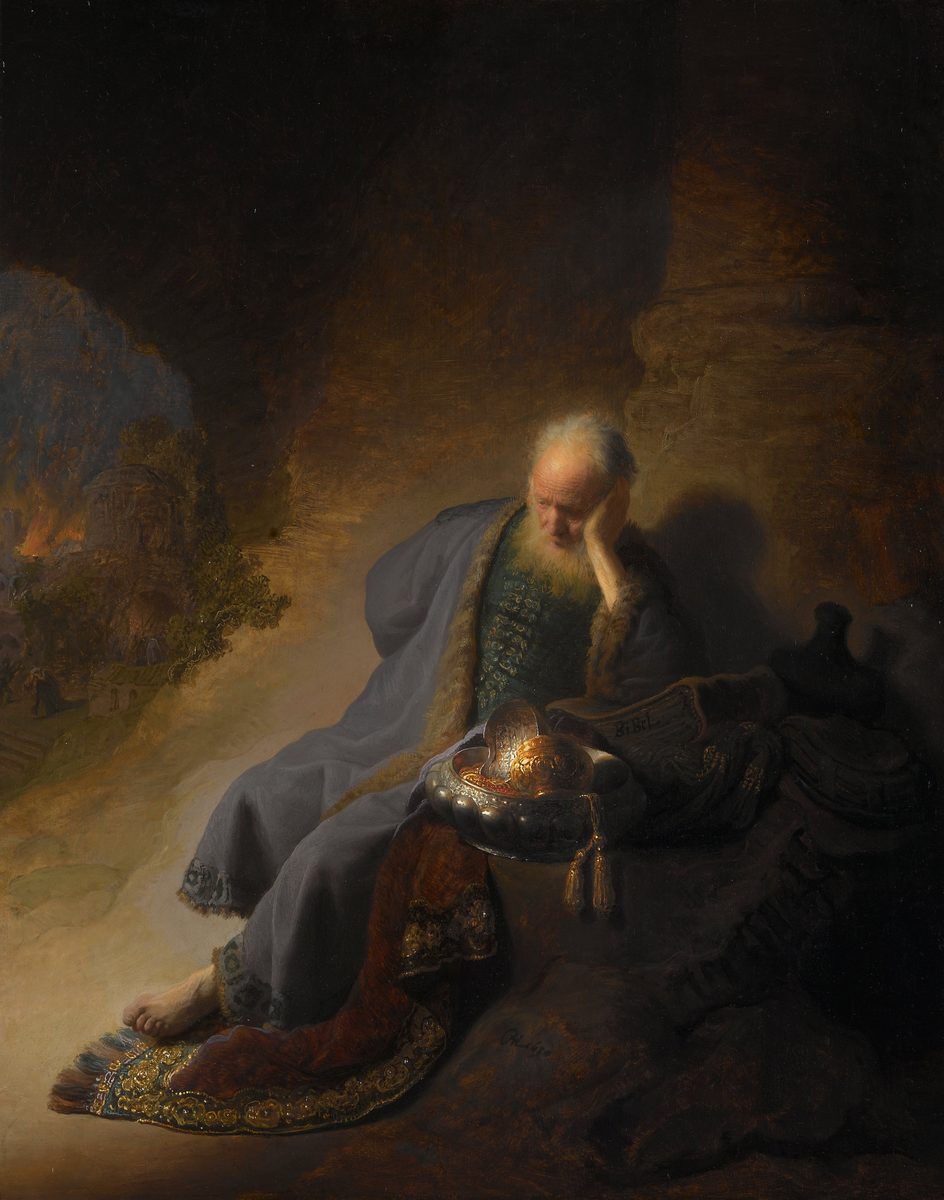
An old man in rich robes leans on one elbow in the dark, head on hand, while a city burns behind him
Jeremiah Lamenting the Destruction of Jerusalem
Rembrandt van Rijn, 1630 · Rijksmuseum, Amsterdam

Painted when Rembrandt was twenty-four. The prophet is not preaching; he is sitting with his head on his hand, and the burning city is small and far off behind him — the ruin is finished, and the whole picture is the aftermath. ⚠ The books and the gold vessels beside him are the painter’s addition, not the text’s: they carry the awkward fact that Jeremiah was treated well by Babylon precisely because he had told Jerusalem to submit.

Public domain · View the original
1
דִּבְרֵי יִרְמְיָהוּ, בֶּן-חִלְקִיָּהוּ, מִן-הַכֹּהֲנִים אֲשֶׁר בַּעֲנָתוֹת, בְּאֶרֶץ בִּנְיָמִן.
The words of Jeremiah son of Hilkiah, of the priests who were in Anathoth, in the land of Benjamin,note
Palabras de Jeremías hijo de Hilcías, de los sacerdotes que estaban en Anatot, en la tierra de Benjamín,
cross-refs⤷ Obadiah 1:1
2
אֲשֶׁר הָיָה דְבַר-יְהוָה אֵלָיו, בִּימֵי יֹאשִׁיָּהוּ בֶן-אָמוֹן מֶלֶךְ יְהוּדָה, בִּשְׁלֹשׁ-עֶשְׂרֵה שָׁנָה, לְמָלְכוֹ.
to whom the word of Jehovah came in the days of Josiah son of Amon, king of Judah, in the thirteenth year of his reign,note
a quien vino la palabra de Jehová en los días de Josías hijo de Amón, rey de Judá, en el año decimotercero de su reinado,
cross-refs⤷ Ezekiel 1:3
3
וַיְהִי, בִּימֵי יְהוֹיָקִים בֶּן-יֹאשִׁיָּהוּ מֶלֶךְ יְהוּדָה, עַד-תֹּם עַשְׁתֵּי עֶשְׂרֵה שָׁנָה, לְצִדְקִיָּהוּ בֶן-יֹאשִׁיָּהוּ מֶלֶךְ יְהוּדָה--עַד-גְּלוֹת יְרוּשָׁלִַם, בַּחֹדֶשׁ הַחֲמִישִׁי. {פ}
and it came in the days of Jehoiakim son of Josiah, king of Judah, until the end of the eleventh year of Zedekiah son of Josiah, king of Judah — until the exile of Jerusalem, in the fifth month.note
y siguió viniendo en los días de Joacim hijo de Josías, rey de Judá, hasta el fin del año undécimo de Sedequías hijo de Josías, rey de Judá — hasta el destierro de Jerusalén, en el mes quinto.
4
וַיְהִי דְבַר-יְהוָה, אֵלַי לֵאמֹר.
And the word of Jehovah came to me, saying:note
Y vino a mí la palabra de Jehová, diciendo:
5
בְּטֶרֶם אצורך אֶצָּרְךָ בַבֶּטֶן יְדַעְתִּיךָ, וּבְטֶרֶם תֵּצֵא מֵרֶחֶם הִקְדַּשְׁתִּיךָ: נָבִיא לַגּוֹיִם, נְתַתִּיךָ.
"Before I formed you in the belly I knew you, and before you came out of the womb I set you apart; a prophet to the nations I appointed you."note
«Antes que te formara en el vientre te conocí, y antes que salieras de la matriz te aparté; profeta a las naciones te puse».
6
וָאֹמַר, אֲהָהּ אֲדֹנָי יְהוִה, הִנֵּה לֹא-יָדַעְתִּי, דַּבֵּר: כִּי-נַעַר, אָנֹכִי. {ס}
And I said, "Ah, Lord Jehovah! Look, I do not know how to speak, for I am only a youth."note
Y dije: «¡Ah, Señor Jehová! Mira, no sé hablar, porque soy solo un joven».
cross-refs⤷ Exod 4:10
7
וַיֹּאמֶר יְהוָה אֵלַי, אַל-תֹּאמַר נַעַר אָנֹכִי: כִּי עַל-כָּל-אֲשֶׁר אֶשְׁלָחֲךָ, תֵּלֵךְ, וְאֵת כָּל-אֲשֶׁר אֲצַוְּךָ, תְּדַבֵּר.
But Jehovah said to me, "Do not say 'I am only a youth,' for to everyone I send you, you shall go, and everything I command you, you shall speak.note
Pero Jehová me dijo: «No digas "soy solo un joven", porque a todo aquel a quien te envíe irás, y todo lo que te mande hablarás.
8
אַל-תִּירָא, מִפְּנֵיהֶם: כִּי-אִתְּךָ אֲנִי לְהַצִּלֶךָ, נְאֻם-יְהוָה.
Do not be afraid before them, for I am with you to deliver you — the utterance of Jehovah."note
No temas delante de ellos, porque yo estoy contigo para librarte — declaración de Jehová».
9
וַיִּשְׁלַח יְהוָה אֶת-יָדוֹ, וַיַּגַּע עַל-פִּי; וַיֹּאמֶר יְהוָה אֵלַי, הִנֵּה נָתַתִּי דְבָרַי בְּפִיךָ.
Then Jehovah stretched out his hand and touched my mouth; and Jehovah said to me, "Look, I have put my words in your mouth.note
Entonces Jehová extendió su mano y tocó mi boca; y me dijo Jehová: «Mira, he puesto mis palabras en tu boca.
10
רְאֵה הִפְקַדְתִּיךָ הַיּוֹם הַזֶּה, עַל-הַגּוֹיִם וְעַל-הַמַּמְלָכוֹת, לִנְתוֹשׁ וְלִנְתוֹץ, וּלְהַאֲבִיד וְלַהֲרוֹס--לִבְנוֹת, וְלִנְטוֹעַ. {פ}
See, I have appointed you this day over the nations and over the kingdoms, to uproot and to tear down, to destroy and to overthrow, to build and to plant."note
Mira, te he puesto hoy sobre las naciones y sobre los reinos, para arrancar y para derribar, para destruir y para arruinar, para edificar y para plantar».
cross-refs⤷ 18:7
11
וַיְהִי דְבַר-יְהוָה אֵלַי לֵאמֹר, מָה-אַתָּה רֹאֶה יִרְמְיָהוּ; וָאֹמַר, מַקֵּל שָׁקֵד אֲנִי רֹאֶה.
And the word of Jehovah came to me, saying, "What do you see, Jeremiah?" And I said, "I see a branch of an almond tree."note
Y vino a mí la palabra de Jehová, diciendo: «¿Qué ves, Jeremías?» Y dije: «Veo una rama de almendro».
12
וַיֹּאמֶר יְהוָה אֵלַי, הֵיטַבְתָּ לִרְאוֹת: כִּי-שֹׁקֵד אֲנִי עַל-דְּבָרִי, לַעֲשֹׂתוֹ. {ס}
And Jehovah said to me, "You have seen well, for I am watching over my word, to do it."note
Y me dijo Jehová: «Bien has visto, porque yo velo sobre mi palabra para cumplirla».
13
וַיְהִי דְבַר-יְהוָה אֵלַי שֵׁנִית לֵאמֹר, מָה אַתָּה רֹאֶה; וָאֹמַר, סִיר נָפוּחַ אֲנִי רֹאֶה, וּפָנָיו, מִפְּנֵי צָפוֹנָה.
And the word of Jehovah came to me a second time, saying, "What do you see?" And I said, "I see a boiling pot, and its face is turned away from the north."note
Y vino a mí la palabra de Jehová por segunda vez, diciendo: «¿Qué ves?» Y dije: «Veo una olla que hierve, y su cara está vuelta desde el norte».
14
וַיֹּאמֶר יְהוָה, אֵלָי: מִצָּפוֹן תִּפָּתַח הָרָעָה, עַל כָּל-יֹשְׁבֵי הָאָרֶץ.
And Jehovah said to me, "Out of the north the disaster shall break loose upon all the inhabitants of the land.note
Y me dijo Jehová: «Del norte se desatará el mal sobre todos los habitantes de la tierra.
15
כִּי הִנְנִי קֹרֵא, לְכָל-מִשְׁפְּחוֹת מַמְלְכוֹת צָפוֹנָה--נְאֻם-יְהוָה; וּבָאוּ וְנָתְנוּ אִישׁ כִּסְאוֹ פֶּתַח שַׁעֲרֵי יְרוּשָׁלִַם, וְעַל כָּל-חוֹמֹתֶיהָ סָבִיב, וְעַל, כָּל-עָרֵי יְהוּדָה.
For behold, I am calling all the families of the kingdoms of the north — the utterance of Jehovah — and they shall come, and each shall set his throne at the entrance of the gates of Jerusalem, against all its walls around, and against all the cities of Judah.note
Porque he aquí que yo llamo a todas las familias de los reinos del norte — declaración de Jehová — y vendrán, y cada uno pondrá su trono a la entrada de las puertas de Jerusalén, contra todos sus muros alrededor, y contra todas las ciudades de Judá.
16
וְדִבַּרְתִּי מִשְׁפָּטַי אוֹתָם, עַל כָּל-רָעָתָם--אֲשֶׁר עֲזָבוּנִי, וַיְקַטְּרוּ לֵאלֹהִים אֲחֵרִים, וַיִּשְׁתַּחֲווּ, לְמַעֲשֵׂי יְדֵיהֶם.
And I will pronounce my judgments against them for all their evil — in forsaking me, and burning incense to other gods, and bowing down to the works of their own hands.note
Y pronunciaré mis juicios contra ellos por toda su maldad — por haberme abandonado, y quemar incienso a otros dioses, y postrarse ante las obras de sus manos.
cross-refs⤷ 22:9
17
וְאַתָּה, תֶּאְזֹר מָתְנֶיךָ, וְקַמְתָּ וְדִבַּרְתָּ אֲלֵיהֶם, אֵת כָּל-אֲשֶׁר אָנֹכִי אֲצַוֶּךָּ; אַל-תֵּחַת, מִפְּנֵיהֶם--פֶּן-אֲחִתְּךָ, לִפְנֵיהֶם.
But you — gird up your loins, and rise and speak to them all that I command you. Do not be shattered before them, lest I shatter you before them.note
Pero tú — ciñe tus lomos, y levántate y háblales todo lo que yo te mande. No te quebrantes delante de ellos, no sea que yo te quebrante delante de ellos.
cross-refs⤷ 20:11
18
וַאֲנִי הִנֵּה נְתַתִּיךָ הַיּוֹם, לְעִיר מִבְצָר וּלְעַמּוּד בַּרְזֶל וּלְחֹמוֹת נְחֹשֶׁת--עַל-כָּל-הָאָרֶץ: לְמַלְכֵי יְהוּדָה לְשָׂרֶיהָ, לְכֹהֲנֶיהָ וּלְעַם הָאָרֶץ.
And I, behold, I have made you this day a fortified city, and an iron pillar, and bronze walls, against the whole land — against the kings of Judah, its princes, its priests, and the people of the land.note
Y yo, he aquí, te he puesto hoy como ciudad fortificada, y columna de hierro, y muros de bronce, contra toda la tierra — contra los reyes de Judá, sus príncipes, sus sacerdotes y el pueblo de la tierra.
19
וְנִלְחֲמוּ אֵלֶיךָ, וְלֹא-יוּכְלוּ לָךְ: כִּי-אִתְּךָ אֲנִי נְאֻם-יְהוָה, לְהַצִּילֶךָ. {פ}
They will fight against you, but they will not prevail against you, for I am with you — the utterance of Jehovah — to deliver you."note
Y pelearán contra ti, pero no te vencerán, porque yo estoy contigo — declaración de Jehová — para librarte».

Translator’s Notes

Verses 1–3 · a forty-year word

The superscription frames the longest and most turbulent prophetic career in the Bible. Jeremiah’s word comes “in the thirteenth year of Josiah” (627 BC), runs on through the reign of Jehoiakim, and does not stop “until the eleventh year of Zedekiah… until the exile of Jerusalem, in the fifth month” (586 BC). Forty years, five kings, and one direction: down toward the fall. The book’s frame is a nation’s collapse, and the man appointed to say it was coming.

«Of the priests who were in Anathoth.» Jeremiah is a priest by birth. Anathoth — a Levitical town about three miles northeast of Jerusalem in the territory of Benjamin — was very likely the village to which Solomon banished the priest Abiathar (1 Kings 2:26). A son of a sidelined priestly line, from a small town, called to indict the temple and the throne it stood beside.

Verses 4–5 · known before the womb

«Before I formed you… I knew you.» The call reaches back before Jeremiah exists. “Formed” is yatsar — the potter’s verb, the word for God shaping the man from the dust (Genesis 2:7), and the very sign Jeremiah will later act out at the potter’s house (ch 18). “Knew” (yada) is not information but the intimate, covenant knowing that means chosen. And “set you apart” (qadash) — consecrated, devoted to a purpose — all before birth. KJV “I knew thee… I sanctified thee, and I ordained thee a prophet unto the nations.”

«A prophet to the nations.» Not to Judah only — goyim, the nations; Jeremiah’s oracles will reach Egypt, Moab, Ammon, Edom, and Babylon (chs 46–51). The scope is set in the first sentence God speaks to him. Paul heard his own calling in these very words — “he who set me apart before I was born” (Galatians 1:15).

Verses 6–8 · I am only a youth

«Ah, Lord Jehovah!» Jeremiah’s first word back to God is a groan (ahah) and the reluctant prophet’s objection: “I do not know how to speak, for I am only a youth (na’ar).” He joins a line — Moses “I am not eloquent,” Gideon “my clan is the weakest,” Isaiah “I am a man of unclean lips.” The called protest their inadequacy; it is always true, and it is never the point.

God does not argue the weakness — he overrides it with two commands and a promise. “Do not say ‘I am a youth.’” “Do not be afraid before them.” And the promise that will bookend the whole call: “I am with you to deliver you” (repeated word for word at v19). “The utterance of Jehovah” (ne’um YHWH) is the prophet’s signature stamp, sounded all through the book.

Verses 9–10 · the hand on the mouth, the six verbs

«He touched my mouth.» God stretches out his hand and touches Jeremiah’s lips — the commissioning gesture. Where Isaiah’s mouth was cleansed by a burning coal (Isaiah 6:7), Jeremiah’s is filled: “I have put my words in your mouth” — the mark of the true prophet, who speaks not his own message but God’s (Deuteronomy 18:18).

The six verbs. Verse 10 is the mission statement of the whole book: “to uproot and to tear down, to destroy and to overthrow, to build and to plant.” Four verbs of demolition, two of construction — and in that proportion. Jeremiah’s is mostly a ministry of tearing down (a doomed nation, warned to the very end), but it does not end there: “to build and to plant” is the seed of the hope that flowers in the new covenant (ch 31). The wrecking clears the ground for the planting. KJV “to root out, and to pull down, and to destroy, and to throw down, to build, and to plant.”

Verses 11–12 · the almond and the Watcher

A pun you can only half-carry into English. Jeremiah sees “a branch of an almond tree” — maqqel shaqed; and God answers, “You have seen well, for I am watching (shoqed) over my word to do it.” Shaqed (“almond”) and shoqed (“watching, wakeful”) are nearly the same sound. The almond is the first tree to wake and blossom in the Judean spring — the “watcher tree” — and God is awake over his word, watching to perform it. The vision’s whole point is certainty: what God has said, he is wakeful to do. ⚠ The KJV catches the wordplay differently — “I will hasten my word” — reading the root as speed rather than watchfulness; the ESV and most modern versions read “watching.”

Verses 13–16 · the pot from the north

The second vision. “A boiling pot, its face turned away from the north” — a cauldron tilting so its scalding contents pour down toward the south, toward Judah. “Out of the north the disaster (ra’ah) shall break loose.” The enemy from the north is Babylon, whose armies came down the fertile-crescent road from the north though Babylon itself lay to the east; their kings “set each his throne at the entrance of the gates of Jerusalem” — the picture of conquest, the invader holding court where the city once judged.

The reason, stated plainly (v16): “for all their evil — in forsaking me, and burning incense to other gods, and bowing down to the works of their own hands.” Idolatry is the root charge of the whole book: a people who traded the living God for gods they made with their hands. The judgment is not arbitrary; it is a marriage betrayed.

Verses 17–19 · an iron pillar

«Gird up your loins.» The charge to the prophet: tuck up your robe to work or run, stand, and speak everything — and “do not be shattered (chatat) before them, lest I shatter you before them.” The pun is a warning wrapped in a command: fear them, and you will be broken; the only safety is obedience. KJV “be not dismayed at their faces, lest I confound thee before them.”

«A fortified city, an iron pillar, bronze walls.» God makes the reluctant youth a fortress against the whole establishment — kings, princes, priests, and people alike. ⚠ Note carefully what the promise is and is not: “they will fight against you” — and they will (Jeremiah will be beaten, put in the stocks, thrown down a cistern, and left to die) — “but they will not prevail against you, for I am with you… to deliver you.” Not a life without attack, but a life that cannot be destroyed. The call closes on the very promise it opened with (v8): I am with you.

Patterns worth carrying forward

Where this translation keeps the exact / distinct words:formed” for yatsar, the potter’s verb that will become a whole sign-act (ch 18); “knew” for yada and “set apart” for qadash, the covenant-and-consecration words of the prenatal call; “a youth” for na’ar, the reluctant prophet’s objection; the six verbs “uproot / tear down / destroy / overthrow / build / plant” kept four-to-two; “watching” for shoqed, held against the “almond” (shaqed) so the pun is at least visible; and “shattered” for chatat, kept the same in the warning “do not be shattered… lest I shatter you.”

Echoes paid. Yatsar forming the man from the dust (Genesis 2:7); the reluctant-prophet line of Moses, Gideon, and Isaiah; the mouth touched, as Isaiah’s was by the coal (Isaiah 6), and filled as the prophet-like-Moses is (Deuteronomy 18:18); the “enemy from the north” that will be named Babylon; and the indictment — forsaking Jehovah for other gods — that the tariff of the last kings turns on (Jer 22:9).

Echoes planted. The six verbs, the program of the whole book, whose two hopeful ones flower in the new covenant (ch 31); the promise “I am with you to deliver you,” which bookends this call (vv8, 19) and is the rope Jeremiah clings to in his darkest confession (20:11); and the iron pillar made of a frightened boy — a man who will be beaten, jailed, and thrown in a cistern, and never destroyed.

This library already carries Jeremiah 20–22 (Pashhur and the stocks, the final siege, the tariff of the last kings). Next in sequence: Jeremiah 2 — the great opening indictment, “my people have committed two evils: they have forsaken me, the fountain of living waters, and hewn out for themselves broken cisterns that can hold no water.”