Jeremiah 31 — The Mister Translation
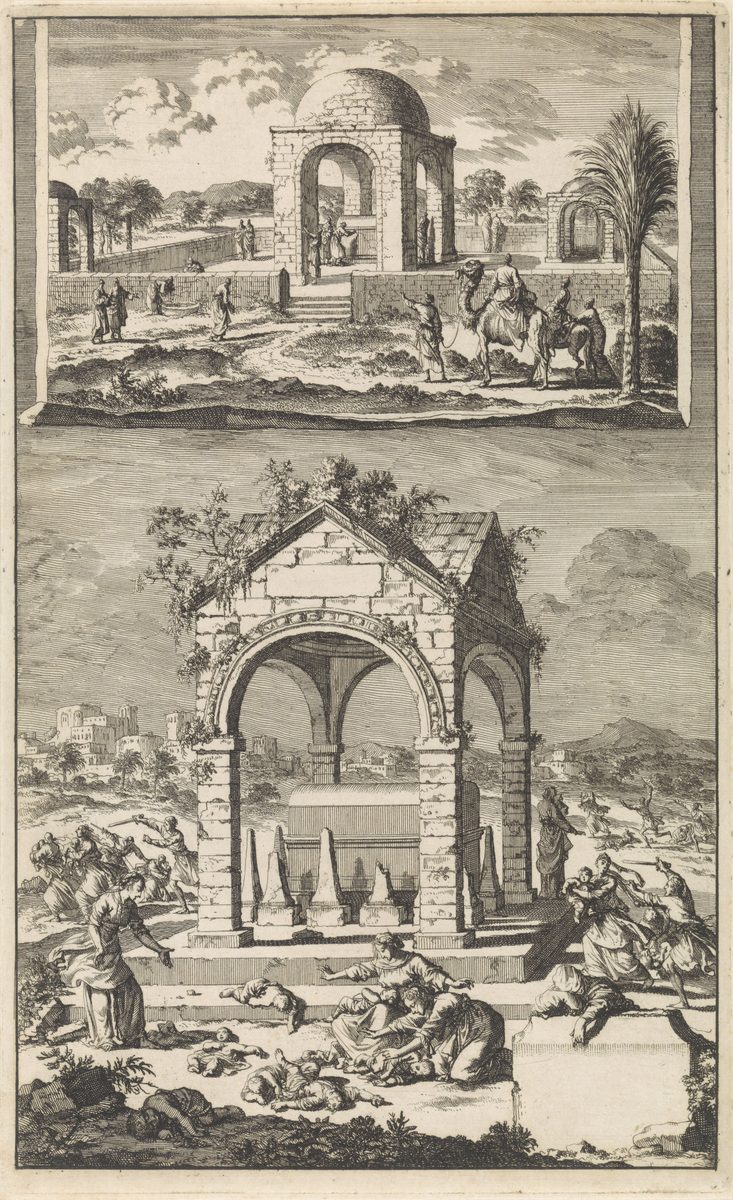
⚠ Luyken builds this print in two decks on purpose. The top panel is reportage, not invention: it copies a travel sketch by the French traveler Jean de Thevenot, who visited the site around 1655 and recorded the tomb as European pilgrims were shown it — a domed monument, walled precinct, camels on the approach road. The bottom panel takes the same monument (redrawn as a roofed, overgrown pavilion, the difference itself a small comment on time passing) and populates it with the Massacre of the Innocents, small bodies on the ground and a soldier prying a child from its mother at the right edge. Nothing in Matthew's own text puts Herod's massacre AT the tomb; Luyken is illustrating the citation, not the geography — folding Jeremiah 31:15's weeping and Matthew 2:18's quotation of it into one image, exactly the layering this chapter's own note on v14 tries to keep visible rather than collapse. ⚠ Jan Luyken (1649–1712) was one of the most prolific book illustrators of the Dutch Golden Age — roughly 3,336 etchings across some 500 books in his working life — and a convert to the Mennonite church whose religious seriousness runs through his biblical work.

Translator’s Notes
Why every verse here carries an “EN” tag
Hebrew Jeremiah 30 has twenty-five verses; every English Bible's chapter 30 has only twenty-four. The missing verse isn't missing — it's this book's opening line. Hebrew 30:25, “At that time, I will be the God of all the families of Israel,” is printed in every English Bible as 31:1. That pushes the whole rest of this chapter back by exactly one: Hebrew 31:1 is English 31:2, Hebrew 31:2 is English 31:3, all the way to Hebrew 31:39 = English 31:40. It does not resolve until chapter 32, where both editions agree again.
This site follows the same rule established for the Psalms' superscriptions (Psalm 51:1 is the heading “For the director…” here, not a floating unnumbered line the way most English Bibles print it): the Hebrew verse number is the page's real number, because it is the number actually printed beside the actual Hebrew words. But this chapter contains some of the most individually famous, individually cited verses in the whole Bible — the new covenant, Rachel weeping — so unlike a Psalm heading, guessing the English number by arithmetic isn't good enough here. Every verse below carries a small EN N tag giving the number your own Bible uses for it.
Jeremiah 30–31 together are traditionally called the Book of Consolation — the one sustained block of pure hope in a book that is mostly indictment and siege. It opens here on a plain declarative sentence, the wilderness generation that survived Egypt's sword: this chapter reaches back to the Exodus to describe a second one.
Loyal-love, from far away
“I have loved you with an everlasting love” is olam (see the Dictionary) doing its most famous single line of work in the whole Bible — not a feeling with a shelf life, but love reaching outside ordinary time altogether. “Therefore I have drawn you with loyal-love” renders chesed the same way this translation renders it everywhere else on this shelf (see Psalm 51): not a private emotion but a covenant obligation kept.
“From far away Jehovah appeared to me” is read two ways, and this translation doesn't force a choice: merachoq can mean spatially distant (Jehovah appearing from a long way off) or temporally distant (“of old,” an appearance remembered from the distant past — Sinai, or the wilderness of v1). Either way the verse that follows is usually read as the people's own remembered words, quoted back to them inside Jehovah's larger oracle — which is why it's set off here in its own quotation, closing only at the end of v5.
Build, and son: one Hebrew root running the whole chapter
“Again I will build you, and you will be built, virgin Israel” opens a wordplay that this chapter will not let go of. Hebrew banah, “to build,” and ben, “son,” share the same two root letters (בנ) — not folk etymology but real shared consonants, the kind Hebrew poets lean on constantly. This chapter uses that root ten times: Israel built again here at v3, Rachel weeping for her sons at v14, the returning children at v16 and v28, Ephraim asked whether he is a precious son at v19, the commissioning verbs “to build and to plant” at v27, and the city itself rebuilt at v37, closing the frame v3 opened. English has no way to keep “build” and “son” visibly related, so this translation can only flag it: whenever build appears in bold below, and whenever son or children does, one Hebrew root is doing both jobs.
Ephraim, firstborn by choice and not by birth
“I am a father to Israel, and Ephraim is my firstborn” is a claim the family tree doesn't support. Reuben was Jacob's actual firstborn son; within Joseph's own household, Manasseh was born before Ephraim (Genesis 41:51-52). “Firstborn” here is a covenant rank, not a birth order — the same reversal Jacob himself performs on his deathbed, crossing his hands to bless the younger Ephraim ahead of Manasseh (Genesis 48:13-20, already on this shelf). By the time this oracle was spoken “Ephraim” had also become shorthand for the whole northern kingdom of Israel, gone to Assyria in 722 BC — so a chapter about Judah's future New Covenant (vv30-33) opens by promising the ALREADY-EXILED northern tribes a homecoming too. The blind, the lame, and two women who by any ordinary reckoning cannot travel — pregnant, and in labor — are named specifically among the returning “great company” at v7: nothing disqualifies a person from this road.
Ransomed, not merely released
“Jehovah has ransomed Jacob” (v10) uses padah, the verb for paying a price to free something otherwise forfeit — a firstborn son, a slave, a life under judgment (Exodus 13:13, 21:8). “Redeemed” in the same verse is ga'al, the kinsman-redeemer's word (see Ruth 4, forthcoming on this shelf) — a relative's legal claim to buy back family property or a family member. Together the two verbs say the exile's end cost something and was owed to someone, not simply granted. The procession that follows — grain, new wine, oil, flock and herd, “a well-watered garden” — is the standard prophetic vocabulary of covenant blessing (compare Deuteronomy 28), turned here from threat to promise.
Rachel weeping
“A voice is heard in Ramah” is not only poetry. Ramah was the staging point where captured Judeans were assembled in chains before the march to Babylon — Jeremiah himself was taken there in 40:1, then released. A voice raised specifically at Ramah is a voice raised at the exact spot where families were being separated.
Rachel died bearing Benjamin and was buried near Ephrath — that is, Bethlehem — a full generation before either the Assyrian exile of the northern tribes (whom she mothered, through Joseph and so through Ephraim) or the Babylonian exile of Judah (Genesis 35:16-20, already on this shelf). A voice from her tomb weeping for children marched past is Jeremiah's image, not a literal ghost story: the ancestor of the very tribes now being deported, grieving from the ground.
Matthew 2:18 (already on this shelf) quotes this verse almost exactly for Herod's massacre at Bethlehem — “weeping and much lamentation; Rachel weeping for her children, and she would not be comforted, because they are not” — though the Hebrew here says “for her sons” twice (מְבַכָּה עַל-בָּנֶיהָ…לְהִנָּחֵם עַל-בָּנֶיהָ) where the Greek Matthew quotes compresses it to one — and KJV, translating the Hebrew directly here rather than the Greek, keeps the double “for her children…for her children” that this translation follows. ⚠ In Jeremiah's own context the next two verses answer the weeping directly — “they will return from the enemy's land” (v15), “your children will return to their own territory” (v16) — a promised homecoming, not a permanent grief. Matthew reads the verse typologically, for a massacre with no homecoming at all; this translation prints Jeremiah's own words and lets both readings stand without forcing one onto the other.
The same two words as Jeremiah 29:11
“There is hope for your outcome” pairs tikvah and acharit — the identical two words, in reverse order, behind the famous “a future and a hope” of Jeremiah 29:11 (already on this shelf, where this translation renders acharit “outcome” rather than “future” for the reasons given in that chapter's note; the same choice is kept here for the echo to stay visible). Both verses promise the same thing to the same exiles in the same short run of chapters — 29 to the Babylon-bound, 31 to the whole scattered nation, north and south alike.
Turning and repenting: one verb pair, twice over
Ephraim's confession runs on two roots this chapter has already used for other things. “Bring me back, and I will return” is shuv (see the Dictionary) — the same verb translated “return” for the exiles throughout this chapter, now spoken by a single voice asking to be personally restored. Then, in the very next verse: “after I turned away, I repented” — shuv again, immediately followed by nacham (see the Dictionary), the same root this translation renders “comfort” twice already in this chapter (vv12, 14). Jeremiah 18 renders Jehovah's own nacham “relent,” specifically because relenting carries no admission of wrongdoing on God's part; here the same root describes Ephraim's own regret over real sin, so “repented” — the sense “relent” was chosen to avoid there — is exactly right in this verse. One root can mean comfort, relent, or repent depending only on who is doing it and why.
A precious son, again by choice
“Is Ephraim a precious son to me?” returns to the birth-order reversal already flagged at v6-9: Jacob's blessing crossed his hands to put the younger Ephraim ahead of Manasseh (Genesis 48, already on this shelf), and here it is Jehovah, not Jacob, doing the choosing and the yearning — “my heart yearns for him” uses hamu me'ai, literally “my innards are in tumult,” the Bible's most visceral verb for compassion.
Waymarks for a road already walked
“Set up road markers” addresses someone who already knows this road — “the road you traveled” follows the Masoretic note (qere) correcting the written text's “I traveled” to the second person, addressed to virgin Israel throughout. “Return…return” doubles shuv a fourth and fifth time in this chapter (after vv7, 15, 16, and the two uses at v17-18) — the single most repeated root in the whole Book of Consolation, on top of the build/son root already flagged at v3. “Faithless daughter” (v21) is its own small case study in how differently one word lands: KJV prints “backsliding,” ESV “faithless,” and ASV and other versions “rebellious” — the Hebrew adjective is shovavah, itself built on the shuv root that dominates this chapter: literally a “turned-away” daughter.
“A woman shall compass a man”
⚠ This half-verse is one of the genuinely unresolved cruxes of the Hebrew Bible. N’qevah t’sovev gaver — “a female surrounds/encircles a male” — uses savav, “to go around, encircle,” a different root from the shuv (“return”) that dominates the verses around it; the two look and sound alike to an English ear but share no consonants in Hebrew (סבב vs שוב). Readings on record include: a woman protecting or taking the initiative toward a man, reversing the expected ancient courtship role, as itself the “new thing”; Israel (grammatically feminine) surrounding, i.e. seeking out, Jehovah (here read as “the man”/“the mighty one”); and, in later Christian typological reading (Jerome among others), an allusion to a woman encompassing a man in the womb without ordinary conception. ⚠ The English shelf alone shows how unsettled this is: KJV prints “compass,” ESV “encircles,” and NIV — reading the verb as though it shared shuv's sense after all — “the woman will return to the man,” three genuinely different pictures from the same four Hebrew words. This translation prints the plain sense, compass, keeping KJV's own word for savav, without adjudicating what the “new thing” actually is.
A blessing repeated back
“Jehovah bless you, dwelling of righteousness” is presented as a saying already familiar — “once again they will say this word,” implying it was said before the exile and will be said again after it, unchanged. Restoration here isn't a new liturgy; it's the old one, usable again.
The prophet's own voice, once
“At this I woke up and looked, and my sleep was pleasant to me” is a rare first-person aside from Jeremiah himself, breaking through the oracle's voice for a single verse. It reads as the sign-off of a dream or night vision — the prophet reporting, almost as an afterthought, that receiving this particular message did not cost him the sleep so many of his other commissions do (compare the burning-bone compulsion of 20:9, already on this shelf).
Sow, uproot, build: this chapter answers Jeremiah 1
“To uproot and to tear down…to build and to plant” repeats — almost word for word, with “overthrow” and “bring disaster” added — the exact six-verb commission Jehovah gave the young Jeremiah at 1:10 (already on this shelf): “to uproot and to tear down, to destroy and to overthrow, to build and to plant.” The book's entire arc runs between those two lists: forty years of the first four verbs, and here, finally, the last two.
The sour-grapes proverb (vv28-29) rejects inherited guilt — each generation answers for its own sin, not its parents' — the same proverb Ezekiel develops at length in his own chapter 18 (not yet on this shelf), almost certainly responding to the same exile-era question both prophets were being asked: is this generation being punished for someone else's failure?
The New Covenant
⚠ “A new covenant” — brit chadashah — is the only place in the entire Hebrew Bible the exact phrase occurs. The verb is karat, literally “to CUT” a covenant (the animal split in two at Genesis 15:9-18 is the picture behind the word) — but KJV, ASV, NIV, and ESV all soften it to “make,” without exception; this translation keeps cut, breaking from every major English version, because the same verb, in the same physical sense, is what Genesis 15 stages: not a metaphor for an agreement but a memory of one made by walking between the halves of a slaughtered animal. Hebrews 8:8-12 (not yet on this shelf) quotes vv31-34 in full, the single longest Old Testament quotation anywhere in the New Testament, and builds its entire argument for a superior covenant on these four verses; Hebrews 10:16-17 quotes the forgiveness clause again to close the case. Jesus's own words over the cup at the Last Supper — “this cup is the new covenant in my blood” (Luke 22:20, 1 Corinthians 11:25) — claim this exact promise as fulfilled at that table.
V31's “I was a husband to them” renders ba'alti vam — the verb ba'al, “to be lord/master/husband of,” the same root as the god's name Israel kept turning to instead (see Baal, forthcoming on this shelf). Jehovah claims the very title his rivals wore.
What makes this covenant new is stated twice, plainly: the law moves from a document to “within them…on their heart” (v32), and “I will forgive their guilt, and remember their sin no more” (v33) — a forgetting, not merely a pardon. Nothing here abolishes the law that was broken at Sinai; the covenant renews the same terms (“I will be their God, and they will be my people”) on a different footing entirely.
A covenant with the sun and sea as witnesses
The permanence clause reaches for the two most obviously fixed things Jeremiah's audience knew: the sun and moon's daily order, and the sea's roar. “If this fixed order ever departs” is deliberately unreachable — and v36 raises the bar again, to measuring the sky and excavating the earth's foundations. The logic runs backward from most covenant language: not a threat conditioned on Israel's behavior, but a promise anchored to something Israel's behavior cannot touch at all.
A valley of corpses, made holy
The rebuilt city's new boundary runs from the Tower of Hananel (in the north wall, also named at Nehemiah 3:1 and Zechariah 14:10, both forthcoming on this shelf) to the Corner Gate, out to a hill called Gareb and a place called Goah — both otherwise unknown to archaeology; their locations are simply lost. ⚠ The ketiv (as literally written) at v38 spells the measuring-line word qavah; the qere (as traditionally read) corrects it to qav, “line,” the word this translation follows.
The boundary's final stretch is the striking part: “the whole valley — the corpses, the ashes…will be holy to Jehovah.” This is very likely the same valley Jeremiah 19:6 (already on this shelf) renamed “the valley of slaughter” — Topheth, the valley of the son of Hinnom, the site of child sacrifice and, in that chapter's judgment oracle, of Jerusalem's own coming dead. The ugliest ground in the whole book, the one place named specifically for corpses and ash, is the one this chapter chooses to declare holy and permanent — the same pair of verbs, “uprooted… torn down,” that opened the destruction in Jeremiah 1:10 and returned at v27 above, used here one final time in the negative: never again.
Notes on this translation
Numbering. This chapter is built on Hebrew/Masoretic verse numbers, which run exactly one behind every English Bible from v1 to v39 (see note on v1). Every verse carries a small EN N tag giving its number in your own Bible — look for it if you're trying to find “the New Covenant verse” (that's Hebrew v30, printed EN 31) or “Rachel weeping” (Hebrew v14, EN 15).
Decisions. Chesed as loyal-love and acharit as outcome, matching this shelf's Psalm 51 and Jeremiah 29 choices respectively, so the echoes stay visible across chapters. Nacham rendered comfort where the object is grief (vv12, 14) and repented where it is Ephraim's own confession (v18) — contrast Jeremiah 18's relented for Jehovah's own use of the same root, a distinction explained at v17. “A woman shall compass a man” (v21) keeps the King James's own word for a crux this translation does not claim to solve.
⚠ A note on order: the arrow at the top of this page points back to Jeremiah 29 and forward to Jeremiah 2 — not 32. Chapter 30, immediately before this one, isn't built yet either, so this site's convention is to point at the lowest chapter still missing from the book rather than assume the very next number is next in line. Jeremiah 2–17, 24–28, 30, and 32–52 remain open.