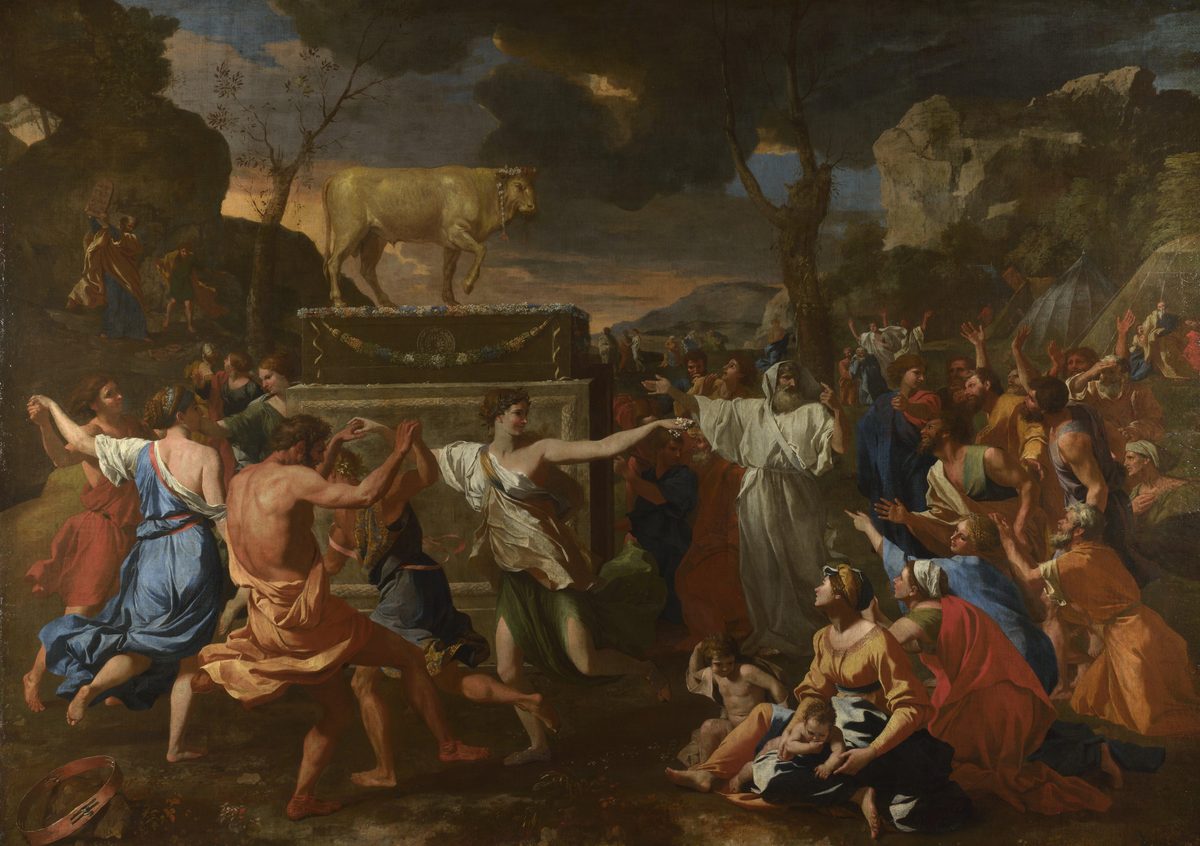
1
וַיַּרְא הָעָם, כִּי-בֹשֵׁשׁ מֹשֶׁה לָרֶדֶת מִן-הָהָר; וַיִּקָּהֵל הָעָם עַל-אַהֲרֹן, וַיֹּאמְרוּ אֵלָיו קוּם עֲשֵׂה-לָנוּ אֱלֹהִים אֲשֶׁר יֵלְכוּ לְפָנֵינוּ--כִּי-זֶה מֹשֶׁה הָאִישׁ אֲשֶׁר הֶעֱלָנוּ מֵאֶרֶץ מִצְרַיִם, לֹא יָדַעְנוּ מֶה-הָיָה לוֹ.
And when the people saw that
Moses delayed to come down from the mountain, they gathered themselves together to Aaron, and said to him: Come, make us gods who will go before us; for as for this Moses, the man who brought us up out of the land of
Egypt, we do not know what has become of him.
noteY viendo el pueblo que Moisés tardaba en descender del monte, se juntaron a Aarón, y le dijeron: Levántate, haznos dioses que vayan delante de nosotros; porque a este Moisés, el varón que nos sacó de la tierra de Egipto, no sabemos qué le haya acontecido.
2
וַיֹּאמֶר אֲלֵהֶם, אַהֲרֹן, פָּרְקוּ נִזְמֵי הַזָּהָב, אֲשֶׁר בְּאָזְנֵי נְשֵׁיכֶם בְּנֵיכֶם וּבְנֹתֵיכֶם; וְהָבִיאוּ, אֵלָי.
And Aaron said to them: Break off the golden rings that are in the ears of your wives, your sons, and your daughters, and bring them to me.
noteY Aarón les dijo: Apartad los zarcillos de oro que están en las orejas de vuestras mujeres, de vuestros hijos, y de vuestras hijas, y traedme los.
3
וַיִּתְפָּרְקוּ, כָּל-הָעָם, אֶת-נִזְמֵי הַזָּהָב, אֲשֶׁר בְּאָזְנֵיהֶם; וַיָּבִיאוּ, אֶל-אַהֲרֹן.
And all the people broke off the golden rings that were in their ears, and brought them to Aaron.
noteY todo el pueblo apartó los zarcillos de oro que tenían en sus orejas, y los trajeron a Aarón.
4
וַיִּקַּח מִיָּדָם, וַיָּצַר אֹתוֹ בַּחֶרֶט, וַיַּעֲשֵׂהוּ, עֵגֶל מַסֵּכָה; וַיֹּאמְרוּ--אֵלֶּה אֱלֹהֶיךָ יִשְׂרָאֵל, אֲשֶׁר הֶעֱלוּךָ מֵאֶרֶץ מִצְרָיִם.
And he took it from their hand, and fashioned it with a graving tool, and made it a molten calf; and they said: These are your gods, O Israel, who brought you up out of the land of Egypt.
noteY él los tomó de sus manos, y le dio forma con buril, e hizo de ello un becerro de fundición; y dijeron: Estos son tus dioses, Israel, que te sacaron de la tierra de Egipto.
5
וַיַּרְא אַהֲרֹן, וַיִּבֶן מִזְבֵּחַ לְפָנָיו; וַיִּקְרָא אַהֲרֹן וַיֹּאמַר, חַג לַיהוָה מָחָר.
And when Aaron saw this, he built an altar before it; and Aaron made a proclamation, and said: Tomorrow is a feast to
Jehovah.
noteY viendo esto Aarón, edificó un altar delante de él; y pregón Aarón, y dijo: Mañana será fiesta para Jehová.
6
וַיַּשְׁכִּימוּ, מִמָּחֳרָת, וַיַּעֲלוּ עֹלֹת, וַיַּגִּשׁוּ שְׁלָמִים; וַיֵּשֶׁב הָעָם לֶאֱכֹל וְשָׁתוֹ, וַיָּקֻמוּ לְצַחֵק. {פ}
And they rose up early the next day, and offered burnt offerings, and brought peace offerings; and the people sat down to eat and drink, and rose up to make merry.
{פ}noteY al día siguiente madrugaron, y ofrecieron holocaustos, y presentaron ofrendas de paz; y se sentó el pueblo a comer y a beber, y se levantaron a jugar. {פ}
7
וַיְדַבֵּר יְהוָה, אֶל-מֹשֶׁה: לֶךְ-רֵד--כִּי שִׁחֵת עַמְּךָ, אֲשֶׁר הֶעֱלֵיתָ מֵאֶרֶץ מִצְרָיִם.
And Jehovah spoke to Moses: Go, get down; for your people, whom you brought up out of the land of Egypt, have dealt corruptly.
noteY habló Jehová a Moisés: Anda, desciende, porque tu pueblo, que sacaste de la tierra de Egipto, se ha corrompido.
8
סָרוּ מַהֵר, מִן-הַדֶּרֶךְ אֲשֶׁר צִוִּיתִם--עָשׂוּ לָהֶם, עֵגֶל מַסֵּכָה; וַיִּשְׁתַּחֲווּ-לוֹ, וַיִּזְבְּחוּ-לוֹ, וַיֹּאמְרוּ, אֵלֶּה אֱלֹהֶיךָ יִשְׂרָאֵל אֲשֶׁר הֶעֱלוּךָ מֵאֶרֶץ מִצְרָיִם.
They have turned aside quickly out of the way that I commanded them; they have made themselves a molten calf, and worshiped it, and sacrificed to it, and said: These are your gods, O Israel, who brought you up out of the land of Egypt.
notePronto se han apartado del camino que yo les mandé; se han hecho un becerro de fundición, y lo han adorado, y le han ofrecido sacrificios, y han dicho: Estos son tus dioses, Israel, que te sacaron de la tierra de Egipto.
9
וַיֹּאמֶר יְהוָה, אֶל-מֹשֶׁה: רָאִיתִי אֶת-הָעָם הַזֶּה, וְהִנֵּה עַם-קְשֵׁה-עֹרֶף הוּא.
And Jehovah said to Moses: I have seen this people, and behold, it is a stiffnecked people.
noteY dijo Jehová a Moisés: Yo he visto a este pueblo, y he aquí que es pueblo de dura cerviz.
10
וְעַתָּה הַנִּיחָה לִּי, וְיִחַר-אַפִּי בָהֶם וַאֲכַלֵּם; וְאֶעֱשֶׂה אוֹתְךָ, לְגוֹי גָּדוֹל.
Now therefore let me alone, that my wrath may burn hot against them, and that I may consume them; and I will make of you a great nation.
noteAhora, pues, déjame, para que se encienda mi ira en ellos, y los consuma; y de ti yo haré una nación grande.
11
וַיְחַל מֹשֶׁה, אֶת-פְּנֵי יְהוָה אֱלֹהָיו; וַיֹּאמֶר, לָמָה יְהוָה יֶחֱרֶה אַפְּךָ בְּעַמֶּךָ, אֲשֶׁר הוֹצֵאתָ מֵאֶרֶץ מִצְרַיִם, בְּכֹחַ גָּדוֹל וּבְיָד חֲזָקָה.
And Moses pleaded with Jehovah his God, and said: Jehovah, why does your wrath burn hot against your people, whom you brought out of the land of Egypt with great power and with a mighty hand?
noteEntonces Moisés imploró a Jehová su Dios, y dijo: Jehová, ¿por qué se encenderá tu ira contra tu pueblo, que tú sacaste de la tierra de Egipto con gran poder y con mano fuerte?
12
לָמָּה יֹאמְרוּ מִצְרַיִם לֵאמֹר, בְּרָעָה הוֹצִיאָם לַהֲרֹג אֹתָם בֶּהָרִים, וּלְכַלֹּתָם, מֵעַל פְּנֵי הָאֲדָמָה; שׁוּב מֵחֲרוֹן אַפֶּךָ, וְהִנָּחֵם עַל-הָרָעָה לְעַמֶּךָ.
Why should the Egyptians say: For evil he brought them out, to kill them in the mountains, and to destroy them from the face of the earth? Turn from your fierce wrath, and relent of this evil against your people.
note¿Por qué han de hablar los egipcios, diciendo: Para mal los sacó, para matarlos en los montes, y para raerlos de sobre la faz de la tierra? Vuélvete del ardor de tu ira, y arrepiéntete de este mal contra tu pueblo.
13
זְכֹר לְאַבְרָהָם לְיִצְחָק וּלְיִשְׂרָאֵל עֲבָדֶיךָ, אֲשֶׁר נִשְׁבַּעְתָּ לָהֶם בָּךְ, וַתְּדַבֵּר אֲלֵהֶם, אַרְבֶּה אֶת-זַרְעֲכֶם כְּכוֹכְבֵי הַשָּׁמָיִם; וְכָל-הָאָרֶץ הַזֹּאת אֲשֶׁר אָמַרְתִּי, אֶתֵּן לְזַרְעֲכֶם, וְנָחֲלוּ, לְעֹלָם.
Remember Abraham, Isaac, and Israel, your servants, to whom you swore by your own self, and said to them: I will multiply your descendants like the stars of heaven, and all this land that I have spoken of I will give to your descendants, and they shall inherit it forever.
noteAcuérdate de Abraham, de Isaac, y de Israel, tus siervos, a quienes has jurado por ti mismo, y les has dicho: Yo multiplicaré vuestra descendencia como las estrellas del cielo; y daré a vuestra descendencia toda esta tierra que he dicho, y la tomarán por heredad para siempre.
14
וַיִּנָּחֶם, יְהוָה, עַל-הָרָעָה, אֲשֶׁר דִּבֶּר לַעֲשׂוֹת לְעַמּוֹ. {פ}
And Jehovah relented of the evil that he had said he would do to his people.
{פ}noteY se arrepintió Jehová del mal que dijo que había de hacer a su pueblo. {פ}
15
וַיִּפֶן וַיֵּרֶד מֹשֶׁה, מִן-הָהָר, וּשְׁנֵי לֻחֹת הָעֵדֻת, בְּיָדוֹ: לֻחֹת, כְּתֻבִים מִשְּׁנֵי עֶבְרֵיהֶם--מִזֶּה וּמִזֶּה, הֵם כְּתֻבִים.
And Moses turned, and went down from the mountain, with the two tablets of the testimony in his hand; tablets written on both their sides, on the one side and on the other were they written.
noteY volvió Moisés y descendió del monte, trayendo en su mano las dos tablas del testimonio, las tablas escritas por ambos lados; de uno y otro lado estaban escritas.
16
וְהַלֻּחֹת--מַעֲשֵׂה אֱלֹהִים, הֵמָּה; וְהַמִּכְתָּב, מִכְתַּב אֱלֹהִים הוּא--חָרוּת, עַל-הַלֻּחֹת.
And the tablets were the work of God, and the writing was the writing of God, engraved on the tablets.
noteY las tablas eran obra de Dios, y la escritura era escritura de Dios grabada sobre las tablas.
17
וַיִּשְׁמַע יְהוֹשֻׁעַ אֶת-קוֹל הָעָם, בְּרֵעֹה; וַיֹּאמֶר, אֶל-מֹשֶׁה, קוֹל מִלְחָמָה, בַּמַּחֲנֶה.
And when
Joshua heard the noise of the people as they shouted, he said to Moses: There is a noise of war in the camp.
noteY oyendo Josué el clamor del pueblo cuando gritaban, dijo a Moisés: Alarido de pelea hay en el campamento.
18
וַיֹּאמֶר, אֵין קוֹל עֲנוֹת גְּבוּרָה, וְאֵין קוֹל, עֲנוֹת חֲלוּשָׁה; קוֹל עַנּוֹת, אָנֹכִי שֹׁמֵעַ.
And he said: It is not the sound of those who shout for victory, nor is it the sound of those who cry out in defeat; but the sound of singing I hear.
noteY él respondió: No es voz de los que gritan como vencedores, ni voz de los que gritan como vencidos; voz de cantar oigo yo.
19
וַיְהִי, כַּאֲשֶׁר קָרַב אֶל-הַמַּחֲנֶה, וַיַּרְא אֶת-הָעֵגֶל, וּמְחֹלֹת; וַיִּחַר-אַף מֹשֶׁה, וַיַּשְׁלֵךְ מִיָּדָו אֶת-הַלֻּחֹת, וַיְשַׁבֵּר אֹתָם, תַּחַת הָהָר.
And as soon as he came near the camp, he saw the calf, and the dancing; and Moses' anger burned hot, and he threw the tablets out of his hands, and broke them at the foot of the mountain.
noteY aconteció que cuando llegó Moisés al campamento, y vio el becerro y las danzas, se encendió la ira de Moisés, y arrojó las tablas de sus manos, y las quebró al pie del monte.
20
וַיִּקַּח אֶת-הָעֵגֶל אֲשֶׁר עָשׂוּ, וַיִּשְׂרֹף בָּאֵשׁ, וַיִּטְחַן, עַד אֲשֶׁר-דָּק; וַיִּזֶר עַל-פְּנֵי הַמַּיִם, וַיַּשְׁקְ אֶת-בְּנֵי יִשְׂרָאֵל.
And he took the calf that they had made, and burned it with fire, and ground it to powder, and scattered it on the water, and made the children of Israel drink it.
noteY tomó el becerro que habían hecho, y lo quemó en el fuego, y lo molió hasta reducirlo a polvo, y lo esparció sobre las aguas, y lo dio a beber a los hijos de Israel.
21
וַיֹּאמֶר מֹשֶׁה אֶל-אַהֲרֹן, מֶה-עָשָׂה לְךָ הָעָם הַזֶּה: כִּי-הֵבֵאתָ עָלָיו, חֲטָאָה גְדֹלָה.
And Moses said to Aaron: What did this people do to you, that you have brought so great a sin upon them?
noteY dijo Moisés a Aarón: ¿Qué te ha hecho este pueblo, que has traído sobre él tan gran pecado?
22
וַיֹּאמֶר אַהֲרֹן, אַל-יִחַר אַף אֲדֹנִי; אַתָּה יָדַעְתָּ אֶת-הָעָם, כִּי בְרָע הוּא.
And Aaron said: Let not the anger of my lord burn hot; you know the people, that they are set on evil.
noteY respondió Aarón: No se enoje mi señor; tú conoces al pueblo, que es inclinado a mal.
23
וַיֹּאמְרוּ לִי--עֲשֵׂה-לָנוּ אֱלֹהִים, אֲשֶׁר יֵלְכוּ לְפָנֵינוּ: כִּי-זֶה מֹשֶׁה הָאִישׁ, אֲשֶׁר הֶעֱלָנוּ מֵאֶרֶץ מִצְרַיִם--לֹא יָדַעְנוּ, מֶה-הָיָה לוֹ.
For they said to me: Make us gods, who will go before us; for as for this Moses, the man who brought us up out of the land of Egypt, we do not know what has become of him.
notePorque me dijeron: Haznos dioses que vayan delante de nosotros; porque a este Moisés, el varón que nos sacó de la tierra de Egipto, no sabemos qué le haya acontecido.
24
וָאֹמַר לָהֶם לְמִי זָהָב, הִתְפָּרָקוּ וַיִּתְּנוּ-לִי; וָאַשְׁלִכֵהוּ בָאֵשׁ, וַיֵּצֵא הָעֵגֶל הַזֶּה.
And I said to them: Whoever has any gold, let them break it off; and they gave it to me; and I threw it into the fire, and out came this calf.
noteY yo les respondí: ¿Quién tiene oro? Apartadlo. Y me lo dieron, y lo eché en el fuego, y salió este becerro.
25
וַיַּרְא מֹשֶׁה אֶת-הָעָם, כִּי פָרֻעַ הוּא: כִּי-פְרָעֹה אַהֲרֹן, לְשִׁמְצָה בְּקָמֵיהֶם.
And when Moses saw that the people were broken loose — for Aaron had let them loose, to their shame among their enemies —
noteY viendo Moisés que el pueblo estaba desenfrenado, porque Aarón lo había permitido, para vergüenza entre sus enemigos,
26
וַיַּעֲמֹד מֹשֶׁה, בְּשַׁעַר הַמַּחֲנֶה, וַיֹּאמֶר, מִי לַיהוָה אֵלָי; וַיֵּאָסְפוּ אֵלָיו, כָּל-בְּנֵי לֵוִי.
then Moses stood in the gate of the camp, and said: Whoever is on Jehovah’s side, come to me. And all the sons of Levi gathered themselves to him.
notese puso Moisés a la puerta del campamento, y dijo: ¿Quién está de parte de Jehová? Júntese conmigo. Y se juntaron con él todos los hijos de Leví.
27
וַיֹּאמֶר לָהֶם, כֹּה-אָמַר יְהוָה אֱלֹהֵי יִשְׂרָאֵל, שִׂימוּ אִישׁ-חַרְבּוֹ, עַל-יְרֵכוֹ; עִבְרוּ וָשׁוּבוּ מִשַּׁעַר לָשַׁעַר, בַּמַּחֲנֶה, וְהִרְגוּ אִישׁ-אֶת-אָחִיו וְאִישׁ אֶת-רֵעֵהוּ, וְאִישׁ אֶת-קְרֹבוֹ.
And he said to them: Thus says Jehovah, the God of Israel: Put every man his sword on his side, and go back and forth from gate to gate throughout the camp, and kill every man his brother, and every man his companion, and every man his neighbor.
noteY él les dijo: Así ha dicho Jehová, el Dios de Israel: Poned cada uno su espada sobre su muslo; pasad y volved de puerta a puerta por el campamento, y matad cada uno a su hermano, y a su amigo, y a su pariente.
28
וַיַּעֲשׂוּ בְנֵי-לֵוִי, כִּדְבַר מֹשֶׁה; וַיִּפֹּל מִן-הָעָם בַּיּוֹם הַהוּא, כִּשְׁלֹשֶׁת אַלְפֵי אִישׁ.
And the sons of Levi did according to the word of Moses; and there fell of the people that day about three thousand men.
noteY los hijos de Leví hicieron conforme al dicho de Moisés; y cayeron del pueblo en aquel día como tres mil hombres.
29
וַיֹּאמֶר מֹשֶׁה, מִלְאוּ יֶדְכֶם הַיּוֹם לַיהוָה, כִּי אִישׁ בִּבְנוֹ, וּבְאָחִיו--וְלָתֵת עֲלֵיכֶם הַיּוֹם, בְּרָכָה.
And Moses said:
Fill your hand today to Jehovah — for every man has been against his son and against his brother — that he may bestow on you a blessing this day.
noteY Moisés dijo:
Llenad hoy vuestra mano para Jehová —porque cada uno se ha puesto contra su hijo y contra su hermano— para que él os dé bendición hoy.
30
וַיְהִי, מִמָּחֳרָת, וַיֹּאמֶר מֹשֶׁה אֶל-הָעָם, אַתֶּם חֲטָאתֶם חֲטָאָה גְדֹלָה; וְעַתָּה אֶעֱלֶה אֶל-יְהוָה, אוּלַי אֲכַפְּרָה בְּעַד חַטַּאתְכֶם.
And on the next day, Moses said to the people: You have sinned a great sin; and now I will go up to Jehovah; perhaps I may make atonement for your sin.
noteY aconteció que al día siguiente dijo Moisés al pueblo: Vosotros habéis cometido un gran pecado; y ahora subiré a Jehová; quizá le aplacaré acerca de vuestro pecado.
31
וַיָּשָׁב מֹשֶׁה אֶל-יְהוָה, וַיֹּאמַר: אָנָּא, חָטָא הָעָם הַזֶּה חֲטָאָה גְדֹלָה, וַיַּעֲשׂוּ לָהֶם, אֱלֹהֵי זָהָב.
And Moses returned to Jehovah, and said: Oh, this people have sinned a great sin, and have made themselves a god of gold.
noteEntonces volvió Moisés a Jehová, y dijo: Te ruego, pues este pueblo ha cometido un gran pecado, pues se hicieron un dios de oro.
32
וְעַתָּה, אִם-תִּשָּׂא חַטָּאתָם; וְאִם-אַיִן--מְחֵנִי נָא, מִסִּפְרְךָ אֲשֶׁר כָּתָבְתָּ.
Yet now, if you will forgive their sin — and if not,
blot me, I pray, out of your book that you have written.
noteQue perdones ahora su pecado, y si no,
ráeme, te ruego, de tu libro que has escrito.
33
וַיֹּאמֶר יְהוָה, אֶל-מֹשֶׁה: מִי אֲשֶׁר חָטָא-לִי, אֶמְחֶנּוּ מִסִּפְרִי.
And Jehovah said to Moses: Whoever has sinned against me, him will I
blot out of my book.
noteY Jehová dijo a Moisés: Al que pecare contra mí, a éste
raeré yo de mi libro.
34
וְעַתָּה לֵךְ נְחֵה אֶת-הָעָם, אֶל אֲשֶׁר-דִּבַּרְתִּי לָךְ--הִנֵּה מַלְאָכִי, יֵלֵךְ לְפָנֶיךָ; וּבְיוֹם פָּקְדִי, וּפָקַדְתִּי עֲלֵהֶם חַטָּאתָם.
And now go, lead the people to the place of which I have spoken to you; behold, my angel shall go before you; nevertheless in the day when I visit, I will visit their sin upon them.
noteVe, pues, ahora, lleva a este pueblo a donde te he dicho; he aquí mi ángel irá delante de ti; pero en el día del castigo, castigaré en ellos su pecado.
35
וַיִּגֹּף יְהוָה, אֶת-הָעָם, עַל אֲשֶׁר עָשׂוּ אֶת-הָעֵגֶל, אֲשֶׁר עָשָׂה אַהֲרֹן. {ס}
And Jehovah struck the people, because they made the calf, which Aaron made.
{ס}noteY Jehová hirió al pueblo, porque habían hecho el becerro que hizo Aarón. {ס}
A demand no English translation can fully settle, and a verb the Torah never uses lightly
Is this a demand for a NEW god, or for an image of the one Israel already has? The Hebrew is genuinely ambiguous, and the shelf splits right along that fault line. Elohim is grammatically plural in form but almost always paired with a singular verb when it names the God of Israel (Genesis 1:1, already on these pages, bara Elohim — a plural noun, a singular verb) — but here the people’s own words use a genuinely PLURAL verb, ‘gods WHO WILL GO before us’ (v1, yelchu), and the identical construction returns when Aaron presents the calf (v4) and again when he explains himself to Moses (v8, v23). KJV, ASV, and ESV all follow the grammar and read plural, ‘gods’; NASB alone reads singular, ‘a god.’ The two readings are two different sins — abandoning Jehovah for other deities entirely, or building an illegitimate image OF Jehovah, a golden pedestal for the invisible God to stand on, the way other Near Eastern storm-gods were pictured riding a bull. This translation follows the plural, but the ambiguity belongs to the chapter, not to any failure of translation.
⚠ The calf itself is an egel massekhah, a ‘molten’ or ‘cast’ image (v4) — from a root meaning to pour out metal — and this exact two-word phrase becomes the Torah’s own standing name for illegitimate worship. It recurs almost as a fixed formula whenever later writers look back on this exact day: Nehemiah’s national confession names it directly, ‘a molten calf, and said, This is your God’ (Nehemiah 9:18, not yet on these pages), and a psalm retells the same scene in poetry — ‘they made a calf in Horeb… they exchanged their glory for the likeness of an ox’ (Psalm 106:19–20, not yet on these pages). Aaron does not coin a new crime here; he coins the phrase every later writer reaches for.
And ‘rose up to make merry’ (v6, le-tzachek) uses the same intensified stem of the same verb, in the identical grammatical form, that Potiphar’s wife will later use to falsely accuse Joseph of coming ‘to sport with me’ (Genesis 39:17, already on these pages). In this intensive stem the verb never seems to mean simple, innocent play when it describes an adult — compare Ishmael ‘mocking’ Isaac (Genesis 21:9) and Isaac visibly ‘caressing’ Rebekah in a way that gave their marriage away to a watching king (Genesis 26:8), both already on these pages. Whatever the feast became, the word the text reaches for is not a neutral one.
Jehovah calls them ‘your people,’ and the first prayer in the Bible that changes God’s mind
Jehovah calls them ‘YOUR people, whom YOU brought up out of the land of Egypt’ (v7) — handing ownership straight back to Moses in the same breath he announces their sin. Every earlier use of that phrase in this book has God as the one doing the bringing (Exodus 20:2, already on these pages: ‘I am Jehovah your God, who brought you out’). Here, for one sentence, it is suddenly Moses’ people, Moses’ doing — a single swapped pronoun measuring exactly how far God is threatening to step back.
⚠ ‘A stiffnecked people’ (v9, qesheh-oref) is the first use of a phrase that will follow Israel through the rest of the wilderness narrative — Jehovah says it to Moses’ face twice more within the very next chapter (Exodus 33:3, 5, already on these pages), and Moses himself takes up the word as his own plea for pardon, the fourth and final use (34:9, already on these pages) — before repeating it once more to the next generation in Deuteronomy (9:6, 13, not yet on these pages). It survives into Greek almost unchanged: the only New Testament use of sklerotrachēloi comes at the climax of a speech that has just retold this exact scene, nearly verbatim — ‘they said to Aaron, Make us gods’ (Acts 7:40, not yet on these pages) — ‘you stiffnecked people… you always resist the Holy Spirit, just as your fathers did’ (Acts 7:51). Nineteen centuries later, a man is stoned to death for calling a crowd the same word Jehovah uses here.
Moses’ argument has two separate moves, and neither one appeals to Israel’s own merit. First, Egypt’s reputation (v12) — what will the nations say, if you rescue this people only to slaughter them in the mountains? Second, and more decisive, a promise already sworn (v13): Jehovah’s own oath to Abraham, Isaac, and Israel, ‘I will multiply your descendants like the stars of heaven’ — the identical promise sworn at Genesis 22:17 (already on these pages). Moses does not ask God to be merciful; he asks God to keep his word.
⚠ ‘And Jehovah relented of the evil’ (v14, vayinachem) is the same rare verb, doing the same theological work, as God’s regret before the flood (Genesis 6:6, already on these pages) — but this time someone is standing in the gap. Genesis 6 has no intercessor; the regret simply proceeds to judgment. Here Moses argues, and the outcome changes. It is the first recorded instance of the very policy a much later chapter will state as an explicit rule (Jeremiah 18, already on these pages) — that a declared judgment can be turned aside by a plea — centuries before that chapter gives the rule a name.
A promise delivered and destroyed within twenty verses
‘The tablets were the work of God, and the writing was the writing of God’ (v16) — the very thing Jehovah promised seven chapters ago, ‘the tablets of stone… that I have written’ (Exodus 24:12, already on these pages), and only just handed over at Exodus 31:18, the last verse of the previous chapter. The gift and its destruction sit almost back to back: Moses receives the two tablets in that chapter’s final line, and shatters them before this one reaches its midpoint. What took seven chapters to promise and deliver is undone in a single gesture.
Joshua, still on the mountain with Moses, hears the noise from the camp below and assumes the worst — ‘a noise of war’ (v17). Moses corrects him: not the sound of victory, not the sound of defeat, but singing (v18). Joshua guesses a battle; the truth, when Moses sees it with his own eyes two verses later, turns out to be worse than one.
⚠ Moses does not drop the tablets in shock; he THROWS them and BREAKS them (v19) — a deliberate act, at the foot of the very mountain where the covenant was sealed. Ancient treaties were sometimes physically destroyed to declare them void, and the timing here reads the same way: Moses breaks the stone the instant he sees, with his own eyes, that the covenant it records has already been broken by the people who swore to keep it (Exodus 24:7, already on these pages — ‘all that Jehovah has spoken we will do’). The gesture matches the crime before a single word of judgment is spoken.
And Moses’ final act toward the calf is strange and oddly specific: burned, ground to powder, scattered on water, and Israel is made to DRINK it (v20) — not simply destroyed, but consumed, the idol forced back inside the very people who worshipped it.
Aaron’s excuse, and an ordination earned in blood
Aaron’s account of what happened is a small masterpiece of evasion (v24): ‘I said to them, Whoever has any gold, let them break it off; and they gave it to me; and I threw it into the fire, and OUT CAME this calf’ — as if the calf shaped itself, with no human hand appearing anywhere in the sentence. Compare what actually happened three verses earlier in this same chapter (v4): Aaron ‘received it… and fashioned it with a graving tool, and made it a molten calf.’ Watch how this chapter answers Aaron’s own story before it ends.
⚠ ‘Broken loose’ (v25, para) is a real fork in the shelf. KJV takes the word at its most literal and reads ‘naked’ — the people had physically stripped, which would fit a scene of pagan revelry uncomfortably well. ASV, NIV, NASB, and ESV all read the same root more figuratively — ‘broken loose,’ ‘running wild,’ ‘out of control’ — a moral state rather than a literal one. This translation follows the majority reading, but the KJV’s more disturbing option is not obviously wrong.
⚠ ‘Fill your hand today to Jehovah’ (v29, mil’u yedchem) is the identical idiom that named Aaron’s own priestly ordination three chapters back (Exodus 28:41, already on these pages) — the same phrase, but shouted this time as a command across a camp still littered with the dead, not performed as a ceremony with robes and anointing oil. Aaron’s line is ordained by ritual; the Levites, here, are ordained by what they were willing to do.
‘Blot me out of your book’ — and the chapter’s own last word on who made the calf
‘Blot me, I pray, out of your book that you have written’ (v32) is one of the most extraordinary offers any human makes to God anywhere in the Bible — Moses asking to be erased, personally, if it will secure forgiveness for people who, a page earlier, were ready to see him disappear. Paul makes almost the identical offer, centuries later: ‘I could wish that I myself were accursed and cut off from Christ for the sake of my brothers’ (Romans 9:3, not yet on these pages) — the same willingness to trade one’s own place for someone else’s rescue.
Jehovah’s answer is not a comforting one, but it is a foundational one: ‘Whoever has sinned against me, him will I blot out of my book’ (v33) — not Moses, not the innocent standing beside the guilty, only the one who actually sinned. Substitution is refused here even as Moses is offering it; the ledger, this chapter insists, is kept person by person.
⚠ And the chapter’s very last sentence delivers its own quiet verdict on Aaron’s excuse: ‘Jehovah struck the people, because they made the calf, WHICH AARON MADE’ (v35) — not ‘which came out of the fire,’ not ‘which appeared,’ but a plain, active verb with Aaron standing as its subject. Three verses of careful passive evasion (v24) are answered by one closing clause that puts his hands back on the object. The narrator, unlike Aaron, does not let the calf make itself.
Notes on this translation
Decisions. ‘Gods’ kept plural for elohim (vv1, 4, 8, 23) rather than singular — see the note above for the genuine grammatical ambiguity and the shelf split. ‘Stiffnecked’ kept as one word for qesheh-oref (v9), matching the idiom’s own later survival into Greek (see the note above). ‘Fill your hand’ kept literal for mil’u yedchem (v29) rather than smoothed into ‘consecrate’ or ‘ordain,’ matching this translation’s own earlier choice for the identical idiom at Exodus 28–29. ‘Broken loose’ chosen over the KJV’s more literal ‘naked’ for para (v25) — see the note above for the fork. The chapter’s own two paragraph breaks ({פ} at v6, {פ} at v14) mark exactly the seam between the sin at the camp and the argument on the mountain; v35 closes with the Torah’s own {ס}. Verse numbering follows the Hebrew exactly; Hebrew and English Exodus 32 both run 1–35.
A note on order: Exodus stands on these pages at chapters 1–40 — the tabernacle instruction now framed by its own betrayal and partial repair: the golden calf, Moses’ intercession, and the tablets broken at the mountain’s foot. Exodus 33, the argument that wins back God’s own presence and Moses’ plea to see his glory, and Exodus 34, the covenant remade and Moses’ own face left shining, and Exodus 35, the people’s own gifts for the tabernacle at last brought forward, and Exodus 36, the craftsmen at work and the people’s giving finally restrained, and Exodus 37, the ark and the table and the lampstand actually built, and Exodus 38, the bronze altar and the courtyard built at last, and Exodus 39, the priestly garments finally sewn, are now on these pages too. Exodus 40 — the tabernacle raised and the glory of Jehovah filling it, the book’s own last chapter — is now on these pages too. Exodus stands complete here, all forty chapters; the story continues in Leviticus, already begun on these pages.