Hebrews 11 — The Mister Translation
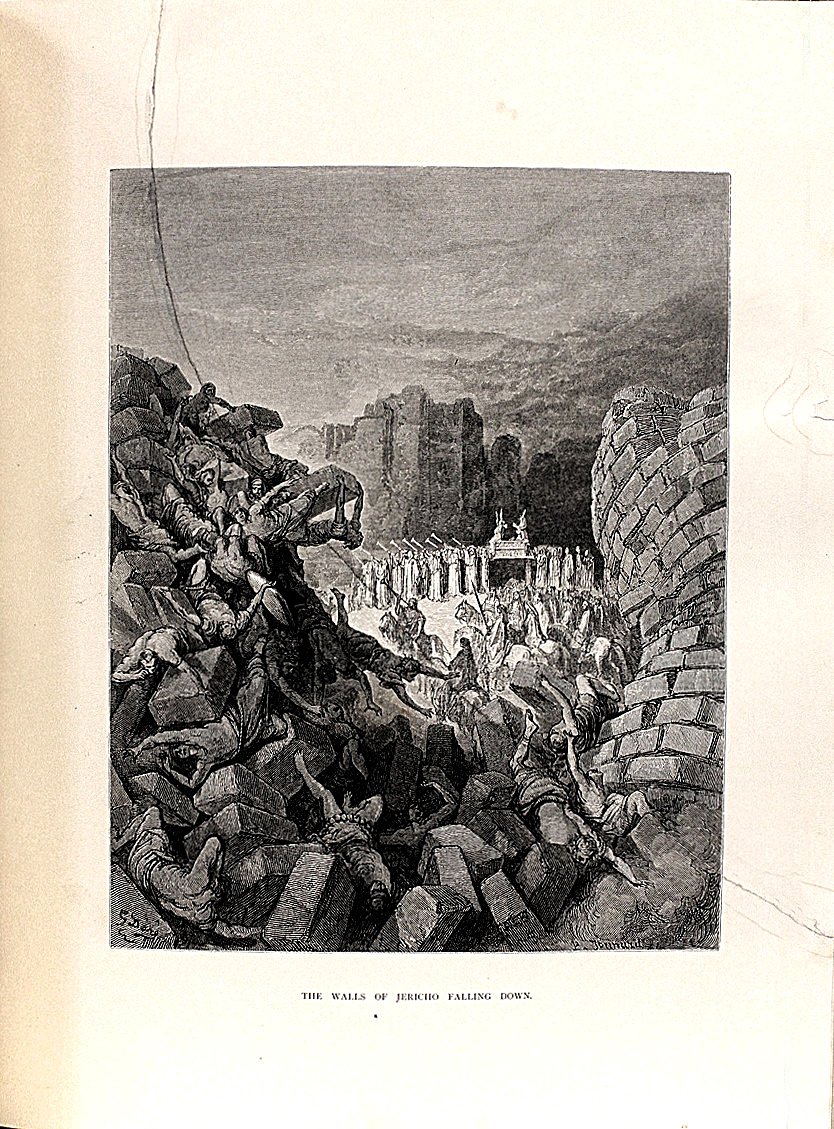
Verse 30, and the most straightforwardly triumphant event in the whole roll: by faith the walls of Jericho fell. Doré draws the triumph — the priests, the trumpets, the ark going past in the middle distance.
⚠ And then look at the foreground. Most of this picture is the crushed. Bodies are pinned between the blocks, sprawled across them, falling with them; they take up more of the engraving than the procession does. The verse does not mention them, and the engraver could not avoid them. That is a fair thing to hang over this chapter, which spends eight verses at its close on what was done to people.
Two connections worth having. Rahab was in that city — she is the very next verse, and this foreground is what she and her household were the exception to. And nine verses later the chapter says that none of them received what was promised. A picture of the roll’s greatest victory sits above a text that ends by saying the victors did not arrive.
The plate is reproduced as it sits on the page of the illustrated Bible it was printed in, foxing and all.
.jpg)
Translator’s Notes
1–3 — ⚠ Two words, and one of them decided a century of councils
The most quoted sentence in the letter turns on two nouns, and both are genuinely contested.
Hypostasis. Literally a standing-under: what stands beneath something and holds it up. Its range runs from the concrete to the psychological, and translators have to pick. The objective end gives “substance” — faith is the reality of what is hoped for: KJV “the substance of things hoped for,” RV «la sustancia». The subjective end gives confidence, the standing-firm inside a person: ASV “assurance,” TNM «la certeza». NWT splits the difference with “the assured expectation.” And the Greek commercial papyri use it for a title-deed — the document proving you own something you cannot presently see — which is a fourth option and arguably the sharpest.
⚠ Now the part worth knowing. Hypostasis occurs five times in the New Testament, and one of the others is Hebrews 1:3, where the Son is the charaktēr of God’s hypostasis. That is the word the fourth-century councils turned into the technical term for person — one ousia, three hypostaseis. So the noun a translator settles here, in a verse about faith, is the same noun carrying the Trinitarian argument eleven chapters earlier. ⚠ So what should it be in English? “The standing-under” is a mistake worth naming: that is the word’s etymology, not its meaning. Hypostasis no more meant “a standing-under” to a first-century reader than understand means “to stand under” to us, and a hyphenated literalism communicates nothing while looking scrupulous. Declining to choose is still a choice; it just moves the difficulty onto the reader.
The text above reads ground — what lies underneath and holds a thing up, in ordinary English. It is chosen partly for the parallel: the second half of the verse is elenchos, a legal word, so “the ground of things hoped for, the proof of matters not seen” keeps both halves in the same register — which the Greek does. A reader who prefers the subjective sense has the ASV and TNM; one who prefers the fully objective has the KJV and RV; and the papyri reading, a title-deed, is arguably the sharpest of the three.
Elenchos is a courtroom and philosophy word: the proof that settles a matter, the cross-examination that exposes it. Socrates’ method is the elenchus. KJV “evidence,” ASV “conviction” — the same objective/subjective split as the first noun, and the versions are consistent about which side they take.
4–7 — The verb that will close the chapter, and the word behind “martyr”
⚠ First, verse 2, where English has a trap. Hoi presbyteroi is the comparative of “old” — and in the New Testament it does double duty: it names older people, the ancestors, and it names an office, the elders of a congregation. Here it is plainly the first: the referents are the people the roll is about to list, Abel and Enoch and Noah and Abraham. But “the elders” in an English Bible points hard at church office, and a reader lands on the wrong one. KJV and ASV both print “the elders”; RV gets it right with «los antiguos» and NWT with “the men of old times.” This translation reads the people of old — people rather than men because the Greek plural is generic and this particular roll contains Sarah and Rahab.
Martyreō, to bear witness, runs through the opening: the people of old were witnessed to (v2), Abel was witnessed to as righteous with God witnessing over his gifts (v4), Enoch has been witnessed to (v5). It occurs five times in the chapter, and the fifth is verse 39 — the last thing said about all of them. It brackets the roll.
⚠ And it is the root of martyr. A chapter built on the verb “to testify” ends with people sawn in two, in a language where the word for a witness became the word for someone killed for being one. The shift was already under way when this was written.
Verse 3’s “ages” is aiōnas — the same word this library met at Romans 8, and it means stretches of time as readily as worlds; “the worlds were framed” (KJV) picks one. And verse 7’s eulabētheis is not “moved with fear” so much as having taken the warning seriously — caution, not terror.
8–12 — ⚠ Whose faith is it in verse 11?
This is the sharpest textual question in the chapter, and the translation above departs from every version on the shelf, so it needs stating plainly.
The base text this library translates prints autēi Sarrai in the dative — “together with Sarah herself” — which makes Abraham the subject of the sentence: by faith, with Sarah, he received power. Most critical editions print the nominative autē Sarra instead, making Sarah the subject, and NA28 adds steira, “barren.”
The whole shelf takes the nominative. KJV “Through faith also Sara herself received strength,” ASV “even Sarah herself,” NWT and TNM the same — and RV carries the NA28 addition as well: «la misma Sara, siendo estéril».
⚠ So what decides it? Not theology — a phrase about anatomy. The power received is eis katabolēn spermatos, for the sowing or depositing of seed, which in Greek usage describes the father’s part, not the mother’s. That is the real argument for the dative, and it is why the reading survives at all. Against it: Sarah is the more striking claim, the chapter is a roll of named believers, and Genesis has her laughing at the promise — which makes her inclusion here pointed rather than obvious.
No vote is taken. The text above follows its base text and prints the alternative here in full, and a reader who prefers the other reading has every version in print on their side.
Smaller, and lovely: verse 10’s city has God as its tēchnitēs and dēmiourgos — craftsman and maker. The second word is Plato’s, from the Timaeus, and it is doing quiet work in a letter to people who knew what it meant.
13–16 — Resident aliens, and the first sounding of the ending
“Strangers and pilgrims” (KJV) is xenoi kai parepidēmoi — a foreigner and a resident alien, the second being a legal status: someone living in a place long-term without belonging to it, with the tax obligations and none of the citizenship. Philippi and its Roman colonists would have understood the distinction precisely.
Note that verse 13 already says what verse 39 will say again: they died not having received the promises. The chapter states its ending twice, once in the middle and once at the close, and the middle statement is usually skipped.
17–22 — A tense that will not resolve, and a staff
Verse 17’s “has offered up” is perfect — a completed act with standing results — immediately followed by an imperfect, “was offering up.” The Greek holds the sacrifice as both finished and in progress, which is a fair description of what Genesis 22 does to a reader.
Verse 19’s en parabolēi is “in a figure” or “as a parable” — and what it modifies is disputed: Abraham got Isaac back figuratively from the dead, or Isaac’s return is a parable of something else. Nothing settles it.
⚠ Verse 21 has Jacob worshipping “on the top of his staff”, which is the Septuagint’s reading of Genesis 47:31 — the Hebrew there has mittah, bed, and the Greek read the same consonants as matteh, staff. The writer of Hebrews is quoting the Greek Bible, and the difference is a vowel. This library has met the same pattern before: the New Testament’s Old Testament is very often the Septuagint, not the Hebrew.
23–31 — Moses, and who ends the list
Verse 23’s asteion is not “beautiful” in a general sense but something like well-formed, urbane, presentable — literally “of the town.” Exodus 2:2 says the same thing about the baby and the Greek Bible uses this word for it.
Verse 26’s “reproach of the Anointed” is tou Christou, and whether the writer means Christ specifically or the anointed status of God’s people is an old question the phrase does not resolve.
⚠ And note who closes the list of named individuals: Rahab the prostitute (v31), given the epithet without softening in any version on the shelf, and set immediately after the walls of Jericho. The roll runs Abel, Enoch, Noah, Abraham, the patriarchs, Moses — and ends on a Canaanite sex worker who hid the spies. The chapter does not comment on the arrangement.
32–38 — ⚠ Two words that occur nowhere else, and a third that may not belong
The chapter turns at verse 32 from a list of victories to a list of what was done to people, and the vocabulary turns with it.
Etympanisthēsan (v35) occurs once in the New Testament. It is built on tympanon, a drum: to be stretched over a frame and beaten, the way a drumhead is stretched. KJV and ASV both give the general “tortured,” and NWT and TNM follow. Only RV keeps the picture: «unos fueron estirados» — stretched. That is the best rendering of the word on this shelf, in any language.
Epristhēsan (v37) also occurs once: sawn in two. It is almost certainly a reference to the tradition — recorded in the Martyrdom of Isaiah, not in the Hebrew Bible — that Isaiah was executed that way by Manasseh. The whole shelf keeps it.
⚠ And a third word in the same verse, which the base text of this translation does not have. Most editions print epeirasthēsan, “they were tempted” — and it has troubled readers for centuries, because it sits in a list of stonings and sawings and killings, where being tested is a category error. The editions cannot even agree where it goes: before the sawing in one, after it in another. Many suspect a copying accident from the very similar eprēsthēsan, “they were burned.” KJV prints “were tempted,” NWT “they were tried,” TNM «puestos a prueba». The text above omits it, following its base text, and says so here.
39–40 — ⚠ The chapter’s point is that it does not end
Everything above has been building an argument that the last two verses reverse. Martyreō returns for the fifth and final time — all these, witnessed to through their faith — and then: they did not receive what was promised. The roll of triumph closes on a negative.
⚠ A note on that clause, because it is easy to misread. Epangelia means the promise and the thing promised, and “did not receive the promise” can be taken to mean they were never given one — which inverts the sentence. They had the promise; what they never got was the delivery. NWT is the clearest on the shelf here, supplying a bracket: “did not get the [fulfilment of the] promise.” KJV and ASV both print the bare “received not the promise.”
And the last word is teleiōthōsin, from teleioō, to complete or bring to its end — which occurs only here in the chapter, in its final clause: God foresaw something better so that they would not be made complete apart from us — which is how KJV, ASV and NWT all read it (“made perfect”). This translation says made complete because the point the chapter is making is about being finished, not about flawlessness.
⚠ Read plainly, that is a strange and generous claim, and it is worth not smoothing: the people in this list are not presented as having arrived. They are presented as waiting — and as unable to be finished without the readers of the letter, who had done nothing yet. The most famous chapter about faith in the Bible ends by saying that its own heroes are not done.
Patterns worth carrying forward.
⚠ The chapter has a countable skeleton. Pistei — “by faith” — opens exactly eighteen verses: 3, 4, 5, 7, 8, 9, 11, 17, 20, 21, 22, 23, 24, 27, 28, 29, 30, 31. The translation above keeps all eighteen in the same position and the same words, because the repetition is the structure. The gaps matter too: the run breaks at 12–16 and again after 31, and both times the chapter stops listing and starts arguing.
⚠ And a second thread brackets it. Martyreō, to bear witness, occurs five times: the people of old were witnessed to (v2), Abel twice (v4), Enoch (v5) — and then verse 39, the last thing said of them all. It is the root of martyr, in a chapter that ends with people sawn in two.
⚠ Verse 1 turns on a word that decided a century of councils. Hypostasis is literally a standing-under, and its range forces a choice: “substance” (KJV, RV) at the objective end, “assurance” (ASV) and «certeza» (TNM) at the subjective, NWT’s “assured expectation” between them — and, in the commercial papyri, a title-deed: the document proving you own what you cannot see. It occurs five times in the New Testament, and one of the others is Hebrews 1:3, where the Son is the impress of God’s hypostasis — the word the fourth-century councils made the technical term for person. The text above reads ground — what lies underneath and holds a thing up — chosen partly for the parallel, since the second half of the verse is a legal word: the ground of things hoped for, the proof of matters not seen.
⚠ Whose faith is verse 11? The base text prints the dative — “together with Sarah herself” — making Abraham the subject; most editions print the nominative, making Sarah the subject, and every version on the shelf follows them. What decides it is not theology but a phrase about anatomy: the power is for the sowing of seed, which in Greek describes the father’s part. Against that, Sarah is the more striking claim and Genesis has her laughing at the promise. No vote is taken; the translation follows its base text and prints the alternative in the note.
⚠ Two words that occur nowhere else, and one that may not belong. Etympanisthēsan (v35) is built on tympanon, a drum — stretched over a frame and beaten. Only RV keeps the picture, with «estirados», stretched; every other version gives the general “tortured.” Epristhēsan (v37) is sawn in two, the traditional death of Isaiah. And most editions add epeirasthēsan, “they were tempted,” which has troubled readers for centuries because it is a category error inside a list of killings — the editions cannot even agree where to put it. The base text omits it, and so does the text above.
Renderings chosen. “Standing-under” and “proof” at v1. “Resident aliens” for parepidēmoi at v13, which is a legal status rather than a mood. “Stretched on the drum” at v35. And “craftsman and maker” at v10, where the second word is dēmiourgos — Plato’s word, from the Timaeus.
⚠ And the ending, which is the point. The most famous chapter about faith in the Bible closes on a negative: they did not receive what was promised — they had the promise; what they never got was the delivery. Its last word is teleioō, to complete, used only there in the chapter, and the claim is that these people cannot be made complete apart from us. The roll of heroes ends by saying the heroes are not done. Verse 13 says the same thing in the middle, and is usually skipped.
⚠ A note on order: Hebrews stands on these pages at chapters 1 and 11 — a deliberate jump to the most-searched chapter in the letter. The sequential thread is unchanged: next in sequence is Hebrews 2, which is where the navigation above points.