Numbers 22 — The Mister Translation
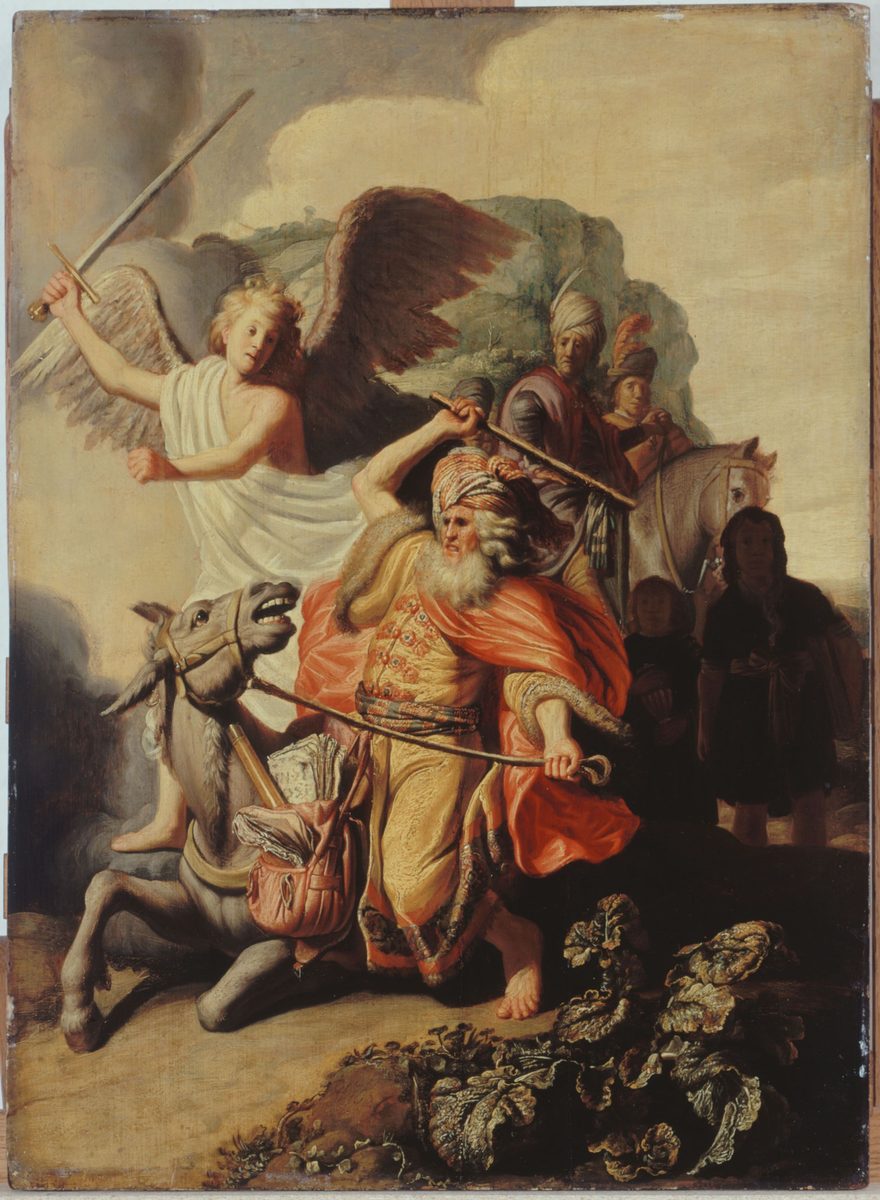
⚠ Look where Balaam is looking. The angel is at his shoulder — close enough to touch, sword up, mouth open — and Balaam’s face is turned down and away. Rembrandt has put the whole point of vv22-31 into one arrangement of heads: the man whose profession is seeing does not see, and neither do the two servants riding behind him. ⭐ Three details are exactly right. The donkey is DOWN on her knees, which is v27 and not v23 or v25 — the third refusal, the one that finally provokes him. Her mouth is OPEN: this is the instant of v28. And what Balaam is swinging is a maqqel, a stick, which is the word v27 uses — not a whip. ⚠ The painting is signed and dated 1626, when Rembrandt was about twenty; it is one of his earliest surviving works, and the crowded, stagey arrangement is a young painter’s. The sword the angel holds is the one Balaam says at v29 he wishes he had.

Numbers 22:1-6 — Balak son of Zippor — why Moab hires a prophet instead of raising an army, and the seer who turns up in a real inscription
Balak has just watched what happened in the previous chapter and drawn the obvious conclusion. Numbers 21 ended with Israel taking everything from the Arnon to the Jabbok off Sihon, and then destroying Og as well — and v2 says exactly that: Balak ‘saw all that Israel had done to the Amorite’. ⚠ Note what he does NOT do. He does not muster Moab. Sihon had an army and it did not help him, so Balak goes looking for the one weapon a bigger army cannot answer. The whole story is set in motion by a king who has correctly worked out that he cannot win a fight.
⭐ And Balaam son of Beor is one of the very few NON-ROYAL figures in the Hebrew Bible attested by name in an inscription found outside it. In 1967 a Dutch expedition digging at Tell Deir ‘Alla, in the Jordan Valley east of the river, recovered a text written in ink on wall plaster that had fallen and shattered. Reassembled, its opening line reads: the misfortunes of the Book of Balaam son of Beor, the man who was a seer of the gods. It dates to roughly the eighth century BC, is written in a dialect scholars still argue about (Aramaic, or a local Canaanite one), and it tells of Balaam receiving a terrifying night vision from the gods and weeping the next morning. ⚠ Two honest cautions, because this is the kind of find that gets over-claimed. The plaster is broken and many lines are reconstructed, so specific readings are genuinely contested. And it is not a copy of Numbers — it is an independent tradition, centuries later, from the same region, about a figure with the same name and the same father. What it establishes is that Balaam was a known name in Transjordan, remembered locally as a visionary, which is precisely how Numbers introduces him: not as an Israelite prophet but as a foreign professional whose reputation reaches as far as Moab.
⭐ Moab’s reaction in v3 is two verbs, and the second is one this project met last chapter. Va-yagor is ordinary dread. Va-yaqotz is quts — to feel a physical revulsion — the verb Numbers 21:5 used when Israel said ‘our soul loathes this worthless bread’. ⚠ A consonantal search will not pair them, because quts is a hollow root and the two forms share only two letters; this is a lexical link, not a string match, and it is worth saying which kind of claim it is. The shelf splits on how bodily to make it: KJV and ASV flatten to ‘was distressed’, Geneva reads ‘fretted’, NIV ‘filled with dread’, RV 1909 and RV60 «angustióse» — while the NWT 1984 alone in English keeps the nausea, ‘a SICKENING dread’, and the TNM 1987 matches it with «un pavor MORBOSO». Moab is not merely frightened of Israel; Moab is sick at the sight of them, in the same word Israel used about the manna.
The simile in v4 is an ox stripping a field, and one revision loses it. Ki-lchokh ha-shor et yereq ha-sadeh — as the ox LICKS UP the greenery. Almost everyone keeps the licking (KJV, ASV, Geneva, NIV, RV 1909 «como lame el buey», NWT 1984 ‘the bull licking up’), which matters because licking is what makes the picture unnerving — it is not violence, it is unhurried consumption. ⚠ The NWT 2013 replaces it with ‘devour’ twice, and the Douay explains it away as eating ‘to the very roots’.
⚠ And the Douay puts Balaam somewhere else entirely. The Hebrew of v5 says Pethor is in the land of bnei ammo, ‘the children of his people’. The Douay prints ‘the children of AMMON’ — the same consonants read as the nation rather than the pronoun, a reading the Samaritan text and some Syriac witnesses share. It also calls him ‘a soothsayer’ in the same verse, a description the Hebrew does not supply until Joshua 13:22. Two departures in one sentence, and both go back to the Latin.
⭐ ‘It has covered the EYE of the land’ — and the chapter has not started talking about eyes by accident. The Hebrew of v5 and v11 is ein ha-aretz, the eye of the land, an idiom for its whole visible surface. ⚠ Eleven of the thirteen versions print ‘the face of the earth’ or «la faz de la tierra», which is what the idiom MEANS and is not wrong. The two that keep the eye are the two this project keeps finding: at v11 the NWT 1984 reads ‘covering the earth as far as the EYE can see’ and the TNM 1987 «hasta donde alcanza a ver el OJO» — and both of their own later revisions drop it back to the face of the earth. That is a sixth instance in this one chapter of the 1984/1987-versus-2013/2019 pattern. This translation keeps the eye, against eleven of thirteen, because it is the first of them: an eye in v5, then a she-ass who sees three times, a seer who does not, eyes uncovered at v31, and a king who ends the chapter marching his prophet uphill for a better view. The idiom is dead in Hebrew and the chapter reanimates it.
Where he is from is a small puzzle. Pethor is ‘by the River’ — in the Hebrew Bible ha-nahar with no qualifier is normally the Euphrates, which would put Balaam some four hundred miles away in northern Syria. The versions all keep it vague except the TLB, which decides for the reader and prints ‘near the Euphrates River’. Deuteronomy 23:5 says Pethor was ‘of Aram-naharaim’, which supports that; the Deir ‘Alla plaster, if it belongs to the same tradition, would suggest somewhere far closer to home. This translation prints what the Hebrew prints.
The blessing formula is Abraham’s, in a pagan king’s mouth. v6: ‘the one you bless is blessed, and the one you curse is cursed’. At Genesis 12:3, already on these pages, Jehovah says to Abram: ‘I will bless those who bless you, and the one who treats you slightingly I will curse.’ ⚠ The difference is who is doing it. In Genesis the power is God’s; here Balak locates it in Balaam — he is hiring what he thinks is a mechanism. The rest of the chapter is about him being wrong.
Two structural things a reader cannot see in translation. First: after v1 this chapter has no Masoretic paragraph break at all — forty verses in one unbroken block, where Numbers 20 has five breaks in twenty-nine verses and Numbers 21 three in thirty-five. The scribes marked the Balaam story as a single unit and did not let the reader stop. Second: the weekly synagogue portion that begins at v2 is called Balaq — named for the enemy king, one of very few Torah portions to carry a gentile’s name.
Numbers 22:7-14 — Balaam’s fee is literally divination money — and he changes the curse-word when he repeats the message to God
⭐ This is the sharpest thing in the chapter and one version on each shelf sees it. Balak’s request in v6 uses arar: arah-li et-ha-am ha-zeh, curse this people for me. When Balaam repeats that request to God in v11, he uses a different verb — qabab, qavah-li oto. And when God answers in v12 he goes back to Balak’s original word: lo ta’or, you shall not arar them. ⚠ Both verbs mean to curse and Hebrew has at least four; the datum is not the meaning but the SWITCH, and that God’s reply corrects it. Exactly two of our thirteen witnesses print two different words here: the NWT 1984 (‘curse’ → ‘execrate’) and the TNM 1987 («maldíceme» → «exécramelo»). The other eleven print one word twice — KJV, ASV, Geneva and Douay all ‘curse’, NIV ‘put a curse on’ both times, RV 1909 and RV60 «maldíce» both times — and that includes the NWT’s own 2013 revision and the TNM’s own 2019, each of which flattens what its predecessor kept. That pattern has now appeared in five Numbers chapters running.
⚠ What the switch might mean is genuinely open, and this translation does not vote. It may be nothing — a storyteller varying his vocabulary. It may be characterisation: Balaam softening the request, or reaching for the more technical word of his own trade. Rendering it ‘hex’ in v11 and v17 is a way of keeping the two verbs visibly different in English without pretending to know which shade is meant; the note is where the range belongs.
The delegation arrives carrying qesamim, and the word is not neutral. v7 says the elders came ‘with the fees of divination in their hand’. Qesem is the standard Hebrew term for the practice, and Deuteronomy 18:10 heads its list of forbidden divinatory practices with qosem qesamim — alongside nachash, the omen-reading this project met in Genesis 44. Joshua 13:22 will call Balaam flatly ha-qosem, the diviner. ⚠ So the chapter introduces its foreign prophet with a professional label the Torah elsewhere forbids, and then has him speak the divine name in the very next verse. The shelf is split on how plainly to say it: KJV, ASV and Geneva keep ‘the rewards of divination’, NWT 1984 has ‘payments for divination’, and the RV 1909 and RV60 read «con las dádivas de adivinación».
‘Who are these men with you?’ God’s opening question at v9 is not a request for information. It is the same move as Genesis 3:9, ‘Where are you?’, and Genesis 4:9, ‘Where is Abel your brother?’ — a question put to someone who is about to have to say out loud what he is doing. Balaam answers it fully and accurately, and then adds the request. The chapter keeps doing this: giving him chances to be honest, which he keeps taking, right up to the point where it costs him something.
Numbers 22:15-21 — ‘A house full of silver and gold’ — the greed the New Testament sees, and the restraint this chapter actually shows
⚠ Read Numbers 22 on its own and Balaam behaves better than his reputation. He refuses the first delegation outright. He tells the second that a palace of silver and gold could not make him exceed ‘the mouth of Jehovah my God’ — and he says my God, using the covenant name. He asks permission a second time rather than assuming it. He goes only when told to go. Nothing in this chapter has him accept a fee.
And the rest of the Bible is much harder on him than that. Numbers 31:16 says it was Balaam’s advice that led Israel into the disaster at Peor; Deuteronomy 23:5 and Joshua 24:9-10 remember him as a hired mouth God overruled; Joshua 13:22 kills him among the Midianites and calls him a diviner. In the New Testament he becomes a type: 2 Peter 2:15 has him ‘loving the wages of unrighteousness’, Jude 11 names his ‘error’, and Revelation 2:14 charges him with teaching Balak to trip Israel up. ⚠ This library’s own encyclopedia entry for Balaam was written from Jude, and it carried only the verdict. It has been rewritten for this chapter to hold both: the later tradition is not making the condemnation up — Numbers 31 is in Numbers — but the portrait here is of a man being scrupulous, and a reader who meets only the verdict will not recognise the man in vv18-19.
What he says he cannot go beyond is, in the Hebrew, God’s MOUTH. Lo uchal la-avor et pi Jehovah Elohai — the mouth, not the word. Most of the shelf smooths it to something more abstract: ‘the word of the Lord my God’ (KJV, ASV, Geneva), ‘the command’ (NIV, TLB), ‘the order’ (NWT 1984). ⚠ Keeping ‘mouth’ is not pedantry here: this whole chapter is about a mouth — God opens a donkey’s at v28, puts words in Balaam’s at v38, and the entire arrangement of the next two chapters is that Balaam may only say what is put there. The organ is the theme. Note too that he ends the sentence ‘to do anything small or great’ — KJV and Geneva read ‘less or more’, which is the same idiom for the whole range.
⚠ The hardest thing in the chapter is that God says go and is then angry that he went. v12: do not go. v20: get up and go. v22: God’s anger burned because he was going. The readings, with their pedigrees and no vote from us. (1) The permission is a concession, not an instruction — the condition ‘IF the men have come to call you’ hands the decision back, and Balaam treats a permission as a green light. (2) It is his eagerness that is judged, not the journey — and the angel does not, in the end, send him home; when Balaam offers to turn back at v34, he is told to carry on. (3) Two strands of an older telling, imperfectly joined, which is the standard source-critical account and worth stating as a reading rather than a discovery. ⚠ Whichever one is right, the narrative is not embarrassed: it lets both stand in consecutive verses and moves on. The TLB is the only version on either shelf that resolves it for the reader, adding a motive the Hebrew does not have — ‘God was angry about Balaam’s EAGER ATTITUDE’. That is reading (2), printed as though it were the text.
Numbers 22:22-27 — Satan in Numbers 22 — every Bible prints the name in Job and translates it here
⭐ Thirteen versions out of thirteen, twice over, and it is the cleanest split this project has measured. The angel of Jehovah stands in the road le-satan lo — as a satan to him. At Job 1:6 and Zechariah 3:1, where the same noun names the figure who stands in God’s court, all thirteen print it as a proper name: ‘Satan’ in the KJV, ASV, Geneva, Douay, NIV, TLB, NWT 1984, «Satán»/«Satanás» in the RV 1909, RV60, NVI and TNM 1987. Here, not one of the thirteen prints the word at all. It becomes ‘an adversary’ (KJV, ASV, RV 1909, RV60), ‘to oppose / to resist’ (NIV, NWT 1984, TNM 1987), ‘to be against him’ (Geneva), «a no dejarlo pasar» (NVI) — and the TLB supplies a purpose the Hebrew never states, ‘to KILL him’.
Why they are right to translate it, and why it still costs the reader something. Satan is an ordinary noun meaning an opponent, and le-satan, ‘as an adversary’, stands in exactly four verses of the Hebrew Bible: these two, and 1 Samuel 29:4, where Philistine commanders worry that David will turn into one in battle, and 2 Samuel 19:23, where David calls the sons of Zeruiah one. ⚠ Not one of those four is the devil; two of them are God’s own angel. The titled figure of Job and Zechariah is always HA-satan, WITH the article — the Accuser, an office — and Hebrew does not put ‘the’ in front of a name. So the versions are following a real distinction. What a reader loses is the ability to see that the office-holder in Job and the angel in this road are described by the same word.
⚠ And this is the second chapter running where the shelf transliterates a word for the supernatural and translates it for the ordinary. Numbers 21:6 did it with seraphim: twelve of thirteen transliterate at Isaiah’s throne and all thirteen translate when the same plural noun bites Israel. Two chapters, two words, the same instinct — a Hebrew common noun becomes an English proper noun exactly when the referent is felt to be a spiritual being. Worth watching for; it is a habit of translation, not of the Hebrew.
⭐ The seer cannot see, and the animal can. Three times the she-ass sees the angel (vv23, 25, 27) and three times Balaam does not; he is a professional visionary being out-seen by his own donkey, and the joke is not subtle. It closes at v31 when Jehovah UNCOVERED Balaam’s eyes — the same idiom he will use of himself in the oracles ahead, ‘the man whose eye is opened’. ⚠ Note also what the two angers have in common: v22 va-yichar af Elohim, God’s anger burned, and v27 va-yichar af Bil’am, Balaam’s anger burned. The identical phrase, five verses apart, for God and for the man who cannot see God’s messenger.
Numbers 22:28-30 — ‘These three times’ is the Torah’s phrase for the three pilgrim festivals
⭐ The donkey counts her beatings in the vocabulary of Israel’s festival calendar, and nothing in any translation can show it. She says zeh shalosh regalim — literally ‘these three FEET’, an idiom for three occasions. That exact phrase stands in four verses of the Hebrew Bible. Three are here (vv28, 32, 33 — hers, then the angel’s, twice). The fourth is Exodus 23:14, already on these pages: shalosh regalim tachog li ba-shanah — ‘three times in the year you shall keep a festival to me’, the law of the three pilgrimages. ⚠ Every version renders both as ‘three times’, which is correct and unavoidable; the TLB alone brings the other sense out at Exodus 23:14 with ‘three annual religious PILGRIMAGES’, and the Douay alone miscounts here, printing ‘lo, now this third time’. The irony is free and nobody planted it: a foreign diviner is on a journey he was three times warned off, being addressed in the phrase that means a journey you are commanded to make.
⭐ Balaam’s reply is one rare word, and its only other occurrence is God speaking about Egypt. v29: ki hit’allalt bi — ‘because you have made a fool of me’. That form of the verb stands in exactly two verses. The other is Exodus 10:2, where Jehovah tells Moses to recount to his children et asher hit’allalti be-Mitzrayim — what I made sport of in Egypt. ⚠ Read the hits and not the tally: the root is common enough in other forms. But this form, with this force, belongs to God dealing with Pharaoh and to a man shouting at a donkey.
And what he shouts is the chapter’s best line of dramatic irony. ‘If only there were a sword in my hand — I would have killed you by now.’ There IS a sword; it is drawn; it is six feet away in the hand of the angel he cannot see, and v33 says the angel would have used it on him. The versions all keep it, because it needs no help.
Her argument at v30 is a character reference, and one version cuts it. She does not protest that the beating is unjust; she asks him to reason from thirty years of evidence — am I not your she-ass, on whom you have ridden all your life until this day? Have I ever been in the habit of doing this to you? ⚠ The TLB drops the first half altogether and leaves only ‘Have I ever done anything like this before in my entire life?’, which loses the claim of relationship that makes the question work. The Douay goes the other way and has her demand proof: ‘TELL ME if I ever did the like thing to thee.’ And Balaam’s answer is one syllable in every version on both shelves — ‘No’, «No», ‘Nay’ — which is the only honest thing he says in the exchange.
Two animals speak in the Hebrew Bible and this is the second. The other is the serpent of Genesis 3. ⚠ Worth noticing how differently the text handles them: Genesis simply reports that the serpent spoke and never explains it, while here the narrator says outright that Jehovah opened the mouth of the she-ass — the speech is a thing done to her, once, for a purpose. And she is a she-ass throughout, feminine in every verb; the NWT 1984 is the only English version on the shelf that says ‘she-ass’ outright, while the NIV and NWT 2013 both drop to ‘it’ the moment she speaks. The Spanish cannot avoid it: «el asna», «la burra», feminine in all four.
Numbers 22:31-35 — Yarat — the obscurest word in the chapter, and an angel who says go after all
v32’s reason is a word almost nobody can construe with confidence. The angel says he came out as an adversary ki yarat ha-derekh le-negdi. Yarat occurs in six verses of the Hebrew Bible and its sense is disputed in most of them; the guesses here run from ‘the way is perverse/contrary before me’ to ‘the way was headlong, rushed’ to an emendation that makes it ‘I have come out as an adversary, for the way is precipitate’. The shelf shows the difficulty rather than hiding it: KJV and ASV ‘thy way is contrary unto me’, NIV ‘your path is a reckless one’, NWT 1984 ‘your way has been headlong’, RV60 «tu camino es perverso delante de mí», NVI «tu camino es perverso». ⚠ This translation prints ‘reckless’ and says here that the word is uncertain, which is the project’s standing habit with a rare root rather than a preference for the NIV.
‘I have sinned’ — and then the angel tells him to keep going. Balaam offers at v34 to turn back, which is the one thing that would end the story, and is refused. ⚠ That refusal is the strongest argument against reading v22 as God simply changing his mind: the anger was not at the destination. What Balaam is given is not a cancelled journey but a muzzle — ‘only the word that I speak to you, that you shall speak’ — and the next two chapters are the muzzle working.
The eye-opening is the chapter’s hinge and it is done TO him. Va-yegal Jehovah et-einei Vil’am — Jehovah UNCOVERED Balaam’s eyes. He does not open them; they are opened. For a man whose profession is seeing, and who has just been out-seen three times by a donkey, the passive is the point.
Numbers 22:36-41 — Bamoth-baal — a king walks his hired prophet up a mountain so he can see what he is cursing
Balak meets him at the frontier, which is a small act of impatience. Ir-moab sits on the Arnon, ‘at the very edge of the border’ — the boundary Numbers 21:13 stopped the narrative twice to establish. Balak does not wait at his capital; he goes out to the edge of his own territory to collect the man. And his first words are a complaint about the delay (v37), which is not how you address someone whose blessing you believe is decisive.
⚠ ‘Did I not send and send to you?’ The Hebrew doubles the verb, shaloach shalachti — a construction this translation keeps as a doubling rather than smoothing to ‘earnestly send’ (KJV, ASV) or dropping it (NIV ‘Did I not send you an urgent summons?’). The TNM 1987 keeps it too: «¿No envié a llamarte con insistencia?»
⭐ The older half of the shelf translates the place-name and the newer half transliterates it — the same five versions that grouped together all through the last chapter. KJV, ASV, Geneva, Douay and RV 1909 all print ‘the high places of Baal’ / «los altos de Baal», so their readers see what the name MEANS; NIV, TLB, NWT 1984, RV60, NVI and TNM 1987 print ‘Bamoth-baal’, so their readers see that it is a PLACE. ⚠ Both are right and neither can be both; this translation transliterates and puts the meaning here, because v41 is a stop on an itinerary.
⚠ One word frames the last six verses and no translation shows it twice. Balak comes out to meet Balaam at Ir-moab, bi-qtzeh ha-gvul, at the EDGE of the border (v36); and at v41 Balaam looks out and sees qetzeh ha-am, the EDGE of the people. Same noun, six verses apart — the king goes to the far edge of what is his to fetch a man who is then shown only the near edge of what he is meant to curse.
And the chapter ends on the word it has been playing with all along: seeing. Balak takes Balaam up to Bamoth-baal — ‘the high places of Baal’ — specifically so that he can look at Israel, and v41 says he ‘saw from there the edge of the people’. ⚠ It is the same noun as the bamah, the raised open-air sanctuary the books of Kings spend centuries condemning, and it is very probably the same place as the Bamoth of Numbers 21:19, a stop on the itinerary two chapters ago. The man who could not see an angel standing in front of him is walked uphill to get a better view, and what he is shown is only the edge of what is there. Balak will move him twice more before he is finished.
Notes on this translation
Decisions. Hebrew and English agree on 41 verses. ⚠ The rendering to flag is ‘hex’ for qabab at vv11 and 17, against eleven of the thirteen versions consulted, which print the same word they use for arar at v6. The reason is in the note: Balaam changes the curse-verb when he repeats Balak’s request to God, and God’s answer goes back to Balak’s word — a three-move exchange that is invisible if both verbs come out as ‘curse’. Only the NWT 1984 and TNM 1987 mark it. ⚠ A third departure is flagged in the same note: ‘the EYE of the land’ at vv5 and 11, where eleven of the thirteen print ‘the face of the earth’. ⚠ Satan at v22 and v32 is rendered ‘an adversary’, with all thirteen versions, and the note carries what that costs. Elsewhere: aton is ‘she-ass’ throughout rather than the neuter most English versions drift into; regel is ‘foot’ at v25 and ‘times’ at vv28/32/33, which is the only honest way to render one word doing two jobs, with the connection kept in the note; and yarat at v32 is ‘reckless’, flagged as uncertain. There is exactly one Masoretic paragraph break in the chapter, a setumah after v1 — forty verses then run without a pause, which is itself unusual enough to note.
Library. Four new dictionary entries in both languages: arar and qabab, the two curse-verbs this chapter sets against each other, given separate entries rather than lumped because the difference is the point; qesem, divination, the fee in the messengers’ hands; and regel, the foot that also means an occasion and, three times a year, a pilgrimage. Three existing entries were rewritten: satan, which had already predicted this chapter and now carries the four-verse count and the 13-versus-13 split; balaam, which had been written from Jude and carried only the New Testament’s verdict; and midian, which mentioned this alliance without being able to link to it. Three new encyclopedia entries — Balak, Pethor and Bamoth-baal — and Balaam, Midian, the Jordan and Moab-and-Ammon gained or kept their Spanish editions.
Echoes paid — three. Numbers 21 planted this chapter as the one ‘where Balak king of Moab watches what has just happened to Sihon and sends for a prophet instead of an army’; v2 says precisely that, and names Sihon’s people. The satan dictionary entry, written for Job, had already cited Numbers 22:22 as ‘the plainest proof that the word is a role’ — the chapter it was pointing at is now here. And Numbers 21’s Arnon, established twice over as the Moab border, is where Balak comes out to meet his prophet.
Patterns worth carrying forward. First, and the one to watch: for the second chapter running, the shelf transliterates a Hebrew common noun when the referent is supernatural and translates it when the referent is mundane — seraphim last chapter, satan this one. That is a habit of translators, not a feature of Hebrew, and it will recur. Second: this chapter is built on seeing — an animal that sees, a seer who does not, eyes uncovered, and a king who ends it by walking his prophet uphill for a better view. Third: Numbers is now quoting a man the ground has independently remembered, which is rarer than it sounds.
Echoes planted. Numbers 23 (now on these pages) and Numbers 24 (not yet), where the muzzle of v35 works four times over and Balaam blesses what he was paid to curse; Numbers 25 and 31:16 (not yet), which is where his reputation is actually made and lost; and Deuteronomy 23:5-6 (not yet; the English numbering is 23:4-5), which remembers the whole affair in two verses and says that Jehovah ‘turned the curse into a blessing for you’.
⚠ A note on order: Numbers stands on these pages at chapters 1, 2, 3, 4, 5, 6, 7, 8, 9, 10, 11, 12, 13, 14, 15, 16, 17, 18, 19, 20, 21, 22, 23, 24, 25, 26, 27, 28, 29, 30, 31, 32, 33, and now 34. Chapters 35–36 remain the open sequence.