Numbers 21 — The Mister Translation
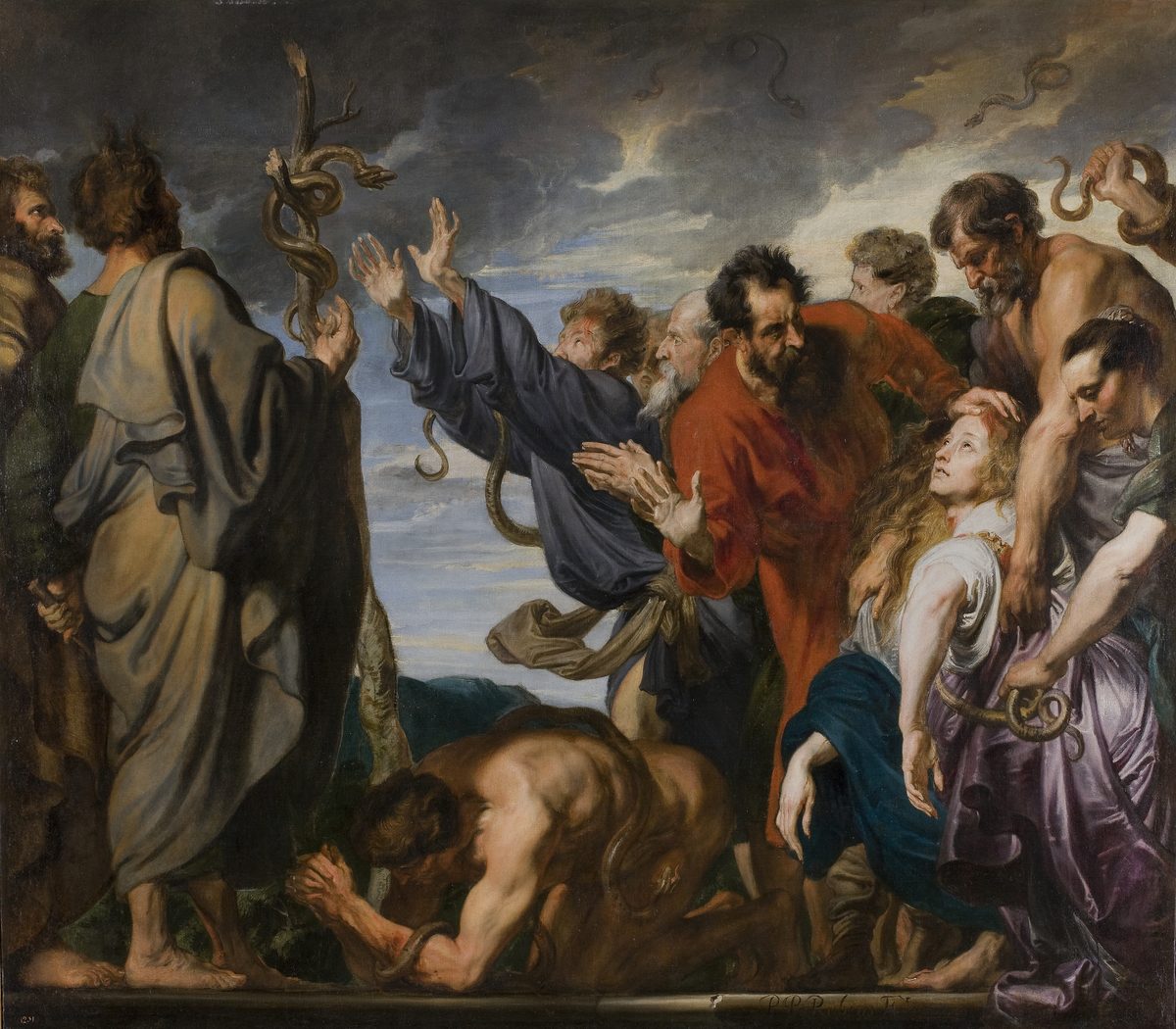
⚠ Look at what the crowd is doing. The chapter’s cure has one condition — the bitten have to LOOK — and van Dyck has painted a dozen figures of whom only two or three actually are. The rest are turned toward each other, or away, or fully occupied with the snake on their own arm. ⭐ Two details are worth catching. The pole is a bare forking BRANCH, not a manufactured standard, and the serpent on it is painted like a live snake rather than a cast metal one — so the picture quietly declines to show the two things the Hebrew of vv8-9 makes a point of: that God said only ‘a burning one’, and that Moses chose bronze. ⚠ And the museum’s own title is a small piece of evidence for a note further down this page: the Prado catalogues the canvas as The metal serpent, which is exactly what the RV 1909 calls it at v9 — the only version on either shelf that leaves the metal unnamed, where the rest say brass, bronze or copper.

Numbers 21:1-3 — Hormah meaning — the chapter opens by winning the battle Israel lost in Numbers 14
The first three verses undo a defeat this site has already published. At Numbers 14:45, the generation that had refused the land attacked the hill country anyway, without the ark and without Moses, and was beaten ‘down, as far as Hormah’. Here the next generation fights the same enemy in the same country and wins, and the place gets its name from the winning. ⚠ Same word, opposite outcome: in Numbers 14 Hormah is where Israel is broken; in Numbers 21 it is what Israel does to somebody else.
The name is the vow, spelled out. Israel promises ve-hacharamti et-areihem — I will devote their cities to cherem — and when it is done, va-yachrem, the place is called Chormah. Vow, act and name are three forms of one root, and no English rendering can carry that without a note. Two versions supply one anyway, from opposite ends of the shelf: the Douay-Rheims glosses it inside the verse, ‘Horma, that is to say, Anathema’ (the Greek-and-Latin church word for a thing placed under a ban), and the TLB adds a parenthesis, ‘(meaning “Utterly Destroyed”)’. The NVI does something subtler by spelling it «Jormá», which is what the Hebrew actually sounds like in Spanish and what the other Spanish versions flatten to «Horma».
⚠ And the Bible tells the naming twice, differently. Judges 1:17 — already on these pages — has Judah and Simeon strike the Canaanite living in Zephath, put it to the ban, and call the city Hormah. That is a different tribe, a different generation and a different town name for the same place-name. This translation does not choose between them. Both are etiologies, both use the same root, and the honest description is that Israel remembered more than one occasion for the name.
‘The way of Atharim’ (derekh ha-Atarim) is a route nobody can now locate. The KJV and TLB do not treat it as a place at all — ‘the way of the spies’, following the Targum and the Vulgate, which read the consonants as if from tur, to scout; the ASV, NIV, NWT 1984 and all three Spanish versions keep it as a name. We keep the name, on the general rule that an untranslated word is more honest than a guessed one.
Numbers 21:4-5 — ‘Our soul loathes this bread’ — two Hebrew words for fed up, and a bread they say does not exist
They are on this road because of the previous chapter. Edom refused passage at Numbers 20:18-21 and Israel turned away rather than fight, so v4 has them going around the land of Edom by the way of the Red Sea — south, away from where they are trying to go. The grumbling that follows is not free-floating petulance: the Hebrew says their patience ran out ba-derekh, ON THE WAY, and the way had just become a great deal longer.
The complaint contradicts itself in one breath, and every version keeps the contradiction. ‘There is no bread… and we are sick of this bread.’ Nobody smooths it, which is right: the sentence is a portrait of a mood, not a report of a shortage. The bread they are sick of is the manna, and they have already called it by name and described it in Numbers 11.
⚠ Two different verbs, one word apart in sound, and the shelf hears neither. v4 is va-tiktzar nefesh ha-am, the people’s nefesh grew SHORT; v5 is nafshenu qatzah, our nefesh LOATHED. Qatzar and qutz are unrelated roots that happen to chime, and the chapter puts them in consecutive verses with the same subject. ⭐ The idiom in v4 is rare, and where else it occurs is the interesting part: va-tiktzar nefesh stands in exactly four verses in the Hebrew Bible — here; Samson at Judges 16:16, worn down to death by Delilah’s nagging; Zechariah 11:8; and Judges 10:16, where it is God’s own nefesh that grows short — over Israel’s misery. The same idiom describes a people who cannot stand God any more and a God who cannot stand their suffering any more.
Why this translation says ‘the people’s patience ran out’ rather than ‘the soul of the people was short’. The literal phrase produces no English meaning; it is the sort of rendering that looks faithful on the page and communicates nothing. KJV and ASV read ‘much discouraged’, which is a real English idea but the wrong one — the Hebrew is exasperation, not despondency. NIV gets closest with ‘grew impatient’, the NWT 1984 keeps the nefesh visible at the cost of the idiom (‘the soul of the people began tiring out’), and the RV 1909 finds the best Spanish line on the shelf, «abatióse el ánimo del pueblo».
‘This worthless bread’ — and the King James is not making a mistake. Ha-lechem ha-qeloqel is the only occurrence of that form in the Bible; its root family means light, slight, of no weight, and hence contemptible. KJV, Geneva and Douay all say ‘this light bread’, which reads today as a comment on the loaf’s density; in 1611 ‘light’ still carried the sense of trifling, and the same range is exactly what the Hebrew has. NIV ‘this miserable food’, NWT 1984 ‘the contemptible bread’ and TNM 1987 «el pan despreciable» take the contempt; RV 1909 and RV60 keep the older sense with «este pan tan liviano».
Numbers 21:6-7 — Seraphim in Numbers 21 — the word every Bible transliterates at Isaiah’s throne, and translates when it bites
⭐ This is the best single fact in the chapter, and it is checkable in any two Bibles you own. The creatures Jehovah sends are ha-nechashim ha-seraphim. That second word, in the plural, stands in exactly three verses of the Hebrew Bible: this one, and Isaiah 6:2 and 6:6 — the six-winged beings standing above the throne, one of whom carries a burning coal to the prophet’s mouth. It is the same plural noun. And the shelf treats it as two different words: at Isaiah 6 twelve of our thirteen witnesses simply transliterate it — ‘seraphims’ (KJV, Geneva, Douay), ‘seraphim’ (ASV, NIV), ‘seraphs’ (NWT 1984), «serafines» (RV 1909, RV60, NVI, TNM 1987) — while here not one of the thirteen transliterates it at all.
Here is how the thirteen divide at v6. Six keep the fire: KJV, ASV, Geneva and Douay read ‘fiery serpents’, and RV 1909 and RV60 read «serpientes ardientes». Seven replace it with a medical explanation: NIV ‘venomous snakes’, TLB ‘poisonous snakes’, NWT 1984 ‘poisonous serpents’, and NVI and TNM 1987 «serpientes venenosas». ⚠ The second group is probably right about the biology and definitely wrong about the vocabulary: once ‘venomous’ is on the page, the sentence can no longer be connected to Isaiah’s throne-room by any reader who does not read Hebrew. This translation says ‘the burning serpents’ — strange enough to send you here, and it keeps the word.
What the word actually means is genuinely open, and the two candidates are not far apart. Saraf is the ordinary root for burning. It may describe the bite — the inflammation of a viper’s venom is a burning — or it may describe the creature, a bright or fiery-looking snake; winged uraeus-serpents guarding a throne are standard Egyptian royal iconography, which is the world these people had just left, and Isaiah’s seraphim fly. The text does not settle it and neither will we.
⚠ And the NUMBER changes at v7, which no version on either shelf prints. v6 sends ha-nechashim ha-seraphim, the burning serpents, PLURAL. From v7 the Hebrew is singular: the people ask Moses to pray that Jehovah take away ha-nachash, THE serpent — and v9 keeps the singular again, ‘if the serpent had bitten a man’. Twelve of the thirteen print a plural at v7 — ‘the serpents’ (KJV, ASV, Geneva, NWT 1984), ‘the snakes’ (NIV, TLB), «las serpientes» (RV 1909, RV60, NVI, TNM 1987) — and the Douay drops the clause altogether. ⭐ A collective singular is ordinary Hebrew and that is presumably why everyone tidies it. But it is doing something here: a plural affliction is asked about as though it were one thing, and one verse later the cure IS one thing, on a pole. This translation keeps the singular — a departure from the entire shelf, which is why it is flagged here rather than left to look like a slip.
⚠ One near-miss worth stating out loud, because it is the sort of thing a letter-search gets wrong. Searching the Hebrew Bible for those consonants in the plural returns five verses, not three. The two extras are different words that happen to be spelled the same: 2 Kings 17:31, where Sepharvites are BURNING their children, and — four chapters back on this site — Numbers 17:4, where Eleazar lifts the censers of ha-serufim, ‘those who were BURNED’, the two hundred and fifty men consumed at Korah’s revolt. Passive participle there, and a serpent here. ⚠ It is a coincidence of spelling and nothing more — but it is a striking one, because in that verse the burned men’s censers are made of bronze, and three verses from here Moses will make a burning-one out of bronze.
Numbers 21:8-9 — The bronze serpent and Nehushtan — God says ‘a burning one’, and Moses makes a snake
⭐ Read v8 slowly: God does not tell Moses to make a snake. The Hebrew is aseh lekha saraf — make yourself a BURNING ONE. The noun ‘serpent’ is not in the sentence. It arrives in v9, when Moses makes a nechash nechoshet, a serpent of bronze, and from then on the object is called a serpent and never a saraf again. ⚠ All thirteen versions supply the missing noun: ‘a fiery serpent’ (KJV, ASV, Geneva), ‘a snake’ (NIV), «una serpiente ardiente» (RV 1909, RV60), ‘a fiery snake’ (NWT 1984). The Douay goes furthest and imports the metal a verse early — ‘Make brazen serpent’ — so a Douay reader never sees that God named the material nowhere and Moses chose it.
Why bronze, then? Because of how it sounds. Nachash is a serpent; nechoshet is bronze; the two words are near-twins in Hebrew and are not related in origin. Moses hears ‘make a burning one’ and makes a nachash of nechoshet — the pun is the reason for the material, and no translation into any language can show it. ⚠ Note also what the museum that owns the painting above calls it: the Prado catalogues van Dyck’s canvas as The metal serpent, which is exactly the RV 1909’s reading at v9, «una serpiente de metal». It is the only version on either shelf that leaves the metal unnamed: the rest divide between brass (KJV, ASV, Geneva, and the Douay’s ‘brazen’), bronze (NIV, TLB, RV60, NVI) and copper (NWT 1984, TNM 1987).
⭐ The phrase nechash ha-nechoshet, ‘the serpent of bronze’, occurs in exactly two verses of the Hebrew Bible — and the second one destroys it. Here it is made; then, seven hundred years later, 2 Kings 18:4 (not yet on these pages) reports that King Hezekiah ‘broke in pieces the serpent of bronze that Moses had made, for until those days the children of Israel had been burning incense to it — and he called it Nechushtan’. That third word is the same pun again, turned into a nickname: roughly ‘Bronzey’, or ‘the brass thing’. The object God commanded became the object a reforming king had to smash, and the Bible reports both without embarrassment.
⚠ And the verb changes between v8 and v9, which is easy to miss and hard to keep. God says the bitten man ve-ra’ah oto — shall SEE it. The narrative says he ve-hibbit el — GAZED at it, a stronger verb, the one used of fixing your eyes on something. ⭐ Exactly four of our thirteen witnesses print two different verbs here: KJV (‘looketh upon’ → ‘beheld’), ASV (‘seeth’ → ‘looked unto’), NWT 1984 (‘look at’ → ‘gazed at’) and TNM 1987 («mirarla» → «fijaba la vista»). The other nine print one verb twice — and that includes the NWT’s own 2013 revision and the TNM’s own 2019 revision, each of which smooths away a distinction its 1984/1987 predecessor had kept. That pattern has now turned up in four Numbers chapters running; it is a fact about those editions, not a scoreboard.
The pole is a word this site has already translated as a name for God. Nes is a raised signal — the thing an army rallies to and can see from a distance, which is the whole point of an object that has to be LOOKED at. At Exodus 17:15 Moses builds an altar and calls it Jehovah nissi, and this translation reads that as ‘Jehovah is my banner’ — so ‘banner pole’ here is not a new decision, it is the same noun kept in the same English. The shelf scatters: seven say ‘pole’ or «asta»/«poste» (KJV, NIV, TLB, RV60, NVI), the ASV says ‘standard’, Geneva and Douay say ‘for a sign’, the NWT 1984 says ‘signal pole’ — and the RV 1909 stands alone on either shelf with «la bandera», the banner.
The one place in the New Testament that reads this scene. At John 3:14, already on these pages, Jesus says: ‘And just as Moses lifted up the serpent in the wilderness, so must the Son of Man be lifted up.’ ⚠ Note what the comparison is and is not about. It is not about the serpent; it is about being raised where everyone can see it, and about a cure that works only if you look.
Numbers 21:10-15 — The Book of the Wars of Jehovah — a lost book quoted once and never named again
Verse 14 quotes a book we do not have. Sefer milchamot YHVH occurs in exactly one verse of the Hebrew Bible, this one; there is no other reference to it anywhere, no author, no date, and no idea how long it was. The Bible does this more than once — the Book of Jashar is quoted at Joshua 10:13 and 2 Samuel 1:18 — and the honest description is that Israel had a war-poetry literature of which the Torah has preserved four lines by quoting them.
⚠ And the four lines are the hardest Hebrew in the chapter, which is itself evidence they are old. Archaic poetry loses its bearings first. Et-Vaheb be-Sufah has no verb, and the shelf splits eight to five on whether the first two words are place-names at all. ASV, NIV, TLB, NWT 1984, NVI and TNM 1987 read names — ‘Vaheb in Suphah’. KJV, Geneva, Douay, RV 1909 and RV60 print a sentence instead: ‘What he did in the Red sea’, «Lo que hizo en el mar Bermejo». ⭐ That second reading is not an invention — suf is the reed of the yam suf — the sea these pages print as the Red Sea — and be-sufah can be read as a common noun: the letters be-sufah stand in exactly two verses of the Bible, and the other one is Nahum 1:3, already on these pages, where Jehovah’s way is ‘in the WHIRLWIND’. So the same four letters can be a place in Moab or a storm, and the older half of the shelf took the storm. ⚠ The NIV does something else again and prints ‘Zahab’, changing a consonant of the Masoretic text; this translation follows the letters that are there.
Between the serpents and the war, the chapter turns into an itinerary — Oboth, Iye-abarim, the valley of Zered, the Arnon. The pace is deliberate: nothing happens for six verses, and the geography is doing the work, because the Arnon gorge is a real and formidable boundary and v13 stops to say so twice. Crossing it means Israel has left the country it was forbidden to touch and entered the country it will take.
Numbers 21:16-20 — The Song of the Well — Numbers 20 done right, and a ruler’s staff from Genesis 49
⭐ Put this beside the chapter before it and the point is unmissable. In Numbers 20 there is no water; the people quarrel; God tells Moses to take the rod and SPEAK to the crag; Moses calls them rebels and strikes it twice, and it costs him the country. Here God says esof et-ha-am ve-etnah lahem mayim — gather the people and I will give them water — and there is no complaint, no rock, no rod and no striking. The people sing instead. The chapter has spent v4-5 showing this generation grumbling exactly like the last one, and then shows it doing the one thing the last one never did.
The song is very short and probably very old. Ali ve’er, enu-lah — two imperatives and a well addressed as if it could hear. ⚠ The second verb, anah, means to answer or respond as much as to sing; the NWT 1984 catches this with ‘Respond to it’ where KJV, ASV and NIV all say ‘sing’, and TNM 1987 has «¡Respóndanle, ustedes!» against the RV60’s «a él cantad». Both are in the word; a work-song is a call and a response.
‘With the ruler’s staff’ — and the shelf disagrees about what that is, but never with itself. Mechoqeq comes from the root for inscribing or decreeing, and so it means either the person who decrees or the staff he holds. It stands in eight verses, and one of them is Genesis 49:10, already on these pages: ‘the sceptre shall not depart from Judah, nor the ruler’s staff from between his feet’. ⭐ No version crosses between the two senses between the two verses — each stays on its own side of the word. The person-camp: KJV and Geneva say ‘lawgiver’ in both, RV 1909 and RV60 say «legislador» in both, and the Douay says ‘a ruler’ in Genesis and ‘the lawgiver’ here — different English, same idea of a man. The object-camp: ASV (‘the ruler’s staff’ → ‘the sceptre’), NIV and NVI print a staff both times. And the NWT 1984 and TNM 1987 use the identical phrase, ‘commander’s staff’, in both. The shelf splits three ways and each version is internally consistent, which is worth noticing, because it means the disagreement is about the word and not about either passage. We keep Genesis 49’s wording here, for the same reason.
Beer simply means ‘well’, so v16 says the people came to Well, and it is the well. The TLB is the only version on either shelf that tells the reader so, with ‘Beer (meaning “A Well”)’. From here the itinerary climbs — Mattanah, Nahaliel, Bamoth, and then the valley below Pisgah, the ridge from which Moses will eventually be shown the land he is not allowed to enter.
Numbers 21:21-31 — The ballad of Heshbon — a taunt-song about Sihon, re-sung by Jeremiah against Moab
The embassy to Sihon is the embassy to Edom, one chapter later and one degree colder. Compare the two, which is possible on this site: Numbers 20:17 asks Edom na’brah-na be-artzekha — ‘let US pass, PLEASE, through your land’ — and v22 here asks Sihon e’brah be-artzekha, ‘let ME pass through your land’. ⚠ The polite particle na is gone and the plural has become a singular. Everything after that is nearly word for word the same speech: we will not drink well-water, we will go by the king’s road, until we have passed your border. Both kings refuse. Edom is left alone and Sihon is destroyed — the difference being that Edom is kin and Deuteronomy 2 says so explicitly.
⭐ The ballad in vv27-30 is a captured song. It celebrates Sihon’s victory over MOAB — not Israel’s victory over Sihon — and Israel quotes it because the land it is now standing on was already taken once. That is what v26 is doing there: it is a legal note. Moab cannot claim this territory back, because Moab had already lost it before Israel arrived.
‘The ballad-makers’ is one word, and it occurs once in the Bible. Ha-moshlim is the plural participle of mashal, and this exact form stands in no other verse. The shelf divides three ways: six say proverbs — KJV and ASV ‘they that speak in proverbs’, Geneva and Douay likewise, RV 1909 and RV60 «los proverbistas»; three say poets (NIV, TLB, NVI); and four hear the mockery, which is the sense the passage actually needs — NWT 1984 ‘the sayers of mock verses’, TNM 1987 «los pronunciadores de versos burlescos». ⚠ And there is a joke in the word that no version can print: the root mashal means both ‘to be like’ and ‘to RULE’. The verse-makers and the ruler are spelled the same, in a poem about a king who ruled and then did not.
⭐ Some eight centuries later Jeremiah sings this song again, at Moab, and both texts survive to be compared. Numbers 21:28 reads ki-esh yatz’ah me-Cheshbon, lehavah mi-qiryat Sichon: akhlah Ar Moav. Jeremiah 48:45 (not yet on these pages) reads ki-esh yatza me-Cheshbon, ve-lehavah mi-bein Sichon, va-tokhal pe’at Moav — the same opening clause, the same fire out of the same city, with ‘from the town of Sihon’ altered to ‘from the midst of Sihon’ and ‘Ar of Moab’ to ‘the corner of Moab’. Jeremiah 48:46 then takes v29 as well: ‘Woe to you, Moab! The people of Chemosh is undone; for your sons are taken captive, and your daughters into captivity.’ An Amorite victory song about Moab, quoted in the Torah as a property record, becomes a prophetic oracle against Moab. Three uses, one poem.
⚠ Verse 30 is the most damaged line in the chapter, and the shelf simply comes apart on it. Count the readings: ‘We have shot at them’ (KJV, ASV), ‘Their empire also is lost’ (Geneva), ‘Their yoke is perished… they came weary to Nophe’ (Douay), ‘we have overthrown them’ (NIV), «devastamos el reino de ellos» (RV 1909, RV60), and the NWT 1984’s startling ‘And the WOMEN up to Nophah, the MEN up to Medeba’ — reading the consonants of va-nashim as the noun ‘women’ rather than a verb of laying waste, which its own 2013 revision then abandons for ‘Fire will spread as far as Medeba’. When a verse produces six mutually exclusive English sentences, the correct report is that the Hebrew is uncertain, and this translation gives the most defensible reading without pretending it is secure.
Chemosh is not a literary flourish. He is the national god of Moab, named on the ninth-century Mesha Stele by Moab’s own king, who credits him with victories in the same voice this ballad uses. ⚠ The NVI adds an interpretation to v29 that is not in the Hebrew — «TU DIOS convirtió a tus hijos en fugitivos», YOUR GOD made your sons fugitives — supplying a subject the verse leaves open. The Hebrew just says ‘he has made’, and it is not obvious whether the he is Chemosh or Sihon.
Numbers 21:32-35 — ‘To spy out Jazer’ — Numbers finally changes its scouting verb, and a ketiv/qere at the end
⭐ This site predicted this verse, in a dictionary entry, before reaching it. The entry for tur — written for Numbers 13, where it governs the whole chapter — says that tur is NOT the ordinary Hebrew word for spying: ‘That is ragal, literally to go about on foot.’ Numbers 21:32 is the one verse in the whole book that uses the VERB ragal, and it is this chapter’s mission to Jazer. The book has used tur twelve times in chapters 13 and 14, of the twelve men whose report cost a generation the land, and once more at Numbers 15:39, negated, of scouting after your own heart and eyes. ⚠ It is not quite confined to those chapters: Numbers 10:33 already used it of the ARK going three days ahead to scout out a resting place. That is the pattern in miniature — when the ark scouts, it finds rest; when the men scout, it costs forty years.
Then it changes verbs, and the mission succeeds. Moses sends men to ragal Jazer; they capture the towns and dispossess the Amorite, in one verse, with no report brought back and no debate about it. ⚠ Do not over-read this: ragal and tur are ordinary synonyms and Hebrew is not obliged to mean anything by choosing one. But this book has been notably consistent, twelve times in a row, and the moment it stops is the moment scouting stops going wrong. The whole shelf renders it as spying — KJV and ASV ‘to spy out’, Geneva ‘to search out’, NIV ‘sent spies’, NWT 1984 ‘to spy on’, RV60 «a reconocer», NVI «a explorar» — none of which can show that a different Hebrew word has arrived.
The same verse carries a ketiv/qere. The consonants written in the column are vayirash; the reading handed down beside them is vayoresh, ‘and he dispossessed’. Both are the same root; the difference is whether the verb is simple or causative, and therefore whether Israel took the land or drove the Amorite out of it. Every version on both shelves follows the qere. The Masoretes kept the other one anyway, in the text, unpronounced — which is the habit this whole apparatus exists for.
Og gets four verses and no introduction at all. He is named as though the reader already knows him, defeated in a sentence, and never speaks. ⚠ The instruction God gives Moses at v34 is worth pausing on: al-tira oto, do not fear HIM — singular, the man, not his army. Deuteronomy 3:11 (not yet on these pages) will later add the detail everyone remembers, that Og’s iron bedstead was nine cubits long and was still on show in Rabbah of the Ammonites; Numbers says none of it. The chapter that began with Israel losing men to a Canaanite raid ends with two kingdoms taken and the whole Transjordan in hand, and it never once pauses to say so.
Notes on this translation
Decisions. Hebrew and English agree on 35 verses. ⚠ The rendering to flag is ‘the burning serpents’ for ha-nechashim ha-seraphim, against seven of the thirteen versions consulted, which read ‘venomous’ or «venenosas». The reason is stated in the note: it is the same plural noun Isaiah 6 uses of the creatures at the throne, twelve of the thirteen transliterate it there, and ‘venomous’ makes that unrecoverable for an English reader. ⚠ A second departure from the whole shelf is flagged in the same note: v7 and v9 keep the Hebrew’s SINGULAR ‘the serpent’ after v6’s plural, where twelve of the thirteen print a plural and the Douay drops the clause. Two more renderings are chosen for consistency with pages already published rather than on their own merits: ‘banner pole’ for nes, because Exodus 17:15 here reads ‘Jehovah is my banner’, and ‘the ruler’s staff’ for mechoqeq, because that is what Genesis 49:10 says. ⚠ And ‘the people’s patience ran out’ at v4 deliberately drops the word nefesh from the verse and puts it in the note: the literal ‘the soul of the people grew short’ produces no English sense, and this project’s rule is to render into real English and keep the range in the note. Elsewhere the established renderings hold: cherem ‘devote to destruction’, yam suf ‘Red Sea’, tur ‘scout out’ and now ragal ‘spy out’, kept distinct. There are three Masoretic paragraph breaks (after vv3, 16 and 20 — two petuchot and one setumah, the setumah falling between the well being promised and the well being sung about).
Library. Six new dictionary entries in both languages: saraf, the burning one; nachash, the serpent — kept separate from the identically-spelled nachash, to read omens, which already had the slug; nes, the raised signal; mechoqeq, the ruler’s staff; ragal, to spy on foot; and qeloqel, worthless. Five existing entries were rewritten: cherem, which now carries this chapter’s naming of Hormah alongside the one in Judges; tur, whose prediction about ragal this chapter pays; mashal, which gains the taunt-song and the once-in-the-Bible plural; the old nachash, which now warns about its twin; and ketiv-qere, which gains v32. Nine new encyclopedia entries — Arad, the Arnon, Sihon, Heshbon, Og, Bashan, Chemosh, Pisgah and Jazer, the Transjordan geography the rest of the Torah is now set in — all nine in both languages, with atlas coordinates; and six things gained their first SPANISH editions along the way — mashal and the old nachash in the dictionary, and Moab, Ammon, the Jabbok and Moab-and-Ammon in the encyclopedia.
Echoes paid — four. Numbers 20 planted this chapter as the one ‘where the people complain about water again and get serpents instead of a rock’; vv4-6 are that, and v16 then gives the water with no rock and no quarrel at all. The tur entry, written back at Numbers 13, named ragal as the word Numbers does not use; v32 uses it. Numbers 14:45’s Hormah, the place of a defeat, is renamed here by a victory. And the seraphim of Numbers 17:4 — who are not seraphim but burned men, spelled the same — turn out to have left bronze censers three chapters before Moses makes a bronze serpent.
Patterns worth carrying forward. First: this chapter is the hinge of the book. Everything before it happens in a wilderness Israel is being punished in; everything after happens in territory Israel holds. Second: it is built out of quoted poetry — a lost war-book, a work-song, a captured taunt-ballad — and each of the three is older than the prose around it and harder to construe, which is what old poetry looks like. Third, and worth watching: the two kings defeated here, Sihon and Og, become a fixed pair in Israel’s memory, recited together for centuries as the standard example of what God did.
Echoes planted. Numbers 22, where Balak king of Moab watches what has just happened to Sihon and sends for a prophet instead of an army; Numbers 33 (already on these pages), which lists this chapter’s itinerary again in a single run; Deuteronomy 2-3 (not yet), which retells Sihon and Og at length and adds Og’s iron bed; and 2 Kings 18:4 (not yet), where the bronze serpent of v9 is smashed by a king of Judah because Israel had started burning incense to it.
⚠ A note on order: Numbers stands on these pages at chapters 1, 2, 3, 4, 5, 6, 7, 8, 9, 10, 11, 12, 13, 14, 15, 16, 17, 18, 19, 20, 21, 22, 23, 24, 25, 26, 27, 28, 29, 30, 31, 32, 33, and now 34. Chapters 35–36 remain the open sequence.