John 3 — The Mister Translation
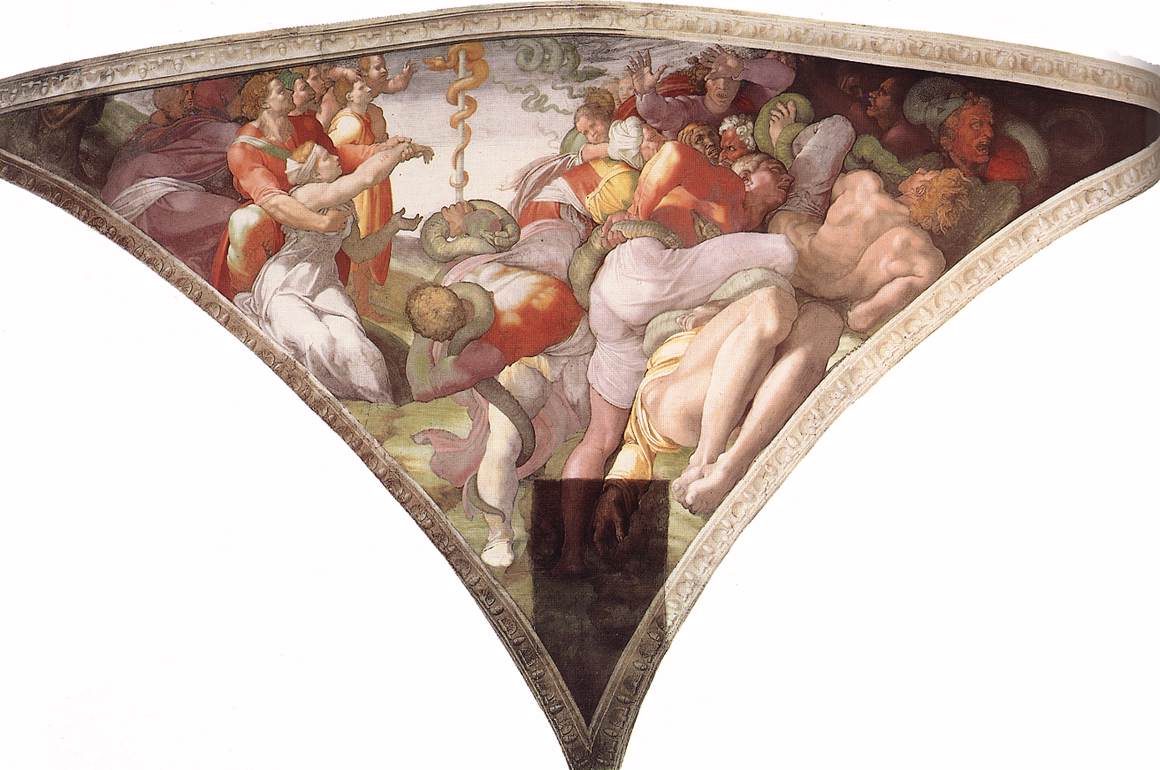
This is the scene verse 14 reaches for — Numbers 21, the bronze serpent Moses raised in the wilderness — painted on one of the four corner pendentives of the Sistine ceiling, all four of which are deliverances (the others are Judith, David and Goliath, and the punishment of Haman). ⚠ But look at how the space is divided. The remedy is small, pale and easy to miss — a thin snake on a thin pole at the centre — while the plague fills two-thirds of the picture in a mass of twisting bodies and heavy green serpents. Michelangelo gives the rescue a fraction of the field and the suffering nearly all of it. ⚠ And notice what the saved are actually doing: on the left they are standing, arms up, looking. That is the whole mechanism in Numbers — whoever was bitten looked at it and lived — and it is why this is the picture John 3 wants, because the verse it is attached to compares that looking to believing. The snake wound round an upright staff also happens to make the shape the typology needs, which no one in 1511 would have thought accidental. ⚠ The awkward triangular field is doing work too: the bodies are foreshortened and piled into the narrowing corner, which is a virtuoso solution to a bad canvas and also, incidentally, makes the dying look like they are sliding off the bottom of the world. This is the second image from this ceiling on these pages — the Jeremiah at Jeremiah 18 is the other.
.png)
Translator’s Notes
Nicodemus is a Pharisee with a Greek name. Nikodēmos is nikē (victory) + dēmos (people) — a perfectly ordinary Greek name borne by a leading Judaean, which is itself a small fact about how mixed that world was. He is an archōn, a ruler, which in this Gospel almost certainly means a member of the council. He appears twice more and both times the same way: at 7:50 insisting the law give a man a hearing, and at 19:39 arriving with a hundred pounds of spices for a burial (neither yet on these pages).
⚠ “By night” is not scene-setting. John names the hour in verse 2 and then, eighteen verses later, tells you what night means in this book: “people loved the darkness rather than the light” (v19). The chapter sets its own trap and springs it. Whether Nicodemus comes at night for safety, for privacy, or because that is simply where he still is, John does not say — he only makes sure you noticed the hour.
And he speaks in the plural. “We know that you have come from God” — he is not quite speaking for himself, which matters when Jesus answers him in the plural too at v11.
⚠ Anōthen means “from above” and it means “again,” and the dialogue only works because it means both. Jesus says a man must be born anōthen; Nicodemus hears the temporal sense and asks the famous absurd question about re-entering a womb. If the word meant only “from above,” his reply would be unintelligible; if it meant only “again,” the rest of the chapter would not follow. English has no word that does both jobs, so every translation has to break the hinge somewhere.
Counted in the archive rather than recalled: the word occurs 13 times in the New Testament, and five of them are John’s (3:3, 3:7, 3:31, 19:11, 19:23). That distribution decides a lot. Every other Johannine use is spatial — authority “given you from above” (19:11) and a tunic woven “from the top” (19:23) — and John never once uses it of time. Meanwhile the temporal sense is unmistakably real elsewhere: Galatians 4:9 has people wanting to be enslaved anōthen, all over again. So Nicodemus’s misunderstanding is a genuine possibility of the Greek and not a straw man set up to be knocked down.
⚠ And John settles which sense he means — in this same chapter. At verse 31 the word returns: “the one coming anōthen is over all… the one coming out of heaven is over all.” The second line glosses the first. John has written his own dictionary entry twenty-eight verses later, and it says from above. This translation therefore uses one English phrase in all three places, on the same rule that kept glōssa identical through Acts 2 and krabattos in Mark 2: switching words to smooth each verse hides the hinge the passage turns on. The cost is real and worth stating — in English, Nicodemus now appears to answer a question nobody asked. That is exactly what the Greek does to a reader who only hears one of the senses.
⚠ Both Spanish witnesses split the word, in the same chapter. RV 1909 has “naciere otra vez” at v3 but “El que de arriba viene” at v31; TNM has “nace de nuevo” and then “El que viene de arriba.” Neither is being careless — they are doing what English versions do, choosing per verse. Printing the split is the clearest possible demonstration that no version can hold the word together. KJV “born again”; NIV “born again” with “from above” in a footnote; NWT “born again”; ASV “anew” with “from above” in the margin.
⚠ Then it happens again at verse 8, with a different word. To pneuma hopou thelei pnei — and the verb is cognate with the noun, so the Greek says something like “the pneuma pneuses where it wishes.” Pneuma is wind and spirit: the first half of the verse is plainly weather (it blows, you hear its sound, you cannot track it) and the second half is plainly the Spirit (you are born of it). One word, two things, in one sentence built on the fact. This translation cannot keep it either — “wind” then “Spirit” — and says so rather than letting the seam pass unmarked. Hebrew ruach carries exactly the same freight, which is presumably why the sentence exists.
Verse 11 changes number on both sides at once. “We speak what we know… and you people do not receive our testimony” — the pronouns are plural where the whole scene has been one man talking to one man. Something has widened: either Jesus is speaking for a group, or John is letting a later argument between communities show through the seam of the story. The library reports the shift rather than smoothing it into the singular, which is what most English versions quietly do by using “you” for both numbers.
⚠ A textual addition at verse 13, and the direction of change is the argument. After “the Son of Man” the Byzantine tradition adds ho ōn en tō ouranō — “who is in heaven” — and the KJV prints it: “the Son of man which is in heaven.” The earliest witnesses do not have it. Ask which way a copyist would move: a scribe with a high christology has an obvious reason to add “who is in heaven” to a sentence about someone who came down from heaven and is standing on the ground; no one has a motive to delete it. Additions of that kind explain themselves. It is the same asymmetry that argues for keeping “nor the Son” at Matthew 24:36, running in the opposite direction.
Hypsoō is “lift up” and “exalt.” John uses it of Jesus three times (3:14, 8:28, 12:32), and at 12:33 he stops and explains: he said it “signifying by what death he was about to die.” So the double is not a scholar’s conjecture — the author flags it. Being raised on a stake and being raised in glory are the same verb in this Gospel, and any English word that picks one loses the other. “Lifted up” keeps both, barely.
The comparison is stranger than it sounds. Moses lifts a bronze serpent on a pole and the people who look at it live (Numbers 21:8–9). What is raised for their healing is a model of the very thing that is killing them. The verse compares the Son of Man to it and does not explain the comparison, and this translation does not explain it either.
⚠ And verse 15 has been pulled toward verse 16 by copyists. The earliest text reads simply “that everyone who believes in him may have eternal life.” The Byzantine tradition inserts “should not perish but” — which is verse 16’s wording. Direction of change again: verse 16 is the most familiar sentence in the Bible, so a copyist has every pull toward it and none away from it, and nobody deletes “should not perish” from a sentence about perishing. ⚠ The harmonization also erases a small real difference: verse 15 has en autō and verse 16 has eis auton — two different prepositions, roughly “in him” and “into him.” Once v15 is conformed to v16, the distinction is gone.
⚠ “For God SO loved the world” is about manner, not quantity. The Greek opens houtōs gar ēgapēsen, and houtōs means thus, in this way. It is not the intensifier English readers hear in “so much.” The construction is houtōs… hōste, “in this way… with the result that” — so the sentence says: this is HOW God loved the world: he gave. The familiar reading turns a statement about the shape of God’s love into a statement about its size, which is a different claim and a smaller one.
⚠ And here the Spanish shelf lands on the right side, with the archaic version leading. RV 1909 reads “Porque de tal manera amó Dios al mundo” — in such a manner, exactly the sense of houtōs — while the modern TNM has “Dios amó tanto al mundo,” loved so much. The English shelf is nearly unanimous the other way (KJV, NIV, NWT all read the degree). This is the second time on these pages that RV 1909 has beaten the TNM on exactness, after lunático at Matthew 17 — the rule is to follow whoever is tighter, not whoever is usually tighter.
Monogenēs is “the only Son,” the rendering this library fixed at John 1:14. The second half is genos, kind — not gennaō, to beget. “Only-begotten” came in through the Latin unigenitus and reads a later argument back into a word that means one of a kind. See monogenes. ⚠ Small textual note in passing: the familiar “his only Son” has the “his” only in the later manuscripts — the earliest text of both v16 and v17 reads simply the Son.
⚠ And now the decision, which this library has to make out loud because of how it prints. Greek manuscripts have no quotation marks. Nothing in the text says where Jesus stops speaking. A large number of modern editors close the speech at verse 15 and read verses 16–21 as the evangelist’s own commentary: the vocabulary is the prologue’s (monogenēs, which the narrator uses at 1:14 and 1:18 and which Jesus never uses of himself), the verbs turn past (“God loved… he gave”), and the Son is discussed in the third person throughout. Others run the quotation to verse 21. Both are respectable and neither has manuscript evidence, because there is none to have.
This translation marks Jesus’ words in red, so it cannot decline to choose. The red ends at verse 15 — following the precedent already set at Revelation 1:8, where the speaker is disputed and the words were left in ordinary type. Which means that on this page John 3:16 is not in red. ⚠ It is worth saying plainly what that does and does not mean: nothing theological turns on it. The sentence says precisely what it says either way; the only question is whose voice is saying it, and a reader who prefers the other reading loses nothing but a colour. What would be dishonest is to print the colour as though the question were settled.
Krisis here is an event, not a verdict. “This is the judgment: that the light has come into the world” — the judging is the arrival itself, not a sentence handed down afterwards. Nothing is pronounced; a light is turned on and people are already moving toward it or away from it. That is why verse 18 can say the unbeliever “has been judged already.”
Two different words for bad, flattened by most versions into one. Verse 19 has ponēra, actively evil; verse 20 has phaula, which is milder — worthless, shoddy, petty. The person who avoids the light in v20 is not necessarily a villain; he may simply have nothing he wants looked at. KJV gives “evil” for both; ASV and NWT distinguish them (“vile,” “worthless”), and this translation follows them on the merits.
“Doing the truth” is a Hebrew idiom, not a Greek one. Poiōn tēn alētheian renders asah emet — truth as something you do rather than something you hold to be the case. And the section closes the circle opened in verse 2: the man who came to Jesus by night has just been told what coming in the dark means.
⚠ This is the only place in any Gospel that says Jesus baptized. Verse 22 says it plainly — and then at 4:2 the same book adds a parenthesis taking it back: “although Jesus himself was not baptizing, but his disciples.” The library’s job is to report that the correction is in the text rather than to decide which half is the author and which a later hand. Both readings of the seam are old.
⚠ And verse 24 is an explicit chronological repair. “For John had not yet been thrown into prison” — a sentence with no narrative purpose whatever except to head off a contradiction. Mark begins Jesus’ public work after the Baptist’s arrest (Mark 1:14); this Gospel has the two men working at the same time, in sight of each other, with disciples moving between them. The aside exists because the author knows the other version.
Aenon near Salim. The name looks like Aramaic for springs, which is presumably why the text immediately explains “because there was much water there” — a gloss for readers who would not hear it. The site is genuinely unidentified; the candidates are guesses, and no pin is offered here.
The image is a specific job, not a general metaphor. “The friend of the bridegroom” is a defined role in Jewish custom — the man who arranged the match, carried the messages, and stood outside the chamber waiting to hear the bridegroom’s voice, at which point his work was finished and his part in the wedding was over. That is exactly the shape of the sentence: he rejoices because of the voice, and then “this joy of mine has been made full.” The Baptist is not being humble in the abstract; he is describing a job with a built-in ending.
“He must increase, but I must decrease.” Auxanein and elattousthai are ordinary words for growing and being made less — used of daylight, of water levels, of a man’s standing. There is no religious vocabulary in the line at all, which is why it has survived so well outside religion.
⚠ Anōthen returns, and here nothing is ambiguous. “The one coming anōthen is over all… the one coming out of heaven is over all” — the second clause defines the first, in the same verse, by parallelism. This is the payoff of the note at verse 3: whatever Nicodemus heard, the sense John is working with is from above, and he says so himself without being asked. It is the kind of thing that is invisible in translation precisely because nothing is mistranslated — every version simply uses a different English word here than it used at verse 3, and the connection disappears.
⚠ And the speaker problem recurs, in the same shape. Does John the Baptist go on talking to verse 36, or does his speech end at verse 30 with verses 31–36 being the evangelist again? The vocabulary of vv31–36 is the vocabulary of vv16–21 and of the prologue, which is itself an argument that both passages have one author and it is not the character each is attached to. Since these are the Baptist’s words and not Jesus’, no red letter is at stake — but the quotation marks are, and this translation closes his speech at verse 30 for the same reasons it closed Jesus’ at verse 15. Twice in one chapter, a long theological passage sits just after a named speaker stops, and both times the punctuation is an editor’s decision rather than the text’s.
Verse 36 does not say what it is usually quoted as saying. The contrast is not believing against not believing: it is ho pisteuōn against ho apeithōn — the one who disobeys. Greek has a perfectly good word for unbelief (apisteō) and this is not it. KJV “he that believeth not” and NIV “whoever rejects” both soften it; ASV (“obeyeth not”) and NWT (“disobeys”) keep the root, and this translation follows them. The wrath that remains is orgē, settled anger rather than a flare of temper — the word already catalogued here from Romans 1:18.
Patterns worth carrying forward.
Renderings chosen. “From above” for anōthen in all three places (vv3, 7, 31), keeping one English phrase so the chapter’s hinge stays visible even though it makes Nicodemus’s reply read like a non-sequitur — which is what the Greek does to a reader anyway. “For this is how God loved the world” for houtōs (v16), manner rather than quantity. “The only Son” for monogenēs, the rendering fixed at John 1:14. “Lifted up” for hypsoō (v14), keeping both senses the author himself flags at 12:33. “Worthless things” for phaula (v20), which is not ponēra. And “disobeys” for apeithōn (v36), because Greek has a word for unbelief and this is not it.
⚠ The decision this page had to make in public. Greek manuscripts carry no quotation marks, and this translation prints Jesus’ words in red, so it cannot leave the question open the way a critical text can. The red ends at verse 15, on the precedent set at Revelation 1:8 — disputed speaker, ordinary type. So John 3:16 is not in red here, and the note says why, names the other reading with its reasons, and states outright that nothing theological turns on it. The identical problem recurs at vv31–36 with the Baptist, and is handled the same way. Twice in one chapter, a long theological passage sits just after a named speaker stops talking.
⚠ Three variants, all argued from the DIRECTION a copyist would move. At v13 the later manuscripts add “who is in heaven” — a scribe has an obvious motive to add it and none to delete it. At v15 they import “should not perish but” from v16, which is assimilation toward the most familiar sentence in the Bible; and that harmonization erases a real difference, since v15 has en autō and v16 eis auton. At vv16–17 the familiar “his Son” has the possessive only in the later text. Whenever reporting a variant, ask which direction of change has a mechanism.
Echoes paid. Monogenes, fixed at John 1:14 and collected here at its most famous occurrence. Orgē (v36), catalogued from Romans 1:18. And night — Nicodemus arrives in it at v2 and the chapter tells you at v19 what it means, which is the tightest setup-and-payoff in the book so far.
Echoes planted. Hypsoō (v14), whose other two uses (8:28, 12:32) are where John explains the pun himself. Anōthen, which returns at 19:11 and 19:23 in its plainly spatial sense. Nicodemus, who comes back at 7:50 and 19:39 — and the second time he is carrying a hundred pounds of spices in daylight. The bronze serpent of Numbers 21, still to be translated. And the Gospel’s correction of itself at 4:2 about who was baptizing.
⚠ Left open on purpose. Where Jesus’ speech ends (v15 or v21), where the Baptist’s ends (v30 or v36), and whether v22’s “Jesus was baptizing” or 4:2’s correction is the earlier hand. In all three the notes give the readings with their reasons; where the printing forced a choice, the note says which rule made it.
Next installment in this book: John 4 — the woman at the well in Samaria, the longest conversation Jesus has with anybody in any Gospel, and the one that begins by his asking a favour; living water, five husbands, “neither on this mountain nor in Jerusalem,” and a village that believes on a woman’s word.