The MisterLibrarian Bible Project
Catalogued & compared, one chapter at a time
☰ Menu
John 5 (coming soon)
🌐 Español🗺️ Atlas

John 4 — The Mister Translation
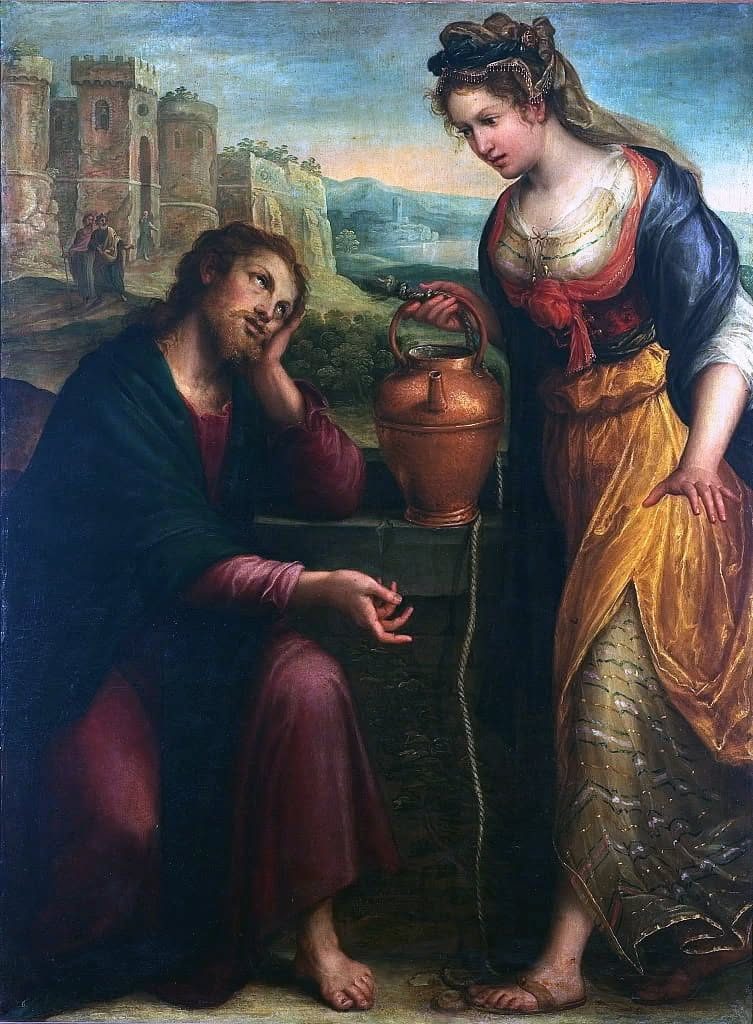
An oil painting. At the left, a bearded man in a dark blue mantle over a deep red robe sits on the stone kerb of a well, barefoot, resting his head on one hand as though tired, looking up; his other hand is open in front of him, mid-gesture. At the right a woman stands over him, taller in the frame, in a gold skirt, red bodice and blue mantle with a jewelled headdress, one hand on her hip and the other on a copper water jar that sits on the well kerb with a rope running down into the shaft. Behind them a landscape and a walled town, with three small figures on the road by its gate.
Christ and the Samaritan Woman at the Well
Lavinia Fontana, 1610s · Museo Nazionale di Capodimonte, Naples

⚠ Almost every other painter has Jesus upright and teaching. Fontana reads verse 6 and paints what it says: he is worn out from the journey, sitting on the kerb with his head propped on his hand, barefoot — and he is looking up. She stands; he sits. The woman is the taller figure, one hand on her hip, and the composition gives her the dominant position in a conversation the disciples will shortly be scandalised by. ⚠ Note the jar: it is still on the well with the rope running down into the water, so this is mid-conversation — before verse 28, where she abandons it. The three small figures at the town gate are the rest of the chapter, either the disciples gone to buy food (v8) or the town coming out (v30). ⚠ And it is worth saying who painted it. Lavinia Fontana (1552–1614) is generally reckoned the first professional woman painter of Renaissance Italy — she ran her own studio in Bologna and later Rome, which is what distinguishes her from earlier women artists working inside convents or courts, and left over a hundred documented works including monumental altarpieces. In 1603 she was inducted into the all-male Academy of St Luke in Rome, an honour that eluded Caravaggio — who appears twice elsewhere on these pages. On a chapter where the disciples are astonished not that the woman is a Samaritan but that she is a woman, and where a town believes on her testimony, the hand that made the picture is part of the note.

Public domain · View the original
1
Ὡς οὖν ἔγνω ὁ Ἰησοῦς ὅτι ἤκουσαν οἱ Φαρισαῖοι ὅτι Ἰησοῦς πλείονας μαθητὰς ποιεῖ καὶ βαπτίζει ἢ Ἰωάννης—
So when the Lord knew that the Pharisees had heard that Jesus was making and baptizing more disciples than Johnnote
Cuando, pues, el Señor supo que los fariseos habían oído que Jesús hacía y bautizaba más discípulos que Juan —
2
καίτοιγε Ἰησοῦς αὐτὸς οὐκ ἐβάπτιζεν ἀλλʼ οἱ μαθηταὶ αὐτοῦ—
although Jesus himself was not baptizing, but his disciples —note
aunque Jesús mismo no bautizaba, sino sus discípulos—,
cross-refs⤷ 3:22
3
ἀφῆκεν τὴν Ἰουδαίαν καὶ ἀπῆλθεν πάλιν εἰς τὴν Γαλιλαίαν.
he left Judea and went away again into Galilee.note
dejó Judea y se fue otra vez a Galilea.
4
ἔδει δὲ αὐτὸν διέρχεσθαι διὰ τῆς Σαμαρείας.
And he had to pass through Samaria.note
Y le era necesario pasar por Samaria.
5
ἔρχεται οὖν εἰς πόλιν τῆς Σαμαρείας λεγομένην Συχὰρ πλησίον τοῦ χωρίου ὃ ἔδωκεν Ἰακὼβ τῷ Ἰωσὴφ τῷ υἱῷ αὐτοῦ·
So he comes to a town of Samaria called Sychar, near the plot of ground that Jacob gave to his son Joseph.note
Llega, pues, a una ciudad de Samaria llamada Sicar, junto a la parcela que Jacob dio a su hijo José.
6
ἦν δὲ ἐκεῖ πηγὴ τοῦ Ἰακώβ. ὁ οὖν Ἰησοῦς κεκοπιακὼς ἐκ τῆς ὁδοιπορίας ἐκαθέζετο οὕτως ἐπὶ τῇ πηγῇ· ὥρα ἦν ὡς ἕκτη.
And Jacob’s spring was there. So Jesus, worn out from the journey, was sitting just as he was by the spring. It was about the sixth hour.note
Y estaba allí la fuente de Jacob. Así que Jesús, cansado del camino, estaba sentado tal como iba junto a la fuente. Era como la hora sexta.
cross-refs⤷ 3:2
7
Ἔρχεται γυνὴ ἐκ τῆς Σαμαρείας ἀντλῆσαι ὕδωρ. λέγει αὐτῇ ὁ Ἰησοῦς· Δός μοι πεῖν·
A woman of Samaria comes to draw water. Jesus says to her, “Give me a drink”note
Viene una mujer de Samaria a sacar agua. Jesús le dice: «Dame de beber»
8
οἱ γὰρ μαθηταὶ αὐτοῦ ἀπεληλύθεισαν εἰς τὴν πόλιν, ἵνα τροφὰς ἀγοράσωσιν.
— for his disciples had gone off into the town to buy food.note
—pues sus discípulos se habían ido a la ciudad a comprar comida—.
9
λέγει οὖν αὐτῷ ἡ γυνὴ ἡ Σαμαρῖτις· Πῶς σὺ Ἰουδαῖος ὢν παρʼ ἐμοῦ πεῖν αἰτεῖς γυναικὸς Σαμαρίτιδος οὔσης ; οὐ γὰρ συγχρῶνται Ἰουδαῖοι Σαμαρίταις.
So the Samaritan woman says to him, “How is it that you, being a Jew, ask a drink from me, a Samaritan woman?” — for Jews have no dealings with Samaritans.note
Le dice entonces la mujer samaritana: «¿Cómo tú, siendo judío, me pides de beber a mí, que soy mujer samaritana?» —porque los judíos no tienen trato con los samaritanos—.
10
ἀπεκρίθη Ἰησοῦς καὶ εἶπεν αὐτῇ· Εἰ ᾔδεις τὴν δωρεὰν τοῦ θεοῦ καὶ τίς ἐστιν ὁ λέγων σοι· Δός μοι πεῖν, σὺ ἂν ᾔτησας αὐτὸν καὶ ἔδωκεν ἄν σοι ὕδωρ ζῶν.
Jesus answered and said to her, “If you had known the gift of God, and who it is who says to you ‘Give me a drink,’ you would have asked him, and he would have given you living water.”note
Respondió Jesús y le dijo: «Si conocieras el don de Dios, y quién es el que te dice “Dame de beber”, tú le habrías pedido a él, y él te habría dado agua viva».
cross-refs⤷ 3:3
11
λέγει αὐτῷ ἡ γυνή · Κύριε, οὔτε ἄντλημα ἔχεις καὶ τὸ φρέαρ ἐστὶν βαθύ· πόθεν οὖν ἔχεις τὸ ὕδωρ τὸ ζῶν;
The woman says to him, “Sir, you have nothing to draw with and the shaft is deep. Where then do you get that living water?note
Le dice la mujer: «Señor, no tienes con qué sacar y el pozo es hondo. ¿De dónde, pues, tienes esa agua viva?
12
μὴ σὺ μείζων εἶ τοῦ πατρὸς ἡμῶν Ἰακώβ, ὃς ἔδωκεν ἡμῖν τὸ φρέαρ καὶ αὐτὸς ἐξ αὐτοῦ ἔπιεν καὶ οἱ υἱοὶ αὐτοῦ καὶ τὰ θρέμματα αὐτοῦ;
You are not greater than our father Jacob, are you, who gave us the shaft and drank from it himself, and his sons, and his livestock?”note
¿Acaso eres tú mayor que nuestro padre Jacob, que nos dio el pozo y bebió de él él mismo, y sus hijos, y sus ganados?»
13
ἀπεκρίθη Ἰησοῦς καὶ εἶπεν αὐτῇ· Πᾶς ὁ πίνων ἐκ τοῦ ὕδατος τούτου διψήσει πάλιν·
Jesus answered and said to her, “Everyone who drinks of this water will thirst again;note
Respondió Jesús y le dijo: «Todo el que bebe de esta agua volverá a tener sed;
14
ὃς δʼ ἂν πίῃ ἐκ τοῦ ὕδατος οὗ ἐγὼ δώσω αὐτῷ, οὐ μὴ διψήσει εἰς τὸν αἰῶνα, ἀλλὰ τὸ ὕδωρ ὃ δώσω αὐτῷ γενήσεται ἐν αὐτῷ πηγὴ ὕδατος ἁλλομένου εἰς ζωὴν αἰώνιον.
but whoever drinks of the water that I will give him will never thirst, ever. Rather, the water that I will give him will become in him a spring of water leaping up into eternal life.”note
pero el que beba del agua que yo le daré no tendrá sed jamás. Antes bien, el agua que yo le daré se convertirá en él en una fuente de agua que brota para vida eterna».
15
λέγει πρὸς αὐτὸν ἡ γυνή· Κύριε, δός μοι τοῦτο τὸ ὕδωρ, ἵνα μὴ διψῶ μηδὲ διέρχωμαι ἐνθάδε ἀντλεῖν.
The woman says to him, “Sir, give me this water, so that I may not thirst or come here to draw.”note
Le dice la mujer: «Señor, dame esa agua, para que no tenga sed ni venga aquí a sacar».
16
Λέγει αὐτῇ Ὕπαγε φώνησον τὸν ἄνδρα σου καὶ ἐλθὲ ἐνθάδε.
He says to her, “Go, call your husband and come here.”note
Le dice: «Ve, llama a tu marido y ven acá».
17
ἀπεκρίθη ἡ γυνὴ καὶ εἶπεν αὐτῷ Οὐκ ἔχω ἄνδρα. λέγει αὐτῇ ὁ Ἰησοῦς· Καλῶς εἶπας ὅτι Ἄνδρα οὐκ ἔχω·
The woman answered and said to him, “I have no husband.” Jesus says to her, “You said it well: ‘I have no husband’;note
Respondió la mujer y le dijo: «No tengo marido». Le dice Jesús: «Bien has dicho: “No tengo marido”;
18
πέντε γὰρ ἄνδρας ἔσχες, καὶ νῦν ὃν ἔχεις οὐκ ἔστιν σου ἀνήρ· τοῦτο ἀληθὲς εἴρηκας.
for you have had five husbands, and the one you have now is not your husband. This you have said truly.”note
porque cinco maridos has tenido, y el que ahora tienes no es tu marido. Esto has dicho con verdad».
19
λέγει αὐτῷ ἡ γυνή· Κύριε, θεωρῶ ὅτι προφήτης εἶ σύ.
The woman says to him, “Sir, I see that you are a prophet.note
Le dice la mujer: «Señor, veo que tú eres profeta.
20
οἱ πατέρες ἡμῶν ἐν τῷ ὄρει τούτῳ προσεκύνησαν· καὶ ὑμεῖς λέγετε ὅτι ἐν Ἱεροσολύμοις ἐστὶν ὁ τόπος ὅπου προσκυνεῖν δεῖ .
Our fathers worshipped on this mountain, and you people say that in Jerusalem is the place where one must worship.”note
Nuestros padres adoraron en este monte, y vosotros decís que en Jerusalén está el lugar donde se debe adorar».
21
λέγει αὐτῇ ὁ Ἰησοῦς· Πίστευέ μοι, γύναι , ὅτι ἔρχεται ὥρα ὅτε οὔτε ἐν τῷ ὄρει τούτῳ οὔτε ἐν Ἱεροσολύμοις προσκυνήσετε τῷ πατρί.
Jesus says to her, “Believe me, woman: an hour is coming when neither on this mountain nor in Jerusalem will you worship the Father.note
Le dice Jesús: «Créeme, mujer: viene la hora en que ni en este monte ni en Jerusalén adoraréis al Padre.
22
ὑμεῖς προσκυνεῖτε ὃ οὐκ οἴδατε, ἡμεῖς προσκυνοῦμεν ὃ οἴδαμεν, ὅτι ἡ σωτηρία ἐκ τῶν Ἰουδαίων ἐστίν·
You worship what you do not know; we worship what we know, because salvation is from the Jews.note
Vosotros adoráis lo que no conocéis; nosotros adoramos lo que conocemos, porque la salvación viene de los judíos.
23
ἀλλὰ ἔρχεται ὥρα καὶ νῦν ἐστιν, ὅτε οἱ ἀληθινοὶ προσκυνηταὶ προσκυνήσουσιν τῷ πατρὶ ἐν πνεύματι καὶ ἀληθείᾳ, καὶ γὰρ ὁ πατὴρ τοιούτους ζητεῖ τοὺς προσκυνοῦντας αὐτόν·
But an hour is coming — and now is — when the true worshippers will worship the Father in spirit and truth; for indeed the Father is looking for such people to worship him.note
Pero viene la hora —y ahora es— cuando los verdaderos adoradores adorarán al Padre en espíritu y en verdad; porque ciertamente el Padre busca a tales que lo adoren.
24
πνεῦμα ὁ θεός, καὶ τοὺς προσκυνοῦντας αὐτὸν ἐν πνεύματι καὶ ἀληθείᾳ δεῖ προσκυνεῖν.
God is spirit, and those worshipping him must worship in spirit and truth.”note
Dios es espíritu, y los que lo adoran deben adorar en espíritu y en verdad».
cross-refs⤷ 1:1
25
λέγει αὐτῷ ἡ γυνή· Οἶδα ὅτι Μεσσίας ἔρχεται, ὁ λεγόμενος χριστός· ὅταν ἔλθῃ ἐκεῖνος, ἀναγγελεῖ ἡμῖν ἅπαντα
The woman says to him, “I know that Messiah is coming, the one called Christ. When that one comes, he will announce everything to us.”note
Le dice la mujer: «Sé que viene el Mesías, el llamado Cristo. Cuando venga aquel, nos lo anunciará todo».
26
λέγει αὐτῇ ὁ Ἰησοῦς· Ἐγώ εἰμι, ὁ λαλῶν σοι.
Jesus says to her, “I am — the one speaking to you.”note
Le dice Jesús: «Yo soy —el que habla contigo».
27
Καὶ ἐπὶ τούτῳ ἦλθαν οἱ μαθηταὶ αὐτοῦ, καὶ ἐθαύμαζον ὅτι μετὰ γυναικὸς ἐλάλει· οὐδεὶς μέντοι εἶπεν· Τί ζητεῖς; ἢ τί λαλεῖς μετʼ αὐτῆς;
And on this his disciples came, and they were astonished that he was speaking with a woman. No one, however, said, “What are you looking for?” or “Why are you speaking with her?”note
Y en esto llegaron sus discípulos, y se asombraban de que hablara con una mujer. Ninguno, sin embargo, dijo: «¿Qué buscas?» ni «¿Por qué hablas con ella?»
28
ἀφῆκεν οὖν τὴν ὑδρίαν αὐτῆς ἡ γυνὴ καὶ ἀπῆλθεν εἰς τὴν πόλιν καὶ λέγει τοῖς ἀνθρώποις·
So the woman left her water jar and went off into the town, and says to the people,note
Dejó, pues, la mujer su cántaro y se fue a la ciudad, y dice a la gente:
29
Δεῦτε ἴδετε ἄνθρωπον ὃς εἶπέ μοι πάντα ὅσα ἐποίησα· μήτι οὗτός ἐστιν ὁ χριστός;
“Come, see a man who told me everything I ever did. Can this be the Christ?”note
«Venid, ved a un hombre que me ha dicho todo lo que he hecho. ¿No será este el Cristo?»
30
ἐξῆλθον ἐκ τῆς πόλεως καὶ ἤρχοντο πρὸς αὐτόν.
They went out of the town and were coming to him.note
Salieron de la ciudad y venían a él.
31
Ἐν τῷ μεταξὺ ἠρώτων αὐτὸν οἱ μαθηταὶ λέγοντες· Ῥαββί, φάγε.
Meanwhile the disciples were urging him, saying, “Rabbi, eat.”note
Entretanto los discípulos le rogaban, diciendo: «Rabí, come».
32
ὁ δὲ εἶπεν αὐτοῖς· Ἐγὼ βρῶσιν ἔχω φαγεῖν ἣν ὑμεῖς οὐκ οἴδατε.
But he said to them, “I have food to eat that you do not know about.”note
Pero él les dijo: «Yo tengo para comer una comida que vosotros no conocéis».
33
ἔλεγον οὖν οἱ μαθηταὶ πρὸς ἀλλήλους· Μή τις ἤνεγκεν αὐτῷ φαγεῖν;
So the disciples said to one another, “Nobody brought him anything to eat, did they?”note
Se decían, pues, los discípulos unos a otros: «¿Le habrá traído alguien de comer?»
34
λέγει αὐτοῖς ὁ Ἰησοῦς· Ἐμὸν βρῶμά ἐστιν ἵνα ποιήσω τὸ θέλημα τοῦ πέμψαντός με καὶ τελειώσω αὐτοῦ τὸ ἔργον.
Jesus says to them, “My food is that I do the will of the one who sent me and complete his work.note
Les dice Jesús: «Mi comida es que yo haga la voluntad del que me envió y lleve a término su obra.
35
οὐχ ὑμεῖς λέγετε ὅτι Ἔτι τετράμηνός ἐστιν καὶ ὁ θερισμὸς ἔρχεται; ἰδοὺ λέγω ὑμῖν, ἐπάρατε τοὺς ὀφθαλμοὺς ὑμῶν καὶ θεάσασθε τὰς χώρας ὅτι λευκαί εἰσιν πρὸς θερισμόν· ἤδη
Do you not say, ‘Four months more and the harvest comes’? Look, I tell you: lift up your eyes and take a good look at the fields — they are white for harvesting. Alreadynote
¿No decís vosotros: “Cuatro meses más y llega la siega”? Mirad, os digo: alzad vuestros ojos y contemplad los campos: ya están blancos para la siega. Ya
36
ὁ θερίζων μισθὸν λαμβάνει καὶ συνάγει καρπὸν εἰς ζωὴν αἰώνιον, ἵνα ὁ σπείρων ὁμοῦ χαίρῃ καὶ ὁ θερίζων.
the reaper is receiving wages and gathering fruit for eternal life, so that the sower and the reaper may rejoice together.note
el segador recibe salario y recoge fruto para vida eterna, para que juntos se alegren el sembrador y el segador.
37
ἐν γὰρ τούτῳ ὁ λόγος ἐστὶν ἀληθινὸς ὅτι Ἄλλος ἐστὶν ὁ σπείρων καὶ ἄλλος ὁ θερίζων·
For in this the saying is true, that one sows and another reaps.note
Porque en esto es verdadero el dicho: uno es el que siembra y otro el que siega.
38
ἐγὼ ἀπέστειλα ὑμᾶς θερίζειν ὃ οὐχ ὑμεῖς κεκοπιάκατε· ἄλλοι κεκοπιάκασιν, καὶ ὑμεῖς εἰς τὸν κόπον αὐτῶν εἰσεληλύθατε.
I sent you to reap what you have not laboured over; others have laboured, and you have entered into their labour.”note
Yo os envié a segar lo que vosotros no habéis trabajado; otros lo trabajaron, y vosotros habéis entrado en su trabajo».
39
Ἐκ δὲ τῆς πόλεως ἐκείνης πολλοὶ ἐπίστευσαν εἰς αὐτὸν τῶν Σαμαριτῶν διὰ τὸν λόγον τῆς γυναικὸς μαρτυρούσης ὅτι Εἶπέν μοι πάντα ἃ ἐποίησα.
And from that town many of the Samaritans believed in him because of the word of the woman testifying, “He told me everything I ever did.”note
Y de aquella ciudad muchos de los samaritanos creyeron en él por la palabra de la mujer que testificaba: «Me ha dicho todo lo que he hecho».
40
ὡς οὖν ἦλθον πρὸς αὐτὸν οἱ Σαμαρῖται, ἠρώτων αὐτὸν μεῖναι παρʼ αὐτοῖς· καὶ ἔμεινεν ἐκεῖ δύο ἡμέρας.
So when the Samaritans came to him they asked him to stay with them, and he stayed there two days.note
Así que, cuando los samaritanos vinieron a él, le rogaron que se quedara con ellos; y se quedó allí dos días.
41
καὶ πολλῷ πλείους ἐπίστευσαν διὰ τὸν λόγον αὐτοῦ,
And far more believed because of his word,note
Y muchos más creyeron por su palabra,
42
τῇ τε γυναικὶ ἔλεγον ὅτι Οὐκέτι διὰ τὴν σὴν λαλιὰν πιστεύομεν· αὐτοὶ γὰρ ἀκηκόαμεν, καὶ οἴδαμεν ὅτι οὗτός ἐστιν ἀληθῶς ὁ σωτὴρ τοῦ κόσμου
and they said to the woman, “It is no longer because of your talk that we believe; for we ourselves have heard, and we know that this is truly the Saviour of the world.”note
y decían a la mujer: «Ya no creemos por lo que tú dices; porque nosotros mismos hemos oído, y sabemos que este es verdaderamente el Salvador del mundo».
43
Μετὰ δὲ τὰς δύο ἡμέρας ἐξῆλθεν ἐκεῖθεν εἰς τὴν Γαλιλαίαν·
And after the two days he went out from there into Galilee —note
Y después de los dos días salió de allí para Galilea —
44
αὐτὸς γὰρ Ἰησοῦς ἐμαρτύρησεν ὅτι προφήτης ἐν τῇ ἰδίᾳ πατρίδι τιμὴν οὐκ ἔχει.
for Jesus himself testified that a prophet has no honour in his own homeland.note
pues Jesús mismo testificó que un profeta no tiene honra en su propia tierra—.
45
ὅτε οὖν ἦλθεν εἰς τὴν Γαλιλαίαν, ἐδέξαντο αὐτὸν οἱ Γαλιλαῖοι, πάντα ἑωρακότες ὅσα ἐποίησεν ἐν Ἱεροσολύμοις ἐν τῇ ἑορτῇ, καὶ αὐτοὶ γὰρ ἦλθον εἰς τὴν ἑορτήν.
So when he came into Galilee the Galileans welcomed him, having seen everything he did in Jerusalem at the festival; for they too had gone to the festival.note
Así que, cuando llegó a Galilea, los galileos lo recibieron, habiendo visto todo lo que hizo en Jerusalén en la fiesta; porque también ellos habían ido a la fiesta.
46
Ἦλθεν οὖν πάλιν εἰς τὴν Κανὰ τῆς Γαλιλαίας, ὅπου ἐποίησεν τὸ ὕδωρ οἶνον. καὶ ἦν τις βασιλικὸς οὗ ὁ υἱὸς ἠσθένει ἐν Καφαρναούμ.
So he came again to Cana of Galilee, where he had made the water wine. And there was a certain royal official whose son was sick in Capernaum.note
Vino, pues, otra vez a Caná de Galilea, donde había hecho el agua vino. Y había un funcionario real cuyo hijo estaba enfermo en Capernaúm.
47
οὗτος ἀκούσας ὅτι Ἰησοῦς ἥκει ἐκ τῆς Ἰουδαίας εἰς τὴν Γαλιλαίαν ἀπῆλθεν πρὸς αὐτὸν καὶ ἠρώτα ἵνα καταβῇ καὶ ἰάσηται αὐτοῦ τὸν υἱόν, ἤμελλεν γὰρ ἀποθνῄσκειν.
When this man heard that Jesus had come out of Judea into Galilee, he went off to him and asked that he come down and heal his son, for he was about to die.note
Cuando este oyó que Jesús había venido de Judea a Galilea, fue a él y le rogó que bajara y sanara a su hijo, porque estaba a punto de morir.
48
εἶπεν οὖν ὁ Ἰησοῦς πρὸς αὐτόν· Ἐὰν μὴ σημεῖα καὶ τέρατα ἴδητε, οὐ μὴ πιστεύσητε.
So Jesus said to him, “Unless you people see signs and wonders, you will never believe.”note
Le dijo entonces Jesús: «Si no veis señales y prodigios, de ninguna manera creeréis».
49
λέγει πρὸς αὐτὸν ὁ βασιλικός· Κύριε, κατάβηθι πρὶν ἀποθανεῖν τὸ παιδίον μου.
The royal official says to him, “Sir, come down before my little boy dies.”note
Le dice el funcionario real: «Señor, baja antes de que muera mi niño».
50
λέγει αὐτῷ ὁ Ἰησοῦς· Πορεύου· ὁ υἱός σου ζῇ. ἐπίστευσεν ὁ ἄνθρωπος τῷ λόγῳ ὃν εἶπεν αὐτῷ ὁ Ἰησοῦς καὶ ἐπορεύετο.
Jesus says to him, “Go your way; your son lives.”note
Le dice Jesús: «Ve; tu hijo vive».
51
ἤδη δὲ αὐτοῦ καταβαίνοντος οἱ δοῦλοι αὐτοῦ ὑπήντησαν αὐτῷ λέγοντες ὅτι ὁ παῖς αὐτοῦ ζῇ.
The man believed the word that Jesus said to him and went his way. And as he was already going down, his slaves met him, saying that his boy was alive.note
Creyó el hombre la palabra que Jesús le dijo, y se fue. Y mientras ya iba bajando, sus siervos le salieron al encuentro diciendo que su muchacho vivía.
52
ἐπύθετο οὖν τὴν ὥραν παρʼ αὐτῶν ἐν ᾗ κομψότερον ἔσχεν· εἶπαν οὖν αὐτῷ ὅτι Ἐχθὲς ὥραν ἑβδόμην ἀφῆκεν αὐτὸν ὁ πυρετός.
So he enquired from them the hour in which he got better. So they said to him, “Yesterday at the seventh hour the fever left him.”note
Les preguntó, pues, la hora en que había mejorado. Le dijeron entonces: «Ayer a la hora séptima lo dejó la fiebre».
53
ἔγνω οὖν ὁ πατὴρ ὅτι ἐκείνῃ τῇ ὥρᾳ ἐν ᾗ εἶπεν αὐτῷ ὁ Ἰησοῦς Ὁ υἱός σου ζῇ, καὶ ἐπίστευσεν αὐτὸς καὶ ἡ οἰκία αὐτοῦ ὅλη.
So the father knew that it was at that hour in which Jesus said to him, “Your son lives,” and he himself believed, and his whole household.note
Conoció, pues, el padre que era en aquella hora en que Jesús le dijo: «Tu hijo vive»; y creyó él y toda su casa.
54
τοῦτο δὲ πάλιν δεύτερον σημεῖον ἐποίησεν ὁ Ἰησοῦς ἐλθὼν ἐκ τῆς Ἰουδαίας εἰς τὴν Γαλιλαίαν.
And this again, a second sign, Jesus did after coming out of Judea into Galilee.note
Y esta, otra vez, una segunda señal hizo Jesús al venir de Judea a Galilea.

Translator’s Notes

Verses 1–6 · a correction paid off, a road nobody had to take, and the opposite hour

⚠ Verse 2 is the parenthesis John 3 was left waiting for. That chapter said plainly that Jesus was baptizing (3:22) and this library flagged it as the only such statement in any Gospel. Here the same book takes it back in a single clause: although Jesus himself was not baptizing, but his disciples. The note there declined to decide which half is the earlier hand, and nothing here settles it — but the debt is now paid in the sense that both halves are on these pages and a reader can hold them side by side.

“He had to pass through Samaria” is not a fact about roads. Edei is the verb of necessity, and geography does not supply it: Judaeans travelling north routinely crossed the Jordan and went up the east bank precisely to avoid Samaria. Josephus says the Galilean route through Samaria was the quick one and also that it was where trouble happened. Whatever kind of necessity this is, it is not the map’s.

⚠ And the hour is the point. “About the sixth hour” is noon — the brightest, hottest, least likely moment to be at a well. Nicodemus came by night (3:2). John has put a named male insider in the dark and an unnamed foreign woman in the full light, back to back, and the two chapters are built to be read against each other at almost every point. The library will keep pointing at the pairing rather than assert what it proves.

Verses 7–15 · ⚠ the same trick as Nicodemus — and this time the Greek marks it with two different nouns

⚠ “Living water” is ordinary Greek for RUNNING water. Hydōr zōn is what you call a spring or a stream as opposed to the still water standing in a cistern — the same idiom Hebrew has in mayim chayyim, the “living water” required for certain purifications. So when the woman hears it as an offer of fresh running water she is not being slow. She is hearing the word correctly in its ordinary sense — which is precisely what Nicodemus did with anōthen one chapter earlier. Two conversations, the same device, and in both the misunderstanding is a real possibility of the Greek rather than a failure of the hearer.

⚠ And here John does something he did not do for Nicodemus: he marks it with the vocabulary. There are two different words in this passage for the hole in the ground, and they sort by who is speaking. The narrator and Jesus say pēgē — a SPRING, water that moves by itself (v6 twice, and v14, “a pēgē of water leaping up”). The woman says phrear — a dug SHAFT, a cistern you lower a bucket into (vv11, 12). Her whole objection is built out of that noun: you have nothing to draw with, and the shaft is deep. The two of them are looking at the same water and naming it with two different words, and the words are the argument. Rendered here “spring” and “shaft” to keep it visible.

The shelf splits, and not the way you would guess. KJV prints “well” at every one of the four — the distinction vanishes completely. But NWT keeps it (“Jacob’s fountain… the well is deep… a fountain of water bubbling up”), and so does the archaic Spanish RV 1909, exactly: la fuente de Jacob at v6 against el pozo es hondo at v11. ⚠ The modern TNM loses it, printing pozo for Jacob’s spring at v6 where the RV had fuente. That is the third time on these pages that the 1909 Reina-Valera has been tighter than the modern Traducción del Nuevo Mundo, after lunático at Matthew 17 and de tal manera at John 3:16 — which is worth saying out loud, because the standing rule is to follow whoever is tighter and not whoever usually is.

One more thing the scene does before any of this. The conversation opens with Jesus asking her for a favour — he has no bucket either. The teacher in John 3 begins by telling; here he begins by needing something, from a person his own culture said he should not accept it from.

Verses 16–19 · ⚠ five husbands, and what the text does not say

⚠ The text never calls her sinful, and Jesus never rebukes her. It is worth stating flatly, because the sermon tradition is nearly unanimous the other way. What the passage says is that she has had five husbands and that the man she is with now is not one. It offers no reason, and in a world where a woman could be widowed or dismissed but could almost never divorce, five marriages is at least as likely to be a history of things done to her as by her. Jesus’ only comment on it is that she told the truth — twice, in two verses. The library flags the moralising reading as an addition rather than a translation problem, because nothing in the Greek carries it.

“You said it well” is a small joke and a real compliment. She said four words; he tells her they were exactly right, then supplies the rest of the sentence himself. Her response is not shame but escalation — she promotes him from kyrie (“sir”) to prophētēs and immediately puts the hardest religious question of her nation to him. She is not deflecting; she is testing what he is.

Verses 20–24 · a mountain with a ruin on it — and a grammar this library has already ruled on

“This mountain” had a temple on it, and it was gone. Gerizim, above Shechem, carried the Samaritan temple until the Hasmonean John Hyrcanus destroyed it around 128 BC — roughly a century and a half before this conversation, and within sight of where the two of them are sitting. The question she asks is not abstract theology; it is about a demolished building on the skyline and whose worship survived. Excavation on Gerizim has since found the precinct.

⚠ And verse 24 is the same Greek construction as John 1:1. Pneuma ho theos — a predicate noun with no article, standing before its subject, exactly like theos ēn ho logos. This library already ruled on that construction in the prologue and took the qualitative reading there (“the Word was divine” — what God is, the Word was), so consistency decides it here: “God is spirit” — spirit is what God is by nature — rather than “God is a spirit,” which makes him one of a class, or “God is the Spirit,” which is a different claim again.

⚠ And the shelf is worth reading fairly here. NWT prints “God is a Spirit” — the indefinite reading — which is the same reading it takes of the same construction at John 1:1 (“a god”). Whatever one makes of that choice, it is being applied consistently, and saying so is simply accurate. RV 1909 has “Dios es Espíritu” with no article, and KJV “God is a Spirit” where ASV and NIV read “God is spirit.” The disagreement across the shelf is not about vocabulary at all — every version knows what the words mean. It is about one point of Greek grammar, and it is the same point in both verses.

Proskyneō, the verb used ten times in this passage, is literally to prostrate — and the answer Jesus gives detaches it from every place it could be done, which is a strange answer to give a woman asking which building is right.

Verses 25–26 · two words, and an argument about how loud they are

Egō eimi — “I am.” The Greek is two words followed by a participle: egō eimi, ho lalōn soi, “I am — the one speaking to you.” Ordinary Greek could mean simply “I’m he, the one talking to you,” and most versions supply the “he” to make an English sentence. But egō eimi is also the Septuagint’s phrase for God’s self-naming, and John will use it later in ways that cannot be anything else (“before Abraham was, I am,” 8:58, not yet on these pages). Whether the loud sense is already audible here is a genuine question, and the honest move is to print the two words plainly and let the reader hear what they hear rather than to close it off with an inserted pronoun.

⚠ And note who gets told. This is the first time in this Gospel that Jesus says it to anyone, and the person is a Samaritan woman with a complicated marital history, alone, at noon. The disciples arrive in the very next verse and are given nothing.

Verses 27–30 · ⚠ what astonished them, and the question nobody asked

⚠ It was not that she was a Samaritan. The Greek says they marvelled hoti meta gynaikos elalei — because he was speaking with a woman. The scandal the disciples register is the gender, not the nationality, and John does not soften it. Then the sentence does something better: “no one, however, said ‘What are you looking for?’ or ‘Why are you speaking with her?’” Both questions are quoted — and neither is asked. John tells you exactly what was in the room and that nobody said it out loud.

She left the water jar. One clause, no comment. She came for water, and she walks back to town without it — and the jar sitting there is also the reason she has to come back. It is the kind of detail this Gospel drops without explanation and never picks up.

Her question to the town is phrased to lose. Mēti houtos estin ho christos? — the particle mēti expects the answer no. “This couldn’t be the Christ, could it?” She makes the claim in the form least likely to get her argued with, and the whole town comes out anyway.

Verses 31–38 · a harvest that is early, and credit given away

The disciples misunderstand food exactly as the woman misunderstood water. Third time in two chapters: born anōthen, living water, and now “I have food you do not know about” — and they ask each other whether somebody brought him lunch. The pattern is deliberate and this time it catches the insiders, which is presumably the point of putting it here rather than earlier.

“Four months more and the harvest” is a proverb about waiting, and he contradicts it. The fields are white already; the interval the saying assumes has collapsed. And the Samaritans are at that moment walking out of the town toward him, which is either a coincidence or the illustration.

⚠ Verse 38 gives the credit away, and it is not clear to whom. “Others have laboured, and you have entered into their labour” — the others are unnamed. The candidates are the Baptist and his people, the prophets, or (most immediately) the woman, who has just done the entire work of bringing this harvest in. The text does not say, and this library does not choose; but the sentence sits four verses after she went to fetch the town, and that placement is itself an argument.

Verses 39–42 · ⚠ the title belonged to Caesar

Sōtēr tou kosmou — “Saviour of the world” — was an imperial title. It appears on inscriptions and coinage for Roman emperors, and for Hellenistic kings before them; it is the sort of phrase a provincial would have read on a public monument. The people who put it on Jesus here are Samaritans — a despised half-foreign population — two days after meeting him, and they apply to a Galilean labourer a phrase the state reserved for the emperor. Whether John expects the reader to hear the collision is not stated; the phrase is simply left where it is.

And they are careful to tell her she is no longer necessary. “It is no longer because of your talk that we believe” — lalia, chatter, speech, is a slightly diminishing word. They believed first on her testimony (v39, stated outright) and then past it. The library notes both halves: the Gospel says plainly that a woman’s word brought a town to belief, and it also records the town telling her they have moved on from it.

Verses 43–54 · the second sign, and a rebuke the man simply ignores

The chapter ends by counting. “This again, a second sign” — John is numbering, as he did at 2:11, and only these two are numbered in the whole Gospel. Both happen at Cana, and the second is introduced by reminding you of the first.

⚠ Verse 48 is aimed past the man asking. “Unless you people see signs and wonders” — the pronoun is plural, addressed over the head of a single father with a dying child. It reads harshly, and the man does not engage with it at all: he simply repeats his request with the child’s age made smaller (paidion, little boy). He is not arguing about epistemology.

And then he believes twice. Verse 50: he believed the word and set off — before any evidence. Verse 53: he believed again, with his whole household, after the timing matched. The Gospel records both without ranking them, which is notable in a chapter that has just made a point about believing on somebody’s word and then past it (v42).

Basilikos (v46) is “royal official” — someone in Herod Antipas’s service, not a king; and the seventh hour of v52 is about one in the afternoon, which lets the father do the arithmetic that convinces him.

Patterns worth carrying forward.

⚠ Renderings chosen — and the one that matters is a pair of nouns.Spring” for pēgē (vv6, 14) against “shaft” for phrear (vv11, 12), because the two words sort by who is speaking — the narrator and Jesus say spring, the woman says shaft — and the KJV’s uniform “well” erases the whole thing. “Living water” kept literal (v10) because it is ordinary Greek for running water and the misunderstanding depends on that. “God is spirit” (v24), the qualitative reading, to match the ruling already made on the identical construction at John 1:1. “I am — the one speaking to you” (v26) with no pronoun supplied. And “Saviour of the world” (v42) left as the imperial title it was.

⚠ This chapter and John 3 are a matched pair, and reading them together is the point. A named male insider, a ruler, who comes by night — and an unnamed foreign woman met at noon. He misunderstands anōthen; she misunderstands living water; the disciples then misunderstand food (v32), which makes three in two chapters and puts the third one on the insiders. He asks “how can these things be?” and leaves the page; she argues, presses, and fetches a town. The Gospel does not comment on the arrangement, and neither does this library — it just declines to print the two chapters as though they were unrelated.

Echoes paid. The correction at 4:2, which John 3 flagged and left open. Pneuma (v24), catalogued one chapter ago for the wind-and-Spirit pun and now carrying a grammatical question instead. And the anarthrous predicate of John 1:1, ruled on in the prologue and applied here.

Echoes planted. Egō eimi (v26), which becomes unmistakable at 8:58. The hour that “is coming and now is” (v23), a formula this Gospel repeats. Gerizim and its demolished temple. And the numbering of signs — the first at Cana (2:11), the second here (v54), and no others counted.

⚠ Left open on purpose. Whether egō eimi at v26 is already the loud sense or simply “I’m he”; who the “others” are who laboured (v38), with the woman sitting four verses upstream as the obvious candidate the text declines to name; and whether 4:2 or 3:22 is the earlier hand. In each case the note gives the readings and says which rule chose a wording where one had to be chosen.

⚠ And one thing named rather than translated: the text never calls the woman sinful and Jesus never rebukes her. The moralising reading is an addition made by readers, not a difficulty in the Greek, and the note says so plainly.

Next installment in this book: John 5 — a man who has been lying by a pool for thirty-eight years and a question that sounds almost cruel (“do you want to get well?”), a healing on a sabbath that starts the first real hostility in this Gospel, and the longest single speech Jesus has given so far — on the Son who can do nothing on his own, and on the witnesses who testify to him.

John 5 (coming soon)