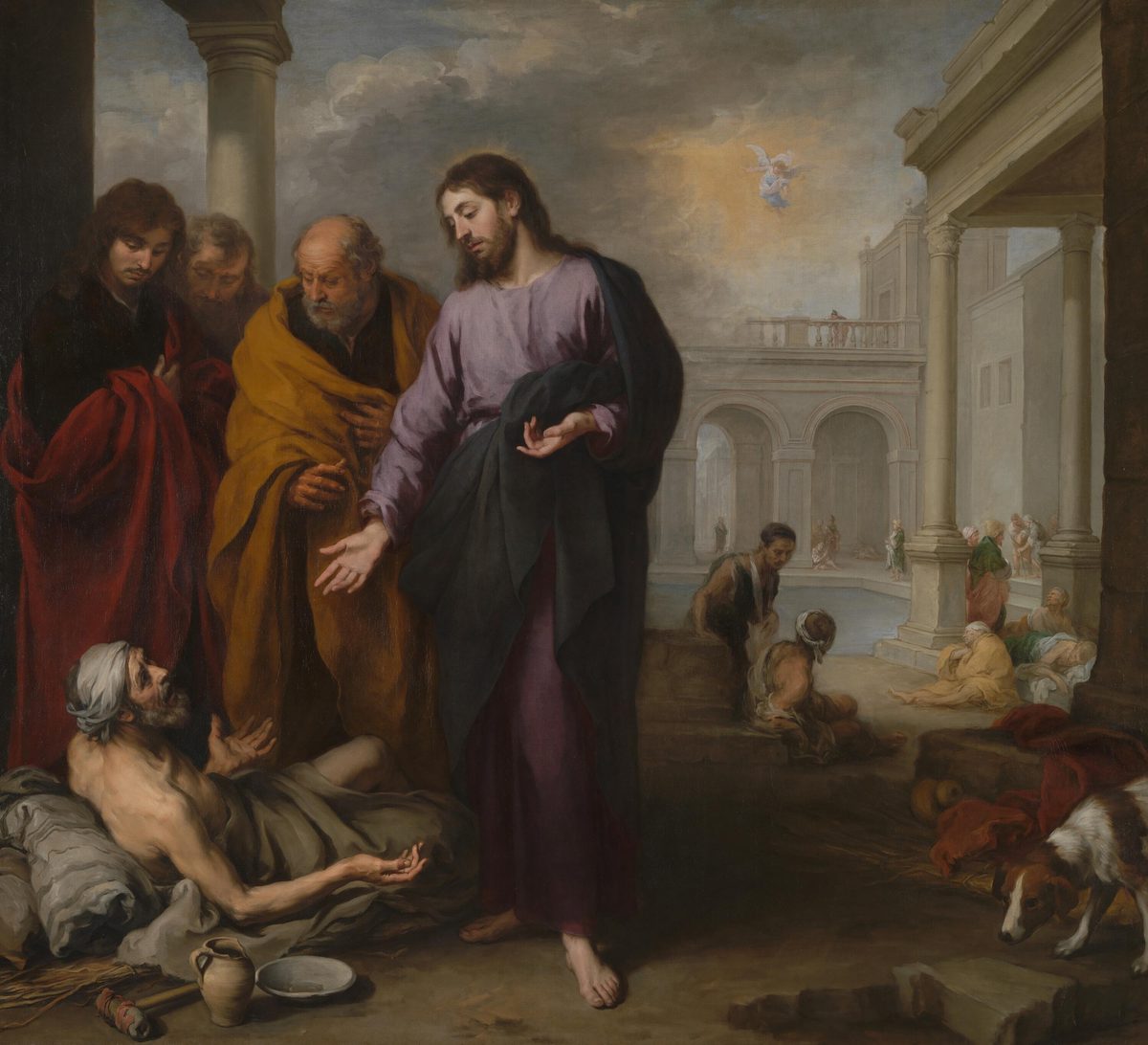
1
Μετὰ ταῦτα ἦν ἑορτὴ τῶν Ἰουδαίων, καὶ ἀνέβη Ἰησοῦς εἰς Ἱεροσόλυμα.
Después de esto había una fiesta de los judíos, y Jesús subió a Jerusalén.
2
ἔστιν δὲ ἐν τοῖς Ἱεροσολύμοις ἐπὶ τῇ προβατικῇ κολυμβήθρα ἡ ἐπιλεγομένη Ἑβραϊστὶ Βηθεσδά πέντε στοὰς ἔχουσα·
Now there is in Jerusalem, by the Sheep Gate, a pool, called in Hebrew
Bethesda, having five porticoes.
noteHay en Jerusalén, junto a la puerta de las Ovejas, un estanque llamado en hebreo Betesda, que tiene cinco pórticos.
3
ἐν ταύταις κατέκειτο πλῆθος τῶν ἀσθενούντων, τυφλῶν, χωλῶν, ξηρῶν
In these lay a multitude of the sick — blind, lame, withered —
noteEn estos yacía una multitud de enfermos: ciegos, cojos, paralíticos—
5
ἦν δέ τις ἄνθρωπος ἐκεῖ τριάκοντα ὀκτὼ ἔτη ἔχων ἐν τῇ ἀσθενείᾳ αὐτοῦ
and a certain man was there who had been
thirty-eight years in his sickness.
notey había allí un hombre que llevaba treinta y ocho años en su enfermedad.
6
τοῦτον ἰδὼν ὁ Ἰησοῦς κατακείμενον, καὶ γνοὺς ὅτι πολὺν ἤδη χρόνον ἔχει, λέγει αὐτῷ· Θέλεις ὑγιὴς γενέσθαι;
When Jesus saw him lying there, and knew that he had already been a long time in that condition, he said to him,
“Do you want to become well?”noteAl verlo Jesús acostado, y sabiendo que ya llevaba mucho tiempo así, le dijo: «¿Quieres quedar sano?»
7
ἀπεκρίθη αὐτῷ ὁ ἀσθενῶν· Κύριε, ἄνθρωπον οὐκ ἔχω ἵνα ὅταν ταραχθῇ τὸ ὕδωρ βάλῃ με εἰς τὴν κολυμβήθραν· ἐν ᾧ δὲ ἔρχομαι ἐγὼ ἄλλος πρὸ ἐμοῦ καταβαίνει.
The sick man answered him, “Sir, I have no one to put me into the pool when the water is stirred; and while I am coming, another steps down before me.”
noteEl enfermo le respondió: «Señor, no tengo a nadie que me meta en el estanque cuando el agua se agita; y mientras yo voy, otro desciende antes que yo.»
8
λέγει αὐτῷ ὁ Ἰησοῦς· Ἔγειρε ἆρον τὸν κράβαττόν σου καὶ περιπάτει.
Jesus said to him,
“Get up, pick up your mat, and walk.”noteJesús le dijo: «Levántate, toma tu camilla y anda.»
9
καὶ εὐθέως ἐγένετο ὑγιὴς ὁ ἄνθρωπος καὶ ἦρε τὸν κράβαττον αὐτοῦ καὶ περιεπάτει. Ἦν δὲ σάββατον ἐν ἐκείνῃ τῇ ἡμέρᾳ.
And immediately the man became well, and picked up his mat, and walked. Now it was the Sabbath on that day.
noteY al instante el hombre quedó sano, tomó su camilla y anduvo. Y era sábado aquel día.
10
ἔλεγον οὖν οἱ Ἰουδαῖοι τῷ τεθεραπευμένῳ· Σάββατόν ἐστιν, καὶ οὐκ ἔξεστίν σοι ἆραι τὸν κράβαττον
So the Jewish leaders said to the man who had been healed, “It is the Sabbath, and it is not lawful for you to carry your mat.”
notePor eso los líderes judíos decían al que había sido sanado: «Es sábado, y no te es lícito llevar la camilla.»
11
ὃς δὲ ἀπεκρίθη αὐτοῖς· Ὁ ποιήσας με ὑγιῆ ἐκεῖνός μοι εἶπεν Ἆρον τὸν κράβαττόν σου καὶ περιπάτει.
But he answered them, “The one who made me well — that one said to me, ‘Pick up your mat and walk.’”
notePero él les respondió: «El que me sanó — ese mismo me dijo: ‘Toma tu camilla y anda.’»
12
ἠρώτησαν οὖν αὐτόν· Τίς ἐστιν ὁ ἄνθρωπος ὁ εἰπών σοι· Ἆρον καὶ περιπάτει;
They asked him, “Who is the man who said to you, ‘Pick it up and walk’?”
noteLe preguntaron: «¿Quién es el hombre que te dijo: ‘Tómala y anda’?»
13
ὁ δὲ ἰαθεὶς οὐκ ᾔδει τίς ἐστιν, ὁ γὰρ Ἰησοῦς ἐξένευσεν ὄχλου ὄντος ἐν τῷ τόπῳ.
But the man who had been healed did not know who it was, for Jesus had slipped away, since there was a crowd in that place.
notePero el que había sido sanado no sabía quién era, porque Jesús se había apartado, pues había una multitud en aquel lugar.
14
μετὰ ταῦτα εὑρίσκει αὐτὸν ὁ Ἰησοῦς ἐν τῷ ἱερῷ καὶ εἶπεν αὐτῷ· Ἴδε ὑγιὴς γέγονας· μηκέτι ἁμάρτανε, ἵνα μὴ χεῖρόν σοί τι γένηται.
After this Jesus found him in the temple, and said to him,
“See, you have become well; sin no more, so that nothing worse happens to you.”noteDespués de esto Jesús lo halló en el templo y le dijo: «Mira, has quedado sano; no peques más, para que no te suceda algo peor.»
15
ἀπῆλθεν ὁ ἄνθρωπος καὶ ἀνήγγειλεν τοῖς Ἰουδαίοις ὅτι Ἰησοῦς ἐστιν ὁ ποιήσας αὐτὸν ὑγιῆ.
The man went away and told the Jewish leaders that it was Jesus who had made him well.
noteEl hombre se fue y anunció a los líderes judíos que era Jesús quien lo había sanado.
16
καὶ διὰ τοῦτο ἐδίωκον οἱ Ἰουδαῖοι τὸν Ἰησοῦν ὅτι ταῦτα ἐποίει ἐν σαββάτῳ.
And for this reason the Jewish leaders were
persecuting Jesus, because he was doing these things on the Sabbath.
noteY por eso los líderes judíos perseguían a Jesús, porque hacía estas cosas en sábado.
17
ὁ δὲ ἀπεκρίνατο αὐτοῖς· Ὁ πατήρ μου ἕως ἄρτι ἐργάζεται κἀγὼ ἐργάζομαι.
But he answered them,
“My Father is working until now, and I am working.”notePero él les respondió: «Mi Padre trabaja hasta ahora, y yo también trabajo.»
18
διὰ τοῦτο οὖν μᾶλλον ἐζήτουν αὐτὸν οἱ Ἰουδαῖοι ἀποκτεῖναι ὅτι οὐ μόνον ἔλυε τὸ σάββατον, ἀλλὰ καὶ πατέρα ἴδιον ἔλεγε τὸν θεόν, ἴσον ἑαυτὸν ποιῶν τῷ θεῷ.
For this reason then the Jewish leaders were seeking all the more to kill him, because not only was he breaking the Sabbath, but he was also calling God his own Father,
making himself equal with God.
notePor eso, pues, los líderes judíos aún más procuraban matarlo, porque no solo quebrantaba el sábado, sino que también llamaba a Dios su propio Padre, haciéndose igual a Dios.
19
Ἀπεκρίνατο οὖν ὁ Ἰησοῦς καὶ ἔλεγεν αὐτοῖς· Ἀμὴν ἀμὴν λέγω ὑμῖν, οὐ δύναται ὁ υἱὸς ποιεῖν ἀφʼ ἑαυτοῦ οὐδὲν ἐὰν μή τι βλέπῃ τὸν πατέρα ποιοῦντα· ἃ γὰρ ἂν ἐκεῖνος ποιῇ, ταῦτα καὶ ὁ υἱὸς ὁμοίως ποιεῖ.
So Jesus answered and said to them,
“Truly, truly, I say to you, the Son can do nothing of himself, unless he sees the Father doing it; for whatever that one does, these things the Son also does likewise.noteRespondió entonces Jesús y les dijo: «De cierto, de cierto os digo: el Hijo no puede hacer nada por sí mismo, sino lo que ve hacer al Padre; porque todo lo que aquel hace, eso también lo hace el Hijo igualmente.
20
ὁ γὰρ πατὴρ φιλεῖ τὸν υἱὸν καὶ πάντα δείκνυσιν αὐτῷ ἃ αὐτὸς ποιεῖ, καὶ μείζονα τούτων δείξει αὐτῷ ἔργα, ἵνα ὑμεῖς θαυμάζητε.
For the Father loves the Son and shows him all that he himself does; and he will show him greater works than these, so that you may marvel.note
Porque el Padre ama al Hijo y le muestra todo lo que él mismo hace; y obras mayores que estas le mostrará, para que vosotros os asombréis.
21
ὥσπερ γὰρ ὁ πατὴρ ἐγείρει τοὺς νεκροὺς καὶ ζῳοποιεῖ, οὕτως καὶ ὁ υἱὸς οὓς θέλει ζῳοποιεῖ.
For just as the Father raises the dead and gives them life, so also the Son gives life to whomever he wishes.note
Porque así como el Padre levanta a los muertos y les da vida, así también el Hijo da vida a los que quiere.
22
οὐδὲ γὰρ ὁ πατὴρ κρίνει οὐδένα, ἀλλὰ τὴν κρίσιν πᾶσαν δέδωκεν τῷ υἱῷ,
For the Father judges no one, but has given all judgment to the Son,note
Porque el Padre a nadie juzga, sino que todo el juicio lo ha dado al Hijo,
23
ἵνα πάντες τιμῶσι τὸν υἱὸν καθὼς τιμῶσι τὸν πατέρα. ὁ μὴ τιμῶν τὸν υἱὸν οὐ τιμᾷ τὸν πατέρα τὸν πέμψαντα αὐτόν.
so that all may honor the Son just as they honor the Father. Whoever does not honor the Son does not honor the Father who sent him.note
para que todos honren al Hijo como honran al Padre. El que no honra al Hijo no honra al Padre que lo envió.
24
Ἀμὴν ἀμὴν λέγω ὑμῖν ὅτι ὁ τὸν λόγον μου ἀκούων καὶ πιστεύων τῷ πέμψαντί με ἔχει ζωὴν αἰώνιον, καὶ εἰς κρίσιν οὐκ ἔρχεται ἀλλὰ μεταβέβηκεν ἐκ τοῦ θανάτου εἰς τὴν ζωήν.
Truly, truly, I say to you, whoever hears my word and believes him who sent me has eternal life, and does not come into judgment, but has passed out of death into life.note
De cierto, de cierto os digo: el que oye mi palabra y cree al que me envió tiene vida eterna, y no viene a juicio, sino que ha pasado de muerte a vida.
25
Ἀμὴν ἀμὴν λέγω ὑμῖν ὅτι ἔρχεται ὥρα καὶ νῦν ἐστιν ὅτε οἱ νεκροὶ ἀκούσουσιν τῆς φωνῆς τοῦ υἱοῦ τοῦ θεοῦ καὶ οἱ ἀκούσαντες ζήσουσιν
Truly, truly, I say to you, an hour is coming, and now is, when the dead will hear the voice of the Son of God, and those who hear will live.note
De cierto, de cierto os digo: viene la hora, y ahora es, cuando los muertos oirán la voz del Hijo de Dios, y los que la oigan vivirán.
26
ὥσπερ γὰρ ὁ πατὴρ ἔχει ζωὴν ἐν ἑαυτῷ, οὕτως καὶ τῷ υἱῷ ἔδωκεν ζωὴν ἔχειν ἐν ἑαυτῷ·
For just as the Father has life in himself, so also he has granted the Son to have life in himself;note
Porque así como el Padre tiene vida en sí mismo, así también le ha concedido al Hijo tener vida en sí mismo;
27
καὶ ἐξουσίαν ἔδωκεν αὐτῷ κρίσιν ποιεῖν, ὅτι υἱὸς ἀνθρώπου ἐστίν.
and he has given him authority to execute judgment, because he is the Son of Man.note
y le ha dado autoridad para ejecutar juicio, porque es Hijo del Hombre.
28
μὴ θαυμάζετε τοῦτο, ὅτι ἔρχεται ὥρα ἐν ᾗ πάντες οἱ ἐν τοῖς μνημείοις ἀκούσουσιν τῆς φωνῆς αὐτοῦ
Do not marvel at this, for an hour is coming in which all who are in the tombs will hear his voicenote
No os asombréis de esto, porque viene la hora en que todos los que están en los sepulcros oirán su voz
29
καὶ ἐκπορεύσονται οἱ τὰ ἀγαθὰ ποιήσαντες εἰς ἀνάστασιν ζωῆς, οἱ δὲ τὰ φαῦλα πράξαντες εἰς ἀνάστασιν κρίσεως.
and will come out — those who have done good things, to a resurrection of life; and those who have practiced vile things, to a resurrection of judgment.note
y saldrán: los que hicieron el bien, a resurrección de vida; y los que practicaron el mal, a resurrección de juicio.
30
Οὐ δύναμαι ἐγὼ ποιεῖν ἀπʼ ἐμαυτοῦ οὐδέν· καθὼς ἀκούω κρίνω, καὶ ἡ κρίσις ἡ ἐμὴ δικαία ἐστίν, ὅτι οὐ ζητῶ τὸ θέλημα τὸ ἐμὸν ἀλλὰ τὸ θέλημα τοῦ πέμψαντός με
I can do nothing of myself; as I hear, I judge, and my judgment is just, because I do not seek my own will, but the will of him who sent me.note
Yo no puedo hacer nada por mí mismo; según oigo, juzgo, y mi juicio es justo, porque no busco mi propia voluntad, sino la voluntad del que me envió.
31
Ἐὰν ἐγὼ μαρτυρῶ περὶ ἐμαυτοῦ, ἡ μαρτυρία μου οὐκ ἔστιν ἀληθής·
If I testify about myself, my testimony is not true.note
Si yo doy testimonio de mí mismo, mi testimonio no es verdadero.
32
ἄλλος ἐστὶν ὁ μαρτυρῶν περὶ ἐμοῦ, καὶ οἶδα ὅτι ἀληθής ἐστιν ἡ μαρτυρία ἣν μαρτυρεῖ περὶ ἐμοῦ.
There is another who testifies about me, and I know that the testimony he testifies about me is true.note
Otro es el que da testimonio de mí, y sé que el testimonio que da de mí es verdadero.
33
ὑμεῖς ἀπεστάλκατε πρὸς Ἰωάννην, καὶ μεμαρτύρηκε τῇ ἀληθείᾳ·
You have sent to John, and he has testified to the truth.note
Vosotros habéis enviado a Juan, y él ha dado testimonio de la verdad.
34
ἐγὼ δὲ οὐ παρὰ ἀνθρώπου τὴν μαρτυρίαν λαμβάνω, ἀλλὰ ταῦτα λέγω ἵνα ὑμεῖς σωθῆτε.
Not that I receive testimony from man, but I say these things so that you may be saved.note
Pero yo no recibo testimonio de hombre, sino que digo esto para que vosotros seáis salvos.
35
ἐκεῖνος ἦν ὁ λύχνος ὁ καιόμενος καὶ φαίνων, ὑμεῖς δὲ ἠθελήσατε ἀγαλλιαθῆναι πρὸς ὥραν ἐν τῷ φωτὶ αὐτοῦ·
That one was the lamp, burning and shining, and you were willing to rejoice for an hour in his light.note
Aquel era la lámpara que ardía y alumbraba, y vosotros quisisteis regocijaros por un tiempo en su luz.
36
ἐγὼ δὲ ἔχω τὴν μαρτυρίαν μείζω τοῦ Ἰωάννου, τὰ γὰρ ἔργα ἃ δέδωκέν μοι ὁ πατὴρ ἵνα τελειώσω αὐτά, αὐτὰ τὰ ἔργα ἃ ποιῶ, μαρτυρεῖ περὶ ἐμοῦ ὅτι ὁ πατήρ με ἀπέσταλκεν,
But I have the testimony greater than John’s; for the works that the Father has given me to complete — these very works that I am doing — testify about me, that the Father has sent me.note
Pero yo tengo un testimonio mayor que el de Juan; porque las obras que el Padre me dio para que las completara — esas mismas obras que hago — dan testimonio de mí, de que el Padre me ha enviado.
37
καὶ ὁ πέμψας με πατὴρ ἐκεῖνος μεμαρτύρηκεν περὶ ἐμοῦ. οὔτε φωνὴν αὐτοῦ πώποτε ἀκηκόατε οὔτε εἶδος αὐτοῦ ἑωράκατε,
And the Father who sent me, that one has testified about me. You have neither heard his voice at any time, nor seen his form,note
Y el Padre que me envió, él mismo ha dado testimonio de mí. Vosotros nunca habéis oído su voz, ni habéis visto su forma,
38
καὶ τὸν λόγον αὐτοῦ οὐκ ἔχετε ἐν ὑμῖν μένοντα, ὅτι ὃν ἀπέστειλεν ἐκεῖνος τούτῳ ὑμεῖς οὐ πιστεύετε.
and you do not have his word remaining in you, because the one whom he sent, this one you do not believe.note
ni tenéis su palabra morando en vosotros, porque al que él envió, a ese no creéis.
39
Ἐραυνᾶτε τὰς γραφάς, ὅτι ὑμεῖς δοκεῖτε ἐν αὐταῖς ζωὴν αἰώνιον ἔχειν· καὶ ἐκεῖναί εἰσιν αἱ μαρτυροῦσαι περὶ ἐμοῦ·
You search the Scriptures, because you think that in them you have eternal life; and it is these that testify about me.note
Escudriñáis las Escrituras porque pensáis que en ellas tenéis vida eterna; y ellas son las que dan testimonio de mí.
40
καὶ οὐ θέλετε ἐλθεῖν πρός με ἵνα ζωὴν ἔχητε.
And you are not willing to come to me, so that you may have life.note
Y no queréis venir a mí para tener vida.
41
δόξαν παρὰ ἀνθρώπων οὐ λαμβάνω,
I do not receive glory from men,note
Gloria de los hombres no recibo,
42
ἀλλὰ ἔγνωκα ὑμᾶς ὅτι τὴν ἀγάπην τοῦ θεοῦ οὐκ ἔχετε ἐν ἑαυτοῖς.
but I know you, that you do not have the love of God in yourselves.note
pero os conozco, que no tenéis el amor de Dios en vosotros mismos.
43
ἐγὼ ἐλήλυθα ἐν τῷ ὀνόματι τοῦ πατρός μου καὶ οὐ λαμβάνετέ με· ἐὰν ἄλλος ἔλθῃ ἐν τῷ ὀνόματι τῷ ἰδίῳ, ἐκεῖνον λήμψεσθε.
I have come in my Father’s name, and you do not receive me; if another comes in his own name, that one you will receive.note
Yo he venido en el nombre de mi Padre, y no me recibís; si otro viene en su propio nombre, a ese recibiréis.
44
πῶς δύνασθε ὑμεῖς πιστεῦσαι, δόξαν παρʼ ἀλλήλων λαμβάνοντες, καὶ τὴν δόξαν τὴν παρὰ τοῦ μόνου θεοῦ οὐ ζητεῖτε;
How can you believe, receiving glory from one another, and not seeking the glory that comes from the only God?note
¿Cómo podéis creer vosotros, que recibís gloria los unos de los otros, y no buscáis la gloria que viene del Dios único?
45
μὴ δοκεῖτε ὅτι ἐγὼ κατηγορήσω ὑμῶν πρὸς τὸν πατέρα· ἔστιν ὁ κατηγορῶν ὑμῶν Μωϋσῆς, εἰς ὃν ὑμεῖς ἠλπίκατε.
Do not think that I will accuse you to the Father; there is one accusing you, Moses, in whom you have hoped.note
No penséis que yo os acusaré ante el Padre; hay quien os acusa: Moisés, en quien tenéis puesta vuestra esperanza.
46
εἰ γὰρ ἐπιστεύετε Μωϋσεῖ, ἐπιστεύετε ἂν ἐμοί, περὶ γὰρ ἐμοῦ ἐκεῖνος ἔγραψεν.
For if you believed Moses, you would believe me, for he wrote about me.note
Porque si creyerais a Moisés, me creeríais a mí, porque de mí escribió él.
47
εἰ δὲ τοῖς ἐκείνου γράμμασιν οὐ πιστεύετε, πῶς τοῖς ἐμοῖς ῥήμασιν πιστεύσετε;
But if you do not believe his writings, how will you believe my words?”note
Pero si no creéis sus escritos, ¿cómo creeréis mis palabras?»
Translator’s Notes
Verses 1–9 · the healing, and the verse that is not here
⚠ There is no verse 4 on this page, and that gap is a decision, not an "
error. The traditional text (KJV, RV60, the Byzantine majority) reads at this
point: “For an angel went down at a certain season into the pool, and troubled the
water: whosoever then first after the troubling of the water stepped in was made whole of
whatsoever disease he had.” The earliest and best Greek manuscripts do not have it
— not a shorter version, but its complete absence — and the oldest witnesses
that do include it disagree with each other on the wording, the classic signature of a
later explanatory gloss that grew in the margin before it grew into the text. KJV and RV60 print it in full;
ASV, NIV, ESV and NVI all omit it to a footnote. This
translation follows the modern critical text and omits it too — but keeps the
traditional NUMBERING, so “verse 5” here is still verse 5 everywhere else. The
gap explains the sick man’s answer at v7 either way: whether or not a verse ever said
an angel stirred the water, he clearly believed something like it, and that belief, not
the mechanism, is what the story needs.
⚠ The pool’s own name is a second, smaller textual fork — and the SBLGNT
text this translation follows does NOT resolve it the same way it resolved v4.
RV60 and NIV read
Bethesda (“house of mercy”), the majority-text reading, and so
does this translation, following SBLGNT’s own printed text here; NVI instead reads Betzatá, the reading of the earliest
manuscripts (the same family that drops v4). SBLGNT is not one consistent voice siding
with “early” or “late” throughout — it makes its own editorial
judgment verse by verse, and this is one of the places it lands on the later, more familiar
side. Archaeologists have in fact excavated a five-porticoed pool near St. Anne’s
Church in Jerusalem’s Muslim Quarter that matches the description exactly — one
of the few Johannine settings with a confirmed physical match.
Every previous friction in John has been misunderstanding, argument, or a temple
cleared with a whip of cords aimed at animals, not people. Here, for the first time, the
text says plainly that people are out to hurt Jesus over what he has done — and it is
worth noticing what actually triggers it. Not the healing. The man carrying his mat on the
Sabbath (v10) is the first complaint; only after Jesus explains himself (v17) does the
charge escalate to something capital (v18). The Sabbath violation is what starts
it. The claim about the Father is what makes it lethal.
John does not report this as the Jews’ overreaction; he states it as the accurate
reading of what Jesus said. Ison heauton poiōn tō theō — ISOS
is the ordinary Greek word for EQUAL, used elsewhere of equal shares, equal wages, equal
weights. Calling God “my own Father” (idion, one’s very own, not
the more general “our Father”) claimed a unique sonship; John's own narration
then supplies the conclusion the hearers drew, without correcting it. Every version checked
here — KJV, ASV,
NIV, ESV, RV60, NVI — renders it the same way:
equal with God. The chapter's long discourse that follows (vv19–47) reads as an
answer to this charge, not a retraction of it — the Son does nothing BUT what the
Father does, which is a claim to unity of action too total for a mere prophet or agent to
make.
The sentence that opens the defense sounds like a concession — the Son can do
NOTHING of himself — and John lets it stand as the frame for everything after it: not
independence from the Father but total identity of action with him, which is a larger claim
than independence would have been, not a smaller one. A slave who does nothing without
orders is a slave; a son who does nothing but what he sees his father doing, in a culture
where a son learned a trade by watching, is claiming to BE what the father is.
⚠ V23's “honor the Son just as they honor the Father”
sets a bar the Old Testament never sets for any angel, any prophet, any king: undivided
honor, not honor-once-removed on the Father's behalf. The verse's second half makes the
claim symmetrical rather than optional — refusing honor to the Son is defined here as
refusing it to the Father, not as a lesser offense.
Verses 25–29 · an hour is coming, and now is — then an hour that is only coming
⚠ This is the formula John 4 planted and told readers to watch for.
At 4:23, of true worshippers, Jesus said “an hour is
coming, and now is.” Here at v25 the identical construction, erchetai hōra kai
nyn estin, is applied to something far larger: the dead hearing the Son's voice and
living. Then, three verses later, the SAME phrase loses its second half — v28 says
only “an hour is coming,” dropping “and now is.” That is not
carelessness. V25's hour is already arriving: people spiritually dead,
hearing and believing, in Jesus's own present tense ministry. V28's hour is still
future: bodies in tombs, a general resurrection to life or to judgment. The
chapter holds both an ALREADY and a NOT-YET hour inside five verses, using the same formula
to mark the difference.
Verses 30–35 · the sentence that answers its own opening, and the first witness
V30 opens “I can do nothing of myself” — the same claim v19
opened with, now bracketing the whole discourse on judgment (vv19–30) inside an
inclusio. Between the two matching sentences: the Father raising the dead and
giving life, all judgment handed to the Son, honor owed the Son as the Father, and an hour
already here and an hour still coming. The frame insists that everything inside it is still,
somehow, the Son doing nothing of himself.
Then the case for witnesses opens on a rule with teeth: “if I testify
about myself, my testimony is not true” — not merely unpersuasive, but
by the legal standard behind it (Deuteronomy 19:15, no charge established on a single
witness), inadmissible. Jesus does not claim an exception. He calls a first witness instead:
John the Baptist, “the lamp, burning and shining” — a borrowed light,
deliberately not the sun John's own Gospel already reserved for the Word (1:5, 9). The
crowd's enthusiasm for John is named for what it was: willing to rejoice FOR AN HOUR, not
believe.
Two further witnesses, both outranking a prophet's word: the WORKS themselves
(ta erga, the same word used of the Bethesda healing that started the chapter),
and the Father directly — though the Father's own testimony is immediately qualified
in the harshest terms available: his hearers have never heard his voice or seen his form,
and do not have his word remaining in them, evidenced by the plainest fact in the room
— they do not believe the one he sent. The chain of witnesses (John, the works, the
Father) is not building toward more proof; it is building toward the accusation that no
amount of testimony will be enough.
Verses 39–40 · search, or you search — the Greek allows either
Eraunate tas graphas is grammatically ambiguous in a way no punctuation in the
original manuscripts could resolve: for a contract verb like this one, the second-person
plural present indicative (“you search”, a statement) and the present
imperative (“Search!”, a command) are IDENTICAL in form. KJV and RV60 both read it as a command:
“Search the scriptures” / “Escudriñad las Escrituras.” ASV, NIV, ESV and NVI all read it as a statement of what
they are already doing. This translation follows the statement reading, on the strength of
what v40 says next — “you are NOT WILLING to come to me” reads as the
second half of a diagnosis (you study hard, and still will not come) rather than a second,
unrelated command.
Verses 41–44 · glory from one another, and the one who comes in his own name
V43's line — “if another comes in his own name, that one you will
receive” — has no named referent in the chapter and the Gospel never resolves
it later either; readers from the earliest centuries have proposed the Pharisaic movement
generally, specific revolutionary or messianic claimants of the period, and (reaching
further forward) an eschatological deceiver in the manner of 1 John 2:18's “many
antichrists.” The text supports the general shape of the claim — a
self-authorized rival will be more welcome than the Father-sent one was — without
naming who. V44 gives the mechanism: glory circulated among people who
already agree with each other is easy to receive and worth nothing outside the circle;
glory sought FROM God is available only from outside it, and asks more.
The closing turn is aimed at the group's own ground, not outside it: not Jesus versus
Moses, but Moses AGAINST them, on their own reading of him — “in whom you have
hoped.” The logic runs backward from where a reader expects: not “believe me,
therefore you should believe Moses less,” but the reverse — a genuine belief in
Moses'’ writings would already have produced belief in Jesus, so its absence is
evidence the first belief was never as solid as claimed. The chapter that opened with a man
unable to get himself into a pool for thirty-eight years closes with a much larger
diagnosis of an inability to move.
Patterns worth carrying forward.
⚠ Renderings chosen. V4 omitted from the running text
(see the note at v1) with the traditional verse numbering kept intact. Isos (v18)
kept as the plain word it is, “equal,” rather than softened. Eraunate
(v39) read as indicative, “you search,” not the KJV/RV60 imperative
“search.” And the chapter's own inclusio — “can do nothing of
himself” opening v19 and reopening v30 — is kept in matching English both
times on purpose, so the frame stays visible.
Echoes paid. The “hour is coming, and now is” formula,
planted at 4:23 and cashed here at v25 — and then
deliberately NOT repeated at v28, where the hour is still only coming. The works as
testimony, first counted at Cana (2:11, 4:54) and now explicitly named a WITNESS in their own right
(v36).
Echoes planted. Ison heauton poiōn tō theō (v18), the charge
this Gospel will let stand rather than answer away, and which recurs in different words
at 10:33 and 19:7. The Father-Son unity-of-action language of vv19–30, which
returns at 10:30 (“I and the Father are one”) and 14:9–11. And the
unnamed “other who comes in his own name” (v43), never identified in this
Gospel.
⚠ Left open on purpose. Who the “other” of v43 is.
Whether v19's grammar (a "so long as" reading is also possible in the Greek) is a
limitation or simply a description of total agreement. And the historical identity of the
pool excavated near St. Anne's Church, matched by archaeology but not provable as THE
site beyond reasonable doubt.
Next installment in this book, whenever it is
translated: John 6, the feeding of the five thousand and the Bread of Life discourse
— the chapter where, for the first time in this Gospel, some of Jesus's own
disciples turn back and no longer walk with him.