Numbers 17 — The Mister Translation
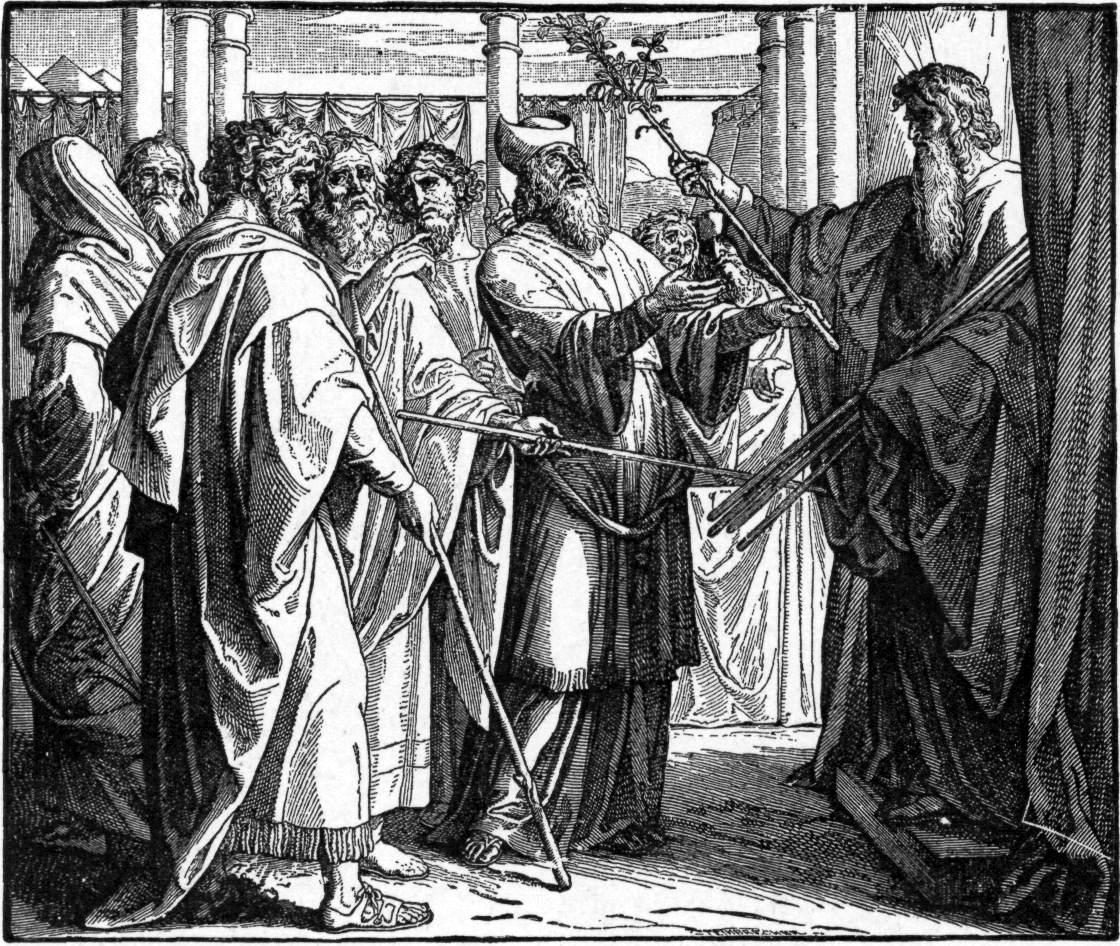
The moment of v24: Moses brings all twelve rods back out from before Jehovah and each man takes his own. Moses is the rayed figure at the right with the bundle; the man in the mitre holding up the one rod that has broken into leaf is Aaron. Every other staff in the picture is straight and dead, which is the whole argument of the chapter drawn in one gesture. ⚠ Two honest departures from the text: the engraver stops at blossom and gives the rod no almonds, though v23 insists on all four stages including ripe fruit; and he sets the scene among stone columns rather than in a tent, which is the 19th century imagining a sanctuary rather than the one Exodus describes.

Numbers 17:1-5 — the censers of the rebels become holy, and are hammered into the skin of the altar
⚠ First, where you are. If you go looking for this passage in an English Bible you will not find it at Numbers 17. It is printed there as Numbers 16:36–50, and what English Bibles call Numbers 17:1–13 is vv16–28 below. The Hebrew chapter runs 1–28 and holds both episodes; the English division cuts between them and pushes the numbering out by fifteen verses. This translation follows the Masoretic division, as Numbers 16 said it would when it stopped at v35.
And the first thing that happens after the fire is an instruction about salvage. Eleazar is to go into the burning and lift out the censers — the verb is rum, the same lifting that gives terumah its name — and scatter the coals. The reason given is the one nobody expects: ki qadeshu, for they have become holy.
⚠ Read that slowly, because it is the most surprising sentence in either chapter. Two hundred and fifty men picked up censers they had no right to hold, in a challenge the text treats as rebellion, and were killed for it. Their equipment is not destroyed and not buried. It is consecrated — and the stated reason is purely procedural: ki hiqrivum lifnei Jehovah, because they were brought near before Jehovah. Holiness here is contagious and indifferent to motive; it attaches to the object because of where the object was taken, not because of what the man carrying it intended. The bronze is then beaten flat and becomes the covering of the altar — so every sacrifice Israel offers from that day is offered on a surface made of the rebellion.
V3's b'nafshotam is a live test of a rendering this project settled two chapters ago. The phrase is ‘with their nefashot’, and the shelf splits exactly down the middle: KJV ‘these sinners against their own souls’ and NWT 1984 the same; ASV ‘against their own lives’, NIV and TLB ‘at the cost of their lives’, and the NWT's 2013 revision the same. ⚠ The Spanish shelf leans the other way — RV60 and RV 1909 both read «contra sus almas» while NVI reads «a costa de su vida» — and two versions solve it a third way entirely: Geneva ‘these sinners, that destroyed themselves’ and the Douay-Rheims ‘in the deaths of the sinners’, which is the Vulgate reading the phrase as a time rather than a price. This translation reads lives, and the reason is the rule rather than the vote: nefesh is rendered ‘soul’ on these pages where it means the PERSON as the subject of a penalty, and ‘life’ where it means the life itself — as at Leviticus 17:11, the life that is in the blood. Here it is a price: they sinned with their lives, and the lives are what was paid. ‘Against their own souls’ in modern English suggests spiritual self-harm, which is not what the Hebrew says.
V5 makes the altar-plating a warning rather than a trophy, and names the man it is a warning about: let no outsider draw near to burn incense, and not become like Korah and like his company. It is one of only two places the chapter says the name at all — the other is v14, which counts this plague's dead separately from ‘those who died over the matter of Korah’. Both times the name is used the same way: not as a character in the scene, but as a measure of something else.
Numbers 17:6 — ‘you have killed the people of Jehovah’: the charge brought the very next morning
One day. The ground has closed over Dathan and Abiram, fire has taken two hundred and fifty chieftains, and on the morrow the whole congregation comes back to say that Moses and Aaron did it. Not that God did it and was wrong; that the two men did it. Attem hamittem et-am Jehovah — you have put to death the people of Jehovah — and the phrase they choose for the dead is the one that makes the accusation sting: not ‘the rebels’, not ‘Korah's company’, but the people of Jehovah.
The verb for the complaint is lun, the grumbling-verb that has run through Numbers 11, 14 and 16:11; and the shelf splits on it in a way worth recording, because one version has already made this translation's choice. KJV, ASV, Geneva and the Douay-Rheims all read ‘murmured’, and NWT 1984 ‘began to murmur’; but NIV reads ‘grumbled’ — the very word used here — and TLB ‘began muttering again’. This translation keeps ‘grumbled’ throughout the book so the reader can count them.
⚠ And v7 uses the root Korah used. B'hiqqahel ha-edah — when the congregation was ASSEMBLED, from qahal, the same root Korah used at 16:19 when he assembled the congregation against Moses. The crowd that Korah convened has now convened itself, without him, and against the same two men. Nothing about the demonstration has been settled by the deaths of its leaders — which is precisely why a second sign is about to be required.
Numbers 17:11-13 — the censer that killed two hundred and fifty men is carried out to stop a plague
⚠ V10 is the sentence of Numbers 16:21 said again, and almost word for word. Compare them: 16:21 hibbadlu mittokh ha-edah ha-zot va-akhalleh otam k'raga — separate yourselves from the midst of this congregation, that I may consume them in a moment; 17:10 heromu mittokh ha-edah ha-zot va-akhalleh otam k'raga — lift yourselves up from the midst of this congregation, that I may consume them in a moment. One verb differs. The rest is identical, one chapter apart.
What differs is the answer. In chapter 16 Moses and Aaron fell on their faces and argued — shall one man sin, and will you be angry with the whole congregation? Here they fall on their faces and say nothing at all. The text gives them no speech. Instead Moses turns and gives Aaron an instruction, and the intercession stops being an argument and becomes an errand.
⚠ And the errand is carried out with a censer. This is the chapter's hinge and it is easy to miss because the object is so ordinary by now: machtah, the same word, the same thing, that two hundred and fifty men were holding when fire came out and consumed them, and that Leviticus 10:1 put in the hands of Nadab and Abihu. Aaron takes one, fills it with fire from the altar — the altar now plated with the dead men's censers — and runs. The instrument of the rebellion, the instrument of the judgement, and the instrument of the rescue are the same instrument. What changes is who is holding it and where the fire came from.
‘And he stood between the dead and the living, and the plague was checked.’ The Hebrew of v13 is seven words and no version on the shelf improves on it; KJV, ASV and RV60 all render it flat and let it stand, which is right. ⚠ Note what the verse does not say: it does not say Aaron prayed, or that the plague stopped when he arrived. It says he stood, in a place defined by what was on either side of him, and that the striking stopped. The NWT 1984 catches something the others let go by making it durative — ‘he kept standing between the dead and the living’ — which is what the Hebrew's verb form allows. ⚠ And three versions quietly reverse the order. The Hebrew is bein ha-metim u-vein ha-chayyim — the dead named first, then the living — and KJV, ASV, Geneva, RV60 and RV 1909 keep it that way, while NIV, TLB and NVI print ‘between the living and the dead’. It is a small inversion with a real effect: the Hebrew has him arrive from the direction of the corpses and stop with the living in front of him. ⚠ The Douay-Rheims does something else again and adds a clause that is not in the Hebrew at all — ‘standing between the dead and the living, HE PRAYED for the people’ — supplying the very thing the verse withholds.
Fourteen thousand seven hundred. The count is given plainly and then qualified: besides those who died over the matter of Korah. The chapter that began with a memorial against being like Korah ends this section by counting the dead separately from his.
Numbers 17:17 — twelve rods, and the Hebrew word for ‘rod’ is also the word for ‘tribe’
The second sign begins, and its whole design rests on a pun that English cannot carry. Matteh means a staff — a cut branch, a rod of office — and it also means a TRIBE. It is the ordinary word for both, and this project has already been printing it as ‘tribe’ since Numbers 1:4. So when God says take twelve mattot, one for each fathers' house, and write each man's name on his matteh, the Hebrew is simultaneously saying twelve staffs and twelve tribes, and the object in each chieftain's hand IS his tribe with his name on it.
The word occurs seventeen times in this chapter's twenty-eight verses, and twelve of them fall in the five verses vv17–21. No English version can keep the double sense — ‘rod’ and ‘tribe’ are simply different words — and every version on both shelves prints ‘rod’ or ‘staff’; three of them (NIV, TLB and NVI) reach for a gloss instead, on which see the note on v23 below. It is worth knowing it was there, because it explains why the test takes the form it does: the question on the table since Numbers 16:1 has been which tribe may approach, and God answers it by asking for the tribes themselves, in wood, overnight, in the dark.
The test is designed to be unfalsifiable in the useful direction. Twelve rods, named, laid in one place, before the testimony, overnight, with nobody present. Whatever happens to them happens to all of them equally. ⚠ And note v20's stated purpose: not to prove Aaron right but to make the grumbling cease from upon me — the complaint is described as something resting on God, which is the same picture Numbers 11 used of the people's weight on Moses.
Numbers 17:23 — it budded, blossomed a blossom, and ripened almonds: four stages in one verse, and the word for ‘blossom’ is the word on Aaron's own forehead
The verse does not say the rod bloomed. It says it did four things, in order, in one night: parach — it had budded; vayyotze ferach — it put out a bud; vayyatzetz tzitz — it blossomed a blossom; vayyigmol shqedim — it ripened almonds. A dead stick performing an entire spring between one evening and one morning, and the Hebrew insists on all four stages rather than summarising them. Two of the four are cognate pairs — a bud budding, a blossom blossoming — and two versions keep the second pair audible in English: the KJV ‘bloomed blossoms’ and, unexpectedly, the Douay-Rheims, which also reads ‘had bloomed blossoms’ on its way to something much stranger (below). ASV breaks the pair with ‘produced blossoms’, NWT 1984 with ‘blossoming flowers’. ⚠ Most of the shelf does keep all four stages — KJV, ASV, Geneva and NWT 1984 all give four verbs, as do RV60 «había reverdecido, y echado flores, y arrojado renuevos, y producido almendras» and, with a different first verb, RV 1909 «había brotado, y echado flores…» — the antigua reading the plain ‘sprouted’ where the 1960 revision chose ‘greened again’. The two that compress are NIV (‘had not only sprouted but had budded, blossomed and produced almonds’) and TLB (‘had budded and was blossoming, and had ripe almonds hanging from it’). ⚠ And those same two, with the NVI, are the three that gloss the pun this note is about rather than translate it: NIV ‘Aaron's staff, WHICH REPRESENTED THE TRIBE OF LEVI’, TLB ‘Aaron's rod, REPRESENTING THE TRIBE OF LEVI’, NVI «la vara QUE REPRESENTABA A LA FAMILIA DE LEVÍ» — each saying in a relative clause what the Hebrew says with one word. ⚠ The Douay-Rheims expands in the opposite direction, inventing a process the Hebrew does not describe: ‘the buds swelling it had bloomed blossoms, which spreading the leaves, were formed into almonds’.
⚠ And tzitz is two things at once. The letters turn up in seventeen verses of the Hebrew Bible, and they have to be read one by one rather than counted, because most of the hits are not this noun: four are the verb tzutz, to peer or sparkle, two are place-names, and one (Jeremiah 48:9) is disputed. That leaves ten. In six of them — Isaiah 28:1, Isaiah 40:6, 7 and 8, Psalm 103:15 and Job 14:2 — tzitz is an ordinary flower, and pointedly the kind that does not last: all flesh is grass, and all its goodliness like the tzitz of the field… the grass withers, the tzitz fades. The word carries a built-in shelf life. ⚠ And that is what makes the remaining three startling, because in those the same noun is what Exodus 28:36 (already on these pages) calls the plate of pure gold engraved HOLY TO JEHOVAH and tied on the front of the high priest's turban — made in Exodus 39:30, and set on Aaron's head in Leviticus 8:9. So the thing Aaron's rod produces overnight, to settle whether Aaron is the priest, is called by the same name as the badge already sitting on Aaron's forehead. The most perishable thing in the language and the one piece of the priesthood made of imperishable gold are called by one word — and to settle whether Aaron is the priest, his dead staff is made to produce the perishable one overnight. The verb form here, vayyatzetz, occurs in exactly one verse in the Bible: this one.
The almonds are the second half of the sign, and they are not incidental either. Shaqed, the almond, is the first tree to wake in the Levant — it flowers in late winter, ahead of everything — and the Hebrew name plays on shaqad, to watch or be wakeful. Jeremiah 1:11-12 (already on these pages) turns that into its own famous pun: I see a branch of an almond tree; I am watching over my word to do it. And the almond is already carved all over the sanctuary this rod is being kept in — Exodus 25:33-34 shapes the lampstand's cups ‘like almond-blossoms’. The rod does not produce a generic miracle. It produces the sanctuary's own decorative motif, in the sanctuary, overnight.
Numbers 17:25 — the rod goes back inside, kept as a sign ‘for the sons of rebellion’
The eleven other chieftains take their rods home. Aaron's does not go home: it goes back in front of the testimony and stays there, l'mishmeret l'ot li-vnei meri — to be kept, as a sign, for the sons of rebellion. ⚠ Two things worth noticing in that phrase. The first is mishmeret, a keeping or a watch, which is the word Numbers 8 used for the Levites' own guard duty — the tribe whose status was in dispute now has its verdict filed under the same word as its job. The second is b'nei meri: not ‘the rebels’ as a past event, but a standing description of the audience, in the plural, with no end date. The sign is not stored as a trophy of a settled argument. It is stored because the argument is expected again. The shelf divides the phrase between the two readings: KJV ‘a token against the rebels’ and NVI «los rebeldes» take it as the people; ASV ‘a token against the children of rebellion’ and RV60 / RV 1909 «los hijos rebeldes» keep the Hebrew idiom, which is the construction that carries the open-ended sense.
V26 is eight Hebrew words — vayyaʻas Mosheh kaʻasher tzivvah Jehovah oto ken asah — and this translation keeps them flat: and Moses did so; as Jehovah commanded him, so he did. The formula closes almost every construction sequence in the Torah, and its appearance here quietly files a two-chapter revolt under the same heading as building a tabernacle.
Numbers 17:27-28 — ‘everyone who draws near, who draws near’: the chapter ends on the exact verb the revolt was about
It does not end in relief. The rod has budded, the plague has stopped, the question of who is the priest has been answered as decisively as it can be — and the people's response is panic: hen gavanu, avadnu, kullanu avadnu. Three verbs stacked with no conjunctions, the second one repeated. KJV ‘behold, we die, we perish, we all perish’; ASV ‘we perish, we are undone, we are all undone’. Nothing on the shelf smooths the piling-up, and this translation does not either.
⚠ And then the last sentence lands on the verb that has been the whole argument. Kol ha-qarev ha-qarev el-mishkan Jehovah yamut — everyone who draws near, who draws near to the dwelling of Jehovah, dies. The participle is doubled, which is Hebrew's way of saying ‘anyone at all who does this’, and the root is qarav, to come near. ⚠ Three versions keep the doubling and the rest flatten it: ASV ‘every one that cometh near, that cometh near’, RV60 «cualquiera que se acercare, el que viniere» and RV 1909 «cualquiera que se llegare, el que se acercare»; Geneva splits it into two verbs, ‘cometh near or approacheth’. KJV converts it into an intensifier (‘whosoever cometh ANY THING near’) and NIV does the same (‘anyone who even comes near’), while NVI simply drops it — «todo el que se acerca al santuario del Señor muere», one participle where the Hebrew has two. The closing question divides them again: KJV ‘shall we be consumed with dying?’, ASV ‘shall we perish all of us?’, Douay-Rheims ‘are we all to a man to be utterly destroyed?’, NIV flatly ‘are we all going to die?’
That root has been running since the revolt began, and the arc it makes is the point of both chapters. Counted directly: it occurs six times in Numbers 16 and five times here. 16:5: Jehovah will bring near the one he chooses, he will bring him near. 16:9–10: is it a small thing that he separated you to bring you near, and he brought you near — and you seek the priesthood also? 16:35: the men who were bringing the incense near. 17:3–4: because they brought them near before Jehovah. 17:5: that no outsider draw near. And now, at the end, the people: everyone who draws near, who draws near, dies.
Korah's complaint was that access was being restricted. Two chapters later the congregation's complaint is that access is lethal. Nobody in the story has changed their mind about the priesthood; they have changed their mind about wanting it. ⚠ The chapter's last words are a question — ha-im tamnu ligvoa, are we to be finished off, perishing? — and it is left hanging. The answer is the next chapter, which is not a narrative at all but a job description: what the priests are for, and what they carry so that everyone else does not have to.
Notes on this translation
Decisions. ⚠ Read the versification note first or nothing else will line up. The Hebrew chapter has 28 verses and holds two episodes; English Bibles split them and renumber, so vv1–15 here are printed as Numbers 16:36–50 in every version on this shelf, and vv16–28 as Numbers 17:1–13. Nothing is added or missing on either side — the same text is divided in two places. Numbers 16 flagged this when it stopped at its own v35, and this is where the fifteen verses arrive. There are five Masoretic paragraph breaks inside the chapter (after vv5, 8, 15, 24 and 26 — four petuchot and one setumah, the setumah being the short one after v8), with a sixth setumah closing the chapter at v28; and the break after v15 is the real seam between the two episodes. Four new dictionary entries in both languages: qarav, the coming-near verb that turns out to be the spine of both chapters; tzitz, blossom and golden plate; maggefah, the striking-blow; and edut, the testimony. shaqed, which already had an English entry, gained its first Spanish one with this chapter. Nothing else in the library was rewritten: matteh and machtah carry this chapter's weight on the entries they already had, and there are no new encyclopedia entries because everyone here — Eleazar, Aaron, Korah, Moses — already has one. Five new cross-references were added.
Echoes paid — five, and the first was promised in writing one chapter ago. Numbers 16 ended by planting ‘the second half of this story under another number — the censers hammered into altar-plating, and Aaron standing between the dead and the living’: both are here, in vv3–4 and v13. The machtah entry, written last chapter, said what kills is not the pan but who is holding it; v11 is the demonstration. Exodus 28:36's golden tzitz comes back as the blossom on the rod. Exodus 25:33's almond-blossom lampstand comes back as real almonds. And Numbers 16:21's offer to consume the congregation in a moment is made again at v10 in nearly the same words — the only substantial difference being that this time nobody argues.
Patterns worth carrying forward. One root holds both chapters together and it is worth counting: qarav, to come near, eleven times across Numbers 16–17. The revolt opens with Moses saying Jehovah will bring near whom he chooses, and closes with the whole congregation crying that everyone who draws near, draws near, dies. Nobody's view of the priesthood changed; their view of wanting it did. Second: holiness in this chapter is contagious and does not care about motive — the rebels' censers are consecrated because of where they were carried, not why, and the altar is then plated with them. Third: the two signs are opposites in method. The first is fire and a body count; the second is a stick left alone overnight in the dark. Only one of them stopped the grumbling.
Echoes planted. Numbers 18 (now on these pages), which answers this chapter's closing question by describing what the priests carry so nobody else has to; Hebrews 9:4 (not yet), which remembers Aaron's rod as one of the three things inside the ark; Numbers 20:8–11 (now on these pages), where a rod is taken from before Jehovah again and used very differently; and Psalm 106:16–18 (not yet), which retells the revolt as a song and mentions the fire but not the rod.
⚠ A note on order: Numbers stands on these pages at chapters 1, 2, 3, 4, 5, 6, 7, 8, 9, 10, 11, 12, 13, 14, 15, 16, 17, 18, 19, 20, 21, 22, 23, 24, 25, 26, 27, 28, 29, 30, 31, 32, 33, and now 34. Chapters 35–36 remain the open sequence.